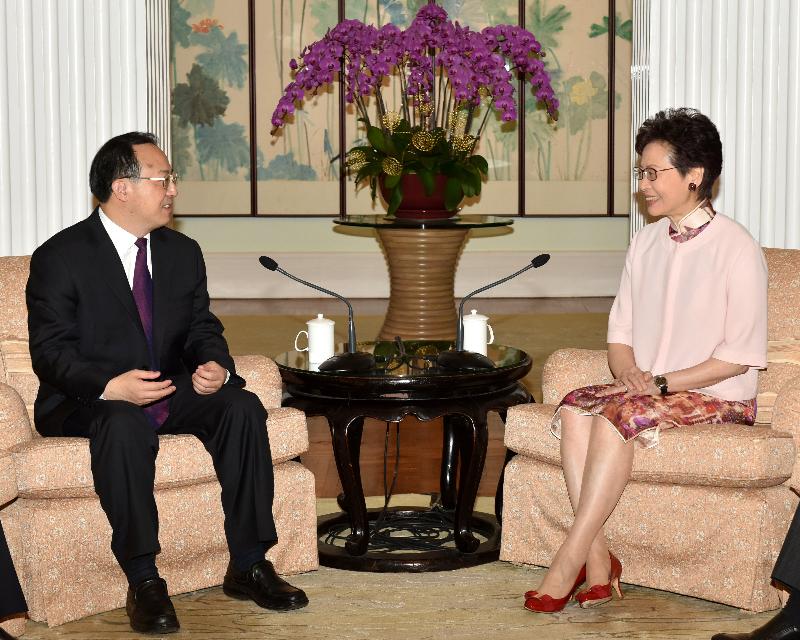
CE meets Governor of Jiangsu Province (with photo)

     The Chief Executive, Mrs Carrie Lam, met the Governor of Jiangsu Province, Mr Wu Zhenglong, at Government House this evening (April 19).

     Mrs Lam welcomed Mr Wu’s first visit to Hong Kong after his assumption of office as the Governor of Jiangsu Province with a delegation. Expressing her gratitude to Jiangsu Province for holding a three-day “Rendezvous with Water Towns” Jiangsu Cultural Carnival in Hong Kong at Victoria Park to enhance Hong Kong people’s understanding of Jiangsu Province in response to her suggestion, she said she looked forward to officiating together with Mr Wu at the opening ceremony of the carnival tomorrow.

     Mrs Lam said that Hong Kong and Jiangsu Province have enjoyed close ties and maintained frequent co-operation with each other in areas ranging from economic and trade activities to culture, education and youth exchanges. Noting that Hong Kong is an international centre for finance, trade and commerce, she said Hong Kong strives to consolidate its traditional industries with clear advantages, in particular finance, and the listing rules will be amended later this year to attract new economy companies to list in Hong Kong. She said that given Jiangsu Province is home to quite a number of new economy companies, she encouraged them to use Hong Kong as a platform to raise capital. She added that Hong Kong is keen to develop new areas of economic growth including innovation and technology and the creative industries. She expressed the hope to explore more room for co-operation with Jiangsu Province in these areas.

     Thanking the Government of Jiangsu Province for its staunch support for Hong Kong’s work on youth development, she said she hopes that Jiangsu Province will continue to implement various measures to help Hong Kong people study, work and live in the Mainland to facilitate Hong Kong young people to develop in the Mainland.

Photo  


Press release: Football agent who killed highways worker and paralysed another jailed for longer

A man who killed a highways worker and left another paralysed after speeding while texting has had his sentence increased after the Solicitor General, Robert Buckland QC MP, referred it for being too low.

Peter Morrison, a 37 year old football agent, hit and killed Adam Gibb, 51, and left his colleague Paul Holroyd, now 53, paralysed from the chest down after losing control of his Mercedes on the M6 in Cumbria.

Morrison had been texting behind the wheel and had been driving at an average speed of 81 mph, when the suggested speed limit was 50 mph, in the period before the collision. His car swerved across three lanes of the carriageway and mounted the crash barrier before rebounding off a rock and hitting the victims.

The two Highways England Officers were overseeing the recovery of vehicles which had crashed earlier in the atrocious weather conditions with strong winds, heavy rain and fog patches causing poor visibility and leaving surface water on some areas of the carriageway.

Morrison had sent a text message 96 seconds before the collision. The last message he received was 45 seconds before it.

Mr Gibb is survived by his wife and young son, who was 15 years old and due to sit his GCSEs at the time. Mr Holroyd suffers long-term effects because of the injuries inflicted by Mr Morrison’s actions.

Morrison pleaded guilty to causing death by careless driving but was found guilty by a jury of causing death and serious injury by dangerous driving. He was sentenced to a total of 7 years’ imprisonment at Liverpool Crown Court in January.

The Court of Appeal has today increased his sentence to 9 years in prison.

Speaking after the hearing, the Solicitor General said:

“Morrison’s deliberate decision to be distracted and drive at excessive speeds in extremely hazardous weather conditions had devastating consequences for two families.

“I am pleased that the Court of Appeal has agreed with me and increased the sentence today.”


Press release: Commonwealth scientific advisers to look at global challenges

Scientific advisers from across the Commonwealth will establish a knowledge exchange network to look at some of the global challenges we face such as climate change, food security and the state of the oceans.

The group was established following the inaugural meeting of chief scientific advisers and equivalents from across the Commonwealth chaired by Dr Patrick Vallance, Government Chief Scientific Adviser and Sir Peter Gluckman, Chief Science Adviser to the Prime Minister of New Zealand. The meeting was held at the Royal Society.

The science leaders met to discuss the role of science and technology in achieving a more secure, sustainable and prosperous future. They discussed how science and technology can benefit Commonwealth countries, both individually and collectively, focusing on 2 main areas:

  • preparing for and responding to emergencies; and
  • meeting the UN Sustainable Development Goals (SDGs)

Dr Patrick Vallance said:

This is an important start to a new Commonwealth science collaboration. The Commonwealth represents a great opportunity for international collaboration, sharing data and science expertise to solve universal challenges such as climate change, food security, the state of the oceans, supporting private sector innovation and managing the impacts of disruptive technologies. These are challenges for which no country can plausibly claim to have all the answers.

Sir Peter Gluckman said

Science, technology and innovation are primary drivers of progress. The Commonwealth presents an obvious forum in which they can and should serve that purpose. Much can be achieved through identifying key knowledge gaps, synthesising and sharing evidence, and by strengthening the link between available evidence and policy.

Science Minister Sam Gyimah said:

Climate change, pollution, food security, healthcare, and clean energy are just some of the world’s biggest challenges. These issues affect everyone and the impact is already being felt, even here in the UK. While the government’s ambitious Industrial Strategy and Grand Challenges are already addressing these global challenges, collaboration is essential to provide effective results.

Across the Commonwealth, the brightest and best talent are conducting incredible research that has the potential to change our world forever. It is essential that we come together and share our expertise and knowledge to speed up the development of innovative solutions, saving our planet and improving everyone’s lives.

The network will foster greater cooperation between Commonwealth science academies and other science advice mechanisms. Specifically, it will seek to:

  • promote information exchange covering scientific and technology-based solutions to the SDGs as they affect Commonwealth countries
  • enhance cooperation on science related to risk management and emergency response
  • develop a strategy for integrating locally-derived data across the Commonwealth to understand and stimulate innovative solutions to such issues as coastal erosion, water quality and food waste
  • explore approaches to data governance
  • promote beneficial collaboration using major science infrastructure where it can support research around the SDGs
  • consider what further mechanisms might strengthen the role of science and innovation in the Commonwealth

A report summarising the projects, their impact and the key lessons learnt will be presented to leaders at the Commonwealth summit in 2020.

Notes to editors

  1. The Commonwealth forms a significant part of the global scientific community. It is home to 12% of the world’s researchers and accounts for around 10% of global research and development expenditure.

  2. The Government Office for Science advises the Prime Minister and members of the Cabinet on all matters related to science and technology ensuring that government policies and decisions are informed by the best scientific evidence and strategic long-term thinking.


Measles cases in Okinawa, Japan closely monitored

     The Centre for Health Protection (CHP) of the Department of Health (DH) is closely monitoring an increase in the number of measles cases in Okinawa, Japan and appealed to the travellers and members of the public for vigilance and reiterated that vaccination is the most effective way to prevent the disease.

     According to the information from the Government of Okinawa Prefecture, there is an ongoing outbreak of measles since late-March involving a total of 65 confirmed cases (as of April 18). The outbreak was triggered by an imported case from Taiwan in late-March. Subsequently, 64 cases have been detected in Okinawa, including 25 cases (39.1%) in Naha and 11 cases (17.2%) in Nago. Among these 64 cases, 43 (67%) affected persons aged 20 to 49 years.

     “Immunisation against measles is the most effective way to prevent the disease. People who intend to travel to Okinawa are advised to review their vaccination history. Non-immune individuals are advised to consult their doctors about measles vaccination, which is usually given together with mumps and rubella vaccines as Measles, Mumps and Rubella (MMR) vaccine,” a spokesman for the CHP of the DH said today (April 19).

     For those who had received two doses of measles vaccine or confirmed to have measles infection in the past are considered to be immune to measles. For those with incomplete vaccination, unknown vaccination history or unknown immunity against measles, they are advised to consult their doctor for advice on measles vaccination.

     “As it takes about two weeks after vaccination for antibodies to develop and provide protection against measles, travellers are advised to plan and get vaccinated ahead,” the spokesman reminded.

     Pregnant women and women preparing for pregnancy should also consult their doctor for advice if they are not sure whether they are immune to measles. If they are non-immune to measles, they are advised not to travel to Okinawa during the outbreak.

     Local children aged under one year are not due for MMR vaccination under the Hong Kong Childhood Immunisation Programme. As they are susceptible to measles, they are advised not to travel to Okinawa during the outbreak. If people must travel to Okinawa with children under one year during the outbreak period, they have to consult their doctor for advice.

     The CHP has been liaising with the World Health Organization as well as the Japanese health authority for further information and will continue to closely monitor the situation.

     Locally, as of April 18 this year, the CHP recorded four cases of measles infection affecting four males aged from nine months to 38 years. Among the cases, two were imported from the Mainland (one case) and Indonesia (one case) respectively.

     The spokesman explained that measles infection is a highly infectious disease caused by the measles virus. It can be transmitted by airborne droplet spread or direct contact with nasal or throat secretions of infected persons, and, less commonly, by articles soiled with nose and throat secretions. A patient can pass the disease to other persons from four days before to four days after the appearance of skin rash.

     In Hong Kong, children are given the MMR vaccine at one year old, followed by a second dose at Primary One under the Hong Kong Childhood Immunisation Programme. The coverage of MMR vaccination in Hong Kong is over 95 per cent at Primary One.
  
     Besides being vaccinated against measles, members of the public should take the following measures to prevent infection:

* Maintain good personal and environmental hygiene;
* Maintain good indoor ventilation;
* Keep hands clean and wash hands properly;
* Wash hands when they are dirtied by respiratory secretions, such as after sneezing;
* Cover the nose and mouth while sneezing or coughing and dispose of nasal and mouth discharge properly;
* Clean used toys and furniture properly; and
* Children with measles should be kept out of school till four days from the appearance of rash to prevent spread of the infection to non-immune persons in school.

     Members of the public should consult doctors promptly if they develop symptoms of measles. Affected persons should avoid contact with non-immune persons, especially those with weakened immunity, pregnant women and infants.

     For more information on measles, the public may call the 24-hour health education hotline 2833 0111 or visit the CHP’s measles page (www.chp.gov.hk/en/content/9/24/31.html). They can also visit the Travel Health Service’s website (www.travelhealth.gov.hk/eindex.html) for the latest travel health advice.


Statement By First Vice-President Timmermans, Vice-President Dombrovskis and Commissioner Jourovà on the adoption by the European Parliament of the 5th Anti-Money Laundering Directive

” We welcome the adoption by the European Parliament of the 5th Anti-Money Laundering Directive. These new rules will bring more transparency to improve the fight against money laundering and terrorist financing across the European Union.

We want to thank the two co-rapporteurs, Mr Kariņš and Mrs Sargentini, and the shadow rapporteurs for their strong support and valuable expertise, which have hugely contributed to this result.

With its vote, the Parliament concludes an ambitious round of negotiations initiated two years ago. In July 2016, in the aftermath of the terrible terrorist attacks that struck the EU and the vast financial dealings uncovered by the “Panama Papers”, the Commission decided to take urgent counter-measures. The revised directive is part of that action plan.

We can be proud of the new measures, which will substantially improve the existing rules. We are today marking an important step in fighting against financial crime. But our work is not over. Fighting effectively against financial crime needs proper implementation of these rules and strong coordination amongst the different authorities.

We commit to helping all Member States put them in place and to monitor their implementation.

We want all EU Member States to uphold high standards in the fight against money laundering and terrorist financing across the EU.”

Background

The proposal was presented by the Commission in July 2016 in the wake of terrorist attacks and the revelations of the Panama Papers scandal, and is part of the Commission’s Action Plan of February 2016 to strengthen the fight against terrorist financing. It sets out a series of measures to better counter the financing of terrorism and to ensure increased transparency of financial transactions.

The 5th Anti-Money Laundering directive will:

  • enhance the powers of EU Financial Intelligence Units and facilitating their increasing transparency on who really owns companies and trusts by establishing beneficial ownership registers;
  • prevent risks associated with the use of virtual currencies for terrorist financing and limiting the use of pre-paid cards;
  • improve the safeguards for financial transactions to and from high-risk third countries;
  • enhance the access of Financial Intelligence Units to information, including centralised bank account registers.
  • ensure centralised national bank and payment account registers or central data retrieval systems in all Member States.

For more information

Factsheet on the main changes of the 5th Anti-Money Laundering Directive

Directive on the use of financial and other information for the prevention, detection, investigation or prosecution of certain criminal offences