DPRK’s suspension of missile tests should lead to ‘irreversible’ commitment to ban nuclear testing – UN-backed treaty body

The world’s nuclear proliferation watchdog has welcomed the announcement by the Democratic People’s Republic of Korea (DPRK) to suspend its nuclear and missile tests and shut down its Punggye-ri atomic test site.

It added that the move should lead to a “sure, definite” and “irreversible” commitment to ban nuclear testing.

“Saying is one thing, but until we have a signature and the ratification by the DPRK, to basically solidify the verbal commitment already to cease testing and close the nuclear test site, I think nothing can be for sure, definite, or irreversible,” Lassina Zerbo, Executive Secretary of the UN-partner Comprehensive Nuclear Test Ban Treaty Organization (CTBTO), told the media at a news briefing in Geneva today.

“I can only welcome and hope for best.”

He also highlighted that the upcoming talks between United States President Donald Trump and DPRK Kim Jong-Un could present a unique opportunity for a lasting contribution to world peace.

“It might be through this negotiation […] that we open up a situation where the DPRK ratify the Comprehensive Nuclear Test Ban Treaty.”

The Comprehensive Nuclear Test Ban Treaty, or CTBT, bans all nuclear explosions, by everyone, everywhere. It has not yet entered into force despite having been opened for signature and ratification over 21 years ago.

Adopted by the UN General Assembly in 1996, the CTBT is nearly universal with 183 signatures and 166 ratifications.

But 44 specific nuclear-capable nations need to ratify the Treaty before it enters into force. Of these, eight – China, Egypt, India, Iran, Israel, DPRK, Pakistan and the US – are still missing. The last country of the 44 to ratify this treaty was Indonesia, on 6 February, 2012.

Since the Treaty is not yet in force, the CTBTO is officially called the Preparatory Commission for the Comprehensive Nuclear-Test-Ban Treaty Organization.


UN-backed programme logs record high cocaine seizures at seaports in Latin America and the Caribbean

UN-trained law enforcement units have intercepted huge shipments of illegal drugs being trafficked through seaports this year, including 2.8 tons of cocaine at Brazil’s Port Santos, the largest such seizure in the port’s history

The joint customs and police Port Control Units, work at some of the world’s busiest ports and are trained to combat smuggling of drugs, precursor chemicals, as well as merchandise breaching intellectual property rights and protected wildlife.

Recently, the Unit in Ecuador has seized two contaminated containers with over a tonne of cocaine. Similarly, the Unit in the Port of Callao in Brazil, interdicted a container with 1.5 tons of cocaine hidden inside.

These units are at the heart of a joint programme launched in 2003 by the UN Office on Drugs and Crime (UNODC) and the World Customs Organization.

The aim is to train customs and law enforcement officials in Latin America and the Caribbean, and elsewhere, to detect and disrupt the flow traffic of illicit goods, while facilitating legitimate trade and raising State revenues.

Every year, more than 720 million containers move around the globe by sea, transporting 90 per cent of the world,s cargo. Most carry licit goods, but some are being used to smuggle drugs, weapons, and other illicit goods.

“The Container Control Programme has become one of the most effective and result-oriented programmes worldwide,” said Tofik Murshudlu, UNODC’s Chief of the Implementation Support Section.

The Programme also helps Member States build capacities and expertise to identify and seize suspicious container shipments of drugs, firearms, precursors, counterfeit medicines, wildlife species, smuggled goods and many others, he added.

According to the UNODC, 18 operations have netted more than 8.9 tons of drugs. In addition, 18 containers have been detained due to intellectual property rights violations.

So far, the Programme is operational in 14 countries in Latin America and the Caribbean, providing site visits, technical assessments, trainings, and other support to create long-term enforcement structures in select seaports. It is also operational in Burkina Faso, Cabo Verde, Ghana, Pakistan, Senegal, Togo and Turkmenistan.


UN-EU conference raises $4.4 billion for war-ravaged Syria; leaders underscore need for political solution

International donors at a United Nations-European Union humanitarian conference pledged nearly $4.4 billion on Wednesday to fund critical aid programmes in war-torn Syria throughout 2018.

Gathered in the Belgian capital, Brussels, alongside top officials from over 85 countries and organizations, UN and EU leaders also stressed that the stalled UN-led Syrian political negotiations, known as the intra-Syrian talks, must be revived.

In a video message to the conference, which aimed to boost support for the future of Syria as well as the wider region, which is hosting millions of refugees,  Secretary-General António Guterres said that negotiations are the only way forward.

“We see confrontations and proxy wars involving several national armies, a number of armed opposition groups, many national and international militia, terrorist groups, foreign fighters from everywhere in the world – all these creating a bleak panorama of Syria today where there is no military solution to the crisis,” he said

“The solution must be political.”

The UN chief also stressed the importance of Security Council resolution 2254 (2015), which endorsed a road map for a peace process in Syria, and the 2012 Geneva Communiqué, which set out the principles for a political transition in the country.

Mr. Guterres said he will continue to engage with Member States to move towards a genuine and credible political solution that meets the aspirations of the Syrian people to dignity and freedom.

Translate every cent into action

Relentless fighting across Syria, a conflict that has now lasted longer than World War II, has claimed hundreds of thousands of lives and left over 13 million in dire need of humanitarian assistance.

It has also forced 5.6 million Syrians to seek refuge in neighbouring countries where vulnerable host communities are reeling under the pressure.

Against this backdrop, the funds committed for 2018, and the additional $3.4 billion for 2019 and beyond, will ensure continuity of critical aid efforts – both for Syrians and refugee hosting communities.

“Every single cent we pledged today needs to be swiftly translated into action, spent in an effective and transparent way, this is our common responsibility,” said Christos Stylianides, the European Commissioner for Humanitarian Aid and Crisis Management, announcing the figures.

The funds will make a ‘real difference’

Mark Lowcock, the UN Emergency Relief Coordinator, welcomed the commitments and said that the resources will make a “real difference” for those suffering in the crisis.

“The pledges announced today are a good start,” Mr. Lowcock said.

He echoed Secretary-General Guterres’ call for a political solution.

“We are appealing on [the Syrian peoples’] behalf for an end to the violence: for a political solution, for a safe future with hope – of education, healthcare, work, and a return home. In other words: for a normal life.”

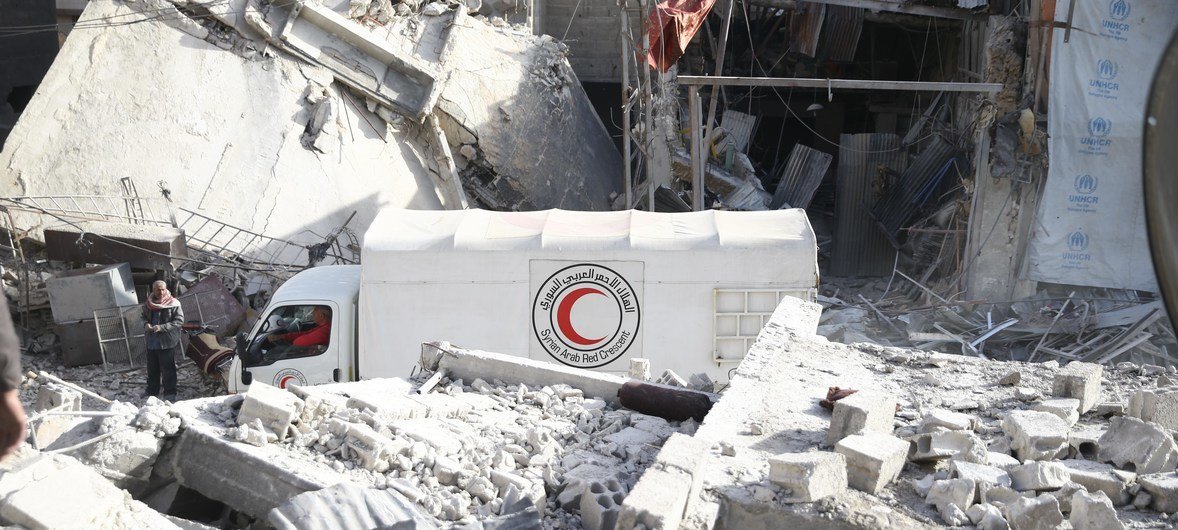
UNICEF/Khabieh

A vehicle from the UN-Syrian Arab Red Crescent (SARC) convoy drives past destroyed buildings in eastern Ghouta (March 2018). Insecurity and access restrictions have severely hampered delivery of life-saving assistance to people in desperate need across Syria.

Parties to the conflict must respect the rules of war

Meanwhile in New York, Ursula Mueller, the UN deputy aid chief, briefed the Security Council on the humanitarian situation in Syria where called for the full implementation for Council resolution 2401.

In that resolution, the 15-member body demanded an immediate cessation of hostilities to enable aid to flow into the areas in need.

“We need to see firm steps taken to ensure that all parties respect the rules of war,” she said, stressing the need to protect civilians and stop attacks on health facilitates.

Ms. Mueller also called for safe, sustained and unimpeded humanitarian access to all in need and underscored that medical items must stop being removed from convoys.

“There is no reason why items previously agreed with the authorities are removed at the last minute. These are critical life-saving items and they must be allowed on our trucks.”


Get malaria response ‘back on track,’ UN says, as progress stalls and funding flatlines

Marking World Malaria Day, the head of the United Nations health agency on Wednesday stressed the need to get the global response against the disease back on track while acknowledging progress that had helped avert millions of malaria deaths, especially among children, since 2000.

“The latest data from WHO [World Health Organization] show that the global malaria response is at a crossroads,” the agency’s Director-General, Tedros Adhanom Ghebreyesus, said in his video message for the Day, explaining that the declining trend in malaria cases and deaths has stalled, and vital funding for malaria programmes has flatlined.

“If we continue along this path, we will lose the gains for which we have fought so hard,” he added.

This year’s theme of the Day is “Ready to Beat Malaria.”

Although more and more countries have eliminated the disease, challenges remain.

In 2016, there were an estimated 216 million cases of malaria in 91 countries, an increase of 5 million cases over 2015, and malaria deaths reached 445,000, a slight decrease from 446,000 in 2015 but still a significant number.

The UN health chief called on countries and the global health community to close the critical gaps in the malaria response, and urged all partners to unite around a common goal: accelerating the pace of progress.

“Together, we must ensure that no one is left behind in accessing life-saving services to prevent, diagnose and treat malaria,” he said.

Key Facts

  • Malaria is a life-threatening disease caused by parasites that are transmitted to people through the bites of infected female Anopheles mosquitoes. It is preventable and curable.
  • In 2016, there were an estimated 216 million cases of malaria in 91 countries, an increase of five million cases over 2015.
  • Malaria deaths reached 445,000 in 2016, a similar number (446,000) to 2015.
  • The WHO African Region carries a disproportionately high share of the global malaria burden. In 2016, the region was home to 90 per cent of malaria cases and 91 per cent of malaria deaths.
  • Total funding for malaria control and elimination reached an estimated $2.7 billion in 2016. Contributions from governments of endemic countries amounted to $800 million, representing 31 per cent of funding.


UN enlists youth in combat against violent extremism in Jordan, Libya, Morocco and Tunisia

With one in four of the world’s 1.2 billion youth affected by some sort of violence or armed conflict, the United Nations on Tuesday launched a project to support new, youth-driven initiatives in education, science, culture and the media to prevent violent extremism in Jordan, Libya, Morocco and Tunisia

Vladimir Voronkov, who heads the UN’s counter-terrorism office (UNOCT) met in Paris with Audrey Azoulay, head of the UN cultural agency, to initiate the joint project, ‘Preventing Violent Extremism through Youth Empowerment in Jordan, Libya, Morocco and Tunisia.’

“Working at the local level with young people [is important] to identify the best ways to prevent violent extremism and win youth’s hearts and minds,” Mr. Voronkov said, adding that the UN places youth high on its agenda.

The project supports young women and men to become responsible citizens, resilient to any form of abuse or manipulation – including violent extremism – and to address hate-related issues.

Mr. Voronkov commended the innovative work of youth-led peace and security networks, and stressed the value of young people’s ideas to improve our world.

Ms. Azoulay, the Director-General of the UN Educational, Scientific and Cultural Organization (UNESCO), added that the UN is working “with youth and for youth” to achieve this goal. 

UNESCO aims to create opportunities for young women and men to be change-makers and peacebuilders in their own communities and wider societies as well as leaders in addressing hate-related issues.

Youth organizations, educators and media professionals will be mobilized around programmes to include cross-cultural youth dialogues, training in conflict-sensitive reporting and critical thinking labs.

Mr. Voronkov invited Ms. Azoulay and youth representatives to attend a follow-up event in New York, on the margins of the Secretary-General’s High-Level Conference of Heads of Counter-Terrorism Agencies of Member States, which will take place from 28 to 29 June. 

Taking advantage of Mr. Voronkov’s visit, Ms. Azoulay signed the UN Global Counter-Terrorism Coordination Compact, which will further seal the collaboration between both entities.

The agreement between the Secretary-General and 36 UN entities plus the International Criminal Police Organization (Interpol) and the World Customs Organization, the largest UN coordination framework, aims bolster counter-terrorism capacity-building support to Member States in implementing the UN Nations Global-counter-Terrorism Strategy, which UNOCT coordinates.