We need change at the Bank of England

I look forward to new leadership at the Bank of England. The current leadership allowed their independence to be tarnished by one sided interventions in the referendum. They compounded the error by making absurdly pessimistic forecasts of house prices, output and unemployment for the short term after any Leave vote. In this they followed in the long unfortunate tradition of the Bank in always recommending and supporting EU policies that were damaging. The Bank’s worst error was recommending UK membership of the European Exchange Rate Mechanism in the 1980s which led to a slump and the long term defeat of the Conservative party which accepted the advice.

The new Governor should have to answer three basic questions about the task ahead:

1 Why is the Bank of England tightening money so markedly when all the other main Central Banks are loosening to stave off the world economic downturn?

2. What action should the Bank take to promote UK growth, given the bad slowdown now experienced?

3. When will the Bank think through the flattening of the Philips curve and the move from national to global capacity, issues which undermine the current basis of assessing interest rates?

I spoke about this yesterday in the Chamber. I did not have time to develop the issue of what the Bank should do to stimulate growth. Some say Central Banks have run out of options with rates so low and QE so large from past programmes. I do not agree. CBs have a huge range of instruments and options to boost activity.

They can cut rates, run Funding for lending programmes, operate LTROs, intervene in money markets, intervene in bond markets, use repo markets, issue new guidance, change banking ratios.

There are two basic ways of stimulating growth. One way is to expand the Central Bank’s balance sheet by QE or money market interventions. The other is to expand commercial banks balance sheets by reducing capital ratios, relaxing lending controls or by open market operations.


Queen’s Speech

I am glad to read we will get Business rate cuts and cuts in NHS parking charges. These were both items I included in my Brexit bonus budget proposals and promised to support in the election.


The ugly duckling

The tiny duckling was born in to a London farm community of ducks and farm animals in 2016. Known as Leave, he did not seem to be like the other baby ducklings. They were all proudly Remain ducklings, as they delighted in telling him. They told him to be like them he had to change his name and agree with everything they said. He was too proud to do that, and did not see what all the fuss was about. His parents had told him his name was special and had been endorsed by millions of people.

The other ducklings  snorted and looked down their bills at him. They told him he could never survive on his own. They  made him feel very uncomfortable trying to live alongside them. They told him  they were superior, could swim faster and fly further. They doubted  his ability to find enough food, and took delight in hiding the food from him or eating it before he could get it. They explained that unless he became a proper Remain duck there was no chance of him having a happy life, and perhaps no chance of his surviving.

When he pushed back and told them being called Leave was just fine, and there was food he could find, and he could be happy on his own they all ganged up on him and tried to starve him out. The ducklings got support from their parents, who used their superior weight and muscle to beat Leave to the food, or to keep him out of the best parts of the pond.  The European geese were particular keen to make his life difficult.

Things got so bad for Leave that he decided to live up to his name and simply leave the farmyard and its pond and all those disagreeable ducklings behind him. After wandering a long way he stumbled in to a new home called Parliament, where some people , a cat and a hen held court. They put up with  him but when they found out he was called Leave they turned on him just like the ducks had done.

They told him Leave was bad. They told him it would mean he could not get access to enough food., They told him if he ever needed medicines the people helping him would not be able to afford them. They shoved him around, and worked out ways to make his life more miserable. Just like the ducks they said he had to change his name to Remain if he wanted peace and quiet. The cat who curled up in a big chair at one end of the Parliament room played with him mercilessly, shouting at him and telling him all the things he could not do. The hen said she was the opposition and planned to see him  off .

Lonely and downhearted, Leave picked up his dignity and moved on. He found a big empty lake and lived a lonely life there, until one day a large number of fine swans arrived. He was afraid they would set on him, so he kept in the reeds on the edge and hoped they would not see.

The swans came straight over to him and told him not to be afraid. He apologised for being an ugly Leave duckling as an act of self preservation. They told him to look at the mirror of the water, for he would then see he was  no ugly duckling but a magnificent swan. They told him they were all Leave swans. Leave meant being free. It meant the right to go anywhere you wished. It gave you access to all the best food . As swans are so much more powerful than Remain ducklings, there was no need to be afraid ever again.

So the ugly duckling looked at himself in the mirror, and looked again. Finally he pronounced “I am a swan. “

He soon discovered how much better  it was being a swan than a duck. He was respected and admired wherever he went. He was free to go as he chose, and accepted rules which only he could make. Gone was all the hassle of the farmyard and the intrusion of all that squawking of all those unhappy ducklings in Parliament.


The Bank of England tightens again

The employment figures last month were good again showing many more full time jobs still being created. The economy however has been slowed by the monetary and fiscal squeeze. Vacancies fell and wage growth reduced as the slowdown starts to reach the jobs market.

The Bank of England has cut itself off from the trends amongst all the main Central banks in the world, who are fighting slowdown and recession by loosening policy. They are cutting rates, pumping liquidity into markets or buying bonds to give things a boost.

The Bank of England instead announces all UK banks meet their stress tests and would survive a deep recession, yet it goes on to demand they increase their capital buffers. This means less lending, less promotion of growth, less support for new investment or for consumers to buy homes and cars.

It’s the opposite of what we need, more money taken out of productive use when our banks are fine anyway. The 1% lift in the countercyclical capital buffers may freeze as much money out of the economy as the budget proposals in the Manifesto might put in.


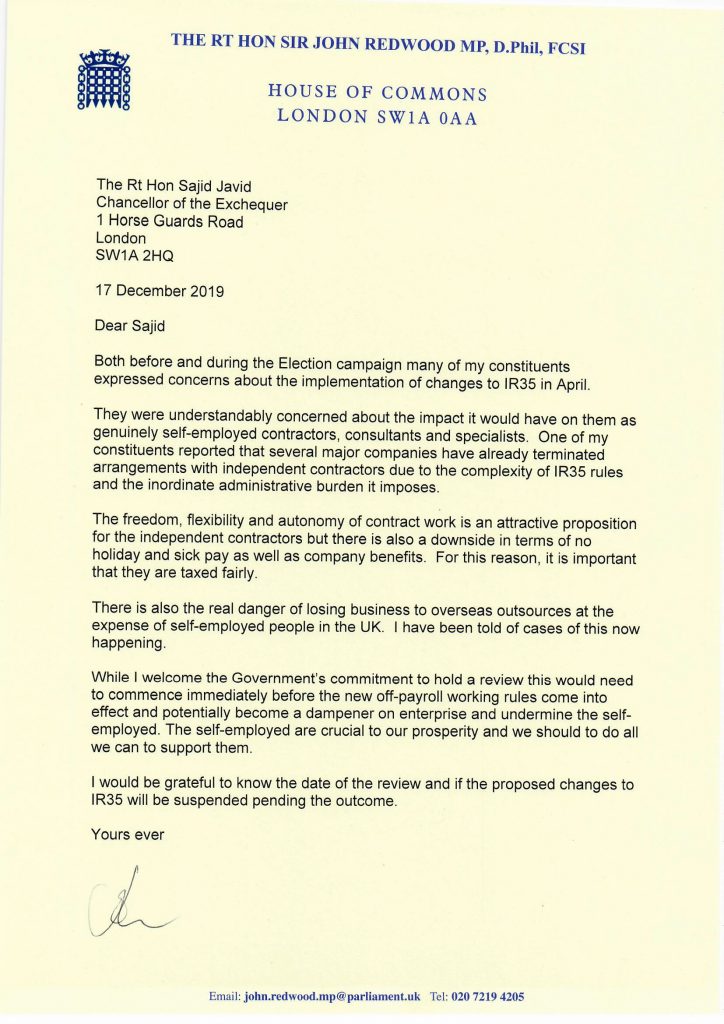
Letter to the Chancellor about the proposed changes to IR35

I have today sent this letter to the Chancellor about the proposed changes to IR35 – a matter of great concern to many of my constituents. I have urged him to start the review immediately before the changes come into effect and potentially become a dampener on enterprise and undermine the self-employed.