Social housing management firm fined for failing to protect workers

  • Multiple workers exposed to vibration-related ill-health.
  • Hand-Arm Vibration Syndrome can make everyday tasks impossible.
  • HSE guidance is available.

An East Midlands social housing provider has been fined £32,000 after multiple workers were diagnosed with vibration related ill-health conditions such as Hand-Arm Vibration Syndrome (HAVS).

The Health and Safety Executive (HSE) launched an investigation after it received more than ten reports of vibration related ill-health in a short period of time. The workers affected had until recently been employed by Nottingham City Homes Limited, an arms-length management organisation that managed social housing on behalf of Nottingham City Council between 2005 and 2023.

The HSE investigation found a large number of the company’s employees were exposed to vibration in their day to day work.  These included bricklayers, joiners, electricians, plasterers, caretakers and others – while their work was varied, all included extensive use of power tools, ranging from drills and impact drivers to vibrating plates and road breakers, over an extended period of time.  Despite this, and the dangers exposure can cause, the company had not properly assessed or controlled worker’s exposure to vibration.

Prolonged and regular exposure to vibration can affect a worker’s health resulting in disorders of the nerves, blood supply, joints and muscles of the hands and arms. These disorders are collectively known as HAVS and symptoms can include pain, tingling, numbness and loss of strength.  HAVS can make everyday tasks such as fastening buttons or holding utensils difficult or impossible.

HSE guidance, available here, and in the HSE publication Hand-arm vibration – The Control of Vibration at Work Regulations 2005 (L140) (PDF), sets out practical guidance to help employers protect their employees and fulfil their legal obligation to control vibration risks. The guidance includes advice on the assessment of risk, ways to control exposure, and in-depth information about health surveillance.

The HSE investigation also found that the company had not undertaken a suitable and sufficient assessment of the risks posed by vibration. Control measures, such as removing the need to use vibrating tools, using lower vibration alternatives, or limiting exposure times, had not been properly implemented. Tool maintenance and health surveillance arrangements were inadequate, and employees had not received sufficient training on the risks that they faced.

Nottingham City Homes Limited, of Loxley House, Station Street, Nottingham, pleaded guilty to breaching Section 2(1) of the Health and Safety at Work etc. Act 1974. The company was fined £32,000 and ordered to pay £6,226 in costs at Nottingham Magistrates’ Court on 3 November 2025.

HSE inspector Tim Nicholson said: “Nottingham City Homes Limited exposed its employees to vibration through the use of power tools for a long period of time.

“The company failed to properly manage this risk which led to employees suffering ill-health – the effects of exposure to vibration can be debilitating and, once damage is done, it is irreversible.

“There is extensive guidance available that is straightforward to follow and includes calculation tools to assist in deciding what is needed to protect employees.

“Employers should take this case as a reminder that HSE will not hesitate to act against companies which do not do all that they should to keep employees safe.”

The prosecution was brought by HSE enforcement lawyer Neenu Bains, and paralegal officer Jorge Kemp.


Further information:

  1. The Health and Safety Executive (HSE) is Britain’s national regulator for workplace health and safety. We are dedicated to protecting people and places, and helping everyone lead safer and healthier lives.
  2. More information about the legislation referred to in this case is available.
  3. Further details on the latest HSE news releases is available.
  4. Guidance on assessing and controlling vibration risks can be found here.
  5. HSE does not pass sentences, set guidelines or collect any fines imposed. Relevant sentencing guidelines must be followed unless the court is satisfied that it would be contrary to the interests of justice to do so. The sentencing guidelines for health and safety offences in England can be found here and those for Scotland here.


Haulage company fined £250,000 following death of employee

  • Man died due to company’s failures
  • Company had never carried out the tasked before.
  • HSE guidance is available.

A Middlesbrough road haulage company has been fined £250,000 after a man died while working inside a shipping container.

Gary Lee James, 30 was working for Ward Bros (Malton) Ltd at its yard at South Bank, in the early hours of 8 January 2019, when he suffered a fatal injury.

Mr James and a colleague had been standing up metal frames, each weighing approximately 120kg, within a shipping container, part of what is known as a “devanning” activity.

As the two men lifted the sixth frame, the fifth one fell back towards them, followed by the four others. Mr James was pinned by the neck between the container wall and the fallen frames. Although he was transported to James Cook University Hospital after suffering a cardiac arrest, he was sadly pronounced dead on three days later.

An investigation by the Health and Safety Executive (HSE) found the frames had not been secured to the container wall. It found that Ward Bros (Malton) Ltd failed to ensure, so far is reasonably practicable, the health, safety and welfare of its employees, including Gary James, at work in connection with the devanning of containers.

Despite the company having never undertaken devanning work before, it failed to create a suitable and sufficient written risk assessment. There was no clear and properly planned safe system of work for its employees.

Instead, the company embarked upon an ad-hoc and ultimately unsafe system of work, which was not effectively communicated to the employees who were left largely unsupervised to determine their own methods of devanning the containers.

HSE guidance states that employers must identify hazards, assess risk, and take action to eliminate or control those risks. Employers are not expected to eliminate all risks but they need to do everything ‘reasonably practicable’ to protect people from harm. This means balancing the level of risk against the measures needed to control the real risk in terms of money, time or trouble. Further guidance can be found here: https://www.hse.gov.uk/simple-health-safety/risk/steps-needed-to-manage-risk.htm

Ward Bros (Malton) Ltd, of Dormor Way, South Bank, Middlesbrough, pleaded guilty to breaching Section 2(1) of the Health and Safety at Work etc. Act 1974. The company was fined £250,000 with costs to be determined at a later date at Teesside Crown Court on 31 October 2025.

HSE Inspector Joy Craighead said: “This was a tragic and preventable incident, that cost a young man his life.

“Every year, a significant proportion of accidents, many of them serious and sometimes fatal, occur as a result of poorly planned work activity.

“In this case there was a complete failure to risk assess and implement control measures. Had the company done so, Mr James would still be alive.”

This HSE prosecution was brought by HSE enforcement lawyer Jonathan Bambro and law clerk Rebecca Forman.

Further information:

  1. The Health and Safety Executive (HSE) is Britain’s national regulator for workplace health and safety. We are dedicated to protecting people and places, and helping everyone lead safer and healthier lives.
  2. More information about the legislation referred to in this case is available.
  3. Further details on the latest HSE news releases is available.
  4. Relevant guidance can be found here: https://www.hse.gov.uk/simple-health-safety/risk/steps-needed-to-manage-risk.htm
  5. HSE does not pass sentences, set guidelines or collect any fines imposed. Relevant sentencing guidelines must be followed unless the court is satisfied that it would be contrary to the interests of justice to do so.  The sentencing guidelines for health and safety offences can be found here.


Stress Awareness Week 2025: Time to act on work-related stress

Work-related stress remains one of the biggest causes of ill health in the workplace. As Stress Awareness Week 2025 begins, the Health and Safety Executive (HSE) is reminding employers that preventing work-related stress is a legal duty – not just a nice-to-have.  

In 2023/24, HSE statistics show that 776,000 workers reported suffering from work-related stress, depression or anxiety. This accounted for nearly half of all self-reported work-related ill health and led to an estimated 16.4 million working days lost over the same period. 

Failing to manage stress effectively can also result in reduced productivity and higher staff turnover. 

Stress risk assessments – it’s the law 

Some employers may not be aware that they must assess and manage the risks of work-related stress in the same way as other health and safety risks. 

Under the Health and Safety at Work Act 1974 and the Management of Health and Safety at Work Regulations 1999, employers must assess risks and take reasonably practicable steps to prevent harm — including from stress. 

It’s not just about responding when problems arise. It’s about taking proactive steps to understand the pressures your employees face and acting on what you find. 

Free tools and support from HSE 

HSE’s Working Minds campaign makes it easier for employers to take action. It’s based on five simple steps – the 5 Rs: 

  1. Reach out – start the conversation
  2. Recognise – spot the signs and causes of stress
  3. Respond – agree actions and make changes 
  4. Reflect – review what’s working and what isn’t 
  5. Make it Routine – embed wellbeing into everyday practices 

A key resource is HSE’s Talking Toolkit, which helps employers hold structured conversations around six key stress factors: Demands, Control, Support, Relationships, Role and Change. 

“Prevention is better than cure,” says Kayleigh Roberts, HSE’s Work-Related Stress Policy Lead. “By acting proactively, employers can better protect employee wellbeing, reduce sickness absence and retain skilled, experienced staff.” 

What employers can do this week 

  • Use the Talking Toolkit – open up discussions around workload, pressures and support. 
  • Watch for early signs – like increased absence, reduced performance, or conflict – and act early. 
  • Normalise these conversations – treat them as part of your routine health and safety management. 

Taking simple, reasonable steps not only protects your employees – it helps you meet your legal obligations and build a healthier, more resilient workforce. 

Share the message 

Help spread awareness during Stress Awareness Week: 

  • Talk about stress at team meetings and one-to-ones 

Our campaign partner Mind shared the following reflection for Stress Awareness Week: 

“Life can feel challenging for many of us, both in and outside of work. That’s why it’s so important that work doesn’t add to the pressure. As a proud Working Minds partner, Mind is supporting employers and workers to prevent work-related stress and create mentally healthy workplaces.”  — Jonathan Stuart, Workplace Partnerships Lead at Mind 

Join the conversation 

Follow and share the Working Minds campaign: 


Construction firm fined after worker fell from barn roof

·       Man fell from height while installing roof sheeting to barn.

·       Work at height was not properly planned.

·       HSE has guidance on working at height.

A construction company has been fined after a worker fell from the roof of a partially constructed barn in Shropshire.

The man had been appointed by Dewi Williams Limited to complete the installation of roof sheets onto a barn that was under construction at a site in Oswestry.

On 2 September 2023, he was stood on a roof sheet that he had recently installed, attempting to put the next one in place, when he fell to the ground below. His fall resulted in significant injuries, including fractures to his ribs and skull.

Partially constructed barn in Shropshire worker fell from

An investigation by the Health and Safety Executive (HSE) found that Dewi Williams Limited failed to properly plan the work and to put in place measures to prevent or protect against a fall from height. Furthermore, company director Dewi Williams was directly involved in the work and had allowed it to be carried out in an unsafe manner.

Working at height remains one of the leading causes of workplace injury and death and HSE has detailed guidance on working safely at height. The Work at Height Regulations 2005 require work at height activities to be properly planned, appropriately supervised, and carried out safely.

Dewi Williams Limited of the Lowlands, Crickheathe, Oswestry, Shropshire, pleaded guilty to breaches of Regulations 4(1) and 6(3) of the Work at Height Regulations 2005 and was fined £15,000 and ordered to pay costs of £2,000.

Partially constructed barn in Shropshire worker fell from

Dewi Williams of the Lowlands, Crickheathe, Oswestry, Shropshire, SY10 8BS, pleaded guilty to the same breaches by virtue of Section 37 of the Health and Safety at Work etc. Act 1974. He was given a 12-month conditional discharge and ordered to pay £1,000 in costs.

HSE Inspector Sara Andrews said: “This case emphasises the importance of properly assessing the risks associated with all work at height activities.

“Suitable control measures should be implemented to minimise the risk of workers falling and suffering injury.

“Had this work been properly planned, and suitable work equipment provided, this incident would not have happened.

The HSE prosecution was brought by HSE enforcement lawyer Matthew Reynolds and paralegal officer Sarah Thomas.

Further information:

1.    The Health and Safety Executive (HSE) is Britain’s national regulator for workplace health and safety. We are dedicated to protecting people and places, and helping everyone lead safer and healthier lives.

2.    More information about the legislation referred to in this case is available.

3.    Further details on the latest HSE news releases is available.

4.    Relevant guidance can be found here Working at height: A brief guide.

5.    HSE does not pass sentences, set guidelines or collect any fines imposed. Relevant sentencing guidelines must be followed unless the court is satisfied that it would be contrary to the interests of justice to do so.  The sentencing guidelines for health and safety offences can be found here.


Transport company fined £133,000 after employee fell from sugar beet conveyor

A Cambridgeshire logistics business has been fined £133,000 after an employee suffered multiple injuries after falling from a sugar beet conveyor.

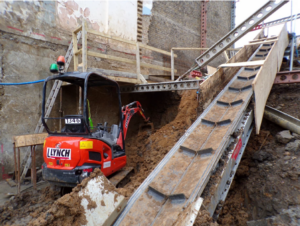
The employee was loading sugar beet for transport using a conveyor at Knowles Logistics Limited, on 28 November 2023, when the system became blocked with waste product. They fell after climbing the side of the conveyor to clear the blockage, suffering multiple injuries including several broken ribs, a punctured lung, and liver damage.

An investigation by the Health and Safety Executive (HSE) found the conveyor system became blocked multiple times during a shift. Often these blockages could only be cleared by climbing up the side of the machine and removing the obstruction by hand. There was no safe system of work in place for clearing blockages.

Sugar beet conveyor

HSE guidance states that work at height must be properly planned, appropriately supervised, and carried out safely by competent people. Work at height includes any place where, without precautions, a person could fall a distance liable to cause personal injury. Further guidance can be found here: Working at height: A brief guide.

Knowles Logistics Limited, of Cambridgeshire, pleaded guilty to breaching Section 2(1) of the Health and Safety at Work etc. Act 1974. The company was fined £133,000 and ordered to pay £5,438 in costs at Peterborough Magistrates’ Court on 24 October 2025.

Following the hearing, HSE Inspector Natalie Prince said:

“Falls from height are one of the biggest causes of workplace fatalities and major injuries. This was a wholly avoidable incident that led to a worker being seriously injured.”

This prosecution was brought by HSE Enforcement Lawyer Iain Jordan, supported by Paralegal Officer Atiya Khan.


Further information:

  1. The Health and Safety Executive (HSE) is Britain’s national regulator for workplace health and safety. We are dedicated to protecting people and places, and helping everyone lead safer and healthier lives.
  2. More information about the legislation referred to in this case is available.
  3. Further details on the latest HSE news releases is available.
  4. Relevant guidance can be found here Working at height: A brief guide.
  5. HSE does not pass sentences, set guidelines or collect any fines imposed. Relevant sentencing guidelines must be followed unless the court is satisfied that it would be contrary to the interests of justice to do so.  The sentencing guidelines for health and safety offences can be found here.