Edinburgh Airport fined after pensioner fell from ambulift

  • James Young died in hospital more than a week after the fall
  • Locking fault on “ambulift” had been in place for some time before incident
  • HSE guidance is available on the maintenance of work equipment.

The owner of Edinburgh Airport has been fined £80,000 after a pensioner fell from an ambulift on his return from holiday.

Following the fall, James Young was admitted to hospital, but died more than a week later from his injuries .

The 81-year-old had just landed at the airport after holidaying on the Greek island of Rhodes with his wife Anne, when the incident happened on 28 November 2023.
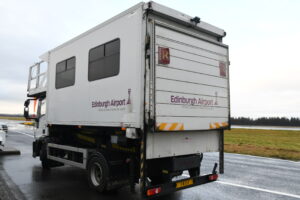
The Ambulift used by Mr Young and his wife

Mr Young and his wife, who has mobility issues, had been waiting for one of the airport’s ambulifts to assist them disembarking the aircraft shortly after 4pm. The couple had been two of six people requiring the assistance of the ambulift following the flight.

Ambulifts are a specially designed vehicle to assist passengers with reduced mobility. Edinburgh airport has several such vehicles which are owned, maintained and operated by the airport and driven by its employees.

Passengers who cannot embark or disembark using the aircraft steps can use an ambulift cabin, which is capable of being elevated to the level of the aircraft’s door and lowered to the chassis of the vehicle. At the rear of the vehicle, a tail lift platform is then deployed to the same level as the floor level of the passenger compartment.
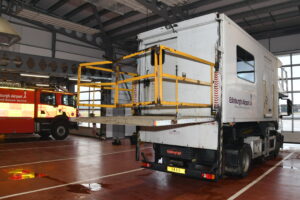
The locking mechanism on the safety rail was misaligned

Passengers then exit the compartment onto the tail lift, which unlike the compartment, is not enclosed, but has safety side rails and a rear gate around its perimeter. Once secure on the tail lift, it is lowered to ground level, allowing its users to move on to the tarmac step free.

Mr Young attempted to pass a piece of hand luggage to a worker on the ground whilst the tail lift had not yet been lowered. It is believed he leant  against the safety rail, which swung open causing him to fall approximately five feet to the ground below.

He was assisted to his feet and helped into a wheelchair and although he wasn’t thought to have sustained serious injury at time, he was taken to hospital. When examined at Edinburgh Royal Infirmary, it was found Mr Young had sustained  serious injuries and he subsequently died on 7 December as a result of these injuries.

As a result of the incident, Edinburgh Airport Limited submitted a RIDDOR to the Health and Safety Executive (HSE) and an investigation was carried out. That found that when it was raised from the ground, the locking mechanism on the tail lift’s safety rail was misaligned, meaning it could potentially open outwards if pressure was applied to it. When the safety rail moved outwards from the lifting platform an open edge was created and it was through this that Mr Young fell.
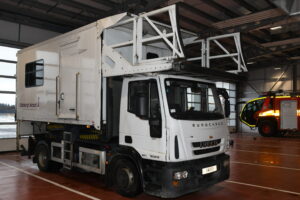
The ambulift that was used on the day in question

The Provision and Use of Work Equipment Regulations 1998 require every employer to ensure that work equipment is maintained in an efficient state, in efficient working order and in good repair. Equipment must be maintained so that its performance does not deteriorate to the extent that people are put at risk. HSE guidance is available on the maintenance of work equipment.

Edinburgh Airport Limited pleaded guilty to breaching Regulation 5(1) of the Provision and Use of Work Equipment Regulations 1998 and Section 33(1)(c) of the Health and Safety at Work etc. Act 1974. The company was fined £80,000 at Edinburgh Sheriff Court on 10 June 2025.

HSE inspector Jurate Gruzaite, said: “Edinburgh Airport Limited had a duty to ensure all of its work equipment was maintained in an efficient state and in working order. The company failed in this duty and had a role in a family tragedy that unfolded the moment Mr and Mrs Young returned from holiday.

“It is clear that the fault on the ambulift had been in place before Mr Young fell from the platform.

“We can only hope this tragic incident is one the industry can learn from.”


Further information:

  1. The Health and Safety Executive (HSE) is Britain’s national regulator for workplace health and safety. We are dedicated to protecting people and places, and helping everyone lead safer and healthier lives.
  2. More information about the legislation referred to in this case is available.
  3. Further details on the latest HSE news releases is available.
  4. HSE does not pass sentences, set guidelines or collect any fines imposed. Relevant sentencing guidelines must be followed unless the court is satisfied that it would be contrary to the interests of justice to do so.  The sentencing guidelines for health and safety offences in Scotland can be found here.



Health and safety regulator reminds farmers to keep visitors safe and healthy at open farm events

Ahead of Open Farm Sunday (Sunday 8 June) the Health and Safety Executive (HSE) is highlighting guidance available to farmers to help them keep people safe.

As we enter the summer months, an increasing number of working farms are taking the opportunity to hold open farm events and allow members of the public to visit their farms.

Open farm events can benefit both visitors and farmers alike, but it is crucial that farmers understand the health and safety measures they should take to keep visitors safe and well.

HSE inspector Wayne Owen said: “Open farm events provide a great opportunity for the public to learn more about farming, but it must be done safely.

“Farmers choosing to hold open farm events should make sure that they comply with health and safety legislation. It is extremely important that farmers understand the risks on their farm and ensure that visitors are protected from them.

“Farms should ensure that safety risks when offering activities like trailer rides are controlled. Our guidance can help: Carrying passengers on farm trailers AIS36. However, there are also health risks from contact with the animals that also need attention and must be controlled.

“The Access to Farms industry group has produced an Industry Code of Practice (ICOP) which is available to download free from their website. Farmers should read and follow the guidance so that visitors remain safe and well on their farms. The ICOP includes a useful checklist for farmers to use.”

Key components of a well-managed open farm event include:

  • Making sure the event is risk assessed and well planned.
  • Ensuring that the farm and farm staff understand the risks on site, including zoonotic risk (i.e. risks from diseases or bugs carried by animals).
  • Providing visitors with enough information on the risks and the controls in place (e.g. the importance of properly washing hands after touching animals, immediately before eating or drinking, and before leaving site).
  • Controlling visitor access to animals.
  • Supervising visitor contact with animals. Providing separate clean areas for petting of animals. Preventing visitors going into the pens with animals.
  • Providing suitable facilities for washing hands (normally this will be hot and cold water, liquid soap and paper towels) and directing visitors to use them after petting animals, immediately before eating food, before and after using any play equipment, and before leaving site. Hand washing gels are not an acceptable substitute for washing facilities.
  • If visitors are allowed to consume food or drink on site, providing separate clean eating areas, near hand washing facilities.
  • Good prominent signage on site giving important information to visitors (but don’t rely on signage alone to give those important messages).
  • Ensuring that visitors are not exposed to other risks on the farm e.g. by fencing off high risk areas or activities and keeping people away from traffic routes and moving vehicles.

By following these principles farms can hold safe and enjoyable open farm events.


Further information:

  1. The Health and Safety Executive(HSE) is Britain’s national regulator for workplace health and safety. We prevent work-related death, injury and ill health through regulatory actions that range from influencing behaviours across whole industry sectors through to targeted interventions on individual businesses. These activities are supported by globally recognised scientific expertise.
  2. Further details on the latest HSE news releasesis available.
  3. HSE was consulted in the production of the ICOP. It provides sensible, proportionate and balanced advice to farms on how to comply with health and safety law and keep visitors safe and well.


Cheshire college fined after student’s fingers severed

A college in Nantwich that specialises in outdoor-based careers has been fined £40,000 after a student’s fingers were severed when his hand came into contact with a mitre saw.

Aaron Maguire, from Crewe, was a second year Horticulture student at Reaseheath College when his hand came into contact with the blade of the saw on 20 September 2023. He had been using the saw to cut a piece of wood along its length when the wood twisted and pulled his hand into the cutting disc of the saw.

This resulted in the then 17-year old cutting through several fingers and the thumb on his left hand. Following an eight hour operation, surgeons managed to successfully re-attach Aaron’s thumb and index finger, but the middle finger could not be saved.

Keen hockey player Aaron, who is now 19, said everyday tasks were now more difficult.

“Although my left hand is not my dominant hand, I have had to adjust to doing things that I would normally do with my left hand, such as cutting food and picking up everyday objects like glasses and cups,” he said.

“I cannot grip things properly and it makes it difficult to do the hobbies I did.

“Prior to the incident, I was a keen hockey player. I still try to play hockey now, but it is nowhere near the level I was playing at before I had my injury.”

Aaron Maguire was just 17 when the incident happened

More than 18 months on, Aaron has been told that he requires further surgery to his middle finger, which he hopes won’t affect his plans to go to university in September.

“There are a number of reasons why an operation needs to take place.

“One of them is because the bone in my index finger is gradually sliding down and pushing into the skin on my hand.

“The operation is due to take place later this year. If the timing of the operation occurs around September when I am due to start my university course, this will have a significant impact on my studies.”

An investigation by the Health and Safety Executive (HSE) found that the college failed to adequately risk assess or produce a written safe system of work for using the mitre saw. The college did not record what training and instruction was given to students on the use of the saw.

There was no process to determine whether supervision was needed, nor was there any refresher training for using the saw following the students’ return from their summer break.

On the day of the incident, Aaron had been seen by the tutor earlier that morning using the saw improperly. Despite this, he was allowed to use the saw again later that day without supervision.

HSE guidance states that a suitable and sufficient risk assessment should be carried out to identify measures that can be taken to overcome the risks that the hazard presents. It also states that young people warrant special consideration due to their judgement and lack of experience.

Employers need to satisfy themselves that in addition to being adequately trained, users can demonstrate competence, and the level of supervision should be directly related to the level of competence. (Further guidance can be found here: Safe use of woodworking machinery. Provision and Use of Work Equipment Regulations 1998 as applied to woodworking machinery. Approved Code of Practice and guidance L114.

Reaseheath College in Nantwich, pleaded guilty to Section 3(1) of the Health and Safety at Work etc Act 1974. The college was fined £40,000 and ordered to pay £6,106 in costs at Chester Magistrates’ Court on 4 June 2025.

HSE inspector Summer Foster said: “Places of education and workplaces must ensure that they have properly assessed the risks where young people are using dangerous machinery.

“If suitable training, an assessment of competence and appropriate supervision had been carried out then this accident would not have been able to happen.

“A young man has been left with life-changing injuries as a result.”

The HSE prosecution was brought by HSE enforcement lawyer Edward Parton and paralegal officer Jason Dix.

Further information:

  1. The Health and Safety Executive (HSE) is Britain’s national regulator for workplace health and safety. We are dedicated to protecting people and places, and helping everyone lead safer and healthier lives.
  2. More information about the legislation referred to in this case is available.
  3. Further details on the latest HSE news releases is available.
  4. Relevant guidance can be found here Safe use of woodworking machinery. Provision and Use of Work Equipment Regulations 1998 as applied to woodworking machinery. Approved Code of Practice and guidance L114.
  5. HSE does not pass sentences, set guidelines or collect any fines imposed. Relevant sentencing guidelines must be followed unless the court is satisfied that it would be contrary to the interests of justice to do so.  The sentencing guidelines for health and safety offences can be found here.


Fine for flour mill after workers severs finger

A Northamptonshire-based flour company has been fined £300,000 after a maintenance worker severed one of his fingers in machinery.

The incident happened at ADM Milling Limited at its site on Earlstrees Industrial Estate in Corby on 28 June 2023.

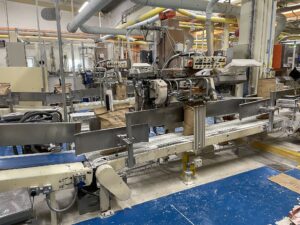
David Wood, who was 59 at the time, had been carrying out maintenance work on a packer closing station. However, the 800-kilogram machine became unbalanced and tipped backwards, trapping his left hand. This resulted in the little finger on the hand being severed.

A yellow brace was installed on the machine following the incident

The incident was investigated by the Health and Safety Executive (HSE) which found the company had failed to safely manage the risks of people performing maintenance at its factory.

ADM Milling Limited were required to fully assess the task that the injured person was assigned, to ensure that his health and safety was not put at risk.

HSE guidance states that maintenance work needs to be correctly planned and carried out. Unsafe maintenance has caused many fatalities and serious injuries, either during the work or as a result of using badly/wrongly maintained machines. Further guidance can be found here: Maintenance of work equipment – HSE

ADM Milling Limited, of Brunel Road, Earlstrees Industrial Estate, Corby, Northamptonshire, pleaded guilty to breaching Section 3(1) of the Health and Safety at Work, etc. Act 1974. The company was fined £300,000 and ordered to pay £7,517 in costs at Northampton Magistrates Court on 4 June 2025.

HSE inspector Abbey Hodson said: “This incident was wholly avoidable.

“The case should highlight to industry that all maintenance tasks, whether they are planned or unplanned, should be carefully assessed and reviewed to ensure that anyone under their control is protected from harm.

“Had this task been competently risk assessed, other control measures that prevented this incident would have been identified.”

The HSE prosecution was brought by HSE enforcement lawyer Samantha Wells and paralegal officer Helen Hugo.

Further Information:

  1. The Health and Safety Executive (HSE) is Britain’s national regulator for workplace health and safety. We are dedicated to protecting people and places, and helping everyone lead safer and healthier lives.
  2. More information about the legislation referred to in this case is available.
  3. Further details on the latest HSE news releases is available.
  4. Relevant guidance can be found here Maintenance of work equipment – HSE
  5. HSE does not pass sentences, set guidelines or collect any fines imposed. Relevant sentencing guidelines must be followed unless the court is satisfied that it would be contrary to the interests of justice to do so.  The sentencing guidelines for health and safety offences can be found here.


Fine for company and director after employee falls through roof light

  • HSE guidance says all work at height must be properly planned

A construction company and its director have been fined after a worker fell through the roof of a sheep barn.

Jack Croft, 30, suffered life changing injuries after the incident in Leyburn, North Yorkshire.

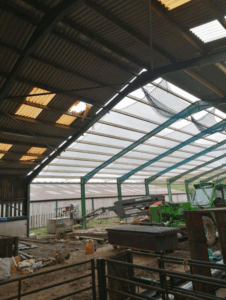
He was working for Norman Iveson Steel Products, as part of a project to extend the sheep barn. Roof sheets needed to be installed, bridging the gap between the old roof and new. Jack, from Bedale, was carrying out the work on 11 October 2022 when he stepped onto a fragile roof light which immediately broke under his weight. He fell from a height of around six metres.

Jack Croft fell through the barn roof light

Mr. Croft suffered significant life changing injuries, including five cranial fractures, 10 fractured ribs, a cranial bleed, hearing loss and fractures to his spine, eye socket, cheek, wrist and shoulder. He also suffered a collapsed left lung and a pulmonary embolism.

An investigation by the Health and Safety Executive (HSE) found the company had failed to implement basic working at height control measures, such as safety netting, to prevent falls from height in this area. The netting that was in place on site did not cover full work areas and was installed by persons without the sufficient skills to rig it. HSE also found a failure to plan, manage and monitor the construction phase, to ensure it was carried out in a safe manner.

HSE has a range of guidance on how to plan and carry out work at height safely: Construction – Work at height – HSE

Norman Iveson Steel Products Limited, of Hill Crest, North Yorkshire, pleaded guilty to Section 2(1) of the Health and Safety at Work etc. Act 1974. The company was fined £100,000 and ordered to pay costs of £6,101 at York Magistrates Court on 22 May 2025.

Phillip Iveson, a director of the company, pleaded guilty to Section 37 of the Health and Safety at Work etc. Act 194 and fined £1,822 and told to pay costs of £2,358.

Speaking after the hearing, HSE inspector Gavin Carruthers, said: “This was a tragic incident where a young man narrowly escaped death but received life changing injuries. Falls from height continue to be the leading cause of workplace death in Great Britain and this incident was fully avoidable if steps were taken to address the risks.”

This prosecution was brought by HSE enforcement lawyer Karen Park and paralegal officer Rebecca Withell.


Further information:

  1. The Health and Safety Executive (HSE) is Britain’s national regulator for workplace health and safety. We are dedicated to protecting people and places, and helping everyone lead safer and healthier lives.
  2. More information about the legislation referred to in this case is available.
  3. Further details on the latest HSE news releases is available.
  4. Relevant guidance can be found here – Construction – Work at height
  5. HSE does not pass sentences, set guidelines or collect any fines imposed. Relevant sentencing guidelines must be followed unless the court is satisfied that it would be contrary to the interests of justice to do so.  The sentencing guidelines for health and safety offences can be found here.