News story: Major boost for the south-west as plans published for £1.6 billion A303 Stonehenge upgrade

The route for the £1.6 billion A303 upgrade near Stonehenge, a key part of the ‘South West expressway’, has today (12 September 2017) been published by Transport Secretary Chris Grayling.

Linking the M3 in the south-east and the M5 in the south-west, the ‘expressway’ will upgrade this key route and improve journey times for millions of people. This major investment will support economic growth and tourism in an area where congestion and slow journeys have long had a negative impact on the region’s economy.

A tunnel near Stonehenge will remove the traffic blight on local communities and enhance the famous landmark. It will reconnect the 2 halves of the 6,500 acre World Heritage site which is currently split by the road, and remove the sight and sound of traffic from the Stonehenge landscape.

Transport Secretary Chris Grayling said:

This government is taking the big decisions for Britain’s future and this major investment in the south-west will provide a huge boost for the region.

Quicker journey times, reduced congestion and cleaner air will benefit people locally and unlock growth in the tourism industry.

The scheme will also support 120,000 extra jobs and 100,000 new homes across the region, helping us build a country that works for everyone.

The A303 upgrade between Amesbury and Berwick Down is a key part of the government’s £15 billion road strategy – the biggest investment in roads in a generation. The scheme includes the 1.8 mile-long tunnel, a free-flowing dual carriageway and a much-needed bypass north of Winterbourne Stoke.

Highways England chief executive Jim O’Sullivan said:

Highways England is committed to delivering a high quality, modern road on this vital route between the south-west and the rest of the country.

The A303 and the World Heritage site has suffered from congestion for many years. This scheme will enhance, protect and restore tranquillity to one of the UK’s most iconic landscapes.

We have listened to feedback from consultation and believe this preferred route will help improve traffic flow, reduce rat-running on the surrounding roads, bringing improvements to local communities and benefits to the south-west economy.

A public consultation was held earlier this year which attracted considerable feedback from thousands of individuals and organisations. Following this and further engagement with local communities, heritage groups, archaeologists, historians and engineers, Highways England has modified the plans, including moving the position of one of the entrances to the tunnel to avoid conflicting with the solstice alignment. The route ensures the Stonehenge World Heritage site will be protected and enhanced for people from across the world to enjoy.

Secretary of State for Culture, Karen Bradley said:

Stonehenge has captured the imagination of people around the world for centuries and is a site of global importance. With over 1 million visitors a year it is one of the jewels in the UK’s crown and it is important that we preserve it for generations to come. This investment from the government will help make the visitor experience much more enjoyable and this is good news for local residents and businesses who will benefit from the new route.

The government will also continue to work closely with key heritage bodies to ensure this scheme respects and protects the Stonehenge World Heritage site.

The government is committed to upgrading all remaining sections of the A303 between the M3 and M5 to dual carriageway standard, starting with 3 schemes: one at Stonehenge, one between Sparkford and Ilchester and the third on the A358 between Taunton and Southfields.

The preferred route includes:

  • 8 miles of free-flowing, high-quality dual carriageway
  • a tunnel at least 1.8 miles long underneath the World Heritage site, closely following the existing A303 route, but a further 50 metres away from the monument, avoiding important archaeological sites and avoiding intrusion on the view of the setting sun from Stonehenge during the winter solstice
  • a new bypass to the north of the village of Winterbourne Stoke
  • junctions with the A345 and A360 either side of the World Heritage site.

Details of the preferred route are available on the scheme webpage.


News story: Thousands of commuters to benefit from UK-built river boats with wifi

Tens of thousands more people will be able to commute by modern river boats kitted out with the latest technology.

In a boost for the UK maritime industry, British shipbuilding company Wight Shipyard has announced recent orders worth £20 million for 4 boats for the Isle of Wight and London.

The news comes during London International Shipping Week 2017, which will showcase the UK’s thriving maritime industry to ministers, industry leaders and delegates from around the world.

The shipyard employs 75 full time workers and their construction programme supports 10 apprentices, who begin training this month – backing the government’s Industrial Strategy to boost jobs, growth and productivity across the country.

Two of the new ‘Hunt Class Mark 2’ boats will serve millions of London commuters a year as they travel with MBNA Thames Clippers along the capital’s famous river. The other two will join the Red Funnel high speed passenger service operating between Southampton and the Isle of Wight.

The British-built boats can carry some 14,000 commuters a day during rush hour and are more environmentally-friendly, with new modern engines burning less fuel and emitting less CO2. They are also fitted with wifi and USB phone chargers for a better passenger experience.

The shipyard has also secured its first multi-million pound export order for a 250-passenger river boat to operate for Twin City Liner – a commuter service running on the Danube between Vienna and Bratislava, joining two European capital cities.

Transport Minister John Hayes said:

As we celebrate London International Shipping Week 2017, we proudly show off our thriving shipping sector and world-leading manufacturing skills and talent.

Countless more commuters will be able to travel in modern, fully kitted out boats built in the UK – helping to slash congestion on our roads and railways.

What’s more, the world is watching and wanting our iconic boats, Wight Shipyard deserve all of our thanks and congratulations for its first international order.

Not only are companies like Wight Shipyard providing specialist training opportunities, they are helping boost our vital maritime sector and the UK economy – especially important making the pace as we look beyond the bureaucracy of the EU to our European friends across the world.

Peter Morton, CEO Wight Shipyard said:

I am extremely proud of my colleagues at Wight Shipyard who I am convinced now build the finest high-speed ferries in the world. Domestic orders for the Red Funnel and MBNA Thames Clippers which we secured against international competition, as well as our first export order to Twin City Liner in Vienna, make the prospects for the Wight Shipyard, jobs on the island and the wider maritime sector in the UK look healthy. Our strong orderbook is a big vote of confidence for the industry and the UK economy.

Sean Collins, CEO at MBNA Thames Clippers

I am extremely pleased that MBNA Thames Clippers were able to recently place an order with a British yard for our 2 new vessels, Mercury and Jupiter Clipper. These vessels are now in full service and delivering a new level of experience to our customers. I have great confidence in the future success of Wight Ship Yard and hope that we can place further orders with them to satisfy the continued growth opportunities open to our business and the industry. Furthermore the new builds have provided significant career opportunities at MBNA Thames Clippers, in particular within Fleet Operations and Engineering, these include several apprenticeships. I believe that London International Shipping Week places great focus on our maritime sector and the valuable contribution of its people and skills to our economy.

Kevin George, CEO of Red Funnel

The construction of Red Jet 6 by Wight Ship Yard in 2016 marked the return of building large high speed aluminium catamarans to the Isle of Wight and to the UK after a gap of 15 years. We are delighted that this investment provided the catalyst for establishing a world class manufacturer that has aided the local and UK economy. Based on the quality and efficiency of the new vessel, which is part of our Red Jet service that carries over 1 million passengers to and from the Isle of Wight per year, we have recently announced the order for a further vessel from Wight Ship Yard to join our fleet in 2018.


News story: New approach to preventing heart attacks and strokes

The NHS and Public Health England (PHE) will today (Tuesday, 12 September 2017) announce a new drive to save thousands of lives by preventing heart attacks and strokes brought on by cardiovascular disease (CVD).

New PHE analysis suggests that there is an opportunity to prevent more than 9,000 heart attacks and at least 14,000 strokes over the next 3 years with better detection and management of:

  • high blood pressure
  • high cholesterol
  • atrial fibrillation

Simon Stevens, the Chief Executive of NHS England said:

Closer working between NHS organisations and local authorities will create new opportunities to get serious about prevention and bear down on 2 of our biggest killers that between them are responsible for 1 in 4 premature deaths.

Heart attacks and strokes devastate the lives of thousands of people. Tackling a problem of this size requires action across areas. It is not something that the health service can do alone.

Speaking at the NHS Expo conference in Manchester, Mr Stevens will urge the new sustainability and transformation partnerships (STPs) to take coordinated cross-system action to improve identification and treatment of these potentially life-threatening conditions. At the same time Duncan Selbie, the Chief Executive of PHE, will highlight the initiative during his annual conference today.

5.5 million people in England have undiagnosed high blood pressure and nearly half a million have undiagnosed atrial fibrillation, which are both symptomless conditions that substantially increase the risk of stroke and heart attack. Treatment is effective at reducing risk but under-treatment is common among those who are diagnosed.

The new analysis shows the scale of the prevention opportunity across England over 3 years if treatment of these high-risk conditions is optimised. Achieving optimal treatment in all people with diagnosed high blood pressure has the potential to avert up to 9,710 heart attacks and 14,500 strokes, saving up to £274 million. Achieving optimal treatment for those diagnosed with atrial fibrillation has the potential to avert up to 14,220 strokes, saving £241 million.

Duncan Selbie, Chief Executive of PHE, said:

High blood pressure is the invisible killer. We want people to be as familiar with their blood pressure numbers as they are with their credit card PIN or their height.

Too many people are still living in poor health and dying from a largely preventable disease. The good news is that we know how most heart attacks and strokes can be avoided. Scaling up CVD prevention locally is a major part of reducing the overall burden on individuals, families and the NHS, and will help us ensure a person’s health is not defined by where they live.

PHE and NHS England have today written to all 44 STPs, drawing attention to the prevention opportunity in their local areas, and sharing with them the data for their individual STPs.

By working across larger populations, STPs can mobilise clinical leaders across a geography and drive larger-scale improvements such as increasing access to blood pressure testing in the workplace, and using the wider local authority and third sector workforce to carry out health checks in community settings.

The majority of STPs have identified prevention of cardiovascular disease as a priority.

They are likely to drive improvements in 2 ways. Firstly through partnerships that support at scale implementation of initiatives such as healthy workforce schemes, active transport plans, the Active 10 app, and smoking cessation programmes. Secondly, they have the ability to roll out the NHS Right Care CVD Prevention Programme across a much wider area.

The NHS Right Care programme will help GPs and local areas to ensure more patients get proven treatments by organising local services differently. This will include more testing and treatment in pharmacies, increasing uptake of NHS Health Check, more self-monitoring, more access to blood pressure testing in community and workplace settings, and new digital tools such as the One You Heart Age Test.

The NHS Health Check is offered to all eligible people between 40 and 74 every 5 years. As well as supporting people to reduce lifestyle risk factors, it provides a systematic way of identifying people with undiagnosed high-risk conditions like high blood pressure and atrial fibrillation (AF). But currently only a half all eligible people take up the offer.

Dr Matt Kearney, the NHS’s National Clinical Director for Cardiovascular Disease Prevention, added:

We know that there are many ways that people can prevent heart attacks and strokes – by being more active, not smoking and having a healthy diet. What the NHS Right Care programme and the STP partnerships bring is an opportunity for the NHS to improve treatment of the high-risk conditions, at scale across an area, and prevent thousands of heart attacks and strokes.

Some areas across the country have already implemented these approaches with encouraging results which the NHS is hoping to expand and improve in every area in the country.

In West Hampshire, a mix of GP education, diagnostic devices for AF and pharmacist-run anticoagulation services resulted in an estimated 52 strokes being averted in 20 months.

In Lambeth and Southwark, pharmacists were commissioned to manage blood pressure and AF. Over 15 months, an estimated 45 strokes were averted.

Bradford Districts CCG has used at-scale methods to transform primary care pathways, optimising treatment in 21,000 patients. This has delivered improved population-level control in blood pressure, cholesterol and AF, and substantial reduction in heart attacks and strokes (over 200 in 15 months).


Press release: Foreign Secretary statement on adoption of UNSC resolution on North Korea

Speaking after the UN Security Council (UNSC) unanimously adopted UNSCR 2375, the Foreign Secretary Boris Johnson said:

I welcome the unanimous adoption of the UNSC resolution today. The international community has shown it is united against the illegal and reckless acts by the North Korean regime. By adopting these new measures, we have the most stringent UN sanctions regime placed on any nation in the 21st century.

This resolution will curtail gas, petrol and oil imports. It will ban all textile exports, taking hundreds of million dollars from the export revenues that the North Korean regime uses to fund its illegal nuclear and ballistic missile programmes. And it will end the exploitation of DPRK labourers abroad.

The North Korean regime bears full responsibility for the measures that the UN Security Council has enacted today. It is their continued, illegal and aggressive actions that have brought us to this point, and it is North Korea that must change its course.


News story: Free at last as jammed fuel is lifted out

Updated: Updated the link to the longer version of the video

When the dome-shaped experimental reactor closed in 1977, most of the core fuel was removed.

But follow-up work came to a halt when some of the metallic casings in the zone surrounding the core were found to be swollen and jammed. Almost 1,000 – around two-thirds of the total – were left in place.

Made of stainless steel, the casings, known as breeder elements, contained natural uranium and were designed to produce more fuel for use in other reactors.

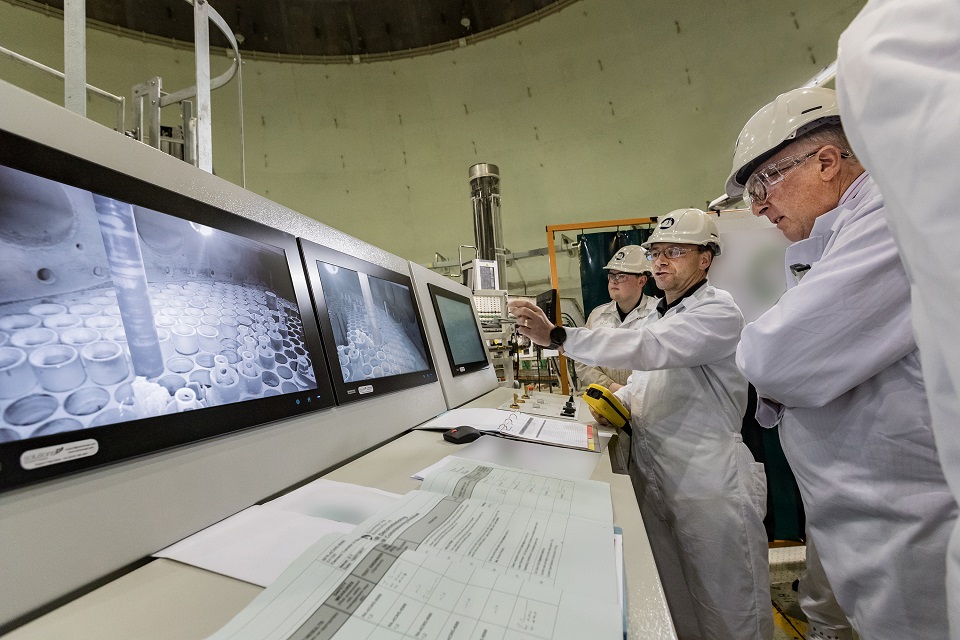
Now, after many years of work to design and test remotely operated equipment, a decommissioning team has started to recover the elements.

Decommissioning the 50-year-old reactor is one of the most technically challenging projects in the NDA estate and removing the breeder elements has been a top priority.

The removal work is expected to take less than 3 years, after which dismantling of the landmark reactor can begin.

David Peattie, NDA Chief Executive, said:

Dealing with this material is one of the highest priorities anywhere for the NDA, not just at Dounreay but across our UK sites. The safe and timely retrieval of the breeder material is crucial to both the site’s closure programme and the national defueling programme.

I am very pleased with this achievement which is a great example of how the Dounreay team and the NDA can work together to deliver results of national importance.

MP Jamie Stone looks on as team members monitor removal of the breeder material

During a visit to the reactor, Jamie Stone, MP for Caithness, Sutherland and Easter Ross, said:

Actually watching on screen the removal of an element from the reactor core was fascinating. Seeing the intricate techniques and skills, and the special locally designed equipment being used was absolutely inspirational.

In an age when sometimes you begin to wonder where British technology is going, it is hugely encouraging to see what is being done at Dounreay. I take my hat off to the workforce.

When the damaged elements were discovered, decommissioning effectively stopped for 20 years, until the decision was taken in 2000 to close down Dounreay and the creation of the NDA a few years later gave fresh momentum to the task.

The elements were immersed in some 57 tonnes of highly reactive liquid metal which had to be removed and destroyed before remotely operated cameras could inspect the condition of the material. This difficult, hazardous programme took more than 10 years.

Now, following extensive research and development trials inside the plant and at a test rig on the outskirts of Thurso, work has started to remove the remaining breeder material.

Watch the DFR breeder material removal process

Dounreay Fast Reactor

After removal, the elements are being transferred to a purpose-built facility, where they are being cut open to remove the uranium fuel, cleansed of any traces of liquid metal and packaged in containers for dispatch to Sellafield. About 40 tonnes of breeder recovered previously has already been sent there.

When all the breeder material has been removed, work can begin on taking the reactor apart.

Main support contractor: JGC Engineering & Technical Services Ltd

About the Dounreay Fast Reactor (DFR)

  • the DFR was built during the 1950s at a time when there was a world-wide shortage of uranium for electricity generation

  • It became the world’s first fast reactor to provide electricity to a national grid, providing enough power for a small town like Thurso (population approx 9,000)

  • DFR’s reactor core was surrounded by a blanket of natural uranium elements that, when exposed to the effects of the radiation, would ‘breed’ to create a new fuel, plutonium

  • UK experimentation with fast breeders came to an end in the 1980s

  • decommissioning DFR is one of the most significant challenges in the UK today. It was one of only two fast reactors ever built in the UK, both at Dounreay.

  • when the breeder material is all removed, the reactor and its circuits will be dismantled, followed by final decontamination of the structures

  • the dome and associated structures will be demolished

Dounreay Site Restoration Ltd (DSRL)

DSRL, a company owned by Cavendish Dounreay Partnership, is responsible for decommissioning the UK’s former centre of fast reactor research on behalf of the NDA.