Press release: Improving work health for a healthy economy

A healthy population is the engine of a healthy economy, says Public Health England’s (PHE) Chief Executive.

Speaking at the opening of PHE’s annual conference, Duncan Selbie said we must look further than the NHS if we are to ensure everyone has a fair chance of good health.

PHE believes that health and wealth are 2 sides of the same coin. Having a job is the key to a long, happy and healthy life.

Illness among working age people costs the UK economy £100 billion a year. About 330,000 every year become unemployed because of health-related issues.

For every unemployed person who gets a job there is an estimated saving to society of £12,035 in a one-year period.

We take an estimated 137.3 million days of sick leave and more than a third of those (£46 million) are due to poor mental health and lower neck and back pain.

But workplace health and wellbeing programmes such as exercise, healthy eating and stop smoking support can make a real difference. Successful programmes such as these have been found to return £2 to £10 for every £1 spent, benefiting staff wellbeing and economic productivity.

Most big employers already have some plans in place that help to improve and protect their staff’s health but many small and medium enterprises (SMEs) do not currently benefit from such programmes.

PHE and Healthy Working Futures, a workplace health provider, has set out advice for SMEs, which account for 60% of private sector employment.

It gives SMEs a series of questions on health and wellbeing including smoking, fitness and sleep, which staff can answer anonymously, enabling them to assess the specific needs of their workforce and create tailored steps to improve their staff’s health and wellbeing, based on evidence.

Later this week, Federation of Small Businesses (FSB) will also publish new guidelines on how businesses can improve their workers’ health, with advice on physical and mental health.

PHE has also created a series of guidance for employers on important issues, such as musculoskeletal (MSK) and mental health, impacting on employees with Business in the Community. Further advice is being developed covering issues including:

  • physical activity
  • diet and weight
  • drugs
  • alcohol
  • tobacco

Duncan Selbie, Public Health England (PHE) Chief Executive, said:

Work is the key to a long, happy and healthy life. But sickness absence and tackling early retirement due to ill health are still major challenges for the economy.

This new package of support for small businesses will help businesses improve the health of their staff.

We can no longer see the health service as the only solution to our ills. We’ve got individual responsibility, and so do employers. Keeping people healthy not only benefits the individual but also benefits the economy and the local community.

We must do more to improve health outcomes, and in turn the health and economic productivity of the country. I urge employers to take advantage of this support.

Mike Cherry, Chairman of the Federation of Small Businesses, said:

Improved wellbeing benefits individual businesses. But more than that, it helps the wider economy, government and public services, as well as the local communities where small businesses play such an important role. There’s never going to be a ‘one size fits all’ approach and not every idea will work for every business – that’s why we’re very pleased to be working with Public Health England in particular to help smaller businesses and the self-employed.

The FSB will soon launch its first wellbeing campaign aimed at providing some simple ideas and suggestions that smaller firms can look to adopt to support themselves and their staff. This sits alongside the medical and health advice service we already offer our members. We are delighted to receive the support of PHE for our campaign and we hope it acts as a catalyst for a positive conversation on wellbeing and mental health.

Louise Aston, Wellbeing Director, Business in the Community, said:

We are delighted to be working in partnership with Public Health England, taking an innovative co-production, whole person, whole system approach to producing a suite of interconnected toolkits that address the two leading causes of days lost at work – mental and musculoskeletal health.

Our suite of toolkits consolidates the very best evidence with the very best employer practice, aligned with freely available resources that are useful to all employers, wherever they are on their journey.

PHE and Business in the Community have developed a series of toolkits for employers.

Northumbria Healthcare NHS Foundation Trust introduced a physiotherapy service for staff with MSK absence from work because it was the second highest reason for sickness absence among staff, and employees had asked for support in this area in health and wellbeing surveys.

Following a successful pilot of early intervention for staff with MSK absence at Wansbeck General Hospital in 2014, the service was extended trust-wide in January 2016.

An additional whole-time equivalent physiotherapist was provided to deliver the service for staff who can either self-refer using the online referral system or be referred by their manager, ideally on the first day of absence.

Staff are then given an appointment with a physiotherapist within 3 days.

Findings show:

  • 15% of staff (86) on short-term MSK absence were referred to the staff physiotherapy service
  • absence length for staff on short-term absence was reduced by 31% when referred on first day of absence, compared to day 2 or more
  • 25% of staff (44) on long-term MSK absence were referred to physiotherapy
  • absence length for staff on long-term absence was reduced by 11% when referred on first day of absence, compared to day 2 or more

For further information on this case study, please contact Jaclyn Curry, Media and Communications Officer, Northumbria Healthcare NHS Foundation Trust on 0191 203 1654 or jaclyn.curry@northumbria.nhs.uk.

Public Health England exists to protect and improve the nation’s health and wellbeing, and reduce health inequalities. It does this through world-class science, knowledge and intelligence, advocacy, partnerships and the delivery of specialist public health services. PHE is an operationally autonomous executive agency of the Department of Health. Follow us on Twitter: @PHE_uk and Facebook: www.facebook.com/PublicHealthEngland.


Press release: New figures reveal junior fishing licences increase 25%

Sales of junior fishing licences across England and Wales, have received a welcome boost over the summer, according to the latest figures from the Environment Agency. The figures reveal junior fishing licence sales increased by 25.7% from 2016/17. The fishing licence, which is now free for 12 to16 year olds, shows figures increased from 52,117 at the end of 2016/17 to 65,487 as of 21 August 2017.

The increase in sales is welcomed by the Environment Agency which highlighted the challenge of attracting juniors to the sport given the popularity of game consoles, TV and social media. The rise in sales figures was helped by last year’s changes to fishing licences which included making them free to anyone aged 12 to16*.

Figures from 2009 to 2016 showed a 52.6% decline in junior licence sales reaching just 52,117 in 2016. It’s hoped that the recent increase marks the start of an upward trend that will help secure the future of the sport. The free juniors fishing licence is supported by hundreds of partnership fishing events run alongside partners including the Angling Trust, Get Hooked on Fishing and National Fishing Month. The events include free family fun days and taster sessions which help remove barriers for juniors and families enabling them to consider taking up fishing.

Kevin Austin, Head of Fisheries at the Environment Agency, said:

Children today have a wealth of technology at their fingertips, and coupled with the costs parents face, it’s easy to see why fewer children are enjoying outdoor activities. We’re really pleased to see that a growing number of young people are taking up the offer of a free junior licence, helping them to enjoy the great outdoors and this great sport.

Today’s children are the anglers of tomorrow. It’s important we attract them to the sport early and offering a free fishing licence is one way to achieve that. Not only does fishing offer great health and educational benefits, angling generates over £1 billion for the UK economy and creates over 37,000 full time jobs.

The Environment Agency works in partnership with the Angling Trust, Get Hooked on Fishing and National Fishing Month to offer free fishing events and activities. To find an event close to you take a look at www.getfishing.org.uk.

The free junior fishing licence is made possible as a result of income generated from adult fishing licence holders.

ENDS.

Notes to editors

  • Figures quoted are for England and Wales
  • *Juniors still need to get a licence in order to fish but the licence will be free www.gov.uk/get-a-fishing-licence.
  • These changes have also been implemented across Wales. Natural Resources Wales is the lead.
  • Anglers are legally required to hold a valid fishing licence to fish in rivers, lakes and other inland waters in England (except the River Tweed) and the Border Esk (and its tributaries) in Scotland.


Press release: Predatory paedophile has his sentence increased by 3 years

Abingdon man who used fake online profiles to abuse children has his sentence increased by the Court of Appeal.

An Abingdon man who was using fake online profiles to abuse children has his sentence increased by the Court of Appeal following a referral under the Unduly Lenient Sentence scheme.

Alex Orr, 27, pleaded guilty to 16 offences against children including extreme pornography and arranging the commission of a child sex offence. Orr received a 6 year custodial term and a 4 year extended licence when he appeared at Oxford Crown Court in January. Today this sentence was increased to 9 years’ imprisonment with a 4 year extension.

Orr created a fake Facebook profile and tricked young teenagers into performing sexual acts for him to view online. He also incited his victims to engage in sexual activity with other children, including one who was just 1 or 2 years’ old.

Speaking after the hearing, the Attorney General Jeremy Wright QC MP said:

“This offender deceived a large number of young victims and manipulated them into doing unspeakable acts, resulting in serious psychological harm.

“Just because these crimes were committed from behind a screen doesn’t make them any less serious. I hope the increased sentence shows how seriously the Courts take these matters.”


News story: Better co-ordination to stop illegal waste carriers

The Environment Agency and Driver and Vehicle Standards Agency (DVSA) have agreed on steps to stop illegal waste carriers and improve road safety in England.

Sir James Bevan, Environment Agency Chief Executive, and Gareth Llewellyn, DVSA Chief Executive, signed an agreement today (12 September 2017) in London.

How being a waste carrier works

Companies must register as a waste carrier if they:

  • transport waste
  • buy, sell or dispose of waste

However, some carriers operate illegally without the necessary licence, and don’t dispose of waste legally.

Companies who use a waste carrier must check they’re registered to dispose of waste, and not allow the waste carrier to dispose of their waste illegally.

Every year waste crime costs taxpayers and businesses £1 billion. The Environment Agency spent almost £15 million stopping illegal waste activity between April 2015 and March 2016.

What the agreement will do

The Environment Agency and DVSA will share intelligence and carry out joint operations in England to:

  • stop waste being illegally transported
  • target unsafe drivers and vehicles

The agreement will see:

  • DVSA staff working within Environment Agency teams, making sure enforcement action is coordinated and effective
  • information and intelligence shared between the 2 agencies, increasing the effectiveness of roadside enforcement activity on waste industry vehicles
  • enforcement teams provided with up-to date and relevant intelligence about waste industry operators
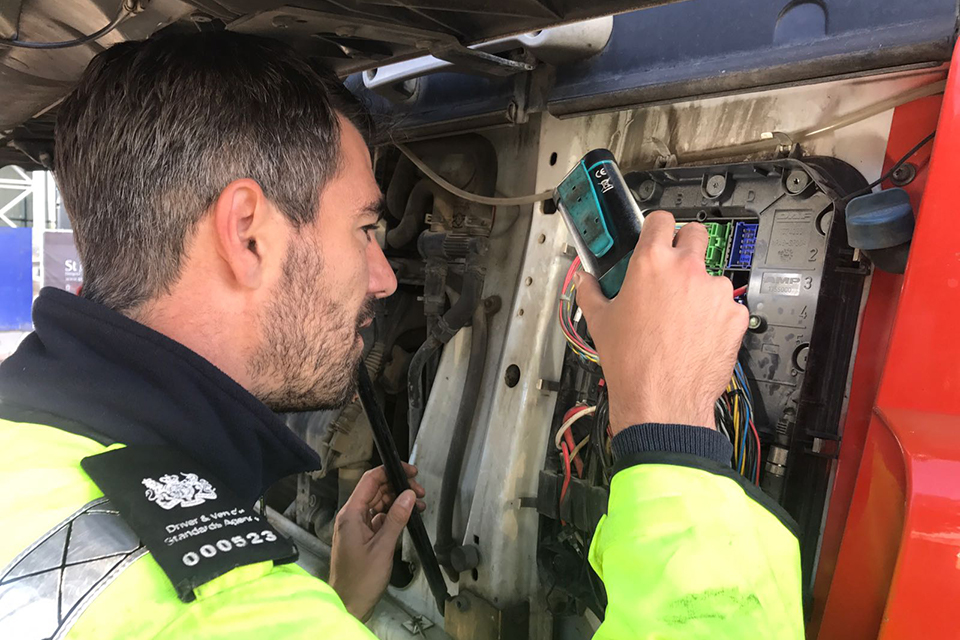
DVSA traffic examiner inspects a waste carrier
A DVSA traffic examiner inspects a waste carrier

This will all help to:

  • identify high-risk or illegal goods vehicle operators who are involved in the transport of waste
  • reduce the number of seriously and serially non-compliant waste industry vehicles on England’s roads

Report unsafe operators

You can report any information you have about to unsafe vehicle operators to DVSA.

DVSA intelligence team

Report vehicle operators or lorry, bus and coach drivers breaking safety rules and laws.

Monday to Friday, 7:30am to 6pm.

Building on years of joint work

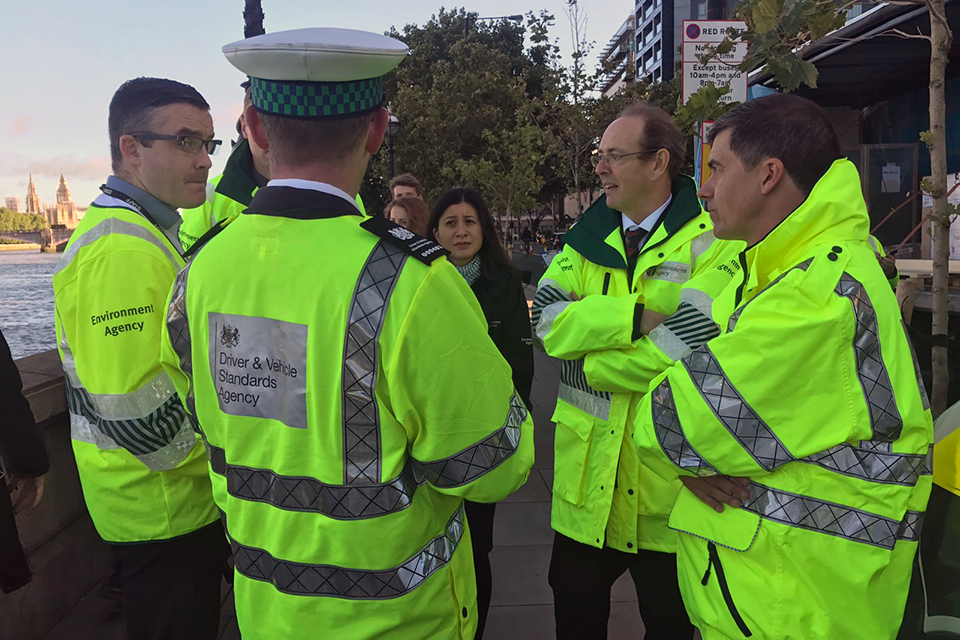
Staff from the Environment Agency and DVSA in London
Sir James Bevan and Gareth Llewellyn (right) talk to Environment Agency and DVSA staff at a joint operation in London

For a number of years, the Environment Agency and DVSA have worked together to stop waste crime, making sure companies are operating legally and vehicle safety is improved.

Gareth Llewellyn said:

DVSA priority is to protect you from unsafe drivers and vehicles.

I am delighted that we will be working with the Environment Agency to tackle those who illegally transport waste. By combining our enforcement powers and intelligence we’ll be able to target those who break the rules more effectively.

DVSA traffic examiners will issue fines to those waste carriers we find to be operating in and unsafe manner. These operators are putting themselves and other road users at risk and pose a danger to our environment.

Sir James Bevan said:

We want to protect people and communities from the impact that vehicle and waste crime can have and create a level playing field for all operators.

This memorandum of understanding with DVSA will help both organisations target the waste industry to improve compliance and vehicle and driver safety standards.

To help us with this, we are encouraging people to check with the Environment Agency if the company they are employing to take their waste away is a fully registered waste carrier.


News story: Better co-ordination to stop illegal waste carriers

The Environment Agency and Driver and Vehicle Standards Agency (DVSA) have agreed on steps to stop illegal waste carriers and improve road safety in England.

Sir James Bevan, Environment Agency Chief Executive, and Gareth Llewellyn, DVSA Chief Executive, signed an agreement today (12 September 2017) in London.

How being a waste carrier works

Companies must register as a waste carrier if they:

  • transport waste
  • buy, sell or dispose of waste

However, some carriers operate illegally without the necessary licence, and don’t dispose of waste legally.

Companies who use a waste carrier must check they’re registered to dispose of waste, and not allow the waste carrier to dispose of their waste illegally.

Every year waste crime costs taxpayers and businesses £1 billion. The Environment Agency spent almost £15 million stopping illegal waste activity between April 2015 and March 2016.

What the agreement will do

The Environment Agency and DVSA will share intelligence and carry out joint operations in England to:

  • stop waste being illegally transported
  • target unsafe drivers and vehicles

The agreement will see:

  • DVSA staff working within Environment Agency teams, making sure enforcement action is coordinated and effective
  • information and intelligence shared between the 2 agencies, increasing the effectiveness of roadside enforcement activity on waste industry vehicles
  • enforcement teams provided with up-to date and relevant intelligence about waste industry operators

A DVSA traffic examiner inspects a waste carrier

This will all help to:

  • identify high-risk or illegal goods vehicle operators who are involved in the transport of waste
  • reduce the number of seriously and serially non-compliant waste industry vehicles on England’s roads

Report unsafe operators

You can report any information you have about to unsafe vehicle operators to DVSA.

Building on years of joint work

Sir James Bevan and Gareth Llewellyn (right) talk to Environment Agency and DVSA staff at a joint operation in London

For a number of years, the Environment Agency and DVSA have worked together to stop waste crime, making sure companies are operating legally and vehicle safety is improved.

Gareth Llewellyn said:

DVSA priority is to protect you from unsafe drivers and vehicles.

I am delighted that we will be working with the Environment Agency to tackle those who illegally transport waste. By combining our enforcement powers and intelligence we’ll be able to target those who break the rules more effectively.

DVSA traffic examiners will issue fines to those waste carriers we find to be operating in an unsafe manner. These operators are putting themselves and other road users at risk and pose a danger to our environment.

Sir James Bevan said:

We want to protect people and communities from the impact that vehicle and waste crime can have and create a level playing field for all operators.

This memorandum of understanding with DVSA will help both organisations target the waste industry to improve compliance and vehicle and driver safety standards.

To help us with this, we are encouraging people to check with the Environment Agency if the company they are employing to take their waste away is a fully registered waste carrier.