Guidance: Implementation of defence policy for health, safety and environmental protection (DSA01.2)

Updated: DSA01.2 chapter 4: management of health, safety & environmental protection risk has been published at version 1

DSA01.2 supports DSA01.1 (the amplification of the Secretary of State’s policy statement for health, safety and environmental protection (HS&EP)) and provides the detail on how to comply with DSA01.1.

It will be comprised of 10 chapters covering duty holding, safety culture, assessment on organisational change through to service inquiries. These chapters will be published in due course.


Press release: Man who planned to detonate pipe bomb on a plane has had his sentence increased

The Court of Appeal has today increased the sentence of Manchester man, Nadeem Muhammed who was convicted of trying to take an improvised explosive device onto a plane.

On 30 January 2017, Muhammed was stopped by security staff at Manchester International Airport on his way to Bergamo in Italy. A small pipe bomb was found in the zipped lining of his carry-on suitcase, which he was planning on detonating on the plane.

Muhammed, 43, was convicted at Manchester Crown Court in August of possessing an explosive with intent to endanger life or property and was sentenced to eighteen years imprisonment with an extended licence period of five years.

Following a referral by the Attorney General Jeremy Wright QC MP under the Unduly Lenient Sentence scheme, the Court of Appeal has today increased Muhammed’s sentence to one of 22 years with an extended licence period of 5 years.

Speaking after the hearing, the Attorney General said: “This is a very disturbing case that could have had a devastating impact.

“I am pleased that the Court of Appeal has sent a strong message, that this type of offending merits very significant sentences.”


News story: Civil news: launch of electronic escape case claim1 forms

We have developed electronic versions of the EC Claim1 forms for providers to use when submitting escape case claims for controlled work matters.

These forms are web based and:

  • make the completion and submission process simpler and quicker
  • reduce the chances of the form being rejected

Does this affect processing of work?

There are no changes to the way this category of work is processed. The electronic forms provide a more efficient way to submit the claim, which providers should find more convenient.

Although no changes to the assessment process are being made the current Word based versions of the form will eventually be withdrawn.

Using digital escape case claim forms will then be mandatory for submitting your claims for controlled work.

Important to learn new process

We recommend that providers begin to familiarise themselves with the process for submitting digital claims before the paper option is withdrawn.

There are separate electronic claim EC Claim1 forms for these escape case categories:

  • civil
  • mental health
  • immigration and asylum

Once the form is completed providers should use the submit button so that the form can be assessed. You can find a link to the new forms below.

Submitting your case file

Paper case files should be submitted to the usual escape cases postal address.

The assessment will be completed and results issued to you in the same format as at present.

Electronic case files should be placed in a secure cloud based system and details of how to access the account included in the relevant section of the electronic EC Claim1.

Assessment of the claim will then be completed without the need for a paper case file. We will then email you with the assessment result.

Further information

Escaped cases – online portal – to download digital form for the appropriate category

mhu-ec@legalaid.gsi.gov.uk – email for advice on using electronic claim forms 0151 235 6750 – urgent enquiries only


News story: Sellafield thinks outside the box

TSP Engineeering Ltd and Cavendish Nuclear will supply containers for decommissioning the Magnox Swarf Storage Silo (MSSS).

The 50-tonne containers will be used to move radioactive material from the MSSS to newly constructed treatment and storage facilities on the site.

Built in the 1960s, the MSSS is made up of 22 compartments – each big enough to fit 6 double decker buses inside – which store waste from the UK’s first generation of nuclear power stations.

It was originally constructed without plans for how the waste would eventually be taken out. Now, more than half a century later, the building is no longer suitable for storing the waste long-term.

TSP Engineeering Ltd and Cavendish Nuclear will supply the containers, which will be manufactured using UK-sourced steel.

A total of 15 of the shielded transport packages will help to finally decommission and clean up the MSSS which is one of the Nuclear Decommissioning Authority’s (NDA) highest priority projects.

In the first stage of the project, worth approximately £3 million to each company, both firms will manufacture a single package for testing.

Martin Chown, Sellafield Ltd’s Supply Chain Director, said:

At Sellafield, we are dedicated to cleaning up our legacy facilities as safely, quickly and cost-effectively as possible.

At the same time, we want to make sure our local communities, and the UK as a whole, experience the social and economic benefits of all our procurements.

I’m delighted that the contract has gone to 2 UK-based companies. The fact that one is based close to our site in West Cumbria shows the strength of the nuclear supply chain in the region.

Ron Gorham, Head of Supply Chain for the NDA, said:

This agreement marks an important step forward, not just for Sellafield as it begins to clean out one of its most hazardous facilities, but also in underlining the important contribution of the supply chain both locally and for the UK.

Three machines are currently being constructed above the compartments which will move along the building clearing out the waste – it will then be transferred to new buildings at Sellafield for treatment and interim storage, ahead of final disposal in a UK Geological Disposal Facility.

Find out more about radioactive waste


News story: Cutting-edge kit set for dry run

As much as 99 per cent of moisture is removed from intermediate level waste (ILW) through the Advanced Vacuum Drying System (AVDS), reducing volume and cutting the cost of storing the material.

AVDS was first used at the Berkeley nuclear site, Gloucestershire, in 2013, to tackle radioactive sludge, resin and other waste generated while the site was producing electricity and in the early stages of decommissioning.

AVDS proved such a success at Berkeley that it was dispatched to Bradwell, in Essex, where it was put to work helping to manage the site’s radioactive waste inventory.

To date, the Bradwell plant has processed 85 different packages of waste.

The experience gained from using AVDS at other sites means that it could be built, installed and commissioned at Dungeness A in just 10 months – 30 per cent quicker than at Bradwell.

AVDS uses a heating, vacuuming and refrigeration process and can be applied to waste that has already been placed in containers for storage. Drier waste is far more suitable for long-term storage because it presents fewer corrosion and gas generation issues for the container.

Developed as a joint project by Magnox Ltd and MechaTech Systems, an SME based near Bristol, the process was highly commended by the NDA’s supply chain awards in 2014 and also won a Magnox innovation award.

Compared to the conventional approach of encapsulating ILW in cement, AVDS also reduces the time it takes to treat ILW before it can be stored.

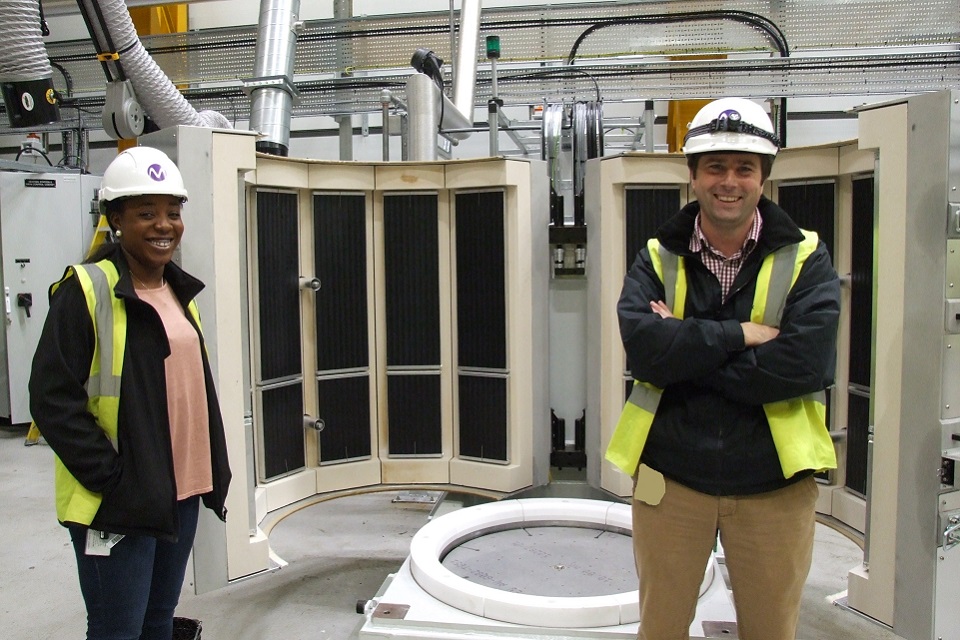
Rob Goodwill, Magnox Ltd Senior Project Manager, and Tomi Ashiru-Balogun, Magnox Ltd Senior Project Engineer in front  Advanced Vacuum Drying System (AVDS) at Dungeness A nuclear site
Rob Goodwill, Magnox Ltd Senior Project Manager, and Tomi Ashiru-Balogun, Magnox Ltd Senior Project Engineer in front Advanced Vacuum Drying System (AVDS) at Dungeness A nuclear site

Steve Batchelor, Programme Delivery Manager at Dungeness A site, said:

AVDS offers us a safe, efficient and low-cost solution to treating Dungeness A’s ILW.

The whole process of building, installing and commissioning the AVDS has been recorded and made available as a time-lapse sequence.

Time lapse video of Advanced Vacuum Drying System (AVDS) Dungeness A