Press release: Fish stocks boost for north east rivers

The Environment Agency has released 12,000 young grayling to give fish stocks a boost in north east rivers.

The fish were released this week into the rivers Deerness, Browney, Blyth and Skerne as well as Langley Beck at Staindrop and Aldbrough Beck near Darlington.

It’s part of the Environment Agency’s ongoing plans to develop and restore rivers in the region, targeting those which have been affected by pollution or where barriers affect fish passage.

The fish were reared at the Environment Agency’s fish farm near Calverton, Nottinghamshire, using funding from rod licence sales.

Help the process of natural recovery

Fisheries Officer Paul Frear was out releasing some of the grayling in the south of the region on Tuesday (1 August). He said:

We’re pleased we can provide these fish for restocking as part of our commitment to rod licence paying anglers and to help the process of natural recovery in waters which have been impacted by pollution or suffered poor water quality.

While it’s a really important aspect of our work, it’s one of many things we do together with our partners to develop fisheries, including reducing the effects of pollution, improving habitat and removing barriers to fish migration.

Grayling released into Langley Beck

Improved water quality

The Environment Agency releases fish into our waterways regularly. Fisheries officers target fish stocking activity in response to impacts on local rivers and using data from national fish surveys to identify where there are problems with poor breeding and survival.

Many of our industrialised rivers have improved dramatically in water quality in the last 30 years and targeted and appropriate restocking has helped the restoration of natural fish stocks and viable fisheries.

Angling is a great way for everyone to keep healthy and enjoy the natural environment. All rod licence income is used to fund work to protect and improve fish stocks and fisheries.

Anyone who wants to go fishing needs to buy a fishing licence. A full annual licence costs £30 (short term and some concessionary licences are also available) and are available online.


Press release: Anglers urged to report pink salmon catches

Recently a non-native pink salmon was caught in the River Tyne at Wylam and around 100 are believed to have been caught in waters off the North East and Yorkshire coast in recent months.

Further afield, anglers have confirmed catches in a number of rivers in Scotland and in western Ireland.

The Environment Agency is collecting vital data about sightings so officers can monitor the situation to determine any impact on the local environment and species. Data collected will help the Environment Agency, fisheries researchers and other organisations with an interest in fisheries management in the United Kingdom, Ireland and Scandinavia, better understand how to manage the arrival of pink salmon in the UK .

Unusual find

Jonathan Shelley from the Environment said:

It is quite unusual to find pink salmon in our waters and we’re keen anglers know we’re aware of the sightings and we’re investigating.

I’d urge anglers to contact us if they see any non-native salmon in the waters, with a date, location and if possible a photograph, which would really help us identify them and build up a picture of where they are.

We are monitoring the situation and early indications is that there is no major impact on wild fish stocks at this point in time.

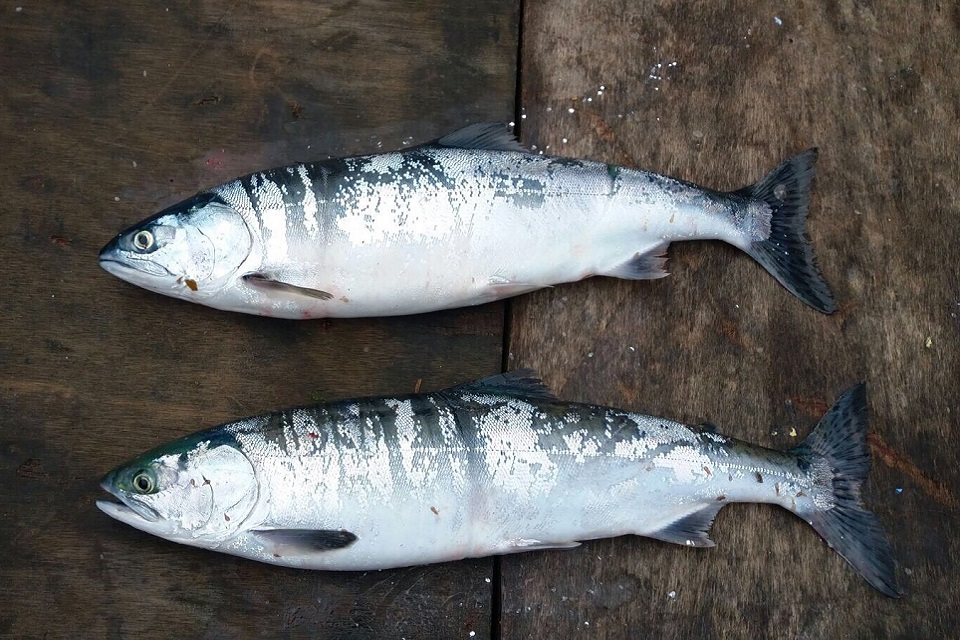
The non-native pink salmon
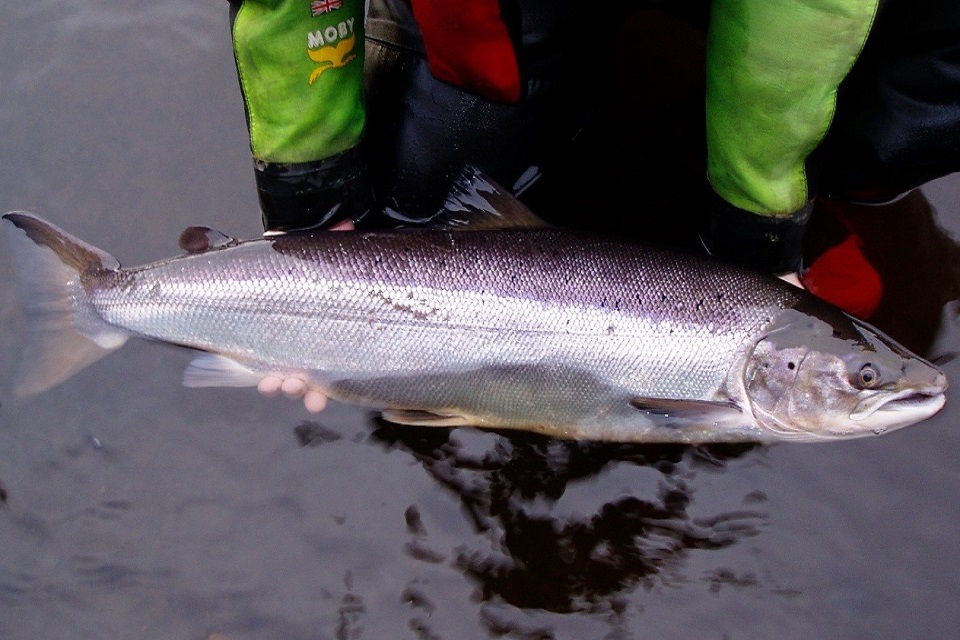
The native Atlantic salmon

Advice for anglers

Anglers holding a salmon licence who catch pink salmon are asked not to return the fish to the water. Instead they are asked to dispatch of them humanely and, if possible, make the fish available to the Environment Agency for inspection and further analysis.

If this is not possible, they are asked to send a sample of the scales. Trout and coarse anglers are asked to call the Environment Agency on 0800 80 70 60, if unsuccessful please return the salmon.

Pink salmon (Onchorhyncus gorbuscha), also known as humpback salmon, originate from the northern Pacific Ocean.

Millions were stocked in the White Sea region of north Russia from the 1950’s until 2003 to develop a net fishery. As a result, some have established self-sustaining populations in rivers in Russia, Finland and northern Norway. This is the most likely origin of the pink salmon recently caught in the UK and Ireland.

Anyone with information is asked to contact the North East environmental monitoring team on 0800 807060 or email jonathan.shelley@environment-agency.gov.uk

How to identify a pink salmon:

  • Large black oval spots on the tail
  • Bluish back, silver flanks and white belly
  • Much smaller scales than an Atlantic salmon of the same size
  • Very dark mouth and tongue
  • 40-60cm in length
  • Breeding males develop a distinctive hump

In contrast, the native Atlantic salmon typically:

  • Have no spots on the tail
  • Usually larger (up 110cm in length)
  • Pale mouth and tongue
  • Larger scales
  • One or two black spots on the gill cover
  • Spots on the back above the lateral line
  • Thicker base of tail than a pink salmon


Press release: Anglers urged to report pink salmon catches

Recently a non-native pink salmon was caught in the River Tyne at Wylam and around 100 are believed to have been caught in waters off the North East and Yorkshire coast in recent months.

Further afield, anglers have confirmed catches in a number of rivers in Scotland and in western Ireland.

The Environment Agency is collecting vital data about sightings so officers can monitor the situation to determine any impact on the local environment and species. Data collected will help the Environment Agency, fisheries researchers and other organisations with an interest in fisheries management in the United Kingdom, Ireland and Scandinavia, better understand how to manage the arrival of pink salmon in the UK .

Unusual find

Jonathan Shelley from the Environment said:

It is quite unusual to find pink salmon in our waters and we’re keen anglers know we’re aware of the sightings and we’re investigating.

I’d urge anglers to contact us if they see any non-native salmon in the waters, with a date, location and if possible a photograph, which would really help us identify them and build up a picture of where they are.

We are monitoring the situation and early indications is that there is no major impact on wild fish stocks at this point in time.

The non-native pink salmon

The native Atlantic salmon

Advice for anglers

Anglers holding a salmon licence who catch pink salmon are asked not to return the fish to the water. Instead they are asked to dispatch of them humanely and, if possible, make the fish available to the Environment Agency for inspection and further analysis.

If this is not possible, they are asked to send a sample of the scales. Trout and coarse anglers are asked to call the Environment Agency on 0800 80 70 60, if unsuccessful please return the salmon.

Pink salmon (Onchorhyncus gorbuscha), also known as humpback salmon, originate from the northern Pacific Ocean.

Millions were stocked in the White Sea region of north Russia from the 1950’s until 2003 to develop a net fishery. As a result, some have established self-sustaining populations in rivers in Russia, Finland and northern Norway. This is the most likely origin of the pink salmon recently caught in the UK and Ireland.

How to identify a pink salmon:

  • Large black oval spots on the tail
  • Bluish back, silver flanks and white belly
  • Much smaller scales than an Atlantic salmon of the same size
  • Very dark mouth and tongue
  • 40-60cm in length
  • Breeding males develop a distinctive hump

In contrast, the native Atlantic salmon typically:

  • Have no spots on the tail
  • Usually larger (up 110cm in length)
  • Pale mouth and tongue
  • Larger scales
  • One or two black spots on the gill cover
  • Spots on the back above the lateral line
  • Thicker base of tail than a pink salmon


Notice: LN5 0AS, Patrick Dean Limited: environmental permit issued

The Environment Agency publish permits that they issue under the Industrial Emissions Directive (IED).

This decision includes the permit and decision document for:

  • Operator name: Patrick Dean Limited
  • Installation name: Boothby Heath Farm
  • Permit number: EPR/BT4150IX/V004


News story: Reducing the use of animals in research: apply for SBRI funding

The National Centre for the Replacement, Refinement and Reduction of Animals in Research (NC3Rs) plus sponsors will invest in collaborative projects that address some of the challenges posed by animal experiments.

This is designed to:

  • minimise the use of animals in research
  • support the development of marketable products
  • improve business processes

Collaborations are encouraged between industry, research organisations and small to medium-sized enterprises (SMEs).

What you need to know

The centre is launching 3 challenges as part of its Crack It initiative.

DARTpaths

This challenge aims to develop an effective data strategy and data management structure to map the developmental and reproductive toxicity (DART) genes of different species. You should compare the effects of toxic compounds across species.

It is in 2 phases. There is up to £100,000 for phase 1. Phase 2 has funding of up to £1 million. Shell and Syngenta are the sponsors.

Dosing for controlled exposure (DoCE)

This challenge aims to improve dosing methods and strategies for in vitro dose-responses and to encourage their uptake, application and use in risk-based decision making. This could offer the potential to eventually replace the need for in vivo animal studies.

It is in 2 phases. There is up to £100,000 for phase 1. Phase 2 has funding of up to £1 million. Unilever and Shell are the sponsors.

RespiraTox

In this challenge the aim is to develop a model that reliably predicts human respiratory irritation to chemicals. It should use in silico-based tools.

This is a single-phase competition. Up to £100,000 is available. The competition is sponsored by Shell.

The background

NC3Rs is an independent scientific organisation that supports the UK science base to find alternative applications to the use of animals in research and improve welfare.

This competition is being run through the Small Business Research Initiative (SBRI).

Competition information

  • the competition opens on 11 September 2017
  • there are different deadlines depending on the competition you are applying into. These are:
    • 8 November 2017 at midday for the 2-phase DARTpaths and DoCE challenges
    • 15 November 2017 at midday for the single-phase RespiraTox challenge
  • there will be a launch event on 7 September 2017 to find out more. You will need to register for the event