Speech: Nerve agent attack in Salisbury, Wiltshire: UK statement to the OSCE, 12 April 2018

Mr Chairman,

A month ago, on 15 March, I tabled at the Permanent Council the attack in Salisbury, Wiltshire, involving an undeclared, Russian developed nerve-agent.

As a courtesy to participating States, I would like to update the Council on this attempted assassination that left Sergey Skripal, his daughter Yulia and a British police officer hospitalised and in a critical condition.

Thankfully DS Bailey has now been discharged from hospital and the Skripals’ health is improving.

A painstaking and thorough UK investigation continues, working to identify the individuals involved in carrying out this attack and to establish potential criminal liability under the UK’s 1996 Chemical Weapons Act.

In accordance with the Chemical Weapons Convention, the Organisation for the Prohibition of Chemical Weapons (OPCW) deployed a team to the UK to collect environmental samples and to observe the taking of biomedical samples. These samples were sent to independent OPCW designated laboratories for analysis, in order to confirm the identity of the chemical involved.

The OPCW has now finalised its report, distributed it to States Parties of the Chemical Weapons Convention, and published its Executive Summary of that report. I quote:

  • the results of analysis of biomedical samples…demonstrate the exposure of the three hospitalised individuals to this toxic chemical

  • the results of analysis of environmental samples….confirm the presence of this toxic chemical

  • the results of analysis…confirm the findings of the United Kingdom relating to the identity of the toxic chemical

and:

  • the toxic chemical was of high purity

The name and structure of that identified toxic chemical is contained in the full classified report to States Parties.

Mr Chairman, I will remind the Council of the reasons for the UK government’s conclusion that it was highly likely that the Russian State was culpable for this attack. These include:

  • identification of the Russian-developed nerve agent
  • the knowledge that the Russian Federation has produced this undeclared agent within the last 10 years, retains the capability to produce it and has investigated ways of delivering nerve agents, it is likely, for use in assassinations
  • Russia’s record of state sponsored assassinations
  • statements, including by the Russian President, indicating that certain people are seen as legitimate targets

Also for clarity, and for the benefit of our Russian colleagues, I will explain why we use the phrase ‘highly likely’. This is because in the UK it is for a Court of Law to deliver a final verdict on responsibility for a criminal offence.

The use of an illegal nerve agent in a British city was a reckless act carried out without regard to the indiscriminate public health consequences. The UK has repeatedly asked the Russian Federation for a credible explanation of how a nerve agent came to be used on the streets of Salisbury, and to disclose the Novichok programme to the OPCW.

What happened in Salisbury contravenes every rule in the international book, including the Chemical Weapons Convention and the fundamental tenets of the OSCE. This was a premeditated attack on the international rules-based order, and therefore, a challenge to us all.

Mr Chairman, this organisation knows better than any other about a pattern of Russian behaviour that seeks to undermine stability and democracy in our region in violation of international commitments and contrary to the principles of co-operation and common security. This is a pattern of disregard for sovereignty and territorial integrity, of attempts to damage the integrity of democratic institutions and the cohesion of democratic society, of cyber-attacks and of industrial scale disinformation that cynically seeks to mislead, distract and confuse.

I wish to thank so many colleagues and partners for the support of their capitals over the past few weeks. The strength of international reaction to what happened in Salisbury – including the largest expulsion of Russian intelligence operatives in history – sends a message that states are ready to stand up for shared principles and for common security; that attempts to undermine our region’s stability and security have costs; that enough is enough.

Mr Chairman, on 15 March our distinguished Russian colleague asked ‘who benefits’?

The answer is clear: no-one benefits. Not the people of Salisbury, who have faced serious risk and disruption. Not the UK government, dealing with the unprecedented use of an illegal nerve agent on British soil. Not the Russian people. Nor even, I would suggest, the Russian state, unprepared for the strength and resolve of the international reaction.

I do not believe any state seeks or enjoys confrontation with Russia or wants to throw away relationships and co-operation developed here and elsewhere over the past 30 years. Our challenge in the OSCE is to persuade our Russian colleagues to break the present cycle of disruption and destabilisation, and to rebuild trust through a return to respect for shared commitments.
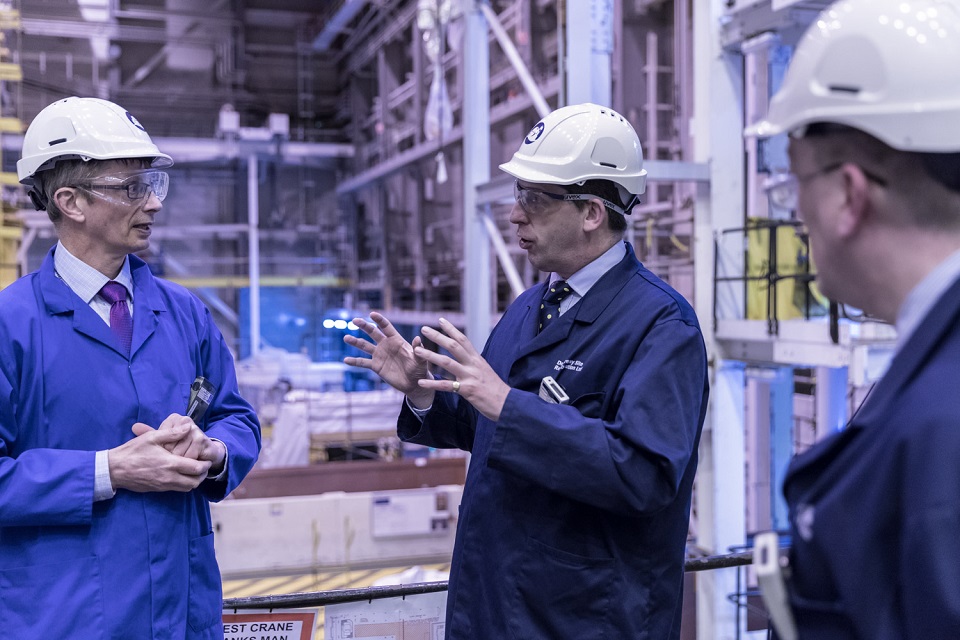


News story: Lord Duncan learns of challenges and opportunities at Dounreay

Lord Duncan travelled to Caithness to learn more about work on Scotland’s largest nuclear clean-up and demolition project. Located in the far north of Scotland, Dounreay employs around 1,200 staff and a similar number of people through the supply chain.

From the mid-1950s, Dounreay was the UK’s centre of research into fast reactors until 1994. The experimental nature of these now-redundant facilities, poses some complex decommissioning challenges that continue to require technological innovation and excellence.

Lord Duncan visits Dounreay Prototype Fast Reactor (PFR) and Dounreay

The NDA spends more than £177 million a year to decommission Dounreay. A significant part of this is spent in the local economy. NDA works in partnership, through the Caithness and North Sutherland Regeneration Partnership (CNSRP), to support the local community and manage the impact of the future closure of the Dounreay nuclear site.

On learning more about the challenges and opportunities faced at the site and in the local communities, Lord Duncan said:

It was fascinating to see first-hand the decommissioning of Dounreay and meet the men and women behind the work.

I was impressed with the site’s commitment to safety, as well as the considerable investment the Nuclear Decommissioning Authority and Dounreay are making in the local community.

Introduction to Dounreay


News story: Lord Duncan learns of challenges and opportunities at Dounreay

Lord Duncan travelled to Caithness to learn more about work on Scotland’s largest nuclear clean-up and demolition project. Located in the far north of Scotland, Dounreay employs around 1,200 staff and a similar number of people through the supply chain.

From the mid-1950s, Dounreay was the UK’s centre of research into fast reactors until 1994. The experimental nature of these now-redundant facilities, poses some complex decommissioning challenges that continue to require technological innovation and excellence.

Lord Duncan visits Dounreay Prototype Fast Reactor (PFR) and Dounreay

The NDA spends more than £177 million a year to decommission Dounreay. A significant part of this is spent in the local economy. NDA works in partnership, through the Caithness and North Sutherland Regeneration Partnership (CNSRP), to support the local community and manage the impact of the future closure of the Dounreay nuclear site.

On learning more about the challenges and opportunities faced at the site and in the local communities, Lord Duncan said:

It was fascinating to see first-hand the decommissioning of Dounreay and meet the men and women behind the work.

I was impressed with the site’s commitment to safety, as well as the considerable investment the Nuclear Decommissioning Authority and Dounreay are making in the local community.

Introduction to Dounreay


Press release: Minister for Human Rights visits the Occupied Palestinian Territories and Israel

I have just returned from my first official visit to the Occupied Palestinian Territories (OPTs) and Israel.

I was pleased to meet Palestinians in East Jerusalem, Hebron, and Abu Nuwar Bedouin Community in Area C of the West Bank. I heard from human rights defenders about the impact of Israel’s occupation and saw the assistance that UK aid is providing to some of the most vulnerable in Palestinian society. I had a positive first meeting with Prime Minister Hamdallah to discuss these issues, the situation in Gaza and reaffirm the UK’s commitment to strengthening the UK-Palestinian Authority relationship. In my role as Minister for Human Rights, including the right to freedom of religion or belief, I met with the Palestinian Minister for Religious Affairs Youssef Ideiss, and hosted an interfaith roundtable.

In Israel, I was humbled to attend the State Opening Ceremony for Holocaust Martyrs and Heroes Remembrance Day at Yad Vashem. I had constructive meetings with Israeli ministers Tzachi Hanegbi and Ayelet Shaked, re-affirming the UK’s commitment to our bilateral relationship with Israel, and raising our human rights concerns relating to the occupation, including the issue of Palestinian children in Israeli military detention. I also met with Israeli companies working on counter terrorism technologies, to discuss what more we can do together to prevent terrorist use of the internet.

I remain deeply concerned about the situation in Gaza, and in particular by the high number of Palestinian deaths in recent weeks. With the Palestinian leadership I reaffirmed the right of the Gazan people, as indeed all peoples, to protest peacefully. It is important to understand the role Hamas continues to play in fomenting the violence. The UK recognises that Israel has the right to protect its borders against Hamas and other terrorist groups but as I said to Israeli Ministers, they must show restraint and consider carefully its use of force in response to future protests.

In my engagement with both Israelis and Palestinians I stressed the importance of addressing the underlying causes of the economic and humanitarian situation, and in particular to improve movement and access for people and goods.

My visit illustrated the urgent need for progress towards a two-state solution, so that Israelis and Palestinians can finally live with the peace and dignity they deserve.


News story: 2018 Clinical Excellence Awards round closed

The 2018 National Clinical Excellence Awards round closed at 5pm on Thursday 12 April 2018.

ACCEA will review and score all applications and announce results at the end of the year.

New awards will be backdated to 1 April 2018. Renewals will be renewed from 1 April 2019. Unsuccessful renewals will cease on 31 March 2019.

As in previous years, we will publish personal statements for successful applications.