Press release: Coal Authority calls for full consideration of legacy issues

The Coal Authority has today called for local authority planners, surveyors, developers and geotechnical and engineering consultants to ensure coal mining legacy issues are considered in light of their findings from a recent subsidence event in north-east England.

The government body, which manages the effects of past coal mining across Britain, said it had issued the information to share its early recommendations.

Initial ground investigations were undertaken at a housing development in North Tyneside by the Coal Authority in July 2016, after it was contacted by the National House Building Council in relation to an extensive area of subsidence. It has since carried out further extensive ground investigations, including underground camera and laser void surveys, to identify the root cause of the subsidence, and installed 300 survey points above and below the ground to monitor for ground and property movement.

The Coal Authority’s ground investigations revealed coal mine workings at a depth in excess of 30 metres. These dated back around 120 years and had not been recorded on the historical mining plans held for the former colliery for this specific area.

The ground investigations proved this specific area had been extensively worked with extraction rates at over 70%, however the plans had showed an area of solid coal. Recorded workings adjacent to this area had typical extraction rates of between 45% and 50%.
This high level of extraction resulted in narrow residual supporting coal pillars and wide extraction rooms in the High Main coal seam, leading to compression on the remaining coal pillars and roof instability. This, together with a fractured sandstone layer above the coal seam, resulted in an underground collapse and subsequent movement at the surface that affected 35 properties on an estate and had an elliptical subsidence zone footprint of around 150 metres x 70 metres.

Coal Authority engineers designed a solution to stabilise the ground, and work to drill and grout the voids has been completed. Ground monitoring will continue to ensure the ground is stable for redevelopment.
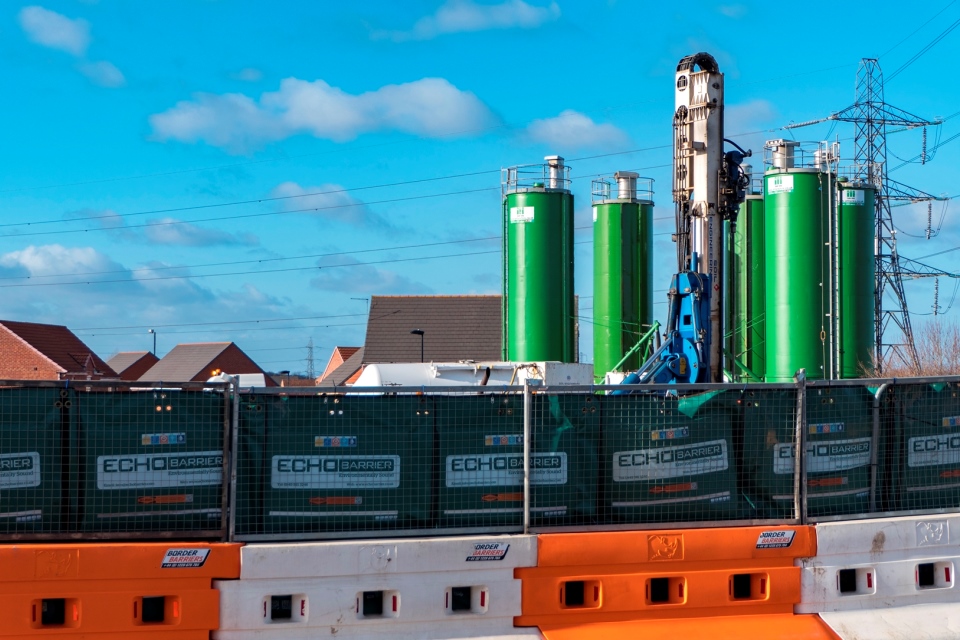
Drilling and grouting operations, and noise reducing acoustic fencing

Simon Reed, Chief Operating Officer, Coal Authority, said:

“We have released our initial recommendations to ensure there is awareness of the risks posed by historical coal mining legacy, in light of our findings from this recent subsidence event.

“In this instance, given the depth and age of the workings, and knowledge about risks of subsidence at the time, we cannot criticise the developer’s approach taken with respect to these mining circumstances, but we must now build on this new knowledge to address these risks better moving forward.

“This was an area of unrecorded mine workings and caution must be adopted in assuming that the absence of a record means the absence of mining. Although our historic plans did not, in this case, reveal the coal workings they are a vital part of any site assessment prior to development, therefore in future we may ask for more information, or for more works to take place, to reduce the likelihood of a similar subsidence event happening again.”

The Coal Authority expects to release further information in the form of a Technical Guidance Note later this year, after works are completed and following a period of monitoring.

Information issued by the Coal Authority

Historic mining plans are invaluable but don’t always give a true representation of the coal workings underground, meaning:

  • areas mined may vary from those shown on historical plans
  • extraction rates may vary from those shown on historical plans
  • plans held in historical records may not be the final abandonment plan for the seams and the mine
  • not all historical coal workings are recorded

Both desk-based research and ground investigations should be undertaken to confirm the:

  • potential for unrecorded shallow workings
  • accuracy of the shallow coal old working plans
  • competence of the strata overlying the coal
  • potential effects of groundwater, including assessment of recovering levels post mining which are still taking place today

The 10 times rock cover guidance outlined in CIRIA SP32* is only ‘a rule of thumb’:

  • in this case, the coal was at a depth that exceeded the 10 times rock cover
  • appropriate ground investigations should always be undertaken to confirm site specific conditions and local geology also needs to be considered

*Special Publication 32

Coal Authority press office

Communications Team
200 Lichfield Lane
Mansfield
Nottinghamshire
NG18 4RG


Press release: Events to spread the word about Hull’s £42m tidal flood scheme

Hull residents and businesses are being invited to learn more about a multi-million scheme to protect thousands of properties from flooding from the Humber at two events this month (May).

They will be held at Mr Chu’s Chinese Restaurant in St Andrew’s Quay Retail Park on Tuesday 15th May and Victoria Dock Village Hall on Wednesday 16 May. Visitors can drop-in anytime between 1-7pm.

Representatives from the Environment Agency and contractors BMM JV
will be on hand to discuss plans for the £42million Humber Hull Frontage Improvement Scheme which will improve flood protection to 113,000 properties in Hull.

Following on from an event at the Guildhall last month, this will be a chance for people to discuss plans for these areas in more detail.

Led by the Environment Agency, the Humber Hull Frontage Improvements Scheme presents an opportunity to improve 7-8 kilometres of tidal flood defences at various sites along the Humber Estuary frontage to better protect homes and businesses that are at risk of flooding.

Subject to planning approval, work on the Humber Hull Frontage Improvements scheme will start in late summer and will be complete by the end of 2020.

Project contractor BMM JV – a joint venture between BAM Nuttall and Mott MacDonald – will be sharing early designs and plans which will build resilience along the city’s 19 kilometre waterfront.

Helen Tattersdale, project manager at the Environment Agency, said:

These two drop-in sessions follow one we held at The Guildhall last month to share our plans. We want to make sure as many residents as possible are aware of what is being proposed and we’re keen to get feedback from them.

Our team is ready to answer any queries residents of business owners may have about what work needs to be done to better protect the city from flooding from the Humber Estuary.

In recent years we have seen the impact tidal flooding can cause and it is vital for the city to have improved flood defences to ensure devastating flooding like that which resulted from the December 2013 tidal surge is few and far between.

Improvements in Hull will be supported by a further four kilometres (2.5 mile) of new and raised tidal defences on either side of the city in the East Riding of Yorkshire, at Hessle and Paull, delivered by East Riding of Yorkshire Council in partnership with the Environment Agency.

The Humber Hull Frontage Improvement Scheme is one of a number of tidal flood alleviation projects that form part of the Humber Flood Risk Management Strategy. The Environment Agency and local partners are now in the process of developing an advanced approach to managing flooding in tidal areas by the Humber for the next 100 years.

It will be a long-term investment that will contribute to securing the viability of Hull and the wider Humber region, ensuring it retains its place as the eastern gateway to the UK economy.


Press release: Events to spread the word about Hull’s £42m tidal flood scheme

Hull residents and businesses are being invited to learn more about a multi-million scheme to protect thousands of properties from flooding from the Humber at two events this month (May).

They will be held at Mr Chu’s Chinese Restaurant in St Andrew’s Quay Retail Park on Tuesday 15th May and Victoria Dock Village Hall on Wednesday 16 May. Visitors can drop-in anytime between 1-7pm.

Representatives from the Environment Agency and contractors BMM JV
will be on hand to discuss plans for the £42million Humber Hull Frontage Improvement Scheme which will improve flood protection to 113,000 properties in Hull.

Following on from an event at the Guildhall last month, this will be a chance for people to discuss plans for these areas in more detail.

Led by the Environment Agency, the Humber Hull Frontage Improvements Scheme presents an opportunity to improve 7-8 kilometres of tidal flood defences at various sites along the Humber Estuary frontage to better protect homes and businesses that are at risk of flooding.

Subject to planning approval, work on the Humber Hull Frontage Improvements scheme will start in late summer and will be complete by the end of 2020.

Project contractor BMM JV – a joint venture between BAM Nuttall and Mott MacDonald – will be sharing early designs and plans which will build resilience along the city’s 19 kilometre waterfront.

Helen Tattersdale, project manager at the Environment Agency, said:

These two drop-in sessions follow one we held at The Guildhall last month to share our plans. We want to make sure as many residents as possible are aware of what is being proposed and we’re keen to get feedback from them.

Our team is ready to answer any queries residents of business owners may have about what work needs to be done to better protect the city from flooding from the Humber Estuary.

In recent years we have seen the impact tidal flooding can cause and it is vital for the city to have improved flood defences to ensure devastating flooding like that which resulted from the December 2013 tidal surge is few and far between.

Improvements in Hull will be supported by a further four kilometres (2.5 mile) of new and raised tidal defences on either side of the city in the East Riding of Yorkshire, at Hessle and Paull, delivered by East Riding of Yorkshire Council in partnership with the Environment Agency.

The Humber Hull Frontage Improvement Scheme is one of a number of tidal flood alleviation projects that form part of the Humber Flood Risk Management Strategy. The Environment Agency and local partners are now in the process of developing an advanced approach to managing flooding in tidal areas by the Humber for the next 100 years.

It will be a long-term investment that will contribute to securing the viability of Hull and the wider Humber region, ensuring it retains its place as the eastern gateway to the UK economy.


News story: Measles outbreaks across England

Latest update

Between 1 January 2018 and 6 July 2018 there have been 757 laboratory confirmed measles cases in England. Cases were reported in most areas with London (268), the South-East (161), South-West (118), West Midlands (85) and Yorkshire and Humberside (73) reporting the most cases (based on provisional figures).

Previous updates

1 June 2018

Between 1 January 2018 and 31 May 2018 there have been 587 laboratory confirmed measles cases in England. Cases were reported in most areas with London (213), the South-East (128), West Midlands (81), South-West (62), and Yorkshire and Humberside (53) reporting the most cases (based on provisional figures).

11 May 2018

Between 1 January 2018 and 9 May 2018 there have been 440 laboratory confirmed measles cases in England, with London (164), the South-East (86), West Midlands (78), South-West (42) and West Yorkshire (37) reporting the most cases.

The increase in measles circulation is mainly associated with travel to and from Europe where there are large ongoing measles outbreaks.

Young people and adults aged 15 and over who missed out on MMR vaccine when they were younger and some under-vaccinated communities have been particularly affected.

Measles is a highly infectious viral illness that can sometimes lead to serious complications and can be fatal in very rare cases.

Anyone who has not received 2 doses of MMR vaccine is at risk, but young people in environments with close mixing such as festivals are more at risk, as well as unvaccinated people travelling to Romania and Italy, where there are currently large outbreaks. Anyone planning to travel to Europe should check NaTHNaC travel health advice.

PHE local health protection teams are working closely with the NHS and local authorities to raise awareness with health professionals and local communities.

The MMR vaccine is available to all adults and children who are not up to date with their two doses.

Anyone who is not sure if they are fully vaccinated should check with their GP practice who can advise them.

Dr Mary Ramsay, Head of Immunisation at PHE, said:

The measles outbreaks we are currently seeing in England are linked to ongoing large outbreaks in Europe. The majority of cases we are seeing are in teenagers and young adults who missed out on their MMR vaccine when they were children.

Anyone who missed out on their MMR vaccine in the past or are unsure if they had 2 doses should contact their GP practice to catch-up.

This serves as an important reminder for parents to take up the offer of MMR vaccination for their children at 1 year of age and as a pre-school booster at 3 years and 4 months of age.

We’d also encourage people to ensure they are up to date with their MMR vaccine before travelling to countries with ongoing measles outbreaks.

The UK recently achieved WHO measles elimination status and so the overall risk of measles to the UK population is low, however, we will continue to see cases in unimmunised individuals and limited onward spread can occur in communities with low MMR coverage and in age groups with very close mixing.


Press release: £9.5 million Ulverston flood scheme officially opened by the Environment Agency

More than 500 homes and businesses in Cumbria will be better protected from flooding thanks to a new £9.5 million scheme completed by the Environment Agency.

The Town Beck Flood Alleviation Scheme in Ulverston, Cumbria, will reduce flood risk to more than 400 homes and more than 100 businesses, as well as critical tourism infrastructure. A maze of underground water channels (culverts) under the houses, roads and carparks in the town centre have been repaired and/or replaced using innovative techniques and flood defences have been constructed.

Emma Howard Boyd, Chair of the Environment Agency, officially opened the scheme, and said:

Cumbrian communities know well the devastation that flooding can cause. The Town Beck flood defence will better protect 500 homes and businesses in Ulverston and support England’s tourist economy by improving protection for the railway that leads to the Lake District.

To achieve this, the Environment Agency has worked closely with local residents, Network Rail, United Utilities and the Council. It’s a brilliant example of how partnership working benefits people, the national economy and the natural environment.

Town Beck lies within a steep catchment and predominantly runs underground through the town centre. The new scheme consists of a number of sections throughout the town centre including raising existing flood defence walls, installing new floodgates, repairing and refurbishing the underground water channels (culverts), and building a swale in the natural flood plain to ensure that there is no increase to flood risk in South Ulverston. A new wildflower meadow has also been created as part of the scheme, boosting biodiversity and improving the local environment.

Much of the scheme is underground, so different construction techniques known as ‘trenchless technologies’ were used. In some cases Environment Agency contractors installed reinforced plastic sleeves to repair pipes – or worked underground wearing specialist breathing apparatus to spray concrete on the inside of the culvert for extra strength.

While this means some of the work isn’t visible, it avoided diverting major services – such as gas, water and electric – and allowed construction without having to dig up the road, avoiding unnecessary disruption to residents while the scheme was underway.

Alternative repair techniques were also used to speed up the completion of the project and to reduce disruption to the town. The potential option for the construction of a flood storage reservoir was replaced with an additional large pipe which runs through the railway embankment and a drainage channel to connect to the flood plain.

The scheme will provide a significant improvement in the standard of protection for the area, which has been affected by flooding several times in recent years – most recently in 2009 and in 2012.

Led by the Environment Agency, the project received strong support from partner organisations including Cumbria County Council, South Lakeland District Council, Network Rail and United Utilities, who provided more than £1 million of contributions towards the development.

Similarly, close links to Ulverston Town Council and local community groups have been vital to minimising the disruption to the Cumbrian town, which has many small to medium businesses and is heavily reliant on the tourist economy.

Adrian Lythgo, Chair of the North West Regional Flood and Coastal Committee said:

The Town Beck Flood Alleviation Scheme is a great example of how such important work can be completed with little disruption to a town so heavily reliant on the tourist trade.

Often people don’t know a river is running beneath their feet or property and could cause such devastating results if flooded. This project has delivered a value for money, quality scheme which I am delighted that the North West Flood and Coastal Committee has supported.

The project was shortlisted for its innovative ways of working at the 2018 ICE North West Civil Engineers Awards.