Press release: Highways England releases first sections of updated road design manual

Highways England today paved the way for improved road building with the much anticipated release of the first suite of new design standards.

The publication of the first sections of the new ‘Design Manual for Roads and Bridges’ (DMRB) will ensure roads are designed, built and maintained to the very highest and safest standards.

Accepted as the cornerstone of the delivery and management of motorway and all-purpose trunk roads across the UK, and a respected document worldwide, the DMRB was first published in 1992.

Highways England, the Government company responsible for maintaining, operating and improving the country’s motorways and major A roads, is currently updating it to make it clearer, more consistent and easier to understand and implement. The update puts design requirements at its core and it will also make it easier to incorporate developments in design best practice. This will result in greater efficiency and innovation throughout the lifecycle of the assets, fewer departures from the requirements, and reduced time and associated cost.

Highways England Chief Highway Engineer, Mike Wilson said:

“This is an exciting time for the highways sector as we continue to successfully deliver the record £15bn investment in roads. The updated DMRB documents mark a historic moment for the design of the UK’s motorways and major A-roads.

“I would like to thank the Devolved Administrations and our supply chain who have supported this significant review, which will ensure our roads are designed, built and maintained to the very highest, safest standards for the millions of drivers that use these roads every day.”

The first four documents of the updated “Design Manual for Roads and Bridges” (DMRB) are:

  • Introduction to the Design Manual for Roads and Bridges
  • Requirements for safety risk assessment
  • Use of Compressive Membrane Action in Bridge Decks
  • Management of Corrugated Steel Buried Structures

Experts at Highways England began the task of updating the complete suite of over 350 documents and associated interim advice notes (IANs) that make up the manual in April 2017 with the review due for completion by March 2020. This is a specific requirement of the Protocol attached to the Highways England Licence as part of the Government’s Road Investment Strategy.

Changes in the updated document include:

  • a new structure of the volumes to be aligned to asset life-cycle stages, from appraisal to design up to disposal
  • new numbering systems of documents reflecting the relevant asset life-cycle stage and the specific discipline covered by the document
  • new style of individual clauses to make a clear distinction between requirements and advisory material
  • incorporation of interim advice notes (IANs) into the DMRB as relevant
  • consolidation of DMRB ‘A’ (advisory) documents with related ‘D’ (design) documents
  • introduction of National Application Annexes attached to the DMRB to cover the specific requirements of the Overseeing Organisations

Several leading UK consultants have supported Highways England with the update, and a new set of drafting rules has been used, which follows best practice from national and international standardisation organisations.

The updated DMRB supports Highways England’s “The road to good design” vision.

The DMRB re-drafting is being completed using a revolutionary online authoring tool purposefully built for the refresh of the document. This signals an important move to digital technology and unlocks the potential of digital innovations.

The updated DMRB documents will be released in phases with completion due by March 2020.

General enquiries

Members of the public should contact the Highways England customer contact centre on 0300 123 5000.

Media enquiries

Journalists should contact the Highways England press office on 0844 693 1448 and use the menu to speak to the most appropriate press officer.


Press release: Glebe Quarry Ltd AKA 1st Call Skips fined for supplying contaminated waste

A Cornish waste disposal company has been ordered to pay £26,500 in fines and costs for illegally handling and disposing of hazardous waste.

Glebe Quarry Limited was also ordered to pay £17,000 compensation to a local farmer after waste contaminated with asbestos was dumped on his land. The case was brought by the Environment Agency.

The company, which trades as 1st Call Skips, operates a permitted waste transfer station at Glebe Quarry near Roche, St Austell. On 6 December 2017, the company pleaded guilty to 5 separate offences at Truro Crown Court.

The offences occurred at 3 sites in Cornwall, including the company’s own waste transfer station, a nearby farm and a site operated by the china clay company, Imerys.

The Environment Agency had earlier advised the company to improve Glebe Quarry after the drainage and concreting at the site was checked and found to be ‘inadequate’. No action was taken so the Environment Agency issued an enforcement notice requesting that improvements works be carried out.

Glebe Quarry Limited appealed, but the appeal was dismissed by the Planning Inspectorate; forcing the company to carry out the improvements that were finally completed in November 2016.

Further checks by the Environment Agency revealed the company had unlawfully dumped more than 2,400 tonnes of waste, some of which was contaminated with asbestos, on land which wasn’t authorised by their site permit. Glebe Quarry Limited continued illegally dumping waste at the site despite being warned they would be committing an offence if they carried on.

In 2015, the defendant also sent waste to Imerys Minerals Ltd with waste that should have been suitable for land improvements for restoring an area of china clay spoil heaps. However, it was later found to be contaminated with asbestos.

The asbestos was discovered before the waste was spread and the loads were returned to Glebe Quarry. Nearly 50 tonnes of hazardous material was removed by Glebe Quarry Limited but was never traced as no paperwork was kept.

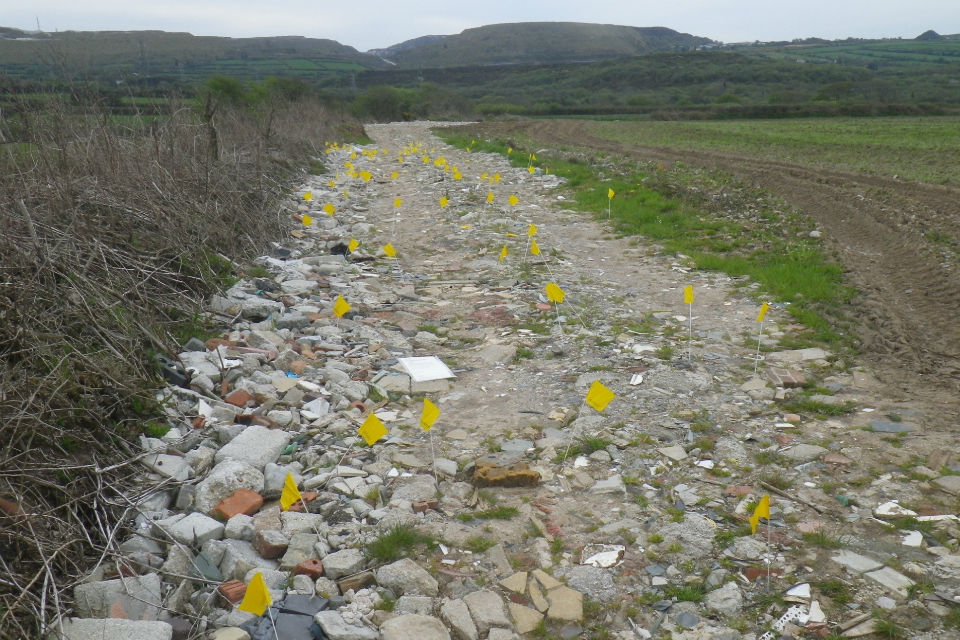
Glebe Quarry Limited also supplied waste to local farms for use in low-risk activities such as the construction of farm tracks. This was done under an exemption which is an agreement that doesn’t require a permit. The waste supplied to one farm was heavily contaminated with asbestos and cost nearly £120,000 to clean-up.

A farm track made of rubble and littered with little yellow flags
Each yellow flag in this farm track, made from waste supplied by Glebe Quarry Ltd, marks where asbestos was found

Matthew Lee of the Environment Agency said:

This case sends a clear message to those who put profit ahead of the environment and human health.

As a minimum, we expect waste companies who hold environmental permits to act legally and should set an example to others, but the behaviour in this case has fallen far short of exemplary.

Appearing before Truro Crown Court on 22 June 2018, Glebe Quarry Limited was fined £12,500 for offences under the Environmental Permitting (England and Wales) Regulations 2010, the Hazardous Waste (England and Wales) Regulations 2005, and the Environmental Protection Act 1990.

In addition to the financial penalty, the court ordered that Glebe Quarry Limited must proactively inform the Environment Agency which sites they are sending their waste to and they must also remedy the sites they have polluted.

If you see waste crime taking place report it by calling our incident hotline on 0800 80 70 60 or anonymously to Crimestoppers.


Press release: Glebe Quarry Ltd AKA 1st Call Skips fined for supplying contaminated waste

A Cornish waste disposal company has been ordered to pay £26,500 in fines and costs for illegally handling and disposing of hazardous waste.

Glebe Quarry Limited was also ordered to pay £17,000 compensation to a local farmer after waste contaminated with asbestos was dumped on his land. The case was brought by the Environment Agency.

The company, which trades as 1st Call Skips, operates a permitted waste transfer station at Glebe Quarry near Roche, St Austell. On 6 December 2017, the company pleaded guilty to 5 separate offences at Truro Crown Court.

The offences occurred at 3 sites in Cornwall, including the company’s own waste transfer station, a nearby farm and a site operated by the china clay company, Imerys.

The Environment Agency had earlier advised the company to improve Glebe Quarry after the drainage and concreting at the site was checked and found to be ‘inadequate’. No action was taken so the Environment Agency issued an enforcement notice requesting that improvements works be carried out.

Glebe Quarry Limited appealed, but the appeal was dismissed by the Planning Inspectorate; forcing the company to carry out the improvements that were finally completed in November 2016.

Further checks by the Environment Agency revealed the company had unlawfully dumped more than 2,400 tonnes of waste, some of which was contaminated with asbestos, on land which wasn’t authorised by their site permit. Glebe Quarry Limited continued illegally dumping waste at the site despite being warned they would be committing an offence if they carried on.

In 2015, the defendant also sent waste to Imerys Minerals Ltd with waste that should have been suitable for land improvements for restoring an area of china clay spoil heaps. However, it was later found to be contaminated with asbestos.

The asbestos was discovered before the waste was spread and the loads were returned to Glebe Quarry. Nearly 50 tonnes of hazardous material was removed by Glebe Quarry Limited but was never traced as no paperwork was kept.

Glebe Quarry Limited also supplied waste to local farms for use in low-risk activities such as the construction of farm tracks. This was done under an exemption which is an agreement that doesn’t require a permit. The waste supplied to one farm was heavily contaminated with asbestos and cost nearly £120,000 to clean-up.

A farm track made of rubble and littered with little yellow flags
Each yellow flag in this farm track, made from waste supplied by Glebe Quarry Ltd, marks where asbestos was found

Matthew Lee of the Environment Agency said:

This case sends a clear message to those who put profit ahead of the environment and human health.

As a minimum, we expect waste companies who hold environmental permits to act legally and should set an example to others, but the behaviour in this case has fallen far short of exemplary.

Appearing before Truro Crown Court on 22 June 2018, Glebe Quarry Limited was fined £12,500 for offences under the Environmental Permitting (England and Wales) Regulations 2010, the Hazardous Waste (England and Wales) Regulations 2005, and the Environmental Protection Act 1990.

In addition to the financial penalty, the court ordered that Glebe Quarry Limited must proactively inform the Environment Agency which sites they are sending their waste to and they must also remedy the sites they have polluted.

If you see waste crime taking place report it by calling our incident hotline on 0800 80 70 60 or anonymously to Crimestoppers.


Press release: Glebe Quarry Ltd AKA 1st Call Skips fined for supplying contaminated waste

A Cornish waste disposal company has been ordered to pay £26,500 in fines and costs for illegally handling and disposing of hazardous waste.

Glebe Quarry Limited was also ordered to pay £17,000 compensation to a local farmer after waste contaminated with asbestos was dumped on his land. The case was brought by the Environment Agency.

The company, which trades as 1st Call Skips, operates a permitted waste transfer station at Glebe Quarry near Roche, St Austell. On 6 December 2017, the company pleaded guilty to 5 separate offences at Truro Crown Court.

The offences occurred at 3 sites in Cornwall, including the company’s own waste transfer station, a nearby farm and a site operated by the china clay company, Imerys.

The Environment Agency had earlier advised the company to improve Glebe Quarry after the drainage and concreting at the site was checked and found to be ‘inadequate’. No action was taken so the Environment Agency issued an enforcement notice requesting that improvements works be carried out.

Glebe Quarry Limited appealed, but the appeal was dismissed by the Planning Inspectorate; forcing the company to carry out the improvements that were finally completed in November 2016.

Further checks by the Environment Agency revealed the company had unlawfully dumped more than 2,400 tonnes of waste, some of which was contaminated with asbestos, on land which wasn’t authorised by their site permit. Glebe Quarry Limited continued illegally dumping waste at the site despite being warned they would be committing an offence if they carried on.

In 2015, the defendant also sent waste to Imerys Minerals Ltd with waste that should have been suitable for land improvements for restoring an area of china clay spoil heaps. However, it was later found to be contaminated with asbestos.

The asbestos was discovered before the waste was spread and the loads were returned to Glebe Quarry. Nearly 50 tonnes of hazardous material was removed by Glebe Quarry Limited but was never traced as no paperwork was kept.

Glebe Quarry Limited also supplied waste to local farms for use in low-risk activities such as the construction of farm tracks. This was done under an exemption which is an agreement that doesn’t require a permit. The waste supplied to one farm was heavily contaminated with asbestos and cost nearly £120,000 to clean-up.

A farm track made of rubble and littered with little yellow flags
Each yellow flag in this farm track, made from waste supplied by Glebe Quarry Ltd, marks where asbestos was found

Matthew Lee of the Environment Agency said:

This case sends a clear message to those who put profit ahead of the environment and human health.

As a minimum, we expect waste companies who hold environmental permits to act legally and should set an example to others, but the behaviour in this case has fallen far short of exemplary.

Appearing before Truro Crown Court on 22 June 2018, Glebe Quarry Limited was fined £12,500 for offences under the Environmental Permitting (England and Wales) Regulations 2010, the Hazardous Waste (England and Wales) Regulations 2005, and the Environmental Protection Act 1990.

In addition to the financial penalty, the court ordered that Glebe Quarry Limited must proactively inform the Environment Agency which sites they are sending their waste to and they must also remedy the sites they have polluted.

If you see waste crime taking place report it by calling our incident hotline on 0800 80 70 60 or anonymously to Crimestoppers.


News story: Appointments to the Independent Advisory Panel on Deaths in Custody

The Secretary of State, in consultation with the Home Office and Department of Health and Social Care, has appointed Deborah Coles, Professor Seena Fazel, Professor Jennifer Shaw, Jenny Talbot OBE and John Wadham as Members of the Independent Advisory Panel on Deaths in Custody 1 July 2018 to 30 June 2021.

The Ministerial Council on Deaths in Custody formally commenced operation on 1 April 2009 and is jointly sponsored by the Ministry of Justice, the Department of Health and Social Care, and the Home Office. The Council consists of 3 tiers:

  • Ministerial Board on Deaths in Custody
  • Independent Advisory Panel (IAP)
  • Practitioner and Stakeholder Group

IAP forms the second tier of the Ministerial Council on Deaths In Custody. The remit of the Council (and IAP) covers deaths which occur in prisons, in or following police custody, immigration detention, the deaths of residents of approved premises and the deaths of those detained under the Mental Health Act (MHA) in hospital.

The role of IAP, an arms-length body, is to provide independent advice and expertise to the Ministerial Board. It provides guidance on policy and best practice across sectors and makes recommendations to Ministers and operational services. IAP’s aim is to bring about a continuing and sustained reduction in the number and rate of deaths in all forms of state custody in England and Wales.

Deborah Coles is Director of INQUEST. She is an experienced strategic thinker and lobbyist for social justice with particular expertise on the investigation of deaths in custody and detention and the treatment of bereaved people in the UK and internationally.

Seena Fazel is a Professor of Forensic Psychiatry at the University of Oxford, a Wellcome Trust Senior Research Fellow in Clinical Science, and honorary consultant forensic psychiatrist for Oxford Health NHS Foundation Trust. He works clinically in a local prison. His main research interests are on suicidal behaviour in prisoners, mental health of prisoners, and risk assessment in criminal justice and mental health.

Jennifer Shaw is Professor of Forensic Psychiatry, University of Manchester and Honorary Consultant Psychiatrist Greater Manchester Mental Health NHS Foundation Trust. Her research interests include suicide primarily within the criminal justice system, homicide and the mental health of prisoners. She has over thirty years experience working clinically in the NHS.

Jenny Talbot has undertaken significant research on people with learning disabilities in the criminal justice system; she works for the Prison Reform Trust

John Wadham is a human rights lawyer and currently chair of the National Preventative Mechanism set up by the United Nations Optional Protocol to the Convention against Torture, which brings together 21 statutory bodies monitoring detention in all forms of state custody in the UK.

John Wadham has stood as a Labour Party candidate – for the Uttlesford District Council 2015 and spoken at one public meeting in Saffron Walden Town Hall in 2015 as Labour Candidate.

The rest of the new members declared no political activity.