Press release: Milestone for managing seas in South of England reached

The Government has now adopted England’s South Marine Plan, which brings a new approach to managing the seas between Kent and Devon.

The new marine plan provides a policy framework which will be used to help inform decision-making on what activities take place in the marine environment and where how the marine environment is developed, protected and improved in the next 20 years. It will inform and guide decisions by regulators managing the development of industry in marine and coastal areas, while conserving and enhancing the environment and recognising leisure uses.

The marine plan, produced by the Marine Management Organisation (MMO) on behalf of the Department for Environment, Food and Rural Affairs, is the culmination of around 5 years of engagement with business, charities, representative organisations and individuals.

The plan will help business realise the economic benefits available from the Marine Plan area whilst ensuring the marine environment remains protected. Covering an area of approximately 1,700 kilometres of coastline and over 21,000 square kilometres of sea, the plan stretches from Felixstowe in Kent to the River Dart in Devon. This is a very dynamic marine area incorporating 9 world heritage sites and some of the busiest shipping channels in Europe.

The MMO is now working with Local Authorities in the area to ensure successful implementation of the new Plan.

Environment Minister Thérèse Coffey said:

The South Marine Plan is a significant milestone in our ambition to create healthy and biologically diverse seas and oceans, as outlined in our 25 Year Environment Plan.

Stretching from Kent to Devon, this is one of the most complex areas of the English coast and this plan will allow us to safeguard our sea life while supporting a more sustainable marine economy.

John Tuckett, Chief Executive Officer at the Marine Management Organisation, said:

This is a significant milestone for one of the most complex and used areas of the English coastline.

The South Marine Plan will help ensure that when activities take place, they happen in the best location and in the right way within the marine environment. We are now working closely with decision makers and stakeholders along the coast to ensure that the Plan is understood and used effectively.

By 2021 all English marine area will have marine plans in place. The South Marine Plan is the second to be adopted following the introduction of the first English marine plan established in the East of England in 2014.

Notes to editors

short animation film to explain marine planning

Further background on marine planning:

  • There are 11 English marine plan areas, including inshore and offshore areas. Work continues to produce plans for the South East, South West, North East and North West, the target for adoption of the remaining plans is before March 2021.
  • Marine planning addresses the key issues for the marine area, including the coast, estuaries and tidal waters, as well as developments that impact on these areas. The plans will include a vision, objectives and detailed policies on how these objectives will be achieved.
  • Marine plans are used by public authorities as part of the decision making process for all new activities and developments in or affecting the marine area.
  • Marine plans build on the requirements of the Marine and Coastal Access Act and the Marine Policy Statement.

More information on marine plans is available elsewhere on GOV.UK

How will marine plans be used?

The plan is brought into effect through its use in decision-making. All public bodies are legally required to make all authorisation and enforcement decisions which are likely to affect the marine areas in accordance with marine plans, unless an exception states otherwise.

Such decisions vary widely and include The Crown Estate leasing the seabed for renewable energy, Environment Agency permitting of flood and coastal defence works and water discharges, Local Planning Authorities (LPAs) determining planning permissions, to Inshore Fisheries and Conservation Authorities (IFCAs) making fisheries byelaws.

The MMO will implement the adopted marine plans across all decision-making functions, including:

  • Marine licensing
  • Marine compliance and enforcement
  • Fisheries management and effort control
  • European Fisheries Funding
  • Coastal operations

The MMO is working to support other relevant authorities to adopt/implement the South Marine Plan in their decision-making processes.

The plans aren’t an enforcement tool as such, more a policy framework for the future use of the sea. (It’s not a law change in that people aren’t being expected to change currently occurring activity to comply with the plan.)

Will the plans result in activities being banned?

The plans are not a list of prohibited activities, but a strategic vision for the sustainable use of shared marine environment seeking to maximise opportunity and encouraging co-existence between many differing marine activities.


Press release: Milestone for managing seas in South of England reached

The Government has now adopted England’s South Marine Plan, which brings a new approach to managing the seas between Kent and Devon.

The new marine plan provides a policy framework which will be used to help inform decision-making on what activities take place in the marine environment and where how the marine environment is developed, protected and improved in the next 20 years. It will inform and guide decisions by regulators managing the development of industry in marine and coastal areas, while conserving and enhancing the environment and recognising leisure uses.

The marine plan, produced by the Marine Management Organisation (MMO) on behalf of the Department for Environment, Food and Rural Affairs, is the culmination of around 5 years of engagement with business, charities, representative organisations and individuals.

The plan will help business realise the economic benefits available from the Marine Plan area whilst ensuring the marine environment remains protected. Covering an area of approximately 1,700 kilometres of coastline and over 21,000 square kilometres of sea, the plan stretches from Felixstowe in Kent to the River Dart in Devon. This is a very dynamic marine area incorporating 9 world heritage sites and some of the busiest shipping channels in Europe.

The MMO is now working with Local Authorities in the area to ensure successful implementation of the new Plan.

Environment Minister Thérèse Coffey said:

The South Marine Plan is a significant milestone in our ambition to create healthy and biologically diverse seas and oceans, as outlined in our 25 Year Environment Plan.

Stretching from Kent to Devon, this is one of the most complex areas of the English coast and this plan will allow us to safeguard our sea life while supporting a more sustainable marine economy.

John Tuckett, Chief Executive Officer at the Marine Management Organisation, said:

This is a significant milestone for one of the most complex and used areas of the English coastline.

The South Marine Plan will help ensure that when activities take place, they happen in the best location and in the right way within the marine environment. We are now working closely with decision makers and stakeholders along the coast to ensure that the Plan is understood and used effectively.

By 2021 all English marine area will have marine plans in place. The South Marine Plan is the second to be adopted following the introduction of the first English marine plan established in the East of England in 2014.

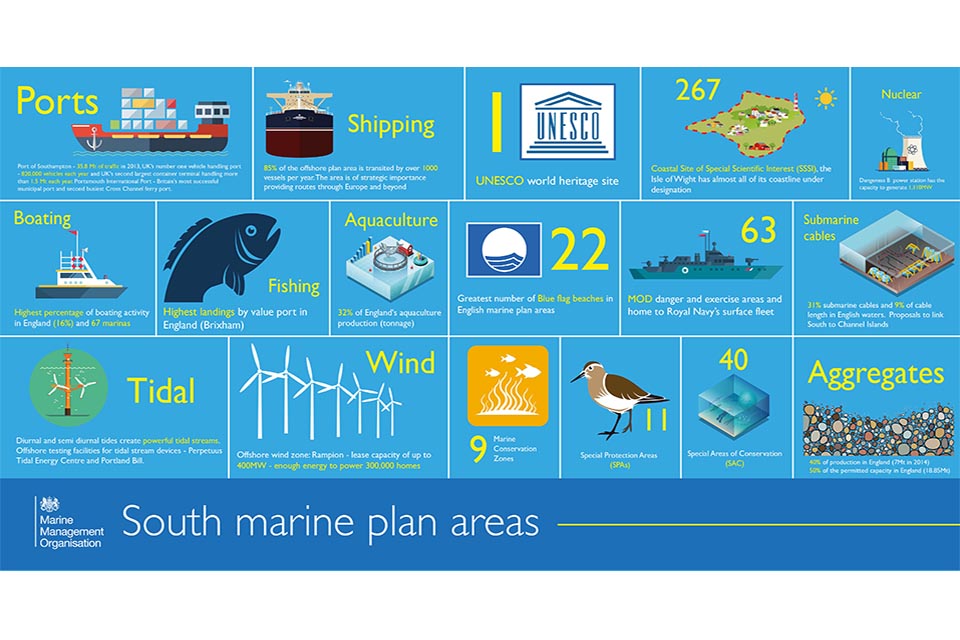
South marine plan infographic

Notes to editors

short animation film to explain marine planning

Further background on marine planning:

  • There are 11 English marine plan areas, including inshore and offshore areas. Work continues to produce plans for the South East, South West, North East and North West, the target for adoption of the remaining plans is before March 2021.
  • Marine planning addresses the key issues for the marine area, including the coast, estuaries and tidal waters, as well as developments that impact on these areas. The plans will include a vision, objectives and detailed policies on how these objectives will be achieved.
  • Marine plans are used by public authorities as part of the decision making process for all new activities and developments in or affecting the marine area.
  • Marine plans build on the requirements of the Marine and Coastal Access Act and the Marine Policy Statement.

More information on marine plans is available elsewhere on GOV.UK

How will marine plans be used?

The plan is brought into effect through its use in decision-making. All public bodies are legally required to make all authorisation and enforcement decisions which are likely to affect the marine areas in accordance with marine plans, unless an exception states otherwise.

Such decisions vary widely and include The Crown Estate leasing the seabed for renewable energy, Environment Agency permitting of flood and coastal defence works and water discharges, Local Planning Authorities (LPAs) determining planning permissions, to Inshore Fisheries and Conservation Authorities (IFCAs) making fisheries byelaws.

The MMO will implement the adopted marine plans across all decision-making functions, including:

  • Marine licensing
  • Marine compliance and enforcement
  • Fisheries management and effort control
  • European Fisheries Funding
  • Coastal operations

The MMO is working to support other relevant authorities to adopt/implement the South Marine Plan in their decision-making processes.

The plans aren’t an enforcement tool as such, more a policy framework for the future use of the sea. (It’s not a law change in that people aren’t being expected to change currently occurring activity to comply with the plan.)

Will the plans result in activities being banned?

The plans are not a list of prohibited activities, but a strategic vision for the sustainable use of shared marine environment seeking to maximise opportunity and encouraging co-existence between many differing marine activities.


Statutory guidance: The South Marine plans documents

Updated: Modification report added

Published July 2018 the South Inshore and South Offshore Marine Plan provides guidance for sustainable development from Folkstone in Kent to the River Dart in Devon.

Marine plans address the key issues for the area, setting a vision and objectives. Detailed policies set out how these will be achieved and how issues will be managed or mitigated. The policies inform decision-making for any activity or development which is in or impacts on a marine area.

Our Marine Information System (MIS) supports decision-makers and applicants using the South Marine Plan. It includes overview of each plan policy by sector and a searchable map of relating data and evidence.

In developing the South Inshore and Offshore Marine Plan we have also published:

  • habitats regulations assessment
  • sustainability appraisal
  • approach to monitoring
  • modification report

Marine plans place sustainability at the centre of all decisions.

The Sustainability Appraisal (SA) provides an independent assessment of economic, social and environmental sustainability.

Public consultation on the Draft South Marine Plan and Draft Technical Annex was held between the 7 November 2016 and the 27 January 2017.

Following this consultation in accordance with the Marine and Coastal Access Act (S15 (7)), the Marine Management Organisation (MMO) are required to publish statements detailing any modifications made to the consultation draft and the reasons for the modifications. The south plan areas Statement of Public Participation describes how the MMO will analyse all responses to the consultation and produce a summary report setting out comments received and changes made to the plans as a result.

The purpose of this document is to summarise:

  • engagement process on the consultation draft
  • responses received, provide an overview of the levels of agreement with the plans supporting sustainable development and compliance with the Statement of Public Participation
  • changes made from the consultation draft to the South Marine Plan and Technical Annex


Press release: Binary options company shut down over false and misleading claims

Eclipse Finance Limited (Eclipse), was incorporated on 9 October 2015 and the company’s registered office is at International House 776-778 Barking Road, London E13 9PJ. The company claimed to be operating a binary options scheme.

Binary options trading is a form of fixed-odds betting on movements in financial markets. A binary option is a financial option in which the payoff is either some fixed monetary amount or nothing at all.

The court heard evidence that following complaints received about the company’s methods, the Insolvency Service investigated and petitioned for the company to be shut down, in the public interest.

The court also heard that:

  • Eclipse traded through a virtual office facility in London and made false and misleading claims in persuading people from Britain and all over the world to invest in a bogus Binary Options scheme, which has since been wound up in the High Court on 26 June 2018
  • the company claimed to be in the business of binary trading, but all the known investors lost significant sums, averaging over £50,000 each. Losses reported to Action Fraud totalled over £600,000
  • potential investors were subject to high pressure sales tactics with misrepresentations being made as to the returns that would be made on investments. Trading was then apparently carried out with investors’ funds without authorisation and monies were removed from investors’ accounts without authorisation

The company then blamed these losses on the hacking of their computer system. This was claimed to have happened on two separate occasions but no evidence of this was provided to victims or to the investigators.

Other investors reported that their accounts were simply drained of funds without explanation and that the company then failed to respond to all attempts at contact.

Commenting on the case, Irshard Mohammed, Investigation Supervisor at the Insolvency Service, said:

Eclipse Finance Limited attracted investors with the promise of high returns but these to be unfounded and investors suffered heavy losses as a result.

The Financial Conduct Authority have warned consumers of the high risks of Binary Options trading, but in this case no evidence has been found that the company engaged in such trading. Instead they used the false promise of high returns to attract investment and then disappeared.

These winding-up proceedings show that the Insolvency Service will use the weight of its powers to take firm action against companies that operate in such an unscrupulous way.

The company was wound up on 26 June 2018 and the Official Receiver has been appointed as liquidator.

Notes to editors

Eclipse Finance Limited, company registration number 09818512, was incorporated on 9 October 2015. The company’s registered office is at International House 776-778 Barking Road, London E13 9PJ, that of a virtual office provider.

The petition to wind-up Eclipse Finance Limited was presented under s124A of the Insolvency Act 1986 on 03 May 2018. The company was wound up on 26 June 2018 and the Official Receiver has been appointed as liquidator.

Binary options trading is a form of fixed-odds betting on movements in financial markets. A binary option is a financial option in which the payoff is either some fixed monetary amount or nothing at all.

By virtue of the appointment of the Official Receiver all public enquiries concerning the affairs of the company should be made to: The Official Receiver, Public Interest Unit, 2nd Floor, 4 Abbey Orchard Street, London SW1P 2HT. Email: piu.south@insolvency.gsi.gov.uk.

Company Investigations, part of the Insolvency Service, uses powers under the Companies Act 1985 to conduct confidential fact-finding investigations into the activities of live limited companies in the UK on behalf of the Secretary of State for Business, Energy & Industrial Strategy (BEIS).

Further information about live company investigations is available here

The Insolvency Service, an executive agency sponsored by the Department for Business, Energy and Industrial Strategy (BEIS), administers the insolvency regime, and aims to deliver and promote a range of investigation and enforcement activities both civil and criminal in nature, to support fair and open markets. We do this by effectively enforcing the statutory company and insolvency regimes, maintaining public confidence in those regimes and reducing the harm caused to victims of fraudulent activity and to the business community, including dealing with the disqualification of directors in corporate failures.

BEIS’ mission is to build a dynamic and competitive UK economy that works for all, in particular by creating the conditions for business success and promoting an open global economy. The Criminal Investigations and Prosecutions team contributes to this aim by taking action to deter fraud and to regulate the market. They investigate and prosecute a range of offences, primarily relating to personal or company insolvencies.

The agency also authorises and regulates the insolvency profession, assesses and pays statutory entitlement to redundancy payments when an employer cannot or will not pay employees, provides banking and investment services for bankruptcy and liquidation estate funds and advises ministers and other government departments on insolvency law and practice.

Further information about the work of the Insolvency Service, and how to complain about financial misconduct, is available.

Media enquiries for this press release – 020 7674 6910 or 020 7596 6187

You can also follow the Insolvency Service on:


Press release: Kent pension company shut down in the interest of investors

Chartwell Trustee Pension Solutions Ltd (Chartwell), was the sole trustee of the Pinnacle Pension Scheme and was incorporated on 14 December 2007. Its registered office was Kingfisher House, Bromley, Kent.

The Insolvency Service launched an investigation into the company’s activities following complaints received by it and Action Fraud.

The investigation found:

  • the company was entrusted with in excess of £4.8m of members’ pension funds following an apparent cold-calling telesales operation. Members were told that they could expect a guaranteed 8% return into their pension for the first two years and that further returns may follow
  • members were told their pensions would be invested in ‘storage products’. However, records provided by the company to the Insolvency Service investigators were incomplete, and it did not provide the investigators with an adequate explanation for the application of the funds it received
  • customers experienced enormous difficulties in contacting the company, received very little information from the company and do not appear to have been issued with any Annual Returns, which are supposed to provide them with details of their invested funds, since October 2015

Investigators were unable to obtain any clear view of how the company operated and records the company did provide were incomplete, inconsistent, and contradicted information the company had itself provided to The Pensions Regulator.

The company was wound up by the court on Wednesday 6 June 2018, on the petition of the Secretary of State for Business, Energy & Industrial Strategy, following an investigation by the Insolvency Service.

The Court said that it was appropriate, desirable, and in the interest of investors to make an order to place the company into insolvent liquidation.

Judge Prentis found that the company operated with a lack of commercial probity, a lack of transparency, and without any presence at its Registered Office address. Investigators were unable to obtain any clear view of how the company operated.

Nobody appeared on behalf of the company to oppose the petition.

Investigation Supervisor Irshard Mohammed, of the Insolvency Service, said:

Those behind companies such as Chartwell should be aware that the Insolvency Service will not tolerate such abuses of the corporate regime. It is telling that this situation appears to have arisen from telephone cold-calling.

Members of the public should be most wary when approached with investment proposals or proposals of how to manage their pension, through unsolicited telephone calls.

Notes to editors

A winding-up order was made against Chartwell Trustee Pension Solutions Ltd on 6 June 2018 in the High Court of Justice.

The petition to wind up the company was presented in the High Court of Justice Business and Property Courts of England and Wales, on 9 April 2018, under the provisions of section 124A of the Insolvency Act 1986 following confidential enquiries by Company Investigations under section 447 of the Companies Act 1985, as amended.

Chartwell Trustee Pension Solutions Ltd was incorporated on 14 December 2007 with the Company Registration Number 06453607. Its Registered Office on 6 June 2018 was Kingfisher House, 21-23 Elmfield Road, Bromley, Kent, England, BR1 1LT.

The company’s sole director at the time of winding up is Christopher William Payne.

Mr Payne and another former director of Chartwell, Karen Carol Burton, were previously directors of Imperial Trustee Services Ltd, which was also wound up by the Insolvency Service on a Public Interest petition. The press release for Imperial Trustee Services Ltd is available here.

All enquiries concerning the affairs of the companies should be made to: The Official Receiver, Public Interest Unit, 4 Abbey Orchard Street, London, SW1P 2HT. Telephone: 0207 637 1110, Email: piu.or@insolvency.gsi.gov.uk.

Company Investigations, part of the Insolvency Service, uses powers under the Companies Act 1985 to conduct confidential fact-finding investigations into the activities of live limited companies in the UK on behalf of the Secretary of State for Business, Energy & Industrial Strategy (BEIS).

Further information about live company investigations is available here.

The Insolvency Service administers the insolvency regime, investigating all compulsory liquidations and individual insolvencies (bankruptcies) through the Official Receiver to establish why they became insolvent. It may also use powers under the Companies Act 1985 to conduct confidential fact-finding investigations into the activities of live limited companies in the UK. In addition, the agency deals with disqualification of directors in corporate failures, assesses and pays statutory entitlement to redundancy payments when an employer cannot or will not pay employees, provides banking and investment services for bankruptcy and liquidation estate funds and advises ministers and other government departments on insolvency law and practice.

Further information about the work of the Insolvency Service, and how to complain about financial misconduct, is available.

Media enquiries for this press release – 020 7674 6910 or 020 7596 6187

You can also follow the Insolvency Service on: