We’re now seeking further views on how decisions on matters covered in that consultation will be implemented into the CfD scheme. We invite comments on the revised drafts of the CfD Standard Terms and Conditions and the CfD generic Agreement published alongside this document: the proposed amendments are shown as tracked changes in these documents.
We also welcome views on a small number of new proposals addressing associated issues that emerged during the original consultation, and on proposed minor and technical contract changes to ensure that the contract terms remain effective. These include:
the way in which reference price forecasts are used during the allocation process
the treatment of those technologies which are eligible to participate in the CfD scheme regardless of whether they deploy with Combined Heat and Power (CHP) (i.e. the ‘optional CHP’ technologies, currently advanced conversion technologies, anaerobic digestion and geothermal)
Issue 7 of the CHP Quality Assurance (CHPQA) Standard and Guidance Note 44 giving effect to new increased efficiency requirements for CHP projects. New versions of both these documents are available on this page, with changes marked
Brexit-related changes to ensure that the CfD contract functions effectively after the UK has left the European Union
a series of proposed minor and technical changes to ensure that the contract terms remain effective
News story: Minister hails world-class Wales’ role in defence industry
Defence invests £945 million in Welsh industry, supporting more than 6,000 jobs. The Minister visited leading firms befitting from defence work such as Defence Electronics and Components Agency (DECA), Kent Periscopes, Qioptiq and Raytheon, which are all supporting essential equipment to the UK’s Armed Forces.
The crucial relationship between the MOD and Welsh industry was clearly laid out in the recent publication of an independent review published by former Defence Minister Philip Dunne, and has now been showcased to the former Wales Office Minister on his return to the nation in his new role.
Defence Minister Stuart Andrew said:
Wales is crucial to our world-leading defence industry, our Armed Forces and their future capabilities. The hundreds of millions of pounds we are investing in Welsh firms means the nation can continue making a massive contribution to our safety in the face of intensifying threats across the globe.
The 6,000 workers in Wales’ defence sector can be extremely proud that their entrepreneurship, innovation and skills are ensuring our brave servicemen and women are equipped with the latest equipment and systems so they can protect us at home and around the world.
The Minister’s tour of Welsh firms began at DECA Sealand, which will be at the forefront of maintaining the UK’s new supersonic F-35 Lightning Force fighter jets.
The Sealand site will become a global repair hub for the aircraft, providing maintenance, repair, overhaul and upgrade services for F-35 avionics, electronic and electrical components, fuel, mechanical and hydraulic systems. The fighter jet work will sustain thousands of jobs and pump hundreds of millions of pounds into the local economy.
Whilst at the site, the Minister announced that the F-35B Lightning has carried out its first trials armed with UK-built weapons out in the US.
The minister also visited Raytheon, where he had the chance to see the cutting-edge capabilities for the British aerospace and defence sectors. The company’s technology is used in some of the most advanced aircraft surveillance and intelligence systems in existence.
This includes the Sentinel, which is one of the UK’s most advanced manned surveillance aircraft, and the closely guarded Shadow special mission aircraft. The Defence Minister’s visit coincided with the company celebrating 10 years of Sentinel and more than 30,000 operational hours.
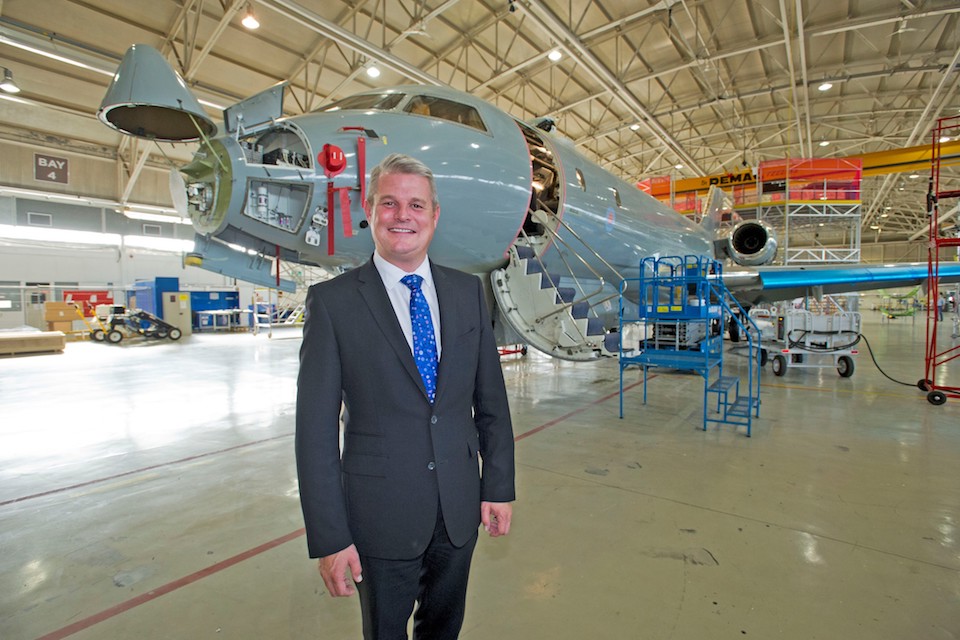
Minister for Defence Procurement Stuart Andrew
Defence Minister Stuart Andrew added:
The Sentinel has proved its enormous worth time and time again, from tracking terrorists in Syria and Iraq, to helping provide overseas aid and even mapping flooding here in the UK.
The fact it has now been on operations for over 30,000 hours not only demonstrates how the RAF are working around the clock to put it to use on behalf of the country, but is a testament to its home here in North Wales.
The workers here in Broughton should be extremely proud of the fantastic work they are doing to ensure this ‘eye-in-the-sky’ continues to collect the crucial intelligence our Armed Forces need to keep us safe.
The Sentinel programme has supported more than 200 suppliers across the country, while Raytheon has supported 450 jobs through the supply chain.
On the second day of his tour, the Minister was also given an insight into the important work being done by Kent Periscopes. The company provides the British Army with crucial periscopes for armoured personnel carriers, infantry fighting vehicles and tanks.
The minister’s final stop involved a visit to Qioptiq, a company that specialises in optics and photonics and provides crucial night vision equipment to UK Armed Forces. Qioptiq’s cutting-edge work supports more than 500 jobs in north Wales.
ENDS
Notes to Editors
The Ministry of Defence spent £945 million with Welsh businesses in 2016/17, equivalent to £300 per person per year. This supports over 6,000 industry jobs Wales provides over 3,000 regulars and reserves to the Armed Forces
Wales is renowned for its vast training areas for the Army and RAF
Since the 2015 SDSR we have announced new contracts with industry in Wales supporting operations at RAF Valley, maintaining F35 components at the Defence Electronics and Components Agency, developing a new battlefield communication system in Oakdale, building AJAX vehicles in Merthyr Tydfil and more. Alongside the many SMEs in Wales that equip and support our Armed Forces, these are a testament to the skills of the workforce in Wales.
News story: Minister hails world-class Wales’ role in defence industry
Defence invests £945 million in Welsh industry, supporting more than 6,000 jobs. The Minister visited leading firms befitting from defence work such as Defence Electronics and Components Agency (DECA), Kent Periscopes, Qioptiq and Raytheon, which are all supporting essential equipment to the UK’s Armed Forces.
The crucial relationship between the MOD and Welsh industry was clearly laid out in the recent publication of an independent review published by former Defence Minister Philip Dunne, and has now been showcased to the former Wales Office Minister on his return to the nation in his new role.
Defence Minister Stuart Andrew said:
Wales is crucial to our world-leading defence industry, our Armed Forces and their future capabilities. The hundreds of millions of pounds we are investing in Welsh firms means the nation can continue making a massive contribution to our safety in the face of intensifying threats across the globe.
The 6,000 workers in Wales’ defence sector can be extremely proud that their entrepreneurship, innovation and skills are ensuring our brave servicemen and women are equipped with the latest equipment and systems so they can protect us at home and around the world.
The Minister’s tour of Welsh firms began at DECA Sealand, which will be at the forefront of maintaining the UK’s new supersonic F-35 Lightning Force fighter jets.
The Sealand site will become a global repair hub for the aircraft, providing maintenance, repair, overhaul and upgrade services for F-35 avionics, electronic and electrical components, fuel, mechanical and hydraulic systems. The fighter jet work will sustain thousands of jobs and pump hundreds of millions of pounds into the local economy.
Whilst at the site, the Minister announced that the F-35B Lightning has carried out its first trials armed with UK-built weapons out in the US.
The minister also visited Raytheon, where he had the chance to see the cutting-edge capabilities for the British aerospace and defence sectors. The company’s technology is used in some of the most advanced aircraft surveillance and intelligence systems in existence.
This includes the Sentinel, which is one of the UK’s most advanced manned surveillance aircraft, and the closely guarded Shadow special mission aircraft. The Defence Minister’s visit coincided with the company celebrating 10 years of Sentinel and more than 30,000 operational hours.
Minister for Defence Procurement Stuart Andrew
Defence Minister Stuart Andrew added:
The Sentinel has proved its enormous worth time and time again, from tracking terrorists in Syria and Iraq, to helping provide overseas aid and even mapping flooding here in the UK.
The fact it has now been on operations for over 30,000 hours not only demonstrates how the RAF are working around the clock to put it to use on behalf of the country, but is a testament to its home here in North Wales.
The workers here in Broughton should be extremely proud of the fantastic work they are doing to ensure this ‘eye-in-the-sky’ continues to collect the crucial intelligence our Armed Forces need to keep us safe.
The Sentinel programme has supported more than 200 suppliers across the country, while Raytheon has supported 450 jobs through the supply chain.
On the second day of his tour, the Minister was also given an insight into the important work being done by Kent Periscopes. The company provides the British Army with crucial periscopes for armoured personnel carriers, infantry fighting vehicles and tanks.
The minister’s final stop involved a visit to Qioptiq, a company that specialises in optics and photonics and provides crucial night vision equipment to UK Armed Forces. Qioptiq’s cutting-edge work supports more than 500 jobs in north Wales.
ENDS
Notes to Editors
The Ministry of Defence spent £945 million with Welsh businesses in 2016/17, equivalent to £300 per person per year. This supports over 6,000 industry jobs Wales provides over 3,000 regulars and reserves to the Armed Forces
Wales is renowned for its vast training areas for the Army and RAF
Since the 2015 SDSR we have announced new contracts with industry in Wales supporting operations at RAF Valley, maintaining F35 components at the Defence Electronics and Components Agency, developing a new battlefield communication system in Oakdale, building AJAX vehicles in Merthyr Tydfil and more. Alongside the many SMEs in Wales that equip and support our Armed Forces, these are a testament to the skills of the workforce in Wales.
Press release: Dstl scientists take to the high seas on HMS Queen Elizabeth
Dstl has been involved in the development of HMS Queen Elizabeth for the past 20 years, starting with the original study to replace the Invincible light carrier fleet. Dstl helped to define the size and shape of the ship and a specialist team investigated ship-air integration, which supported the design of the flight deck and ski-jump used to launch the F-35B Lightning II fighter jets.
Currently on-board is Dstl operational analyst Tom, who will be joined later in September by Hannah, both of whom will provide vital analysis to the battle group and commanders during the voyage. It will be HMS Queen Elizabeth’s maiden voyage across the Atlantic as she prepares to embark her first F-35B Lightning II fighter jets. She is one of two new aircraft carriers built for the Royal Navy with the second, HMS Prince of Wales, nearing the end of construction in Rosyth.
The aim of the flight trials is to use specially equipped test aircraft and sensors around the ship to work out the operating parameters of the aircraft and the carrier itself in a range of conditions. The carrier has already conducted similar trials for helicopters.
During the exercise, Dstl scientists will focus on operational analysis, gathering data that will be used inform future operational activity.
Tom said:
This is a fantastic opportunity, not only to be part of Dstl’s continued involvement with the carrier, but to join more than 1,000 military personnel on-board. It’s a huge craft and quite daunting – and also the first time I’ve deployed to sea, let alone on the Queen Elizabeth – but I’m very much looking forward to the tasks ahead and hopefully witness the F-35 jets on-board and in action off the flight deck for the first time.
In addition to providing analytic support to the carrier strike group and commanders, analysis will include looking at the way manpower use can be improved, from how efficiently the vessel can be cleaned to the sortie rates the fighter aircraft can carry out.
Tom added:
Analysis at this level has never been done before, so we will be learning on task; helping to adapt and shape the way the ship will run come its first operational deployment in 2021.
Press release: Dstl scientists take to the high seas on HMS Queen Elizabeth
Dstl has been involved in the development of HMS Queen Elizabeth for the past 20 years, starting with the original study to replace the Invincible light carrier fleet. Dstl helped to define the size and shape of the ship and a specialist team investigated ship-air integration, which supported the design of the flight deck and ski-jump used to launch the F-35B Lightning II fighter jets.
Currently on-board is Dstl operational analyst Tom, who will be joined later in September by Hannah, both of whom will provide vital analysis to the battle group and commanders during the voyage. It will be HMS Queen Elizabeth’s maiden voyage across the Atlantic as she prepares to embark her first F-35B Lightning II fighter jets. She is one of two new aircraft carriers built for the Royal Navy with the second, HMS Prince of Wales, nearing the end of construction in Rosyth.
The aim of the flight trials is to use specially equipped test aircraft and sensors around the ship to work out the operating parameters of the aircraft and the carrier itself in a range of conditions. The carrier has already conducted similar trials for helicopters.
During the exercise, Dstl scientists will focus on operational analysis, gathering data that will be used inform future operational activity.
Tom said:
This is a fantastic opportunity, not only to be part of Dstl’s continued involvement with the carrier, but to join more than 1,000 military personnel on-board. It’s a huge craft and quite daunting – and also the first time I’ve deployed to sea, let alone on the Queen Elizabeth – but I’m very much looking forward to the tasks ahead and hopefully witness the F-35 jets on-board and in action off the flight deck for the first time.
In addition to providing analytic support to the carrier strike group and commanders, analysis will include looking at the way manpower use can be improved, from how efficiently the vessel can be cleaned to the sortie rates the fighter aircraft can carry out.
Tom added:
Analysis at this level has never been done before, so we will be learning on task; helping to adapt and shape the way the ship will run come its first operational deployment in 2021.