Press release: Foreign Secretary congratulates Iraq on election of President and Prime Minister

Foreign Secretary Jeremy Hunt has welcomed the news of the election of the new Iraqi president and prime minister, and of the successful elections in the Kurdistan Regional Government.

The Foreign Secretary said:

I congratulate President Barham Saleh on his election by the Iraqi Parliament, and his nomination of Adel Abdul Mahdi to form the next government as Prime Minister. On behalf of the British Government, I must also express my gratitude to Prime Minister Abadi and President Masum both for their service to Iraq and for the crucial and successful collaboration with the UK in our joint determination to defeat Daesh.

I would also like to congratulate the people of the Kurdistan Region of Iraq on a successful parliamentary election. The formation of an effective Kurdistan Regional Government that delivers for all the people in the region will be a welcome step.

I look forward to working with the Government of Iraq and the Kurdistan Regional Government to deliver stability, security and prosperity for all Iraqis.


Open consultation: Assessing and scoring permit compliance

The Environment Agency has listened to your feedback that the current guidance for assessing permit compliance is too complex.

This consultation is an opportunity to comment on its proposed revisions to assessing and scoring permit compliance.

If the proposed changes to the guidance are supported the changes will start on 1 January 2019 (the start of the compliance year).


Press release: Sword-wielding Bristol murderer to spend longer in prison

A man who murdered his friend with a martial arts weapon has today had his sentence increased after the Attorney General, Geoffrey Cox QC MP, referred his sentence to the Court of Appeal for being too lenient.

Kerr Somers, 29, and Nathan Jones, 39, had been out drinking in Bristol together when they got into a fight. After leaving the pub, Somers returned home, armed himself with the sword, and hid in a hedge that he knew Jones would pass. Somers then snuck up behind Jones and stabbed him with such force that the sword penetrated all the way through his body. He later claimed that he had acted in self-defence.

Somers was originally sentenced at Bristol Crown Court in July to life imprisonment with a minimum term of 18 years. Today, after the Attorney General’s referral, the Court of Appeal increased his minimum term to 21 years.

Commenting on the increase, the Attorney General said:

“Somers’ brutal attack on Nathan Jones was just the latest in a series of violent offences. The Court of Appeal’s decision today ensures greater public protection from this dangerous individual.”


News story: UK to send transport aircraft to provide relief to Indonesia

The RAF A400M ‘Atlas’ aircraft, currently in the Middle East, will assist following the 7.5 magnitude earthquake and subsequent 3-metre wave that has so far left more than 1,500 people dead, missing or injured. She will be loaded with aid from the Department for International Development (DFID).

A small team of UK military experts are deploying this evening to assist with the mission.

Defence Secretary Gavin Williamson said:

Britain stands united with Indonesia as they recover from this devastating tragedy. An RAF transport aircraft and her crew will provide vital supplies to those who are in desperate need.

This shows that once again Britain and her allies across the globe can depend on us to provide support and assistance no matter the time, no matter the place, and no matter the problem.

The deployment of the Atlas follows the commitment of a team of experts and £2 million in UK aid from the DFID.


News story: Government announces plans for earlier diagnosis for cancer patients

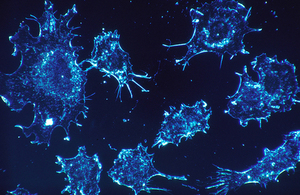
Cancer cells under a microscope

As part of the long-term plan for the NHS, a package of measures will be rolled out across the country with the aim of seeing 3 out of 4 of all cancers detected at an early stage by 2028.

The plan will:

  • overhaul screening programmes
  • provide new investment in state-of-the-art technology to transform the process of diagnosis
  • boost research and innovation

Screening programmes will be made more accessible and easier to use. They will be based on the latest breakthrough research and technology. Those at risk will be able to benefit from options including:

  • new tests for bowel cancer
  • mobile lung screening units
  • the roll-out of rapid diagnostic centres across the country with same-day testing

Patients diagnosed early, at stages 1 or 2, have the best chance of long-term survival. For example, 96% of people with colorectal cancer diagnosed at stage 1 will survive one year or more, compared with 46% diagnosed at stage 4.

At present, 52% of the top 10 cancers are diagnosed at stages 1 and 2. The government aims to increase this to 75% by 2028.

As part of the new measures the government will:

  • use artificial intelligence (AI) to better target at-risk populations and bring screening closer to home
  • lower the recommended starting age for bowel cancer screening from 60 to 50 and adopt a new easier to use test (the Faecal Immunochemical Test) which detects cancer at an earlier stage
  • speed up access to ground-breaking treatments with quicker translation of new breakthroughs into practice, through investment in world-leading cancer research centres

Funding for today’s announcement will be allocated through NHS England’s long-term plan.

Published 3 October 2018
Last updated 3 October 2018