Press release: Smart meter enabled technology could see electric car owners cut bills and make money

  • growing number of electric car owners could save and even make money from innovative technology by selling energy back to the grid
  • smart energy innovations, including smart tariffs, could save the UK as much as £40 billion between now and 2050

Energy Minister Claire Perry today (16 August 2018) hailed OVO Energy for its “innovative” electric vehicle (EV) products – enabled by smart meters – which could see millions save and even make money from their electric cars.

OVO Energy, based in Bristol city centre and London, is one of just a few companies already using smart meters to offer innovative products, such as rewarding customers for charging their electric vehicles at off-peak times. These offers, made possible thanks to a smart meter, help customers use energy at times when there is less demand on the grid, in turn saving money on their bills.

Smart charging and Vehicle to Grid charging could become a cornerstone of the way we use energy in the UK, with more than 8 million people in Britain considering buying or leasing an electric vehicle in the next 5 years. With this technology, customers will not only be able to choose to use energy at the cheapest times but also make money by selling energy from their vehicle’s battery at times when it is most in demand. This will support the growth of renewable energy generation in the UK.

Smart energy innovations, such as smart tariffs and smart charging, could save the UK as much as £40 billion between now and 2050.

Smart meters also support OVO’s intelligent platform VCharge, which is enabling residential appliances such as electric vehicles, electric heaters and in-home batteries to help balance the grid and reduce energy costs.

Energy and Clean Growth Minister Claire Perry said:

More than 11 million meters are already empowering consumers to reap the rewards of a smarter energy system, putting homes and small businesses on the road to a smarter future.

Smart meters will be the cornerstone of a cleaner, flexible and efficient energy system, saving the country tens of billions of pounds.

New innovative products and tariffs like these will put consumers in the fast lane when it comes to control of their energy use, saving and even making them money when using their electric vehicles.

These products are just one of the ways smart meters save money. They put people in control of their energy use by showing them how much energy they use in pounds and pence via an easy to understand In-Home Display. With this information at their fingertips, consumers can easily understand how they can make small changes to the way they use energy in order to use less and save money on their bills – up to £1.2 billion a year by 2030.

Stephen Fitzpatrick, CEO and Founder, OVO said:

Getting the smart meter rollout right should be the top priority for the government and the energy sector in the UK right now so it’s encouraging to see the minister here today.

The smart meter rollout is a huge and complicated programme. However, there’s no question it needs to be done as we can’t build the energy system of the future unless we know accurately how much energy people are using and when.

OVO is using technology like electric vehicles, smart electric heat and batteries to help lower energy bills for consumers and enable us to use more renewable energy. None of this technology will work without smart metering.

We welcome the government’s recent efforts to improve the delivery of smart meters but there is still more work to do.

At OVO’s offices, the minister also met with their smart meter installation engineers, who undergo thorough training ahead of installations. When having a smart meter installed all homes and small businesses benefit from a free visual safety check of their gas appliances and electricity supply; and the past 18 months alone, installers have raised 430,000 safety notices for issues not related to smart meters during installation visits as part of the free visual safety check provided.

More than 400,000 meters are being installed by energy suppliers across Great Britain each month. Consumers can call their supplier and book and appointment to have one installed.

More than 500,000 households in the South West have already had a smart meter installed and those still without one could save a collective £50 million if they had a smart meter installed. If every household in Great Britain got a smart meter, we could save enough energy to power every household in Exeter, Plymouth and Swindon for 2 years.

Apprentices powering Hinkley Point C

Separately, the minister also visited new nuclear site Hinkley Point C today, where a 250-strong apprentice force is powering this Somerset nuclear project – site owners, EDF expect 1,000 apprentices to work on the project during its lifespan.

Hinkley Point C is the UK’s first new nuclear power station in a generation and is poised to make a major contribution to the UK’s move to reduce carbon emissions through clean energy production.

Nuclear energy already provides around 20% of the UK’s electricity from existing sites and Hinkley Point C’s future output will significantly boost this figure. The clean electricity it will generate upon completion is all part of this government’s modern Industrial Strategy, which actively encourages clean growth in business and energy production, helping to create better higher-paying jobs across the UK.

Hinkley Point C remains on track to meet its next major milestone, the 2019 nuclear concrete construction target of completing the foundations for the first reactor. Energy production is expected to start in 2025.

Notes to editors

82% of people with smart meters say they have a better idea of their energy costs and 8 out 10 people with smart meters say they would recommend them to friends or family.

For more information about the benefits smart meters can bring and to dispel myths surrounding them view our explainer ‘Smart meters – the smart choice’.


Press release: Smart meter enabled technology could see electric car owners cut bills and make money

  • growing number of electric car owners could save and even make money from innovative technology by selling energy back to the grid
  • smart energy innovations, including smart tariffs, could save the UK as much as £40 billion between now and 2050

Energy Minister Claire Perry today (16 August 2018) hailed OVO Energy for its “innovative” electric vehicle (EV) products – enabled by smart meters – which could see millions save and even make money from their electric cars.

OVO Energy, based in Bristol city centre and London, is one of just a few companies already using smart meters to offer innovative products, such as rewarding customers for charging their electric vehicles at off-peak times. These offers, made possible thanks to a smart meter, help customers use energy at times when there is less demand on the grid, in turn saving money on their bills.

Smart charging and Vehicle to Grid charging could become a cornerstone of the way we use energy in the UK, with more than 8 million people in Britain considering buying or leasing an electric vehicle in the next 5 years. With this technology, customers will not only be able to choose to use energy at the cheapest times but also make money by selling energy from their vehicle’s battery at times when it is most in demand. This will support the growth of renewable energy generation in the UK.

Smart energy innovations, such as smart tariffs and smart charging, could save the UK as much as £40 billion between now and 2050.

Smart meters also support OVO’s intelligent platform VCharge, which is enabling residential appliances such as electric vehicles, electric heaters and in-home batteries to help balance the grid and reduce energy costs.

Energy and Clean Growth Minister Claire Perry said:

More than 11 million meters are already empowering consumers to reap the rewards of a smarter energy system, putting homes and small businesses on the road to a smarter future.

Smart meters will be the cornerstone of a cleaner, flexible and efficient energy system, saving the country tens of billions of pounds.

New innovative products and tariffs like these will put consumers in the fast lane when it comes to control of their energy use, saving and even making them money when using their electric vehicles.

These products are just one of the ways smart meters save money. They put people in control of their energy use by showing them how much energy they use in pounds and pence via an easy to understand In-Home Display. With this information at their fingertips, consumers can easily understand how they can make small changes to the way they use energy in order to use less and save money on their bills – up to £1.2 billion a year by 2030.

Stephen Fitzpatrick, CEO and Founder, OVO said:

Getting the smart meter rollout right should be the top priority for the government and the energy sector in the UK right now so it’s encouraging to see the minister here today.

The smart meter rollout is a huge and complicated programme. However, there’s no question it needs to be done as we can’t build the energy system of the future unless we know accurately how much energy people are using and when.

OVO is using technology like electric vehicles, smart electric heat and batteries to help lower energy bills for consumers and enable us to use more renewable energy. None of this technology will work without smart metering.

We welcome the government’s recent efforts to improve the delivery of smart meters but there is still more work to do.

At OVO’s offices, the minister also met with their smart meter installation engineers, who undergo thorough training ahead of installations. When having a smart meter installed all homes and small businesses benefit from a free visual safety check of their gas appliances and electricity supply; and the past 18 months alone, installers have raised 430,000 safety notices for issues not related to smart meters during installation visits as part of the free visual safety check provided.

More than 400,000 meters are being installed by energy suppliers across Great Britain each month. Consumers can call their supplier and book and appointment to have one installed.

More than 500,000 households in the South West have already had a smart meter installed and those still without one could save a collective £50 million if they had a smart meter installed. If every household in Great Britain got a smart meter, we could save enough energy to power every household in Exeter, Plymouth and Swindon for 2 years.

Apprentices powering Hinkley Point C

Separately, the minister also visited new nuclear site Hinkley Point C today, where a 250-strong apprentice force is powering this Somerset nuclear project – site owners, EDF expect 1,000 apprentices to work on the project during its lifespan.

Hinkley Point C is the UK’s first new nuclear power station in a generation and is poised to make a major contribution to the UK’s move to reduce carbon emissions through clean energy production.

Nuclear energy already provides around 20% of the UK’s electricity from existing sites and Hinkley Point C’s future output will significantly boost this figure. The clean electricity it will generate upon completion is all part of this government’s modern Industrial Strategy, which actively encourages clean growth in business and energy production, helping to create better higher-paying jobs across the UK.

Hinkley Point C remains on track to meet its next major milestone, the 2019 nuclear concrete construction target of completing the foundations for the first reactor. Energy production is expected to start in 2025.

Notes to editors

82% of people with smart meters say they have a better idea of their energy costs and 8 out 10 people with smart meters say they would recommend them to friends or family.

For more information about the benefits smart meters can bring and to dispel myths surrounding them view our explainer ‘Smart meters – the smart choice’.


News story: RAF helicopters ready to support French in Mali

The helicopters, from RAF Odiham, are providing niche logistical support to French combat forces conducting counter-terrorism operations as part of Operation Barkhane. UK forces have built three temporary aircraft hangers on the ground, enabling the Chinooks to fly multiple missions each week.

Armed Forces minister Mark Lancaster said:

This deployment demonstrates the vital role our Armed Forces play, working alongside our French allies to tackle terrorism and reduce threats to European and UK security.

The deployment is in addition to the UK’s long-standing support of UN, EU and G5 Sahel Joint Force operations in Mali aimed at preventing extremists from using the ungoverned space in the Sahel to plan and launch attacks on Europe, as well as countering the illegal trade in people, drugs, weapons and wildlife.

Minister for Africa Harriett Baldwin said:

This helicopter deployment demonstrates the UK’s commitment to do more in the Sahel, alongside £50m of UK Aid providing lifesaving humanitarian support, and a bigger diplomatic network.


Press release: Paedophile has sentence increased after Unduly Lenient Sentence referral

A man who sexually abused an underage girl over a number of years has had his sentence increased after the Attorney General’s Office referred it to the Court of Appeal for being too low.

David Ballinger, 52, began sexually abusing his victim when she was around 10 years old, and continued his offending for many years. The abuse included carrying-out and recording various sexual acts with the victim, as well as coercing her into sending him indecent images.

In addition to this, thousands of indecent images of other children were recovered from Ballinger’s computer.

Ballinger was originally sentenced at Gloucester Crown Court in May, where he was sentenced to 8 years and 8 months’ imprisonment. Today, after the Unduly Lenient Sentence referral, the Court of Appeal increased his sentence to 12 years 8 months imprisonment plus 1 year extended licence.

Speaking after the hearing, Attorney General Geoffrey Cox QC MP said:

“Ballinger carried out a campaign of sexual abuse against a child over many years, and it is important that this is reflected in his sentence. Following the Court of Appeal’s decision today I am satisfied that justice has now been done and seen to be done by those who have suffered at his hands.”


News story: Brigadier promotion for lifetime Reservist and Dstl employee

Andy’s time as a reservist has been in addition to a full-time career, beginning as an electronics engineering apprentice before his time in Bosnia prompted the move to the Defence Science and Technology Laboratory (Dstl). In 16 years at Dstl, Andy has worked in a number of areas, beginning with the replacement of the ‘Wheelbarrow’ – a bomb disposal remote control vehicle (RCV), then focusing on electronic countermeasures and IEDs and, most recently, undertaking a Masters in International Security and Strategy while at the Royal College of Defence Studies, with a focus on artificial intelligence.

Working for a defence executive agency can have natural parallels with reservist duties and Dstl recognises the value of reservists, providing 15 days’ special paid leave for annual training commitments. Andy said:

Dstl’s strength lies in its people and their individual knowledge, skills and experience. As the UK’s leading government agency in applying science and technology to the defence and security of the UK, reservists are able to leverage their military experience to the benefit of Dstl. Quid pro quo, the Regular Armed Forces benefit from Dstl reservists, given their specific defence-related roles.

He also conveyed how operational service, both as reservists and as civil servants, highlights what a difference Dstl staff can make on the ground. Equally, as the first reserve officer to command a troop on live bomb disposal tasks, Andy brought back real insight to Dstl for what is needed on the front line in Bosnia, adding:

When I was deployed as a bomb disposal officer, I wasn’t dealing with IEDs (like those deployed in Iraq and Afghanistan). My team and I were dealing with air dropped weapons (large unexploded bombs), unexploded mortars, booby-trapped grenades, rockets that had malfunctioned and thousands of mines, both anti-vehicular and anti-personnel left over from the War. Our biggest threat came from booby-trapped mines.

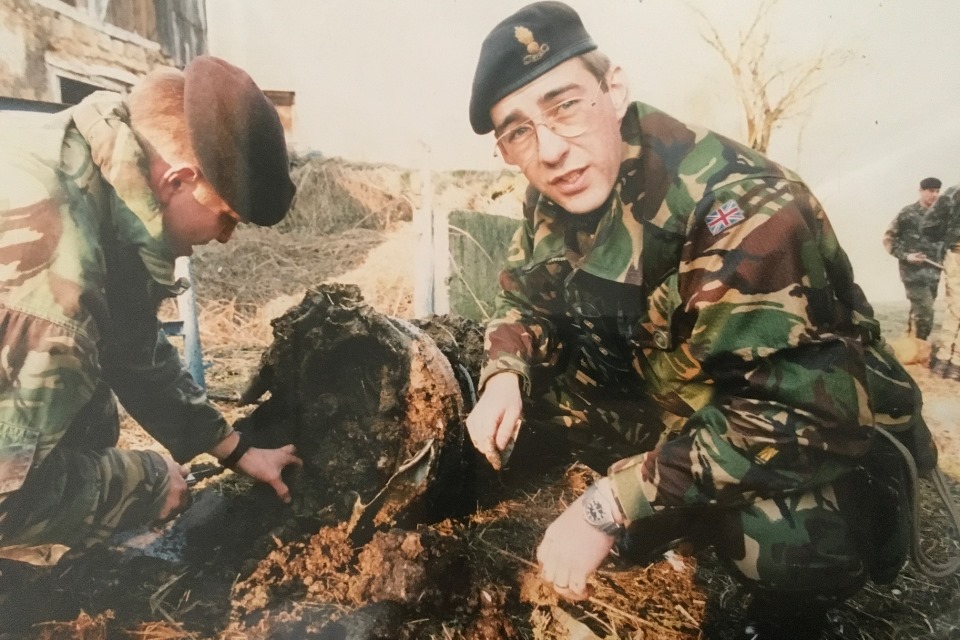
Andrew Wood - Royal Engineers Explosive Ordnance Disposal Detachment Commander alongside the Cluster Bomb Aimable Container.
Andrew Wood – Royal Engineers Explosive Ordnance Disposal Detachment Commander alongside the Cluster Bomb Aimable Container.

As a reservist, Andy received the same training as his regular counterparts and when commanding troops the same high standards are necessary for safety and mutual trust:

Needless to say the sense of ‘belonging’ and team work in the Army is very strong, and arguably more so within explosive ordnance disposal.

He is still proudly representing the Army Reserve Force and he recently found himself at a 10 Downing Street breakfast reception with the Secretary of State for Defence, Gavin Williamson, to mark Reserves Day. After an impressive 36 years as a reservist, Andy takes up a new role next year as Deputy Director of Land Warfare Centre in Warminster.