Press release: Next generation of leaders to join fight against plastic pollution

Young people across the country will join together to tackle plastic pollution through a new partnership between the UK Scouts and Government.

Harnessing the enthusiasm of the UK’s girl and boy Scouts, the Government will create and distribute a new Plastics and Marine Environment Activity Pack to help them in efforts to slash the amount of single-use plastics in our oceans.

Recognising the need for global action, this toolkit will be supported by a new international exchange programme, allowing Scouts from the UK and Kenya to visit one another and learn how important the issue of plastics is in different parts of the world.

The announcement was made by the Prime Minister during her visit to Africa this week, where she also pledged almost £40,000 for a new Girl Guides and Scouts Plastic Challenge Badge This will help an estimated 50,000 young people in Kenya and two further African countries, to better understand the importance of reducing plastic consumption.

Environment Minister Thérèse Coffey said:

Plastic pollution is one of the greatest environmental challenges of our time and we all have a role to play in turning the tide on single-use plastic in our oceans.

This new partnership will help mobilise Scouts to take action and inspire a new generation of leaders in kick-starting behaviour change towards single-use plastics.

The new partnership will build on the work the Scouts are already doing as part of their A Million Hands programme which gives young people the chance to take action with issues they care about.

This summer Scouts have been working with the Canal & River Trust to collect plastic and other litter from canals and rivers across the country. By doing this they have already built better outdoor spaces to bring communities together all across the UK.

Tim Kidd, UK Chief Commissioner for The Scouts said:

As Scouts, we’re committed to helping tackle some of the biggest challenges of our time. We have always had a strong connection to the environment, and so taking action on plastic pollution is an obvious cause for our young people to champion.

I’m proud of the role our young people will play in taking a stand against single use plastics.

Speaking to Scouts and Guides with the Prime Minister in Kenya today, Head of UN Environment, Erik Solheim, said:

The environment has already paid a heavy price for our addiction to single-use plastics. We simply can’t allow that cost to extend to the next generation.

That’s why this support from the UK government to create and launch a plastic pollution badge with the Guides and Scouts is such an inspiring step in the right direction. This global partnership allows us to not just fight plastic pollution on the beaches, but to invest in the young minds that will preserve the planet for future generations to come.

Today’s announcement is the latest step in the Government’s ongoing fight against plastic, both at home and abroad.

This includes a world-leading ban on microbeads in rinse-off personal care products which harm marine life, and plans to ban the sale of plastic straws, stirrers and cotton buds and introduce a deposit return scheme to drive up the recycling of drinks bottles and cans, subject to consultation.


News story: Plastic bag charge set to be rolled out to all retailers

The 5p plastic bag charge will be extended to all retailers and not just big businesses, subject to consultation later this year, to help fight the global scourge of plastic pollution, Prime Minister Theresa May has announced today (30 August).

It is estimated over 3.4 billion single-use plastic bags are supplied annually by small and medium-sized enterprises (SMEs). Trade bodies representing 40,000 small retailers have already launched a voluntarily approach to a 5p charge, but this accounts for less than one-fifth of England’s estimated 220,000 SMEs.

A consultation, to be launched later this year, will also explore the possibility of increasing the 5p minimum charge to encourage further behaviour change, potentially doubling it to at least 10p.

Welcoming today’s announcement Environment Secretary Michael Gove said:

We are committed to being a global leader in tackling plastic pollution. It blights our seas and land and chokes our wildlife.

Thanks to the public’s support, our plastic bag charge has been hugely successful. It has taken 13 billion plastic bags out of circulation in the last two years alone.

Today we are building on that success to ensure we leave our environment in a better state than we inherited it.

The move follows the success of the 5p charge introduced in 2015, which has seen plastic bag sales in major supermarkets drop by 86%. This is equivalent to just 19 bags in 2016/17 per person in England, compared with 140 bags each before the government introduced the charge.

Plastic bags have a significant impact on the environment. Government scientists believe plastic in the sea is set to treble in a decade unless marine litter is curbed – with one million birds and over 100,000 sea mammals dying every year from eating and getting tangled in plastic waste.

Mike Mitchelson, National President of The Federation of Independent Retailers (NFRN), said:

We welcome the announcement that the 5p plastic bag levy is likely to be extended to smaller shops. Independent retailers are environmentally friendly and like to play their part in reducing plastic waste so many of our members have already chosen to implement the 5p charge. As a result, they have been delighted to donate the proceeds from the charge to local and worthy good causes.

The 5p charge has made a huge difference to plastic bag usage and all independent retailers can look forward to playing their part in reducing further waste and raise money for local charities.

Today’s announcement comes during the Prime Minister’s visit to Kenya, where she has announced a further six African Commonwealth Countries (Seychelles, Mauritius, Sierra Leone, Mozambique, Namibia and the Gambia) have now joined the Commonwealth Clean Oceans Alliance (CCOA), pledging their support to end the scourge of plastics in our oceans.

The Alliance, announced in April during the Commonwealth Heads of Government Meeting (CHOGM), sees countries across the Commonwealth join forces in the fight against plastic, whether through a ban on microbeads, a commitment to cutting down on single-use plastic bags, or taking other steps to eliminate avoidable single-use plastic.

The UK will provide up to an additional £5 million in funding to assist CCOA countries seeking to take ambitious action – doubling the amount announced at CHOGM.

Today’s announcement is the latest move in a government crackdown on plastic, with the UK continuing to be a global leader in protecting seas, oceans and marine life. The government has recently announced a range of measures to eliminate all avoidable plastic waste including a world-leading ban on microbeads and plans to explore plastic free aisles in supermarkets.

Earlier this year government announced its intention to ban the sale of plastic straws, stirrers and cotton buds , plans for a deposit return scheme to increase recycling rates of drinks bottles and cans subject to consultation, and ran a call for evidence on using the tax system or charges to address single-use plastic waste, which attracted record-breaking public support for reducing single-use plastics and boosting recycling through the tax system. The Government is considering a number of options, including taxes or charges on specific plastic items which are commonly used on-the-go and littered.

Further information:


Guidance: Optimisation of heat networks: issues for project sponsors to consider

This guidance is for project sponsors or owner-operators who are developing a heat network scheme and may be thinking about taking their project to market or applying for Heat Networks Investment Project (HNIP) funding.

It considers some of the appropriate evidence that is required to give projects the best chance of success.


Press release: PM confirms consultation on plastic bag charge to go ahead

Further action to tackle the blight of plastic waste and leave the environment in a better state than we found it has been confirmed by the Prime Minister Theresa May today, as she sets out government plans to consult on extending the 5p plastic bag charge to all retailers, not just big businesses.

The consultation, to be launched later this year, will also explore the possibility of increasing the 5p minimum charge to encourage further behaviour change, potentially doubling it to at least 10p.

The changes will build on the success of the current charge, which has seen plastic bag sales in England’s ‘big seven’ supermarkets drop by 86% and 13 billion plastic bags taken out of circulation in the last two years.

Over three billion bags are estimated to be supplied by small and medium sized enterprises (SMEs) each year. Together these steps will help to cut down the number of unnecessary bags we still use, and which litter our towns and rivers.

Prime Minister Theresa May said:

We have taken huge strides to improve the environment, and the charge on plastic bags in supermarkets and big retailers has demonstrated the difference we can achieve by making small changes to our everyday habits.

I want to leave a greener, healthier environment for future generations, but with plastic in the sea still set to treble we know we need to do more to better protect our oceans and eliminate this harmful waste.

Today’s announcement is the latest step in the government’s ongoing fight against plastic, both at home and abroad.

This includes a world-leading ban on microbeads which harm marine life, and plans to ban the sale of plastic straws, stirrers and cotton buds and introduce a deposit return scheme to drive up the recycling of drinks bottles and cans, subject to consultation.

To spearhead further international collaboration, the Prime Minister also announced over £61 million in UK Aid to boost global research, and help countries stop plastic waste from entering the oceans, at this year’s Commonwealth Heads of Government Meeting (CHOGM).

In a demonstration of ongoing global partnership, the UK will now provide £250,000 to support the design and delivery of a Sustainable Blue Economy Conference, to be hosted by Kenya in Nairobi in November.

The commitment was made by the Prime Minister during her visit to Kenya, and will see the UK bring its expertise to the first ever major oceans conference to be hosted on the African mainland to help control pollution and support green jobs.

In addition the UK can announce that a further six African Commonwealth countries (Seychelles, Mauritius, Sierra Leone, Mozambique, Namibia and the Gambia) have now joined the Commonwealth Clean Oceans Alliance (CCOA), pledging their support and cooperation to end the scourge of plastics in our oceans.

The UK will provide up to an additional £5million in funding to assist CCOA countries seeking to take ambitious action – doubling the amount announced at CHOGM.

Prime Minister Theresa May said:

With over twelve million tonnes of plastic making their way into our oceans each year, plastic pollution is one of the biggest challenges facing the environment today.

But marine litter is a global problem, and cleaning up our seas and oceans requires a global effort.

The UK has been at the forefront of raising the importance of tackling plastics on the international stage, and I am delighted to see more countries across Africa sign up to our ambitious Commonwealth Alliance, and pledge action to reduce it.

Finally, the Prime Minister used her visit to Kenya to set out plans to inspire young people to become leaders in the fight against single-use plastic, with a new Girl Guides and Scouts Plastic Challenge Badge.

Working in partnership with UN Environment, and backed by an initial investment of almost £40,000 from the UK Government, the new badge will first target schools and youth groups in Kenya, then two further countries, helping an estimated 50,000 young people to better understand the importance of reducing plastic consumption and kick-start behaviour change.

The ambition is to then reach the 50 million global membership of the Girl Guiding and Scouts Associations.

Erik Solheim, Head of UN Environment:

The environment has already paid a heavy price for our addiction to single-use plastics. We simply can’t allow that cost to extend to the next generation.

That’s why this support from the UK government to create and launch a plastic pollution badge with the Guides and Scouts is such an inspiring step in the right direction. This global partnership allows us to not just fight plastic pollution on the beaches, but to invest in the young minds that will preserve the planet for future generations to come.

To harness the enthusiasm of its 400,000 members, the government will also work in partnership with the UK Scout Association to create a new Plastics and the Marine Environment Activity Pack to support Scouts in reducing plastic waste through their existing environmental challenge badges.

The UK will also establish an exchange programme that will enable Scouts from the UK and Kenya to learn from one another how important the issue of plastics is in different parts of the world.


Press release: New UK support to boost long-term stability in Somalia

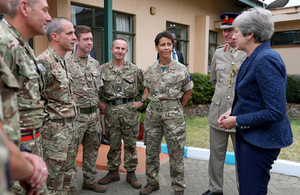
Prime Minister Theresa May at IED training centre in Kenya

The international community must do more to help the African Union lead the fight against al-Shabaab as Somalia takes on greater responsibility for its own security, Theresa May will say today.

The UK has a strong track record both in supporting the African Union and helping Somalia rebuild its police and military forces after decades of insecurity.

On a visit to a UK-backed Counter-IED training centre in Nairobi the Prime Minister will see British troops helping prepare soldiers from Kenya and the region to deploy as part of the African Union Mission to Somalia (AMISOM).

British instructors and their Kenyan counterparts are training troops in the tactics and techniques needed to identify and destroy the home-made bombs which are increasingly the weapon of choice for terrorists in the region.

Announcing over £7 million of new UK funding to support the AU’s peacekeeping mission in Somalia, she will call on international donors to contribute more, setting out that an unstable Somalia has a knock-on effect on stability across the region and further afield.

Prime Minister Theresa May said:

Somalia is at a critical juncture and sustainable, predictable funding and support for the troops who are building stability in the region is vital to support a transition to Somali-led security, when the conditions for a handover are right.

Last year the UK contributed £385 million towards international efforts to help the Somali people build an increasingly secure, stable and prosperous country.

The Prime Minister hosted the London Somalia Conference in 2017 which agreed the international community’s new partnership with the Federal Government of Somalia.

While in Kenya, she will announce further funding to support Somalia in a range of areas, including:

  • more than £60 million to help over a million people cope with and recover from the impact of conflict and drought. Lifesaving food, clean water and medicine, along with support to find stable jobs, will help Somalis to look after themselves and their families in the long-term, reducing their dependence on humanitarian aid
  • more than £25 million to support Somalia as it works to establish a stable and democratic political system. This will include advice to help develop rules on resource and power-sharing, and to prepare for landmark elections, including through support for voter and political party registration
Published 30 August 2018
Last updated 30 August 2018 + show all updates

  1. Added image for context.
  2. First published.