Government response: P3 + 1 Statement on Libya

placeholder

The Governments of France, Italy, the United Kingdom, and the United States welcome the result of the mediation reached today in Tripoli by the United Nations Support Mission that aims to deescalate violence in and around Tripoli and ensure the protection of civilians. We reiterate our strong support for Special Representative of the Secretary-General Ghassan Salame as he works to realize an immediate and durable cessation of hostilities in the Libyan capital, which is a critical step to advancing the political process in accordance with the United Nations Action Plan.

As the Secretary-General noted on September 2, all parties should immediately cease hostilities and abide by the ceasefire agreement brokered by the United Nations. We call on all Libyan parties to refrain from any actions that could undermine today’s ceasefire announcement, jeopardize the security of civilians, or set back Libyan efforts to advance the political process and move forward in the spirit of compromise.

We also reiterate support for the President of the Presidency Council, Fayez al-Sarraj, and the Government of National Accord as they work in partnership with the United Nations to promote reconciliation and support a Libyan-led political process.

Further information

Published 4 September 2018


Government response: P3 + 1 Statement on Libya

The Governments of France, Italy, the United Kingdom, and the United States welcome the result of the mediation reached today in Tripoli by the United Nations Support Mission that aims to deescalate violence in and around Tripoli and ensure the protection of civilians. We reiterate our strong support for Special Representative of the Secretary-General Ghassan Salame as he works to realize an immediate and durable cessation of hostilities in the Libyan capital, which is a critical step to advancing the political process in accordance with the United Nations Action Plan.

As the Secretary-General noted on September 2, all parties should immediately cease hostilities and abide by the ceasefire agreement brokered by the United Nations. We call on all Libyan parties to refrain from any actions that could undermine today’s ceasefire announcement, jeopardize the security of civilians, or set back Libyan efforts to advance the political process and move forward in the spirit of compromise.

We also reiterate support for the President of the Presidency Council, Fayez al-Sarraj, and the Government of National Accord as they work in partnership with the United Nations to promote reconciliation and support a Libyan-led political process.

Further information

Media enquiries

For journalists


Press release: Foreign Secretary statement on the OPCW report into Amesbury

The independent report produced by the Organisation for the Prohibition of Chemical Weapons (OPCW) has today confirmed the assessment of the United Kingdom in identifying the chemical agent responsible for the death of Dawn Sturgess in Amesbury on 8 July. This was a Novichok nerve agent, of the same kind used in the attempted assassinations of Sergei and Yulia Skripal earlier this year.

Analysis carried out by the Defence Science and Technology Laboratory (DSTL) at Porton Down had previously identified the nerve agent as Novichok.

Chemical weapons experts from the OPCW have twice visited the UK to collect samples for testing after this latest detection of chemical weapons use on the streets of the UK. All the samples returned equally conclusive results.

The Foreign Secretary said:

We are grateful to the OPCW for the independent, expert work in confirming the type of nerve agent used in Amesbury, and once again pay tribute to the high standards set by our world-leading scientists.

The recklessness of the Russian state in bringing a nerve agent in to the UK, and total disregard for the safety of the public, is appalling and irresponsible. Our thoughts are with the family of Dawn Sturgess, and with Charlie Rowley.

This is another reminder of the importance of the international community standing together to uphold the global ban on all use of chemical weapons, and ensure that the rules based international order is respected so we can all keep our citizens safe.

In the interests of transparency, the UK has requested that the OPCW publish the executive summary and share the full report with all state parties of the Chemical Weapons Convention.

The police continue their investigation into the poisonings in Amesbury and Salisbury and we await their further conclusions.

Further information


Press release: New UK aid package to meet immediate needs of Palestinians through UN Relief and Works Agency

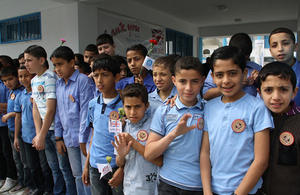
Children attending an UNRWA school in Gaza.

The UK will step up its support to the UN Relief and Works Agency (UNRWA) to help ensure vulnerable Palestinians are able to continue accessing vital healthcare and education services, Minister for the Middle East Alistair Burt has announced.

The UN agency, which is facing severe financial pressure at a time of unprecedented demand, is a lifeline for millions of Palestinian refugees across the Middle East.

Today’s announcement of additional UK aid support from the Department for International Development aims to help UNRWA keep schools open for over 500,000 children, and provide medical care for 3.5 million refugees.

Minister for the Middle East Alistair Burt said:

UK aid support through UNRWA provides an essential humanitarian and stabilising force in the Middle East, educating hundreds of thousands of children every year and providing healthcare to some of the most vulnerable Palestinian refugees. Today’s UK aid package reaffirms our unequivocal support to this UN agency and the important work it does.

We are deeply concerned about the devastating impact a shortage of funds for UNRWA could cause on those that rely on its services, as well as the consequences this could have for regional stability.

Whilst today’s UK aid announcement will help to meet immediate needs, we are clear that the UK cannot act alone. For the sake of millions of Palestinians, the international community and other donors must follow our lead and step up support to UNRWA to ensure its vital services are not interrupted.

In March the UK announced that it was providing financial assistance earlier than originally planned to ensure some of the poorest Palestinians continue to receive education and healthcare. In June the UK provided an additional £10 million to help address the unexpected shortfall in funding, and meet growing beneficiary needs, particularly in Gaza.

Notes to editors

  • Today’s £7 million announcement brings the total UK contribution to UNRWA’s Programme Budget to £45.5m.
  • In the financial year 2018/19, the UK has already provided £38.5m to UNRWA to ensure core programmes and services remain uninterrupted.
  • The £7 million is being provided by DFID in addition to its existing programme in the Occupied Palestinian Territories – this has been reallocated from other DFID programmes.
Published 4 September 2018
Last updated 4 September 2018 + show all updates

  1. Minor typo corrected.
  2. First published.


News story: Primary school standards continue to rise

The statistics, based on this year’s Key Stage 2 National Curriculum Assessments – commonly referred to as SATs and designed to measure school performance – show that schools that benefit from the freedoms academy status bring have had particular success in improving outcomes for pupils, with results improving the longer a school has been an academy.

School Standards Minister Nick Gibb has welcomed the results and the improvements that have come from schools that became sponsored academies.

Figures published today (Tuesday 4 September) show:

  • Academies open for the longest have the highest results:
  • At converter academies open for one year, 65% of pupils reach the expected standards in reading, writing and maths; this figure rises to 71% in converter academies open for seven years; and
  • At sponsored academies that typically converted because of poor performance, those that have had academy status for one year saw 53% of pupils meet the expected standards in reading, writing and maths, rising to 62% after seven years;
  • The gender gap between boys and girls has remained stable, with girls outperforming boys by 8%; and
  • London is the best performing region with Richmond Upon Thames the best performing local authority in the country, followed by Trafford.

The new national curriculum and assessments have set a higher standard in schools and today’s rising results show more pupils are meeting that standard, thanks to the hard work of teachers and pupils, and government reforms.

Earlier this year, figures showed:

  • 64% of pupils met the expected standard in all of reading, writing and maths. This figure was 61% in 2017;
  • 75% of pupils met the expected standard in reading, compared to 71% last year and 66% in 2016
  • 76% of pupils met the expected standard in maths, up by 1 percentage point;
  • 78% of pupils met the expected standard in grammar, punctuation and spelling, up by 1 percentage point; and
  • 78% of pupils met the expected standard in writing. This figure was 76% in 2017.

This year’s results are the third to be released following the introduction of a more rigorous national curriculum assessments in Summer 2016, bringing primary education in line with the best in the world. The tests assess how well schools are equipping pupils to go on to secondary school, rather than as a measure of individual pupils’ performance.

Standards are rising in primary schools. In 2017 the attainment gap between disadvantaged primary pupils and their more affluent peers had narrowed by 10.5% since 2011.

School Standards Minister Nick Gibb said:

Today’s results show how well schools have adapted to the higher expectations and greater challenge of the new primary curriculum. In the first SATs that tested pupils’ achievements in 2016, just 66% reached the expected standard in reading. Today that figure is 75%.

Standards are rising in our primary schools and pupils starting secondary school for the first time this week will be better prepared for its new challenges than ever before.

The government has invested in programmes to help raise standards in our primary schools, including a £26 million network of specialist English Hubs around the country to improve pupils’ literacy and £41 million to follow the same approach to teaching maths as world leading countries through the Shanghai Mastery for Maths programme. ‎This is on top of wider changes to the primary assessment system which will reduce unnecessary workload for teachers so they can focus on what really matters in the classroom.

The introduction of phonics – where children learn to read by sounding out and blending letter – has played a significant part the improvement in primary school standards. Since the introduction of phonics in 2012 154,000 more six-year-olds are now on track to be fluent readers and in the latest PIRLS results – an international study of reading at primary school – England achieved its highest ever score.

Today’s figures build on the record 1.9 million children now in good or outstanding schools than in 2010 – an increase from 66% of pupils to 86%. The government is continuing to ensure all parents have a good school place on their doorstep, with the recent announcement of £680million to create 40,000 more good school places in primary and secondary schools. Since 2010, 825,000 new school places have been created, with recent analysis showing 91% of those in 2016-17 were in good or outstanding schools.