Press release: UK thanks Turkey for longstanding role in tackling North West Syria crisis

Minister for the Middle East Alistair Burt has thanked the people and Government of Turkey for their role in responding to the Syrian refugee crisis and maintaining regional security.

Mr. Burt, who was visiting Gaziantep, Istanbul and Ankara, met with representatives of the Turkish Government to discuss efforts to prevent a humanitarian disaster in Idlib.

Whilst in Turkey, Minister Burt visited the founders of Hala Systems, a social enterprise funded by UK aid which is saving civilian lives by providing early warnings of incoming airstrikes by WhatsApp and on social media. The technology detects aircraft using remote sensors and machine-learning algorithms before sending early warnings to civilians through air raid sirens and social media alerts.

The Minister also met members of the White Helmets, a Nobel Peace Prize-nominated civilian defence group who work tirelessly to protect the lives of civilians caught in the conflict.

Speaking from Turkey, Minister Burt said:

“Turkey is an important and longstanding friend of the UK, and I was pleased that I was able to offer the UK’s thanks to our partners in the Turkish Government for their frontline role in tackling the Syrian refugee crisis. We are encouraged by this week’s agreement between Turkey and Russia to avoid a military offensive by the Syrian regime and its allies. This agreement, if implemented in accordance with International Humanitarian Law, will help to avoid a humanitarian catastrophe.

“During my visit, I had the privilege of meeting members of the White Helmets, and we thank them for their service, courage and sacrifice which has saved over 115,000 Syrian lives. They must be able to continue their vital work without being targeted by the Asad regime.

“I was also deeply impressed by the innovative work of Hala Systems, a UK aid funded initiative that can offer Syrian civilians valuable minutes to get to safety ahead of airstrikes, and which has seen a 27% reduction in the number of casualties in areas under heavy bombardment.”

Whilst in Turkey Minister Burt met Mr Ibrahim Kalin, Chief Advisor to President Erdogan, and Governor Ismail Çatakli, Deputy Minister of the Interior. He thanked the Turkish government for its important role in supporting over 3.5 million Syrians displaced by the conflict, and discussed ways that the UK and Turkey can continue to work closely together.

Last week the UK announced a new aid package to provide life-saving clean water, medical care and shelter, for over a quarter of a million people in North West Syria.

Since the crisis started, the UK is the second largest humanitarian donor to the response inside Syria and has committed £2.71 billion since 2012, the UK’s largest ever response to a single humanitarian crisis.

Last week’s package is in addition to the UK’s existing humanitarian assistance in north-west Syria. During the previous financial year, our support in Idlib Governorate has provided 654,000 people with access to clean drinking water, immunised nearly a million children under the age of five and helped over 300,000 children access education.

Notes to editors

  • Last week, the UK’s Department for International Development UK announced £32 million of additional aid to meet emergency needs in Idlib and the surrounding areas. £17 million will support emergency preparedness, provided by NGOs and UN agencies, including UNICEF, WHO and UNFPA. The remaining £15m will go to the UN Office for the Coordination of Humanitarian Affair’s Turkey Humanitarian Fund to meet emergency needs in North West Syria.
  • This year alone UK support across Idlib has enabled DFID’s partners to provide approximately 572,000 people with access to clean drinking water, immunise 95,000 children under five, provide 500,000 medical consultations, provide safe spaces for over 29,000 women and girls, distribute over 23,000 food rations and support over 2,300 health facilities.
  • The UK is the largest donor to the White Helmets who have saved over 115,000 lives during the conflict. The UK remains committed to supporting the White Helmets and the vital life-saving assistance they provide.
  • Through the Conflict, Stability and Security Fund, alongside our international partners, the UK has supported Hala Systems, a social enterprise focused on developing innovative technical solutions aimed at helping protect civilian communities caught in conflict, including in Syria.


News story: Home Secretary visits Pakistan

Home Secretary Sajid Javid has reaffirmed the UK and Pakistan’s strength in partnership as part of a 2 day visit to the country.

In the first visit to Pakistan by a UK minister since the Pakistani elections, Sajid Javid met with new Prime Minister Imran Khan. He also met with other government ministers including the Foreign Minister and the Minister for the Interior to discuss cooperation on organised crime, terrorism and corruption.

During the visit, the government announced a new UK-Pakistan partnership on accountability to tackle illicit finance – a priority for the new Pakistani government. The partnership includes £500,000 support to Pakistan to enable them to pursue money launderers and to recover assets.

The Home Secretary, whose parents were born in Pakistan, also had the opportunity to visit a girls’ school in Islamabad to see how UK government funding has helped support educational programmes in the country. Over 9.5 million children in primary schools – including 4.6 million girls – have benefited from UK sponsored programmes since 2011.

He also attended a Forced Marriage roundtable hosted by the High Commission and attended by operational partners.

The visit concluded with a tour of Iqbal tomb and the Badshahi Mosque with Punjab Governor Sarwar where they discussed continued partnership in the province on security, health and education.

Speaking after the visit to Pakistan, Mr Javid said:

Pakistan has a special place in my heart and our two countries have a historic bond underpinned by the strong links between our people.

It is vital that our deep and enduring relationship continues and we cooperate further to tackle the shared threats we face.

I discussed this on my visit and made clear Britain is committed to Pakistan’s long-term stability and prosperity.


News story: Home Secretary visits Pakistan

Home Secretary Sajid Javid has reaffirmed the UK and Pakistan’s strength in partnership as part of a 2 day visit to the country.

In the first visit to Pakistan by a UK minister since the Pakistani elections, Sajid Javid met with new Prime Minister Imran Khan. He also met with other government ministers including the Foreign Minister and the Minister for the Interior to discuss cooperation on organised crime, terrorism and corruption.

During the visit, the government announced a new UK-Pakistan partnership on accountability to tackle illicit finance – a priority for the new Pakistani government. The partnership includes £500,000 support to Pakistan to enable them to pursue money launderers and to recover assets.

The Home Secretary, whose parents were born in Pakistan, also had the opportunity to visit a girls’ school in Islamabad to see how UK government funding has helped support educational programmes in the country. Over 9.5 million children in primary schools – including 4.6 million girls – have benefited from UK sponsored programmes since 2011.

He also attended a Forced Marriage roundtable hosted by the High Commission and attended by operational partners.

The visit concluded with a tour of Iqbal tomb and the Badshahi Mosque with Punjab Governor Sarwar where they discussed continued partnership in the province on security, health and education.

Speaking after the visit to Pakistan, Mr Javid said:

Pakistan has a special place in my heart and our two countries have a historic bond underpinned by the strong links between our people.

It is vital that our deep and enduring relationship continues and we cooperate further to tackle the shared threats we face.

I discussed this on my visit and made clear Britain is committed to Pakistan’s long-term stability and prosperity.


News story: RWM at New Scientist Live

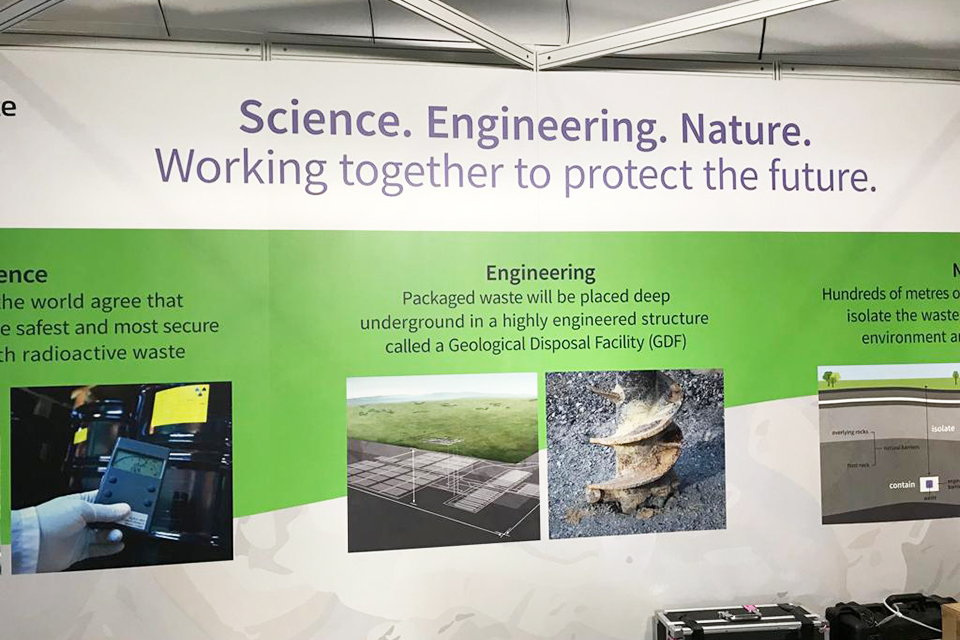
Over the next four days (20-23 September) at New Scientist Live (NSL) in London, scientists and engineers from Radioactive Waste Management (RWM) will be explaining how leading-edge science and technology is making the safe and secure disposal of radioactive waste possible.

RWM works to ensure that radioactive waste is safely managed and packaged today ready for permanent disposal in the future. Geological disposal, endorsed by scientists worldwide, involves placing radioactive waste in highly-engineered vaults and tunnels deep underground.

RWM will host a stand at NSL, catering to an expected audience of around 40,000+ visitors keen to learn about the latest science and technology across a variety of sectors. Visitors to RWM’s stand can take a glimpse into the future with a virtual reality journey deep underground into a highly-engineered facility in which the UK’s radioactive waste will be disposed, keeping future generations and the environment safe from harm.

Our stand at the New Scientist Live Exhibition

RWM will bring to life the often controversial subject of radioactive waste, and how to deal with it, by showcasing robotics, models, and most importantly, providing access to the scientists and engineers whose mission it is to deliver geological disposal for the UK.

Mohammed Sammur, RWM’s Technical Director said:

NSL provides a great opportunity to bring to life the plans for the long-term safe and secure management and
disposal of radioactive waste – one of the greatest challenges facing this generation. The event will also provide us
with an opportunity to engage with an important segment of our community and listen to their views and questions on this subject.


News story: Work kicks-off to examine digital competition in UK

The inaugural meeting of a new independent expert panel looking at competition in the digital economy was held in Downing Street today (19 September 2018).

Philip Hammond hosted the meeting after formally appointing Professors Diane Coyle, Amelia Fletcher, Derek McAuley and Philip Marsden to the team. These experts join Professor Jason Furman, former economic adviser to Barack Obama, who is leading this important work that will help ensure the UK remains at the centre of the digital revolution.

The Chancellor of the Exchequer, Philip Hammond, said:

Our digital economy is one of the UK’s great strengths, employing two million people across the country. But people are concerned that the big players could be accumulating too much power in our new digital world. The work this panel is doing will help ensure we have the right regulations so that our digital markets are competitive and consumers are protected.

Harvard Professor Jason Furman added:

I am delighted to be leading such a strong panel of genuine experts in their respective fields of economics, technology and law.

We help to ensure that the UK remains at the forefront of the global digital economy, and that consumers continue to benefit as innovative technologies develop and evolve.

The review will investigate the UK’s competition regime in the context of the digital economy. It will look at how this affects consumers, and the impact of competition policy on the UK’s growth, productivity, wages and labour markets.

The panel will run from Sept 2018 to early 2019. Its work will culminate in a final report of recommendations for the government. Over the course of the review, the panel will meet with a wide range of academics, businesses and representative groups. A call for evidence will be launched shortly, giving people the chance to have a say.

The panel consists of:

Professor Jason Furman

Professor Jason Furman served as the top economic advisor in the Obama administration, including his role as chair of the Council of Economic Advisers from August 2013 to January 2017, acting as both chief economist and a member of the cabinet. In academia, he has conducted research in a wide range of areas including: fiscal policy, competition policy, tax policy, health economics and international and domestic macroeconomics.

Professor Diane Coyle CBE

Professor Diane Coyle CBE is the Bennett Professor of Public Policy at the University of Cambridge and has held a number of public service roles including Vice Chair of the BBC Trust (2006-2014), member of the Competition Commission (2001-2009), and member of the Migration Advisory Committee (2009-2014). She is currently a member of the Natural Capital Committee, an expert adviser to the National Infrastructure Commission and a member of the Council of Economic Advisers.

Professor Amelia Fletcher OBE

Professor Amelia Fletcher OBE is the Professor of Competition Policy at the Centre for Competition Policy, University of East Anglia. She is a Non-Executive Director at the Competition and Markets Authority, the Financial Conduct Authority and the Payment Systems Regulator. She was previously Chief Economist at the Office of Fair Trading (2001-2013).

Professor Derek McAuley

Professor Derek McAuley is Professor of Digital Economy in the School of Computer Science at the University of Nottingham. He is Director of Horizon, an interdisciplinary Digital Economy research institute and previously founded the Cambridge Microsoft Research facility and the Intel lablet in Cambridge. He is a Fellow of the British Computer Society and member of the UK Computing Research Committee’s executive committee.

Professor Philip Marsden

Professor Philip Marsden is Professor of Law and Economics at the College of Europe, Bruges, and Senior Director, Case Decision Groups at the Competition and Markets Authority (until end September) and CMA representative at the NESTA Open Banking panel. He is also Deputy Chair of the Bank of England’s Enforcement Decision Making Committee and co-founder and General Editor of the European Competition Journal.