Press release: One person quits smoking every 80 seconds in England

Last year, nearly 400,000 smokers in England quit successfully, which is the equivalent to 1,069 smokers each day. Despite new smokers starting and ex-smokers relapsing, there are now 1 million fewer smokers in England since 2014.

Of the 6.1 million smokers in England, 6 in 10 want to quit but most try to quit using willpower alone (or ‘cold turkey’) despite this being the least effective method. The most successful quit attempts use a combination of effective stop smoking support methods.

The best way to quit is with expert help from local stop smoking services together with stop smoking aids. In 2017 to 2018, half (51%) of smokers who got this package of support managed to quit and among those who used an e-cigarette in their quit attempt, the success rate was up to 63%.

New to this year, Public Health England’s Stoptober campaign is offering a free online ‘Personal Quit Plan’ to help smokers find the right stop smoking support for them. The online plan asks a number of questions and provides smokers with a suggested combination of support based on their level of tobacco dependency and what quitting support they have used previously.

Smokers will be advised that nicotine replacement therapy (NRT) products are most effective when used in combination – an all-day patch together with a fast-acting option such as an inhaler or lozenges to help them deal with any immediate cravings.

Dr. Jenny Harries, Deputy Medical Director at Public Health England, said:

There are many different types of stop smoking support available, so it can be difficult for a smoker to know what will work best for them. The important thing is not to be put off trying to quit even if you have not managed to in the past.

This year, Stoptober can help you find a combination that could work for you. We predict that thousands of smokers will quit every day over the next 10 years – I urge smokers not to get left behind for the benefit of their health. Join in, find your best way to quit and start your 28-day journey to becoming smokefree.

Steve Brine, Public Health Minister said:

Millions of people are living healthier lives as a result of our efforts to reduce smoking rates. Britain is a global leader on tobacco control and our robust policies mean smoking rates have fallen to record lows. But we are not complacent – we know we must do all we can to keep encouraging smokers to quit for good.

Quitting altogether is the single best thing a smoker can do for their health — Stoptober is a brilliant chance to go smoke-free for 28 days and see the benefits for yourself.

Dr Sarah Jarvis, GP and TV doctor said:

I see many people in my surgery who want to quit smoking but far too many try without support, and they end up going back to smoking after a short period. Stop smoking aids and face-to-face support from local stop smoking services are proven methods of support that help many thousands of people to quit each year.

The Personal Quit Plan is a quick and useful free tool for smokers looking to quit. People just answer a few questions about their smoking and they are then recommended a combination of support to increase their chances of quitting this Stoptober.

Jeremy Kyle, TV presenter and until recently a smoker of 35 years, said:

I was a 20 a day smoker for most of my life and am proud to say I quit smoking earlier this year. I’ve tried many times in the past to quit but nothing really worked for me. This year, however, the time was right and I wanted to do it for me. With the death of my mother, having cancer myself and becoming a grandad this year, I was determined and I’m so happy I’m now smokefree. I’m not going to pretend it is easy, but I knew my time smoking was up.

The thing that is really helping me stay smokefree is vaping. I’m currently on the lowest nicotine strength and will then come off the e-cigarette altogether when the time is right for me. Since quitting I’ve learned just how important using support is and for people not to go ‘cold turkey’ – that certainly didn’t work for me in the past. If I can quit, I honestly believe anyone can quit if you just have the right support, and that’s what Stoptober is there to give you and I want people to know that and to do it this year.

Stoptober is based on research that if you can make it to 28 days smokefree, you are five times more likely to quit for good. The new Personal Quit Plan will recommend a range of options to smokers including face-to-face support, nicotine replacement therapies like patches, gum or inhalers, and e-cigarettes.

E-cigarettes remain the nation’s favourite stop smoking aid, with an estimated 3.2 million adult users in Great Britain. Over time, the proportion who are ex-smokers has risen and over half (52%) of current vapers have stopped smoking completely. A further 900,000 people have given up both smoking and vaping.

Search ‘Stoptober’ to use the Personal Quit Plan and to find out about the range of free and proven support available to help you start your quitting journey on 1 October.

  1. In 2017 there were 6.1 million smokers and 6.4% of those quit successfully last year (390,400).
  2. Total quits in 2017: 390,400 / 365 = 1,069 per day; 1,069 / 24 = 44 per hour; 60 mins / 44 per hour = 1 every 1.36 mins or 81 secs. Source: Smoking in England: Smoking Toolkit Study – Stopped smoking in the past 12 months, University College London.


News story: Government announces ‘root and branch’ review of rail

  • former British Airways chief executive Keith Williams to lead major review of rail industry, supported by an expert challenge panel
  • review to look at the structure of the whole rail industry, including increasing integration between track and train, regional partnerships and improving value for money for passengers and taxpayers
  • plans for reform to be implemented from 2020

A sweeping review to transform Britain’s railways has been launched today (20 September 2018) by Transport Secretary Chris Grayling.

The review — the most significant since privatisation — will consider ambitious recommendations for reform to ensure our vital rail system continues to benefit passengers and support a stronger, fairer economy.

The review — led by independent chair Keith Williams, the former British Airways chief executive and deputy chairman of John Lewis Partnership — will build on the government’s franchising strategy — bringing track and train closer together to reduce disruption and improve accountability, and considering regional partnerships and how we can use innovation to improve services and value for money for passengers.

Keith Williams will be supported by an external panel and will report next year. The government will publish a white paper on the review’s recommendations, with the implementation of reforms planned to start from 2020.

The panel will consider all parts of the rail industry, from the current franchising system and industry structures, accountability, and value for money for passengers and taxpayers.

The panel membership will include Roger Marsh, who chairs the body representing the 11 local enterprise partnerships in the north of England and will bring his expert knowledge and experience of business and transport needs across the north of the country.

Privatisation has led to a level of growth never seen under nationalisation, and reversed the decline the railways saw under British Rail, where routes and stations were closing.

Passenger journeys have more than doubled -— from 735 million in 1994-5 to 1.73 billion in 2016-17. Private investment is at record levels, totalling £5.6 billion over the past 10 years, and the rail network has one of the highest rates of satisfaction and safety in Europe.

However, the industry has not kept pace with this significant growth, shown as the industry struggled to deliver for passengers following the May timetable disruption.

The government has already taken steps to strengthen future train franchises and improve reliability. However, we want to ensure the rail system continues to deliver benefits in the face of these challenges.

The review will analyse all aspects of the industry, alongside the country’s changing travel and work patterns. It will make recommendations to improve the current franchising model in terms of reliability, delivering better services and value for money for passengers, commercial sustainability and innovation.

The review has been launched ahead of the interim report by Professor Stephen Glaister into the timetabling issues in May. It will it take into account the findings of his final report at the end of the year.

Transport Secretary Chris Grayling said:

Privatisation has delivered huge benefits of passengers on Britain’s railways — doubling passenger journeys and bringing in billions of private investment.

But it is clear that the structure we inherited is no longer fit to meet today’s challenges and cope with increasing customer demand. Following the disruption this summer we took immediate action to improve services and ensure the industry compensated passengers.

We’ve been clear that the railway needs reform to prioritise its passengers, and we have set out plans for closer partnerships between operators of track and train, including on the LNER and South Eastern networks.

But as part of our vision for the future of mobility, we need to go further and more quickly, to get the best from the public and private sectors and deliver the railway we need for the 21st century. It is vital that this review leaves no stone unturned and makes bold recommendations for the future.

I am delighted that Keith Williams — who has significant experience leading businesses within the transport sector — has agreed to be the independent chair of this review. His expertise in driving customer service excellence will be incredibly valuable as we seek to reform the rail industry to become more passenger focused.

The review has a wide scope and will focus on:

  • leveraging the commercial model to ensure improved services for passengers and taxpayers, and more effectively balance public and private sector involvement
  • the roles and structures of all parts of the industry, looking at how they can work together more effectively to reduce fragmentation, improve passenger services and increase accountability
  • how the railway can support a fares system that delivers value for money for passengers and taxpayers; and improved industrial relations to maintain performance for passengers

While the review is taking place, the government will continue with its ambitious programme of investment — £48 billion over the next 5 years.

Keith Williams said:

It’s clear that Britain’s railway has seen unprecedented growth and is carrying more passengers than it did a century ago on a network a fraction of the size. But it also clear it faces significant challenges.

I am looking forward to working with the industry and passengers to tackle these challenges.

While the review is underway, the department will work closely with industry to ensure that rail delivers the day-to-day performance and transformational improvements that passengers expect.

The government will set out the terms of reference of the review and the membership of the panel when Parliament returns. The Transport Secretary has asked that the review engages with a wide range of stakeholders in all parts of the country, including passenger representatives, businesses, and local and devolved bodies and governments.

The department has reviewed all ongoing franchise competitions and other live rail projects in the context of the rail review. Due to the unique geographic nature of the Cross Country franchise, which runs from Aberdeen to Penzance and cuts across multiple parts of the railway, awarding this franchise in 2019 could impact on the review’s conclusions.

It has therefore been decided that this competition will not proceed. Services will continue to be operated by the existing franchisee with options beyond this to be considered in due course. The department will consider the responses to the Cross Country public consultation in the development of future options for the franchise.

All other ongoing franchise competitions and other live rail projects are continuing as planned.


News story: How to rent as a student

Renting your first place in the private rented sector while at university can be a daunting task, but it needn’t be with all the measures the Government has put in place to drive up standards and protect tenants.

Knowing your rights – as well as your responsibilities – ensures you’ll live in a safe and comfortable environment and will be able to hold your landlord or agent to account if certain standards aren’t met.

There are lots of things the Government requires landlords to do. To make understanding all this simple, we’ve put together a definitive guide to renting that tells you everything you need to consider, know and do.

Protecting your deposit

By law, your landlord or letting agent is required to protect your deposit in a Government-approved scheme within 30 days of taking it. These schemes ensure your money can’t be misused, lost or kept from you when you’re entitled to it back. There are only three:

Your landlord or agent must also provide you with all the information on the scheme they’ve used within 30 days. If they fail to do either of these things they lose their ability to evict you with a section 21 notice.

There is a useful guide on what to do if your landlord breaks your tenancy deposit protection scheme rules available from Shelter.

Houses in multiple occupation

The rules around houses in multiple occupation (HMO) will be changing on 1 October 2018. Among other things, the new rules set out a minimum bedroom size; no less than 6.51 square metres for a single adult.

They also make it mandatory for landlords to adhere to council refuse schemes and ensure their properties have adequate waste facilities.

Councils may give landlords up to 18 months to make changes to ensure their HMOs comply with the bedroom size rules, but if you’ve just taken out a two-year tenancy you should consider now how these rules will affect your property in the future.

If something goes wrong

It is your landlord or agent’s responsibility to ensure the property is kept up to standard. This includes arranging prompt and certifiable repairs when utilities like gas, water and electricity fail, repairing or replacing faulty appliances, and maintaining the condition of the property.

All letting agents and property managers in England must belong to a Government approved redress scheme. There are only two:

These schemes provide help in resolving disputes between landlords, agents and tenants, and are a safeguard for when you’re unable to resolve a dispute yourself.

More information

More detailed information on everything contained in this article is available in our How To Rent guide – which your landlord must provide you with at the beginning of your tenancy – and our How To Rent a Safe Home guide.

Share this information

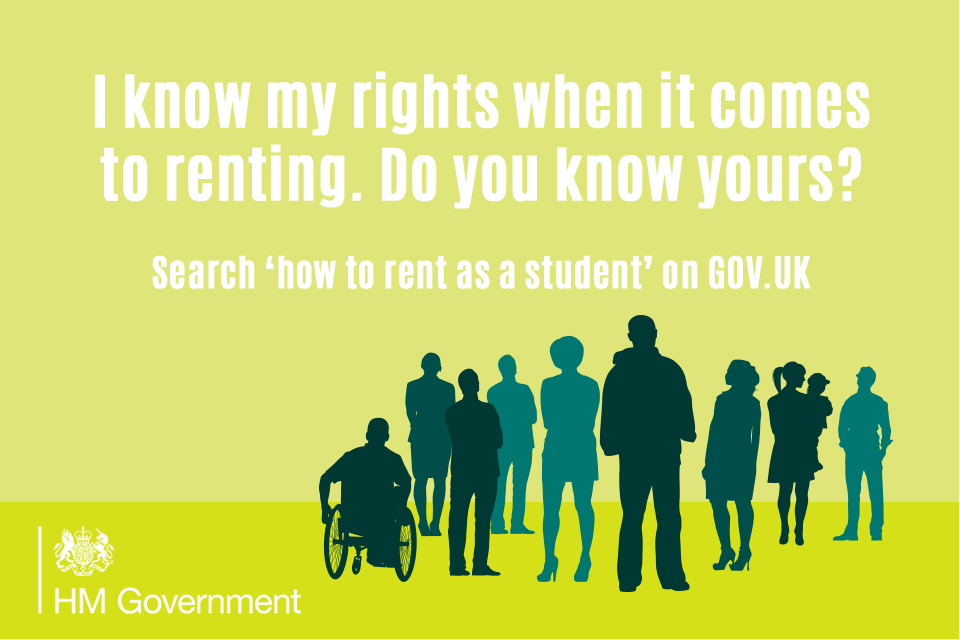
Savvy students know their rights. Share this article on social media and use the below image to tell other students you know your rights when it comes to renting.

Share this image on social media and include a link to this article

If you’re a university or student union, download our helpful poster and display around campus.


News story: How to rent as a student

Renting your first place in the private rented sector while at university can be a daunting task, but it needn’t be with all the measures the Government has put in place to drive up standards and protect tenants.

Knowing your rights – as well as your responsibilities – ensures you’ll live in a safe and comfortable environment and will be able to hold your landlord or agent to account if certain standards aren’t met.

There are lots of things the Government requires landlords to do. To make understanding all this simple, we’ve put together a definitive guide to renting that tells you everything you need to consider, know and do.

Protecting your deposit

By law, your landlord or letting agent is required to protect your deposit in a Government-approved scheme within 30 days of taking it. These schemes ensure your money can’t be misused, lost or kept from you when you’re entitled to it back. There are only three:

Your landlord or agent must also provide you with all the information on the scheme they’ve used within 30 days. If they fail to do either of these things they lose their ability to evict you with a section 21 notice.

There is a useful guide on what to do if your landlord breaks your tenancy deposit protection scheme rules available from Shelter.

Houses in multiple occupation

The rules around houses in multiple occupation (HMO) will be changing on 1 October 2018. Among other things, the new rules set out a minimum bedroom size; no less than 6.51 square metres for a single adult.

They also make it mandatory for landlords to adhere to council refuse schemes and ensure their properties have adequate waste facilities.

Councils may give landlords up to 18 months to make changes to ensure their HMOs comply with the bedroom size rules, but if you’ve just taken out a two-year tenancy you should consider now how these rules will affect your property in the future.

If something goes wrong

It is your landlord or agent’s responsibility to ensure the property is kept up to standard. This includes arranging prompt and certifiable repairs when utilities like gas, water and electricity fail, repairing or replacing faulty appliances, and maintaining the condition of the property.

All letting agents and property managers in England must belong to a Government approved redress scheme. There are only two:

These schemes provide help in resolving disputes between landlords, agents and tenants, and are a safeguard for when you’re unable to resolve a dispute yourself.

More information

More detailed information on everything contained in this article is available in our How To Rent guide – which your landlord must provide you with at the beginning of your tenancy – and our How To Rent a Safe Home guide.

Share this information

Savvy students know their rights. Share this article on social media and use the below image to tell other students you know your rights when it comes to renting.

Share this image on social media
Share this image on social media and include a link to this article

If you’re a university or student union, download our helpful poster and display around campus.

How to rent as a student poster


Press release: UK thanks Turkey for longstanding role in tackling North West Syria crisis

Minister for the Middle East Alistair Burt has thanked the people and Government of Turkey for their role in responding to the Syrian refugee crisis and maintaining regional security.

Mr. Burt, who was visiting Gaziantep, Istanbul and Ankara, met with representatives of the Turkish Government to discuss efforts to prevent a humanitarian disaster in Idlib.

Whilst in Turkey, Minister Burt visited the founders of Hala Systems, a social enterprise funded by UK aid which is saving civilian lives by providing early warnings of incoming airstrikes by WhatsApp and on social media. The technology detects aircraft using remote sensors and machine-learning algorithms before sending early warnings to civilians through air raid sirens and social media alerts.

The Minister also met members of the White Helmets, a Nobel Peace Prize-nominated civilian defence group who work tirelessly to protect the lives of civilians caught in the conflict.

Speaking from Turkey, Minister Burt said:

“Turkey is an important and longstanding friend of the UK, and I was pleased that I was able to offer the UK’s thanks to our partners in the Turkish Government for their frontline role in tackling the Syrian refugee crisis. We are encouraged by this week’s agreement between Turkey and Russia to avoid a military offensive by the Syrian regime and its allies. This agreement, if implemented in accordance with International Humanitarian Law, will help to avoid a humanitarian catastrophe.

“During my visit, I had the privilege of meeting members of the White Helmets, and we thank them for their service, courage and sacrifice which has saved over 115,000 Syrian lives. They must be able to continue their vital work without being targeted by the Asad regime.

“I was also deeply impressed by the innovative work of Hala Systems, a UK aid funded initiative that can offer Syrian civilians valuable minutes to get to safety ahead of airstrikes, and which has seen a 27% reduction in the number of casualties in areas under heavy bombardment.”

Whilst in Turkey Minister Burt met Mr Ibrahim Kalin, Chief Advisor to President Erdogan, and Governor Ismail Çatakli, Deputy Minister of the Interior. He thanked the Turkish government for its important role in supporting over 3.5 million Syrians displaced by the conflict, and discussed ways that the UK and Turkey can continue to work closely together.

Last week the UK announced a new aid package to provide life-saving clean water, medical care and shelter, for over a quarter of a million people in North West Syria.

Since the crisis started, the UK is the second largest humanitarian donor to the response inside Syria and has committed £2.71 billion since 2012, the UK’s largest ever response to a single humanitarian crisis.

Last week’s package is in addition to the UK’s existing humanitarian assistance in north-west Syria. During the previous financial year, our support in Idlib Governorate has provided 654,000 people with access to clean drinking water, immunised nearly a million children under the age of five and helped over 300,000 children access education.

Notes to editors

  • Last week, the UK’s Department for International Development UK announced £32 million of additional aid to meet emergency needs in Idlib and the surrounding areas. £17 million will support emergency preparedness, provided by NGOs and UN agencies, including UNICEF, WHO and UNFPA. The remaining £15m will go to the UN Office for the Coordination of Humanitarian Affair’s Turkey Humanitarian Fund to meet emergency needs in North West Syria.
  • This year alone UK support across Idlib has enabled DFID’s partners to provide approximately 572,000 people with access to clean drinking water, immunise 95,000 children under five, provide 500,000 medical consultations, provide safe spaces for over 29,000 women and girls, distribute over 23,000 food rations and support over 2,300 health facilities.
  • The UK is the largest donor to the White Helmets who have saved over 115,000 lives during the conflict. The UK remains committed to supporting the White Helmets and the vital life-saving assistance they provide.
  • Through the Conflict, Stability and Security Fund, alongside our international partners, the UK has supported Hala Systems, a social enterprise focused on developing innovative technical solutions aimed at helping protect civilian communities caught in conflict, including in Syria.

General media queries

Follow the DFID Media office on Twitter – @DFID_Press