Speech: Community Engagement and Political Stability to Ensure Peace in Abyei

Thank you Mr President. I would like to begin by thanking Under-Secretary-General Lacroix for his presentation and I would also like to thank Special Envoy Haysom both for your presentation and for your excellent work you have done during your tenure to support peace and stability between South Sudan and Sudan and we look forward to working with you in your new role.

Mr President, I would like to touch on three issues. First, I would like to talk about the progress that’s been made by UNISFA, and particularly by the Joint Border Verification Monitoring Mechanism (JBVMM), against the benchmarks set out in Resolution 2412 (2018).

The UK welcomes the maintenance of standing clearance for all UNISFA air and ground patrols along with both governments’ support of the Mission, particularly ceasing to obstruct the movements of the Mission as we have seen in previous reporting periods.

However, as the Netherlands has said, the lack of progress against other benchmarks has been disappointing and we do urge both governments to devote their efforts to change this. Establishing the four remaining JBVMM team sites and holding two meetings of the Joint Political and Security Mechanism must be a priority.

While both government’s efforts are essential to progress, we do recognise, as Special Envoy Haysom has said, that wider dynamics, including both government’s focus on the South Sudan peace process and a lack of agreement from local communities for JBVMM team sites have both contributed to delays. Therefore, we believe it is essential, as France has said, that UNISFA and the JBVMM engage local communities so their concerns can be considered and their support garnered.

Second Mr President, let me touch on the Secretary-General’s recommendations for UNIFSA which, broadly speaking, we welcome. We support the recommendation to augment the civilian component of UNISFA, particularly via the deployment of community liaison officers. We also acknowledge the Secretary-General’s recommendation to deploy a civilian Deputy Head of Mission and we commend UNIFSA for improving the security situation in Abyei and reducing the need for a large military presence in the area. We welcome therefore Secretary-General’s recommendation that UNISFA’s military component concentrate its deployment along the borders of the Abyei area in light of the finding that cross-border military action is the most likely threat to security in the area.

Despite improvements to the security situation, we, like many others, are concerned by reports of increased criminality within the Abyei Area and at the continued delays to establish the joint administrative arrangements, including the Abyei Police Service. We therefore fully support for the recommendation to deploy three formed police units to the three major population centres in the Abyei Area.

Third and finally, again, as others have said, only a political settlement can address the underlying causes of this conflict and ensure that long-term stability for the people of Abyei is a reality.

It is this Council’s responsibility to ensure that the Mission is resourced appropriately to support this overarching aim. We welcome very much Special Envoy Haysom’s sense of optimism that I detected that Sudan and South Sudan are now more willing and more able to make progress on the political track. I look forward to hearing from them both today on how they intend to do that and of course, they will have our full support.
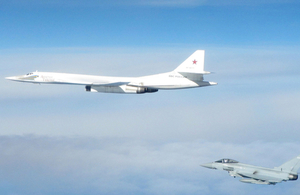


News story: UK fighter jets intercept Russian bombers approaching UK airspace

UK fighter jets intercept Russian bombers approaching UK airspace

Today (20 September), RAF Quick Reaction Alert (QRA) Typhoon fighter aircraft scrambled from RAF Lossiemouth to monitor two Russian planes approaching UK airspace. The Russian Blackjacks long-range bombers were not talking to air traffic control, making them a hazard to all other aviation.

Defence Secretary Gavin Williamson said:

Russian bombers probing UK airspace is another reminder of the very serious military challenge that Russia poses us today.

We will not hesitate to continually defend our skies from acts of aggression. Once again the rapid reactions of our RAF have demonstrated how vital our Armed Forces are in protecting Britain.

The RAF worked closely with NATO partners to monitor the jets as they passed through a variety of international airspace before they were intercepted by the RAF over the North Sea. Subsequently, our fighters escorted the Russian Blackjacks north, out of the UK’s area of interest. At no time did the Russian bombers enter UK sovereign airspace.

RAF QRA was launched today because the Russian Military aircraft were not talking to air traffic agencies. The RAF routinely intercept, identify and escort Russian aircraft that transit international airspace within the UK’s area of interest and continue to be on call; 24/7, 365.

Published 20 September 2018


Correspondence: eAlert: 20 September 2018 – New guidance on managing ash in woodland in light of ash dieback

Contents

  • New guidance on managing ash in woodland in light of ash dieback
  • A reminder of when and how to claim force majeure


Press release: Foreign Secretary statement to media on his visit to Burma

placeholder

Foreign Secretary Jeremy Hunt has today (20 September) completed a two day visit to Burma which included talks with State Counsellor Aung San Suu Kyi and a tour of northern Rakhine, the area where thousands of Rohingya have fled.

Speaking to media, Foreign Secretary Jeremy Hunt said:

Burma is a country that has made some important steps towards democracy in the last few years, holding their first democratic elections three years ago. Although they are not fully democratic they have been moving in the right direction.

On the Rohingya crisis, the Foreign Secretary said:

I went to Rakhine State myself to see what had happened. What is essential now is that the perpetrators of any atrocities are brought to justice, because without that there can be no solution to the huge refugee problem. We will use all the tools at our disposal to try and make sure there is accountability.

I’ll be going to New York next week for the United Nations General Assembly to discuss what we should do. Britain can’t act alone. We need to act in concert with other countries – we are a believer in the international rules based order. It’s incredible important for all of us that those perpetrators face justice.

On the first day of his visit, Foreign Secretary Hunt met human rights defenders from the Association for the Assistance of Political Prisoners and toured the Shwedagon Pagoda in Rangoon.

Further information

Published 20 September 2018


News story: National Drought Group – Chairman’s Statement – September 2018

The National Drought Group (NDG), chaired by Environment Agency Chief Executive Sir James Bevan, brings together government departments, water companies, environmental groups and others to coordinate action to maintain water supplies and manage the other risks associated with drought.

The NDG convened on Thursday 20 September to assess the present situation and review the action being taken to reduce the risk of drought in 2019.

CURRENT SITUATION AND PROSPECTS:

The National Drought Group noted that despite recent rainfall and cooler weather, a significant number of reservoirs in the area around Manchester, Sheffield and Stoke-on-Trent are very low. United Utilities, Yorkshire Water and Severn Trent Water are all taking action to reduce water taken from these sources. It is unlikely that restrictions on customers will be used this autumn.

Recent heavy rainfall across Cumbria has improved the water resources situation for some reservoirs operated by United Utilities. However, there is continuing localised drought risk in some areas of the Pennines, Yorkshire, Manchester, Sheffield, Stoke and parts of central England.

Water companies need higher-than-average rainfall over the next few months to ensure good water supplies next spring and summer, and avoid the risk of water restrictions then.

ACTION TO BE TAKEN:

The water companies set out the action they will be taking to meet this challenge. This includes putting more resources into efforts to reduce leakage, seeking to capture and store as much water as possible going into the autumn, exploring the opportunities for water transfers between companies, improving and implementing their drought plans and other operational contingency measures. The action also covers preparing applications for drought permits should these prove necessary in the coming months, and continuing to communicate with customers the latest water resources position and encouraging their customers to use water wisely, including by encouraging moves to more metering.

The Environment Agency confirmed that it will sustain its enhanced activity to seek to ensure water users and the environment get the water they need and:

  • Ensure they are responding quickly to emergencies
  • Work with the water companies to ensure they are following their drought plans and implementing all agreed actions in a timely way
  • Work proactively with farmers and other water users who abstract water under licence from the Environment Agency to seek to ensure they get the water they need whilst sustaining environmental needs
  • Continue to actively monitor the weather, water situation and the environment. Manage down demand and protect the environment, using regulatory powers as necessary
  • Assist the Canal and Rivers Trust with water supplies for canal networks to avoid impacts to those who use canals for homes
  • continue to operate its own water transfer schemes where necessary to maintain river flows for water supply and the environment
  • Communicate with those who use the environment to help identify potential impacts as quickly as possible
  • Continue to respond to drought-related and other environmental incidents

The Environment Agency is working actively with the water companies and others to balance the needs of the public, industry and farmers, and the environment; and to ensure long-term water resilience. Following the National Drought Group, Sir James Bevan will chair the first steering group meeting of the water national water resources framework meeting, which will look at long-term pressures facing all sectors, and how to express these to ensure greater water resilience in the future.

Other NDG members set out the action they will be taking to preserve water supplies, sustain economic and leisure activity and protect as far as possible the environment, rivers, lakes and wildlife.

CONCLUSIONS AND NEXT STEPS

The NDG confirmed that there is no threat to essential water supplies. But a drier than average winter would bring the risk of restrictions on water company customers. It would also prove another challenging summer for farmers next year and cause further environmental impacts across the country. NDG members agreed to continue to work together to manage down these risks in the short to medium term and to balance the needs of people, the economy and the environment; and to work collaboratively to enhance the country’s long-term resilience to drought and water shortages.

The NDG will meet again on 19 November to take stock and agree any further necessary measures going into winter.