Press release: Defra approves sale of Sequoia for use only in greenhouses

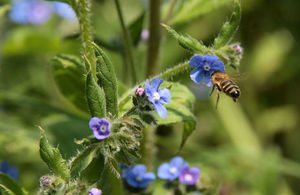
bee

Sequoia contains the active ingredient Sulfoxaflor which was approved by the EU in 2015 following assessment by the European Food Safety Authority (EFSA).

The Government’s decision follows a full assessment by the Health and Safety Executive (HSE) and the UK Expert Committee on Pesticides (ECP).

A Defra spokesperson said:

The Health and Safety Executive and the Expert Committee on Pesticides recommended that Sequoia should be authorised for use in greenhouses as they assessed the risk to bees and pollinators to be low. In line with commitments to be led by the science, Ministers have accepted this recommendation.

Both organisations concluded Sequoia used in greenhouses meets the requirements for authorisation as the risk to pollinators is low.

Our priority is the protection of people and the environment which is why decisions on the use of pesticides are based on a careful scientific assessment of the risks.

This decision is consistent with the EU’s recent decision on neonicotinoids, which bans the outdoor use of neonicotinoids while allowing continued use in greenhouses. Further information is online.

Published 11 October 2018


Press release: University laundry merger broken up by CMA

The decision by the Competition and Markets Authority (CMA) comes following an in-depth investigation into market leader JLA’s takeover in May 2017 of its closest competitor Washstation. The 2 firms supply managed laundry services to higher education providers including universities, colleges and student accommodation providers.

The merger was investigated by a CMA group of independent panel members which today published its final decision. The group found a substantial loss of competition resulting from the merger and that customers may be expected to pay more for, or receive lower quality, managed laundry services.

Findings show that other firms offering laundry services to higher education providers are not currently able to compete effectively with JLA / Washstation. The investigation also found that any future growth by these smaller rivals would be unlikely to offset the loss of competition resulting from the merger, either sufficiently or quickly enough. Additionally, it was found that companies providing laundry services in other sectors, such as healthcare or leisure, would find it difficult to enter the higher education sector and compete effectively against JLA / Washstation in the foreseeable future.

In order to address the loss of competition resulting from the merger, the CMA has decided that JLA must sell Washstation’s higher education business to a new owner to be approved by the CMA.

Stuart McIntosh, Inquiry Chair, said:

Our decision will preserve competition and choice for universities and other providers of student accommodation.

The CMA thoroughly monitors mergers across the UK. Where it finds concerns it will take action, and has the ability to reverse completed mergers to ensure that customers are not worse off.

Full information on the merger investigation can be found on the case page.

Notes for editors

  1. The CMA is the UK’s primary competition and consumer authority. It is an independent non-ministerial government department with responsibility for carrying out investigations into mergers, markets and the regulated industries and enforcing competition and consumer law.
  2. JLA and Washstation are both UK companies predominantly active in the UK.
  3. JLA acquired Washstation in May 2017. In December 2017, the CMA called in the merger for investigation. At the end of the initial (phase 1) review, JLA offered no undertakings to address the competition concerns found in the CMA’s phase 1 decision, and the CMA therefore referred the case for an in-depth (phase 2) investigation on 16 April 2018.
  4. On 10 August 2018 the group of independent panel members published its provisional findings and notice of possible remedies and invited views. The group considered responses to its provisional findings and proposals on remedies.
  5. The CMA’s functions in phase 2 merger investigations are performed by inquiry groups chosen from the CMA’s panel members. The appointed inquiry group are the decision-makers on phase 2 investigations.
  6. The CMA’s panel members come from a variety of backgrounds, including economics, law, accountancy and/or business; the membership of an inquiry group usually reflects a mix of expertise and experience.
  7. The members of this inquiry group are Stuart McIntosh (Inquiry Chair), Anne Fletcher, Ulrike Hotopp and Sheila McClelland.
  8. Media enquiries to the CMA should be directed to press@cma.gsi.gov.uk or 020 3738 6460.


Press release: Foreign Secretary pledges to do everything possible to protect wild animals

In the last five decades, the world has lost nearly 60 percent of its vertebrate animals. In case you believe that is just another statistic, think about what it means.

The magnificent wildlife that humanity has inherited – the animals that enliven our imaginations, enhance the beauty of the world and provide livelihoods for millions of people – are disappearing with terrifying speed. We have lost two thirds of Africa’s elephants since the 1970s. We are down to the last 80,000 giraffes and the final 20,000 lions. The world’s tiger population has dropped by 95 per cent in the last century.

If we go on like this, our grandchildren may only know of these animals from David Attenborough documentaries.

So today, I will open a conference in London attended by 80 countries on how to combat the illegal wildlife trade. The criminal gangs who smuggle horns and tusks pose one of the greatest threats to the survival of wildlife. They target some of the poorest countries in the world, spreading corruption and depriving governments of desperately needed revenues that could be used for schools and hospitals.

The World Bank estimates that governments lose as much as $15 billion (£11 billion) every year because of illegal logging. And the same criminal networks that traffic the body parts of wild animals may also deal in guns and drugs and people.

This week, I have joined Penny Mordaunt, the International Development Secretary, to announce a new British initiative to target the traffickers by helping countries in Africa and Asia to launch investigations and seize assets. We are sending more British diplomats to Africa, including experts on combating the illegal wildlife trade.

Last year, our Parliament passed the Criminal Finances Act, strengthening the British Government’s powers to combat money laundering and freeze unexplained wealth. Since then, we have placed another law before Parliament that would ban domestic ivory sales.

We will also contribute £250 million to the United Nations Global Environment Facility by 2022. As part of this, the Global Wildlife Programme has worked with Kenya on a new law imposing tougher punishments for wildlife crimes, including life imprisonment for anyone caught smuggling the body parts of an endangered species.

We are using our aid budget to help the UN Office of Drugs and Crime to strengthen the ability of developing countries to enforce their laws against the wildlife trade and improve their investigative skills.

When laws are enforced and smugglers prosecuted, wildlife populations can and do recover. The number of wild tigers in Nepal, for example, has doubled in the last nine years.

The London conference will be the biggest international gathering of its kind ever held. My aim is for Britain to do everything possible to protect wild animals for the sake of our grandchildren. If we failed to act, quite simply we would never be forgiven.


News story: Dounreay awards £22m waste store contract

The project will see an existing above ground intermediate level waste store extended to house intermediate level waste that is expected to be processed and packaged as part of the site’s clean-up. Passively safe containers will be kept in long-term storage within the facility in accordance with Scottish Government policy.

Work is expected to begin this month and take around 3 years to complete.

Construction Director David Hubbard said:

This contract represents an important step in the long-term management of the site’s waste. It is just one of several contracts being awarded to ensure we continue to reduce hazards and make progress towards the site’s interim end state. The next few years will see us construct several new facilities to support the programme as well as starting to demolish a number of redundant structures.

Around 100 people are expected to work on the project. GRAHAM has also committed to a series of community development initiatives, such as work placements and the recruitment of trainee positions, as part of Dounreay’s requirement for its supply chain partners to consider how they can support Caithness and North Sutherland’s socio-economic agenda. It plans to work with local training suppliers to develop its workforce involved in the project, including supporting some to achieve NVQ level 2 and above qualifications.

Leo Martin, GRAHAM Managing Director – Civil Engineering, added:

This is an important project on behalf of Dounreay and will support the continued transformation of the nuclear site into a safe, secure area. We have already established a strong partnership with Dounreay Site Restoration Limited (DSRL), stretching back to 2012, and will once again apply our collaborative approach and technical expertise to maximise the success of this project.

This will be the latest in a series of facilities built to safely manage legacy waste at the Caithness plant. Two disposal vaults for low level waste have already been successfully constructed adjacent to the site by the same contractor.

Dounreay is Scotland’s largest nuclear decommissioning project and is widely recognised as one of Europe’s most complex nuclear closure programmes. The work is being delivered by DSRL, a company owned by Cavendish Dounreay Partnership, on behalf of the Nuclear Decommissioning Authority.


Press release: Record high levels of severe obesity found in year 6 children

New data published today show the rate of severe obesity among year 6 children (aged 10 to 11) has increased by more than a third since 2006 to 2007 to 4.2%, its highest rate ever.

The latest data from the national child measurement programme (NCMP), overseen by Public Health England (PHE), also shows stubborn inequalities persist, with obesity in the poorest areas more than double that of the richest areas.

This highlights the importance of the government’s steps to tackle childhood obesity. The most important aspects of these are overseen by PHE, including its challenge to the food industry to reduce 20% of sugar and calories in everyday foods consumed regularly by children.

The NCMP provides the most comprehensive picture of the state of childhood obesity for the 2017 to 2018 school year in England. It found:

  • the proportion of overweight and obese children in reception year (aged 4 to 5) has remained stable at 22.4% (equal to 136,586 children)

  • for year 6 children, it is 34.3% (equal to 197,888 children) compared to 31.6% in 2016 to 2017

  • in the most deprived areas, 12.8% of children in reception year are obese, compared to 5.7% in the least deprived areas

  • in year 6 it is 26.8% in the most deprived areas, compared to 11.7% in the least deprived areas

  • in both age groups, severe obesity is 4 times higher in deprived areas

This week, PHE met with major trade bodies, retailers, manufacturers, out of home sector businesses – including takeaways, cafes and pubs – and public health NGOs, to discuss the next phase of the calorie reduction programme.

The second chapter of the government’s childhood obesity plan was published in June 2018 and includes mandatory calorie labelling in the out of home sector, a restriction on price promotions on unhealthy foods and a ban on the sale of energy drinks to children.

Steve Brine, Public Health Minister said:

Obesity is a problem that has been decades in the making – one that will take significant effort across government, schools, families and wider society to address. We cannot expect to see a reversal in trends overnight – but we have been clear that we are willing to do whatever it takes to keep children healthy and well in this country.

We have already removed tonnes of sugar from children’s diets through the sugar tax, which has funded vital school sports and breakfast programmes, and this summer we announced the second chapter of our childhood obesity strategy with a series of bold plans to halve childhood obesity by 2030.

Dr Alison Tedstone, Chief Nutritionist at PHE, said:

These continuing high rates of childhood obesity, combined with widening health inequalities, highlight why government is taking bold steps to tackle this crisis.

This threat to our children’s health has been decades in the making – we’re moving in the right direction but reversing it will not happen overnight.

Children with excess weight are more likely to suffer from poor self-esteem, bullying and stigma in childhood. They are also more likely to be overweight or obese as adults, increasing their risk of preventable illnesses including heart disease, type 2 diabetes and some cancers.

PHE’s Change4Life campaigns help millions of families to make healthier choices through meal swap suggestions and the Food Scanner app, which reveals the sugar, salt and fat in foods and drinks. Change4Life also supports schools to embed healthier habits into everyday school life.

Eustace De Sousa, national lead for children at PHE, said:

These figures are a stark reminder that addressing childhood obesity is everyone’s problem.

We owe it to current and future generations to act now. Everyone – from the food industry to local councils – should play their part, but families can also make positive changes with help from Change4Life.

Background

  1. Latest NCMP data is published by NHS Digital.
  2. Severe obesity is BMI on or above the 99.6th percentile for a child’s age and sex.
  3. PHE published Trends in children’s body mass index between 2006 to 2007 and 2016 to 2017 in July 2018.
  4. PHE published Childhood obesity: a plan for action, chapter 2 in June 2018.
  5. PHE published Sugar reduction: report on first year progress in May 2018.
  6. PHE published Calorie reduction: the scope and ambition for action in March 2018.