Press release: New gritters take to the road

The first delivery of the new gritters took place in October and will improve safety for drivers and workers due to the vehicles improved technology, ergonomics and enhanced visibility.

Despite weighing 26 tonnes and measuring a maximum of 2.5 meters wide, there have been a number of incidents where gritters have been struck by other vehicles.

Research carried out by Transport Research Laboratory (TRL) shows that vehicles stand out more if painted in one block colour and are solid in shape, which is where the new design has come from.

The new vehicles also contain innovative technology which includes being able to pre-programme them with information specific to each gritting route. This enables salt to be spread onto the road automatically, taking into account any specific requirements for bridges, landscape and other road features, allowing drivers to give their full attention to driving at all times.

Two gritters ready to go out on the road

Our winter fleet manager Jane Wilkins said:

Safety is our top priority and we are always looking at ways we can improve our winter resilience. Using the research carried out by TRL and our own data, we have looked carefully at the number of incidents involving gritters to see what more can be done to improve safety and the service we provide.

The roll out of this £30 million programme started this year with 34 new vehicles in East Anglia. The remainder of the 157 vehicles, will be replaced over the next two years.

We’re working closely with gritter manufacturer Romaquip on the roll-out of the new fleet.

Romaquip technical director Stephen McKeown said:

We are excited to be working with Highways England, manufacturing a new generation of winter vehicles with numerous safety and technical advances. It is a pleasure to work with an organisation that strives to develop and improve their service, actively partnering with us to achieve these goals.

It is clear to see that the specification of these vehicles has been derived from consciously deciding to improve safety for both operators and other road users, and that the innovation to improve efficiency and functionality has also been thoroughly considered.

Romaquip is committed to delivering the best quality machines to all of our customers, we welcome this improvement and look forward to working with Highways England over the years to come.
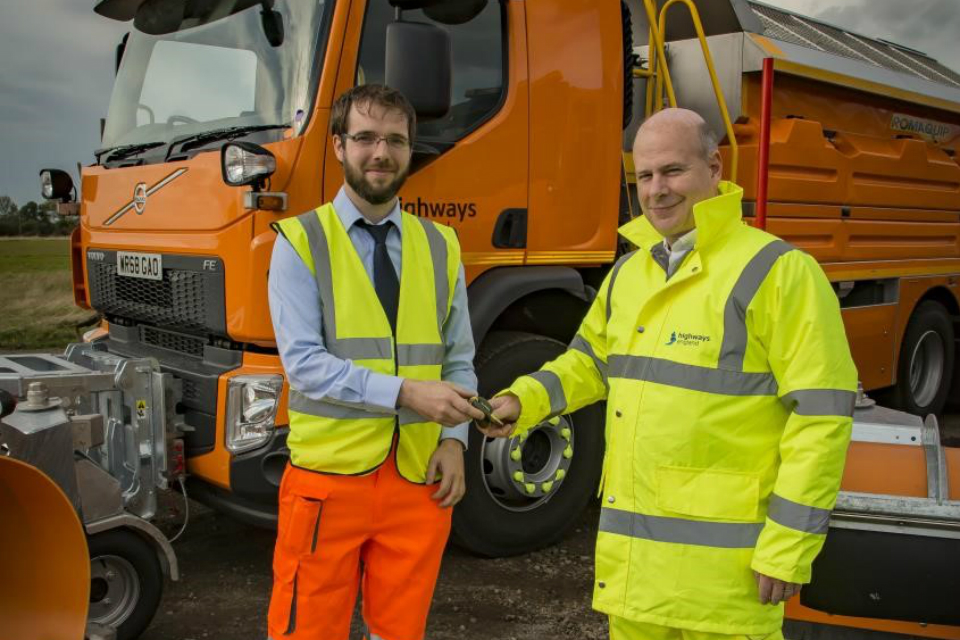
Romaquip technical director Stephen McKeown hands over the keys to Nick Harris, Highways England's executive director of operations
Romaquip technical director Stephen McKeown hands over the keys to Nick Harris, Highways England’s executive director of operations

We currently have 535 winter vehicles patrolling the 4,400 miles of motorways and major A roads across the country.

General enquiries

Members of the public should contact the Highways England customer contact centre on 0300 123 5000.

Media enquiries

Journalists should contact the Highways England press office on 0844 693 1448 and use the menu to speak to the most appropriate press officer.


Press release: New gritters take to the road

The first delivery of the new gritters took place in October and will improve safety for drivers and workers due to the vehicles improved technology, ergonomics and enhanced visibility.

Despite weighing 26 tonnes and measuring a maximum of 2.5 meters wide, there have been a number of incidents where gritters have been struck by other vehicles.

Research carried out by Transport Research Laboratory (TRL) shows that vehicles stand out more if painted in one block colour and are solid in shape, which is where the new design has come from.

The new vehicles also contain innovative technology which includes being able to pre-programme them with information specific to each gritting route. This enables salt to be spread onto the road automatically, taking into account any specific requirements for bridges, landscape and other road features, allowing drivers to give their full attention to driving at all times.

Two gritters ready to go out on the road

Our winter fleet manager Jane Wilkins said:

Safety is our top priority and we are always looking at ways we can improve our winter resilience. Using the research carried out by TRL and our own data, we have looked carefully at the number of incidents involving gritters to see what more can be done to improve safety and the service we provide.

The roll out of this £30 million programme started this year with 34 new vehicles in East Anglia. The remainder of the 157 vehicles, will be replaced over the next two years.

We’re working closely with gritter manufacturer Romaquip on the roll-out of the new fleet.

Romaquip technical director Stephen McKeown said:

We are excited to be working with Highways England, manufacturing a new generation of winter vehicles with numerous safety and technical advances. It is a pleasure to work with an organisation that strives to develop and improve their service, actively partnering with us to achieve these goals.

It is clear to see that the specification of these vehicles has been derived from consciously deciding to improve safety for both operators and other road users, and that the innovation to improve efficiency and functionality has also been thoroughly considered.

Romaquip is committed to delivering the best quality machines to all of our customers, we welcome this improvement and look forward to working with Highways England over the years to come.

Romaquip technical director Stephen McKeown hands over the keys to Nick Harris, Highways England's executive director of operations
Romaquip technical director Stephen McKeown hands over the keys to Nick Harris, Highways England’s executive director of operations

We currently have 535 winter vehicles patrolling the 4,400 miles of motorways and major A roads across the country.

General enquiries

Members of the public should contact the Highways England customer contact centre on 0300 123 5000.

Media enquiries

Journalists should contact the Highways England press office on 0844 693 1448 and use the menu to speak to the most appropriate press officer.


News story: Quantum leap: prototype devices will be ready in 2 years’ time

Advancements in quantum technologies are predicted to have a big impact on our lives – from creating navigation systems that can operate without GPS to new cameras that can see around corners.

To help accelerate progress in this field, the government is funding 4 projects that will use the latest quantum technology to develop prototype devices. Projects will receive a share of £20 million from the Industrial Strategy Challenge Fund, delivered by UK Research and Innovation.

It follows the Chancellor’s announcement of up to £235 million of further support to develop the next generation of transformative quantum technologies in the Budget 2018.

This includes a new national quantum computing centre, additional investment in the next wave of the Industrial Strategy Challenge Fund, and a training and skills package.

Leading the development of quantum technologies

Projects will receive funding to develop quantum prototypes in 4 fields.

Surveying underground before you start digging

RSK will lead a project with a consortium of businesses and universities to use quantum sensors to detect objects underground. Initially, the technology will be used by road-working companies, but it could also be used in the rail network.

Precise timing

Manufacturer Teledyne e2V (UK) will lead a project to develop a pre-production prototype of a miniature atomic clock.

It will enable services such as energy supply, transport and mobile communications to function in the event of disruption to the current standard timing service, Global Navigation Satellite Systems (GNSS).

Secure encryption

Toshiba Research Europe will lead a project to develop the UK supply of low-cost integrated chips, which will enable more secure transmission of data using new encryption technologies.

Keeping data safe

Another encryption project will be led by ArQit. It will create advanced receivers to pick up quantum key signals. These keys are used to keep data safe by using quantum technology to let companies know if the data they are transmitting has been accessed.

Making the impossible possible

Business Secretary Greg Clark said:

There is a huge future for cutting-edge science in the UK, which is why we are investing in ambitious technologies like quantum in our modern Industrial Strategy.

The projects announced today will benefit ordinary people around the country, from easing traffic congestion to offering more data security for online transactions.

Quantum technology has already developed sensors that can see around corners, and make the impossible, possible. We are backing world-leading innovators to continue this important work.

Working across industry, academia and government

Roger McKinlay, Challenge Director for Quantum Technologies at UK Research and Innovation, said:

The rise of quantum technologies will bring a huge impact on all our lives. In order to secure the UK lead in this area, and make sure that companies based here and UK jobs take a significant share of this opportunity, we must continue to work across industry, academia and government to achieve innovation.

This is why the government’s investment of £20 million through these 4 successful, pioneer challenge-funded projects will put prototype quantum-enabled devices into the hands of users.


News story: Government sets out plans to support underperforming schools

Underperforming schools in England are set to receive extra support under Government plans to raise standards in classrooms across the country.

Following a pledge by the Secretary of State to simplify the school accountability system, giving teachers freedom to get on with their job without interference, Schools Minister Lord Agnew has today (9 November) set out how the department will support schools that are underperforming and how they will be identified.

From today, the following measures will be used to identify schools that need additional support. They include:

  • the floor and coasting standards being used as ways to identify schools that need help, rather than as triggers for intervention ahead of an academy conversion;
  • where a school is struggling it will receive support from a high-performing school leader, as well as access to up to £16,000 for the small number of schools judged as ‘Requires Improvement’ in their last two Ofsted inspections; and
  • the ‘coasting’ measure will no longer be used as the starting point of a formal intervention – this was a key pledge by the Education Secretary during a speech to school leaders earlier this year.

Regional Schools Commissioners will no longer issue warning notices to schools on educational grounds unless they have been rated inadequate by Ofsted.

Today’s changes come ahead of a formal consultation in the New Year looking at whether the floor and coasting standards used to judge school performance should be replaced by a single measure.

Minister for the School System, Lord Agnew, said:

Standards in our schools have risen, with the proportion of pupils in good or outstanding schools up from 66% in 2010 to 86% in 2018.

Today’s changes will simplify the school accountability system so teachers and school leaders know where they stand and simplify a system that we know can be a concern amongst the profession.

Where a school is struggling, we will aim to take swift action, providing practical hands on support and, where necessary, more formal steps.

The support that we are offering will be focused around delivering support that can be embedded into a school’s teaching programme for the long term.

The changes confirmed today will make the school system easier for school leaders and parents to understand.

Schools that meet the criteria for extra support will be able to do so in two ways:

  • Up to three days’ support from a designated National Leader of Education (NLE) who will work with the senior leadership of the school or trust to identify their specific needs and ways these can be addressed through DfE funded programmes; and
  • For those also judged as ‘Requires Improvement’ in their last two Ofsted inspections, an additional offer of up to £16,000 that can be put towards the costs of implementing the activity agreed between the NLE and school.

Paul Whiteman, General Secretary of the National Association of Head Teachers (NAHT), said:

Today’s announcement is a welcome clarification of the promises made by the Secretary of State at our annual conference in May this year. It also marks a significant point in the ongoing work between NAHT and the DfE to address some of the big concerns of school leaders.

Accountability is obviously a key concern, and today’s announcement clears up some of the confusion regarding the roles of Ofsted and RSCs, as well as providing much needed reassurance that schools seeking to improve will receive support rather than sanction. This is an important step forward, and consistent with the findings of our Improving School Accountability report which was published in September.

Richard Gill, National Leader of Education and Member of the Teaching Schools Council, said:

This programme of support, coordinated by the Teaching Schools Council, will ensure that there is greater collaboration across our regions with the aim of providing bespoke support where needed, ensuring that more children and young people can attend a great school.

This will also support the self-improving system which relies on effective leaders working beyond their own schools to make improvements to the wider school landscape.

Today’s announcements follow the Education Secretary’s commitment with teaching unions and Ofsted to strip away unnecessary workload for teachers, and are part of a drive led by the Education Secretary to trust the best school leaders to make decisions in their staff and pupils’ best interest.


News story: Cutting-edge digital map to boost Midlands engine

Local business and council leaders across the Midlands will receive up to £1.5 million to pioneer cutting-edge technology to identify the best investment and regeneration opportunities across the area.

The Midlands Engine Partnership, in collaboration with the Geospatial Commission, will use the funding to develop a digital map of the region combining vast amounts of existing public and private sector data linked to location – covering infrastructure, local services, housing and other developments.

Bringing this information about the Midlands together in one place for the first time will allow for better, faster and more informed decisions around health, education, housing, trade and tourism.

The move will help create jobs, benefit the local economy and increase productivity. For example, land earmarked for housebuilding could be identified by other sectors as an opportunity to invest in developing nearby public assets, such as a school or office complex, as well as installing next-generation technologies, such as 5G connectivity.

On a visit to Derby, the Exchequer Secretary to the Treasury, Robert Jenrick, said:

In last week’s Budget, the Chancellor pledged to fuel the Midlands Engine and back the region’s growth and today we are building on that.

By opening up this valuable data to both investors and developers we will create greater opportunities across the Midlands in vital areas like housebuilding.

Through the harnessing of this data, we are encouraging both public and private sectors to work in smarter, more joined-up ways that will create jobs, boost productivity and grow the economy here in Derby and across the Midlands.

The work is part of the government’s drive to maximise the value of data linked to locations, which could generate £11 billion a year. The work is led by the Geospatial Commission and was announced by the Chancellor in November 2017.

Cabinet Office Minister for Implementation, Oliver Dowden MP, said:

This project will further cement the UK’s place as a geospatial world leader, once again showing our commitment to providing more opportunities for tech companies to flourish, including small businesses.

Technology using this location data is revolutionising our economy. From navigating public transport to tracking supply chains and planning efficient delivery routes, these digital services are set to become part of everyday life and business in the Midlands.

Midlands Engine Chairman Sir John Peace said:

This really is great news for everyone in the Midlands Engine Partnership. This will fund an invaluable one-stop digital map for local authorities that will allow them to work much faster and more efficiently.

At the Midlands Engine we have committed to supporting the build of 600,000 new homes in the next 15 years. This is an ambitious target and the tool will support local authorities by giving them the information that they need to identify suitable development sites and work in a more joined-up way.

The mapping tool will also allow faster and more informed decisions with ready access to maps of utilities, surgeries and educational establishments.

Further information

  • The Chancellor announced in November 2017 a new Geospatial Commission to maximise the value of all UK government data linked to location, and to create jobs and growth in a modern economy.

  • Funding from the Geospatial Commission is subject to business case approval, and will cover initial start up costs and the first year of operation, with a view to the map becoming self-sustaining after this point

  • A similar initiative was recently undertaken by Greater Manchester Combined Authority, which developed a digital map of assets and investment. It is estimated that the map saves planners and developers between one and three hours every time it is used. See the Greater Manchester Open Data Infrastructure Map online.

  • Through the Midlands Engine Strategy, the government has set out its commitment to making the Midlands an even better place to live, work, study and do business. The strategy, launched last year, includes £20 million for the Midlands Skills Challenge to make sure that everyone across the region is equipped with the skills they need to thrive, as well as £4 million to support the Midlands Engine Partnership.

  • The government is also backing the Midlands through investment in vital transport links, such as HS2 which will include a new East Midlands station between Nottingham and Derby.

  • Last year, the West Midlands Combined Mayoral Authority received £250 million as part of the Transforming Cities Fund towards upgrading transport infrastructure. At the Budget, this fund was extended to 22/23, providing a further £71.5 million for the West Midlands. The Derby and Nottingham city region, Leicester and Stoke-on-Trent were recently shortlisted for a share of the £1.3 billion competitive element of the fund.