Press release: Government uses innovative tech companies to tackle rural isolation and loneliness
Five tech companies have been awarded contracts to use cutting-edge technology to tackle the problem of rural isolation and loneliness.
Five tech companies have been awarded contracts to use cutting-edge technology to tackle the problem of rural isolation and loneliness.
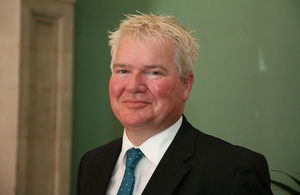
Mr Hugh Philpott OBE has been appointed Her Majesty’s Ambassador to Turkmenistan in succession to Miss Thorda Abbott-Watt. Mr Philpott will take up his appointment in Summer 2019.
Full Name: Hugh Stanley Philpott OBE
Married to:Janine Frederica Philpott
Children: One
| 2015 to present | Dushanbe, Her Majesty’s Ambassador |
| 2014 to 2015 | Temporary Assignments including as Charge d’Affaires in Astana and Crisis Manager and resilience Deputy Head of Mission in Kyiv |
| 2012 to 2013 | Language training (Russian) |
| 2008 to 2012 | FCO and Department for Business, Innovation and Skills, Head of Science & Innovation Network and Deputy Head of International Science & Innovation Unit |
| 2007 to 2008 | FCO, Deputy Head of Science & Innovation Group |
| 2005 to 2007 | FCO, Deputy Head of Overseas Territories Department |
| 2001 to 2004 | Muscat, Deputy Head of Mission |
| 1999 to 2001 | FCO, Head of Bermuda and Caribbean Section, Overseas Territories Directorate |
| 1997 to 1999 | Department for International Development, Programme Manager, Russia, East Europe and Central Asia Department |
| 1991 to 1993 | FCO, Desk Officer, Bermuda, Turks & Caicos Islands, Anguilla and the Cayman Islands |
| 1990 to 1991 | FCO, Assistant Desk Officer for Israel and Lebanon |
| 1988 to 1990 | Iraq, Third Secretary |
| 1987 to 1988 | Language training (Arabic) |
| 1985 to 1987 | Budapest, Vice-Consul |
| 1984 to 1985 | Language Training (Hungarian) |
| 1982 to 1984 | Oslo, Pro-consul |
| 1980 to 1982 | FCO, Assistant Desk Officer Security Dept |
| 1980 | Joined FCO |
Published 27 November 2018
The Government has signalled its intention to deliver a landmark sector deal for the UK tourism industry to attract more domestic and overseas visitors and help drive major economic growth.
Speaking to the Tourism Industry Council, made up of leading members of the tourism industry and government, the Secretary of State for Digital, Culture, Media and Sport Jeremy Wright confirmed the Government will begin negotiations with the sector on an ambitious Industrial Strategy sector deal that will benefit the whole country.
As part of this process, he has called upon the industry to respond with a renewed commitment to promote its offer throughout the year, not just in the peak summer months, and increase clear career paths.
The sector has been asked to look at the key themes of:
The announcement follows an initial proposal submitted by tourism industry leaders, led by Steve Ridgway, Chair of the British Tourist Authority. It also comes as the Government marks one year since the launch of its modern Industrial Strategy, which aims to boost productivity by backing businesses to create good jobs and increase the earning power of people throughout the UK with investment in skills, industries and infrastructure.
Jeremy Wright, Secretary of State for Digital, Culture, Media and Sport, said:
The tourism industry is one of the UK’s most successful exports. Every time a leisure or business traveller chooses to visit, it brings investment in our economy and supports jobs across the country. But we are in a competitive global market and we need to be ambitious to maintain the fantastic growth we have seen in recent years.
I want to make sure that we continue to attract visitors to all parts of the UK throughout the year, who are welcomed by a highly-trained and highly-motivated workforce.
A Sector Deal is a way to deliver this, and the industry have put forward some strong ideas to Government. We are ready to formally negotiate on a deal which can boost productivity in this crucial sector.
I want to achieve the best deal possible for tourism and know that the industry will respond with renewed energy to achieve this.
UK tourism is now worth over £66 billion a year to the economy. The sector employs 1.6 million people, covering beaches and activity parks, to hundreds of thousands of heritage sites.
Annual statistics released in July revealed that a record-breaking 39.2 million visits were made by overseas tourists to the UK in 2017, with the latest domestic tourism figures showing that residents across Great Britain took a total of 120.7 million overnight visits to destinations in England, Scotland and Wales in 2017.
There are more than 11 million disabled people in the UK with a combined spending power of their households, ‘the purple pound’, standing at around £250 billion. There are a number of business benefits for ensuring that disabled people’s needs are catered for – from improved training on disability awareness for staff to adaptations to ensure facilities are accessible.
A potential tourism sector deal is an opportunity for driving change, through workforce development and consequent productivity gains, resulting in perception changes of hospitality and tourism as a career for life.
British Tourist Authority Chair Steve Ridgway CBE, former Chief Executive of Virgin Atlantic Airways, who is leading the UK tourism industry’s bid for a sector deal under the UK Government’s Industrial Strategy said:
Tourism is an economic powerhouse, a growing industry with huge potential to scale-up productivity, so it is very welcome news that an official negotiation for a sector deal has today been confirmed by the UK Government.
Securing this deal will be a game-changer for the industry, spelling a step-change in how we underpin the success of tourism for a generation, fixing issues from skills and productivity to extending the season year-round and building stronger tourism destinations up and down the country. And it will be a game-changer for the economy with a sector deal growing the value of the industry and increasing employment in tourism.
One of the UK’s most valuable export industries, tourism needs no trade deals to attract overseas investment. It is also a fiercely competitive global industry and a sector deal moves tourism right up the UK Government’s agenda as a priority for future economic planning, ensuring we continue to compete as a world-class destination for all visitors.
The Secretary of State also challenged the tourism industry to use the sector deal negotiations as an opportunity to deliver more collaborative data sharing with VisitBritain, around visitor figures, behaviours and audience analysis. This is to help take a more strategic approach to promotional activity and a more united approach to environmental protection.
Negotiations will take place between Government and the Sector, following the meeting of the Tourism Industry Council today.
In 2017, EU member states accounted for 75% of the 72 million visits abroad by UK residents and 65% of the UK’s 39 million inbound visits were from EU residents.
Six sector deals between Government and industry have been published over the past year – from construction and automotive, to nuclear and the creative industries, including £1.9 billion of investment in life sciences and £1 billion for artificial intelligence. Sector deals are designed to attract investment and growth, and ensure we have the skilled, diverse workforce we need for the future.
Sources of latest tourism figures:
Good evening everyone and welcome to Downing Street. As always at events like this it’s a real pleasure to share this remarkable house with some truly remarkable people. But I confess that, tonight, my emotions are somewhat mixed.
Throughout 2018, I’ve had the privilege of taking in part in many celebrations of women and women’s rights.
Events marking the centenary of British women winning the vote. The unveiling of the Millicent Fawcett statue. An unprecedented gathering of women MPs from around the world.
But the joy of those occasions has been tempered by the resurgence of two age-old hatreds that many had dared to hope were becoming a thing of the past.
2018 was the year in which Claire Kober, who is here today, stepped down as a council leader after facing a torrent of personal abuse in which, as she said, “the only thing worse than the sexism was the antisemitism”.
It was the year in which journalist Karen Glaser felt compelled to write that “When my … mother came to Britain in the Sixties she stopped feeling scared of being Jewish. But now, 50 years later, she was feeling frightened again.”
And it was the year in which Parliament heard women MPs, many of whom are here today, describing the deluge of vile misogynistic and antisemitic threats they receive on a near-daily basis.
The research published at today’s conference, showing that Jewish women politicians are more likely to attract the attentions of far-Right hate groups, was deeply disturbing. But I doubt it came as much of a surprise to those who have been on the receiving end.
In both data and anecdote, the evidence is clear: in 2018, in the United Kingdom, Jewish women are increasingly coming under dual attack. Abused for being women and abused for being Jewish.
These attitudes are not limited to the far Right. As is so often the case with antisemitism, bigotry directed at Jewish women also comes from those who would never consider themselves to be racist, including within the women’s rights movement itself.
Some Jewish women have been told that they’re not “real” feminists unless they publically disavow Israel’s right to exist, or been thrown off pride marches for flying rainbow flags that feature the Star of David. And as one British Jew put it earlier this year, “Going on a … women’s rights march can be a tricky affair when you find yourself marching alongside people carrying banners merging the Israeli flag with a swastika”.
This kind of double-standard is often justified by the old canard that antisemitism isn’t really racism, as racism can only “punch down” and Jews are universally wealthy and powerful – an argument that is, in itself, deeply antisemitic.
I have no time for equivocation. Antisemitism is racism – and any “equality” movement that indulges or ignores it is not worthy of the name.
Because hatred and discrimination must be tackled wherever and however it rears its head. And I’m proud to lead a government that is doing so.
We’re making sure courts have powers they need to deal with those who peddle hatred, asking the Law Commission to undertake a full review of hate crime legislation.
We’re working to stem the rising tide of online bigotry, establishing a new Annual Internet Safety Transparency Report. The report will provide comprehensive data on what offensive content is being reported, what is being removed, and how social media companies are responding to complaints.
We’re standing up for women’s rights at home and abroad– forcing companies to reveal their gender pay gaps, cracking down on modern slavery, backing the Women’s Business Council and more.
We’re removing all hiding places for antisemitism, becoming the first government in the world to adopt the IHRA’s working definition – and all its examples.
And we’re protecting Jewish people from the kind of violent attacks their community has experienced in the United States and Europe, which is why we continue to provide more than £13 million of funding to the Community Security Trust each year.
But tackling the visible symptoms of hatred is only half the battle. To eradicate a noxious weed you must also remove its root, which is why we are also committed to educating people about where bigotry can lead.
Standing in the heart of our democracy on a site right next to Parliament, the National Holocaust Memorial will be accompanied by an education centre that will lead a national effort to fight hatred and prejudice in all its forms. As the Chancellor announced in last month’s Budget, we will also provide £1.7 million for school programmes marking the 75th anniversary of the liberation of Bergen-Belsen.
And we are continuing to support the Holocaust Educational Trust, not just backing its Lessons From Auschwitz programme but extending it to cover universities. The first students and university leaders to take part in the new scheme travelled to Poland just last week.
The HET is just one of many bodies working hard to tackle the kind of prejudices you discussed at today’s conference.
John Mann and the APPG on antisemitism have also done so much not just to highlight the scale of the problem but also to explore solutions, particularly with their work around online abuse – so thank you, John, for all your work.
I’d also like to thank Sir Trevor Pears and everyone at the Antisemitism Policy Trust, who made today’s world-first conference happen… And the three women who chaired it: Luciana Berger, Theresa Villiers, and Dr Lisa Cameron – a trio that demonstrates how this is an issue that truly transcends party lines.
But most of all, I’d like to thank each and every one of you.
As Claire Kober said when she was bombarded with abuse, “to be tolerant is to be complicit”.
So thank you for refusing to tolerate antisemitism and misogyny in any form.
Thank you for refusing to be complicit and look the other way when confronted with bigotry of any kind.
And thank you for lending your voices to the growing chorus that will drown out the sound and fury of the racists and the sexists.
Freedom of thought and freedom of speech have never meant freedom to abuse and freedom to threaten.
Antisemitism and misogyny have no place in this country.
Hatred can be defeated.
Hatred must be defeated.
And, when I look around this room and see so many brave, dedicated men and women, I know that hatred will be defeated.