Press release: Court shuts down fraudulent interior design company
Interior design company has been wound up in by the courts after it was found to be used as a vehicle to fraudulently secure credit.
Interior design company has been wound up in by the courts after it was found to be used as a vehicle to fraudulently secure credit.
With offices in London and Sheffield, White Space Communications Ltd was incorporated in September 2000, providing web design and marketing services.
Jeffrey Alexander Roberts (65) and Anthony John Samuel Barry (56) were both appointed directors of the agency in 2013.
Two years after their appointment, however, the company went into administration in April 2015 and just under a year later, entered into liquidation in January 2016 owing at least £364,000 to creditors.
This triggered an investigation into the company’s affairs by the Insolvency Service and investigators found that from May 2014, the two directors caused or allowed White Space to make £831,000 worth of payments or loans to companies they had connections with.
The directors failed to provide any explanation or valid commercial reason to investigators for the loans and the monies paid were unrecoverable, which meant creditors who were owed money in the liquidation lost out.
Jeffrey Roberts and Anthony Barry have now given disqualification undertakings to the Secretary of State for Business, Energy & Industrial Strategy having accepted they breached their fiduciary duties.
The bans prevent them from becoming directly or indirectly involved in the promotion, formation or management of a company for six years. Jeffrey’s disqualification was made effective from 6 November 2018, while Anthony Barry’s ban came into affect on 19 November 2018.
Martin Gitner, Deputy Head, Insolvent Investigations, part of the Insolvency Service said:
The Insolvency Service will not hesitate to investigate and seek to disqualify directors who have caused a company to loan or pay monies to connected parties rather than to the benefit of either the company or its creditors.
Mr Roberts, date of birth is October 1953 and resides in Lorgues, France.
Mr Barry, date of birth is December 1961 and resides in London.
The Company went into administration on 14 April 2015 and Creditors Voluntary Liquidation on 27 January 2016 with an estimated deficiency of £401,239.
Matters of unfitness, which Mr Roberts and Mr Barry did not dispute, were that from 22 May 2014, they breached their fiduciary duties in that they caused or allowed White Space Communications Limited (“White Space”) to make payments or loans to connected companies, which were to the risk and ultimate detriment of creditors accrued from that point:
A disqualification order has the effect that without specific permission of a court, a person with a disqualification cannot:
Disqualification undertakings are the administrative equivalent of a disqualification order but do not involve court proceedings. Further information on director disqualifications and restrictions can be found here.
The Insolvency Service administers the insolvency regime, investigating all compulsory liquidations and individual insolvencies (bankruptcies) through the Official Receiver to establish why they became insolvent. It may also use powers under the Companies Act 1985 to conduct confidential fact-finding investigations into the activities of live limited companies in the UK. In addition, the agency authorises and regulates the insolvency profession, deals with disqualification of directors in corporate failures, assesses and pays statutory entitlement to redundancy payments when an employer cannot or will not pay employees, provides banking and investment services for bankruptcy and liquidation estate funds and advises ministers and other government departments on insolvency law and practice.
Further information about the work of the Insolvency Service, and how to complain about financial misconduct, is available.
Media enquiries for this press release – 020 7637 6498
You can also follow the Insolvency Service on:
Two marketing bosses disqualified for total of 12 years after causing their company to pay more than £830,000 to businesses they had connections with.
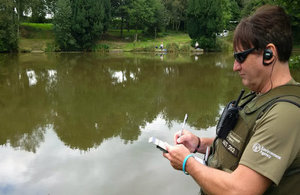
Dumitru Stancu, (24) and Adrian Diaconescu (21), both of Newhampton Road West, Wolverhampton, were found guilty in their absence at Telford Magistrates’ Court on 26 November for using an unlicensed fishing rod and line on the Shropshire Union Canal in Telford and for contravening a national byelaw of removing fish without permission, on 3 June 2018. Both men were fined £440 and each ordered to pay costs of £127, plus a £44 victim surcharge.
A spokesperson from the Environment Agency said:
An annual fishing licence costs just £30, yet a small number of anglers continue to flout the law and risk prosecution for fishing without a licence and breaching byelaws in place to protect fish stocks.
It’s important anglers have a licence before fishing; the money from licences is invested into England’s fisheries and rivers; improving the sport of angling. Anglers should also ensure that they are familiar with our byelaws, which are available on the Environment Agency web pages.
Environment Agency officers are out checking licences and byelaw compliance regularly throughout the year. A licence costs just £30 and lasts for 12 months from the day it is purchased, and becomes valid around 30 minutes after buying online.
Money from fishing licence sales is invested in England’s fisheries and is used to fund a wide range of projects to improve facilities for anglers including; protecting stocks from illegal fishing, pollution and disease, restoring fish stocks through re-stocking, eradicating invasive species and fish habitat improvements. Fishing licence money is also used to fund the Angling Trust to provide information about fishing, to encourage participation in the sport and to manage a voluntary bailiff scheme.
Children aged 12 and under can fish for free without a licence. Anyone aged 13 to 16 also fish for free, but does need to have a valid Environment Agency fishing licence. Anyone over 16 must pay for an Environment Agency fishing licence to fish for salmon, trout, freshwater fish, smelt or eel in England.
Anyone witnessing illegal fishing can report it directly to the Environment Agency hotline, 0800 80 70 60. Information on illegal fishing and environmental crime can also be reported anonymously to Crime stoppers on 0800 555 111.
A careful balance between ensuring passenger safety, reliability and protecting lineside wildlife and trees is at the core of the independent Vegetation Management Review undertaken for the government, Rail Minister Andrew Jones revealed today (28 November 2018).
His comments came on a visit with review author John Varley to the launch of the first British railway hedge planting trial at Hadley Wood, by Network Rail, the Tree Council, and Hadley Wood Association and Rail User Group in Hertfordshire.
Mr Varley, an experienced land manager, sets out a number of recommendations for Network Rail to revamp its lineside operations across the network. They include calling on the Department for Transport to set out clear expectations for Network Rail, and for the organisation to implement a cultural change focused on valuing nature and the environment as well as improving communication with affected communities.
Network Rail is the one of the largest landowners in the UK. Last year there were an estimated 1,500 incidents of rail disruption due to trees and bad weather.
Over the next 6 months Network Rail will develop a plan to address the recommendations. This includes a commitment to improving the way it operates to better protect nesting birds, before next year’s nesting season.
Rail Minister Andrew Jones said:
This is a positive report and I welcome it. The thousands of miles of lineside vegetation and wildlife on our rail network are valuable assets which need protection because of the environmental benefits they bring.
So I completely understand people’s concerns when they see trees being cut down, but it’s also important to recognise that without effective lineside vegetation management we risk delays and compromise safety for passengers.
Network Rail already demonstrates good practice in many locations but it is vital this is mirrored across the network, which is why I have asked the organisation to put together a plan which addresses these issues in the next 6 months. This is about culture change across the organisation as a whole.
Review chair John Varley said:
The profile of today’s line-side vegetation is a product of the evolution of the railway over decades. If laid out end to end it would stretch over halfway around the circumference of the earth.
This is a valuable and nationally important natural asset. Taken together, my review’s recommendations should lead to a significant improvement in the environmental impact of the railway, while reducing cost, and safety and performance risks.
The time is right for Network Rail to not only be one of the safest railways in Europe, but the greenest too, by valuing nature and providing a railway for people and wildlife.
Andrew Haines, Network Rail chief executive, said:
I welcome the Varley Review, in particular the opportunity it gives Network Rail to develop an ambitious vision for increasing biodiversity on the railway. Over the next 6 months we will develop a costed plan to deliver the aims and recommendations of this report. We will also improve the way we operate to better protect nesting birds, ready for next year’s breeding season.
We are grateful to John and the team for their vision, insight and guidance.
Mike Clarke, Chief Executive, Royal Society for Protection of Birds (RSPB):
The Network Rail estate is an important national asset for biodiversity, providing vital connections for wildlife throughout the landscape. The RSPB commends the recommendations in this review as the right ones to resolve the issue of vegetation management in the bird nesting season, and, enable Network Rail to deliver a positive approach to environmental management that enhances the estate’s biodiversity, natural capital and provides a safe railway.
The Department for Transport accepts the recommendation for government.