Press release: Virtual reality to revolutionise UK’s construction sector
Virtual reality, digital design and offsite manufacturing technologies are the future of UK construction thanks to £72 million investment from the government.
Virtual reality, digital design and offsite manufacturing technologies are the future of UK construction thanks to £72 million investment from the government.
Some of Scotland’s finest food and drink producers had the chance to boost export sales at a showcase in London
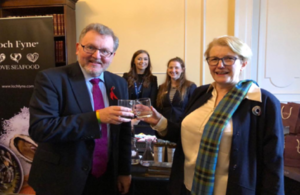
Scottish companies had the chance to boost export sales yesterday [29 November] when they were showcased in London to an audience of Ambassadors and High Commissioners from all around the world including Japan, Denmark and Paraguay.
The ‘Taste of Scotland’ event hosted by Scottish Secretary David Mundell came following the UK’s Brexit agreement with the EU which will create huge opportunities for Scottish companies – not just in trade with the EU but across the globe.
Scottish Secretary David Mundell said:
Scottish food producers are world-renowned. New and innovative companies are thriving while iconic brands remain much-love household names.
The ‘Taste of Scotland’ event is not just a St Andrew’s Day celebration, but a fantastic opportunity for producers to build on Scotland’s great export record.
That is as important as ever as we prepare to leave the EU and the deal secured by the Prime Minister in Brussels this week creates positive opportunities for Scottish companies – continuing frictionless trade with the EU and opening up new markets across the globe.
Held in Dover House on Whitehall, the event saw influential guests from around the world enjoy a range of high-quality Scottish produce. From the Isle of Arran to Aberdeenshire though to the central belt, products on display included seafood, whisky, gin and shortbread.
The products on show at the reception were
Loch Fyne Seafood – Argyll seafood
Tunnock’s – Lanarkshire bakery
Edinburgh Gin – Edinburgh distillery
Walkers – Speyside shortbread
AG Barr – Glasgow soft drinks manufacturer
Really Good Fudge Co – Edinburgh fudge
Scottish Bakers – Trade Association for the production, retail and craft bakery in Scotland
Simon Howie – Scottish butcher
Arran Aromatics – Isle of Arran fragrance products
Mackie’s of Scotland – Aberdeenshire dairy farm
Harris Tweed – clothing made from Outer Hebrides fabric
Gin Bothy – Angus distillery
First Milk – creameries on the Mull of Kintyre and Isle of Arran
MacAllan – Moray distillery
Ishga – Organic Skincare Products from the Outer Hebrides
Published 30 November 2018
A multi-million pound painting by JMW Turner – one of Britain’s most celebrated artists – is at risk of being exported from the UK unless a buyer can be found.
The oil on canvas ‘Walton Bridges’, believed to have been painted in 1806, has been blocked from export by Michael Ellis, Minister for Arts, Heritage and Tourism, to provide an opportunity to keep it in the country.
The painting, which was sold at auction in July 2018 for £3.4 million, shows the double-span bridge that ran across the River Thames between the locks at Sunbury and Shepperton in Surrey. It had been erected in 1788 to replace a wooden structure, depicted by Canaletto, which had fallen into decay.
It is understood to be the first Turner completed in the open air and followed his move to Sion Ferry House in Isleworth in 1804/5.
The piece led to a major series of Thames river scenes during a prolific period where Turner worked in sketchbooks and painted in watercolour and oil, collecting material for exhibited pictures.
It is believed that Turner exhibited the painting at his own gallery on London’s Harley Street in 1806, which he used for personal and specifically English subjects, presented in series, rather than larger, grand manner pictures which he showed at the Royal Academy.
Michael Ellis, Minister for Arts, Heritage and Tourism, said:
Turner is one of Britain’s greatest ever artists, whose studies of British life still resonate with the public today. ‘Walton Bridges’ is a wonderful example of his distinctive style and his fascination with the landscapes of 19th century Britain.
It has so much significance for artistic and historical reasons that it is right that we do all we can to save this masterpiece for the benefit of the nation.
The painting was owned by several major collectors and uniquely held the auction record for a Turner painting three times in the 19th century. Turner sold it in 1807 to Sir John Leicester – the leading collector of British art who subsequently put it on public exhibition with his other paintings by the leading British artists of the era. It was subsequently acquired by other major collectors including Thomas Wright, Joseph Gillott and Lord Wantage, with descendants of the latter loaning it to Oxford’s Ashmolean Museum between 1997 and 2017.
The decision to defer the export licence follows a recommendation by the Reviewing Committee on the Export of Works of Art and Objects of Cultural Interest, administered by The Arts Council. They made their recommendation on the grounds that the painting is of outstanding aesthetic importance, and has an outstanding significance to the study of Turner’s work supported by a history of ownership by leading collectors of British art.
Reviewing Committee on the Export of Works of Art and Objects of Cultural Interest member Lowell Libson said:
This beautiful evocation of the unusual and picturesque double bridge crossing the Thames by the market town of Walton was made at a time when Turner was mostly living at nearby Isleworth rather than in London. At that time, around 1806, Turner was frequently sketching in oil, watercolour or pencil from a boat which he rowed along this stretch of the Thames.
This calm elegiac painting of gentle water-bound commerce and agricultural activity would have contrasted greatly with the turmoil in Continental Europe during this phase of the Napoleonic Wars. It is the absolute antithesis of his ‘Battle of Trafalgar’ (Tate Britain) which was painted at the same time. This is a superb example of Turner’s work from the early years of his success and fame.
The decision on the export licence application for the sculpture will be deferred until 28 February 2019. This may be extended until 30 June 2019 if a serious intention to raise funds to purchase it is made at the recommended price of £3,484,000 (£2,800,000 hammer price, £570,000 Buyer’s premium, plus VAT of £114,000).
Organisations or individuals interested in purchasing the table should contact the RCEWA on 0845 300 6200.
Offers from public bodies for less than the recommended price through the private treaty sale arrangements, where appropriate, may also be considered by Michael Ellis. Such purchases frequently offer substantial financial benefit to a public institution wishing to acquire the item.
Details of the painting are as follows:
Turner’s view is from the south-west, looking downstream. The river curves gently round to the left, passing under the main section of the bridge; the other section seen on the right, its profile somewhat lower, crosses a marshy stretch believed to have been the original bed of the river.
Walton lies behind the ridge and trees further to the right. Cattle have come down to graze on the bank and drink from the shallows on the left. To the right, barges have pulled in to the side of the river. Smaller, luff- barges that plied the upper Thames, they are powered by oarsmen or by sail. Furling their sails or with mast lowered, these barges are being prepared to pass under the bridge, pulled by horses that a boy is watering at the river’s edge on the far right.
The warm golden lighting indicates late afternoon or early evening in summer, with shadows lengthening on the river banks and the sun low in the sky, partly veiled by high cloud.
An image of the painting is available on Flickr.
The Reviewing Committee on the Export of Works of Art and Objects of Cultural Interest is an independent body, serviced by The Arts Council, which advises the Secretary of State for Digital, Culture, Media and Sport on whether a cultural object, intended for export, is of national importance under specified criteria.
The Arts Council champions, develops and invests in artistic and cultural experiences that enrich people’s lives. It supports a range of activities across the arts, museums and libraries – from theatre to digital art, reading to dance, music to literature, and crafts to collections. www.artscouncil.org.uk.
A Buyer’s Premium is an additional percentage charge on the hammer price, which is charged by the auctioneer to cover their expenses.
Culture Minister steps in to prevent JMW Turner’s ‘Walton Bridges’, valued at £3.4 million, from export