Press release: SpaceX launches pioneering UK maritime communications satellite

The first of its kind satellite was launched this evening (03 December) into a 575 km sun-synchronous orbit as part of Spaceflight’s SSO-A SmallSat Express mission on-board a SpaceX Falcon 9 rocket from Vandenburg Air Force Base, USA, at 18:30 GMT.

VESTA (‘VdES Transmitting sAtellite system) will support new two-way maritime information services between ship and shore. The payload was designed and built by Honeywell UK in Aylesbury and the spacecraft by Surrey Satellites (SSTL) in Guilford.

Dr Graham Turnock, Chief Executive, UK Space Agency said:

There are still vast areas of the Earth where communication remains difficult, none more so than out at sea.

Satellites can bridge this gap, however testing new technology is risky and expensive. That’s why the UK Space Agency is helping to fund promising UK technologies like VESTA as part of the government’s Industrial Strategy, to kick start innovation and growth, while delivering safety at sea and jobs back home.

The mission was made possible through £1 million flagship funding from the UK Space Agency’s National Space Technology programme which aims to accelerate innovation and better position UK organisations to enter and expand within both institutional and commercial space markets, growing the UK space economy.

Chris Bee, a Business Manager at Honeywell Aerospace UK said:

While leading the way in demonstrating small data packet transfer from a small payload into remote maritime locations beyond our phone networks, this mission is also leading us into an even broader range of remote communication scenarios to increase the connectivity of our world.

VESTA will demonstrate:

  • Broadcasting vessel traffic information, such as the delivery of ice-maps to shipping in the polar regions and;
  • two-way communications to support commercial fleet monitoring by relaying real-time ship engine, emissions and fuel data to operators as well as provision of specific meteorological data.

Spaceflight’s SSO-A mission is the largest single rideshare mission from a U.S.-based launch vehicle to date. The company has contracted with 34 different organisations to launch 64 spacecraft on just one rocket.

The UK’s space sector is going from strength to strength, employing around 40,000 people and carrying our world-class science while growing the economy.

Last month (19 November) a contract worth several hundred million-pounds was signed for Eutelsat to procure two innovative new telecommunications satellites from Airbus, with much of the work taking place in the UK, at manufacturing sites in Portsmouth and Stevenage.

This is all supported by the Government’s Industrial Strategy, with major initiatives such as the National Satellite Test Facility at Harwell and the development of the proposed commercial spaceport in Sutherland, Scotland.


News story: ePassport gates to open to visitors from Singapore and South Korea

Announcement follows initial extension of countries confirmed in the Budget.


News story: ePassport gates to open to visitors from Singapore and South Korea

Singapore and South Korea will be added to the list of countries whose nationals will be eligible to use ePassport gates to enter the UK from summer 2019, under plans announced by the Home Secretary today.

ePassport gates, which are currently available for British and EU nationals, provide a faster route through the border as they allow eligible passengers to be processed quickly and securely.

The proposals build on those set out in the Budget, to allow nationals from the US, Canada, New Zealand, Australia and Japan to use ePassport gates, and demonstrate the government’s commitment to develop a new global immigration system as we leave the EU.

An estimated additional 6.5 million passengers per year will be able to take an automated route through the UK border as part of the government’s ongoing work to ease the passage for legitimate travellers.

Home Secretary Sajid Javid said:

The UK is absolutely open for business from the rest of the world and as part of that we are improving the experience for travellers coming into the UK.

I’m pleased to announce today that, in addition to the US, Canada, Australia, New Zealand and Japan, we will be allowing passengers from Singapore and South Korea to use ePassport gates when they travel into the UK – a transformational experience for the passengers involved.

ePassport gates use facial recognition technology to compare the passenger’s face to the digital image recorded in their passport. The system is monitored by Border Force officers and anyone rejected by the gates will be sent to an alternative manned channel to have their passport checked.

All passengers are automatically checked against Border Force systems and watchlists.

There are now 259 ePassport gates in operation at 14 ports around the UK and juxtaposed control locations. The gates can be used by those aged 18 and over, and who are travelling using a biometric or ‘chipped’ passport. Those aged 12 to 17 years old, and who are accompanied by an adult, are also able to use them.

A statutory instrument will be laid in Parliament shortly which will legislate to facilitate the extension of the use of ePassport gates to include the US, Canada, New Zealand, Australia, Japan, Singapore and South Korea.


News story: Thousands of new places created in Outstanding schools

Selective schools are to introduce a range of measures to improve access for disadvantaged children after being given permission to expand, Education Secretary Damian Hinds announced today (Monday 3 December).

The first 16 schools to receive funding from the £50m Selective School Expansion Fund have been confirmed and all have set out clear actions that will prioritise access for children on the pupil premium and are undertaking outreach work with local schools.

All 16 selective schools will be making changes to their admission arrangements to increase access for disadvantaged children, with over half of the schools committing to lowering the mark required to pass the entrance test for pupil premium pupils. Many more will help pupil premium children or children attending schools in less affluent areas prepare for their entrance tests.

Today’s announcement builds on the 825,000 new school places created since 2010 and the one million this government is on course to create by 2020.

Education Secretary, Damian Hinds, said:

One of the stand-out features of this country’s education system is its diversity, and selective schools are an important part of that. They include some of the best schools in this country, with almost all selective schools rated Good or Outstanding, and they are popular with parents. So it is right that when there is need for more places in an area, these schools should be able to expand – as other schools can – to enable as many children as possible to benefit.

I have always been clear that selective schools will only be able to expand if they meet the high bar we have set for increasing access for disadvantaged children, and all of these schools have done that. As a result, countless more children from disadvantaged areas will benefit from places at outstanding schools.

The schools are:

  • Altrincham Grammar School for Boys (Trafford)
  • Bournemouth School (Bournemouth)
  • Bournemouth School for Girls (Bournemouth)
  • Chelmsford County High School (Essex)
  • Colchester County High School (Essex)
  • Colyton Grammar School (Devon)
  • John Hampden Grammar School (Buckinghamshire)
  • Kendrick School (Reading)
  • Lawrence Sheriff School (Warwickshire)
  • Queen Mary’s Grammar School (Walsall)
  • Queen Mary’s High School (Walsall)
  • Sir Thomas Rich’s School (Gloucestershire)
  • Sir William Borlase’s Grammar school (Buckinghamshire)
  • St Michael’s Catholic Grammar School (Barnet)
  • Rochester Grammar School (Medway)
  • Wolverhampton Girls High School (Wolverhampton)

As well as prioritising access for children from disadvantaged backgrounds, the successful schools have also committed to a variety of outreach initiatives. For example, Queen Mary’s High School in Walsall will set up help desks in partner primary schools to assist parents registering children for the selection test and answer any questions they may have about the process.

Today’s announcement builds on the Memorandum of Understanding the government agreed with the Grammar School Heads Association (GSHA) earlier this year, in which the group outlined its commitment to widening access and working with local schools to raise standards for all children.

Chief Executive of the Grammar School Heads Association Jim Skinner said:

We are delighted that selective schools are being supported to expand. It is really important that, just like other good and outstanding schools, they are able to expand to meet parental demand, especially at a time of significant growth in the number of pupils reaching secondary age.

The large majority of selective schools now prioritise access for disadvantaged pupils, which is backed up by outreach and partnership work with local schools. Selective schools are therefore well placed to contribute to meeting the ongoing need for more school places and supporting high quality education provision elsewhere.


News story: Vulnerability and digital economy feature in CMA’s draft plan

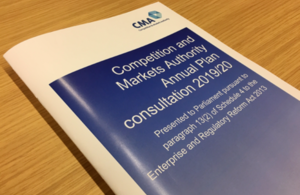
Cover of the draft Annual Plan 2019/20

Making sure people get a good deal from businesses and that firms treat their customers fairly remain central to the CMA’s work.

In 2019/20 the CMA proposes to:

  • step up its interest in people who are vulnerable to exploitation, or getting a poor deal due to their personal circumstances, building on the programme of work it launched in 2018
  • improve trust in markets, by ensuring customers are treated fairly and clearly explaining how competitive markets benefit people across the UK
  • promote better competition in online markets, retaining a strong interest in how the digital economy is developing, and protecting people from illegal and unfair practices online
  • support economic growth and productivity, helping to create the conditions which allow innovative businesses that treat their customers well to emerge and succeed

The draft plan sets out how preparing for the UK’s exit from the EU is a high priority for the CMA, both in terms of policy development and expansion to prepare for significant additional responsibilities. The CMA is focused on being ready whether or not there is an implementation period after March 2019.

The CMA enters 2019/20 with a substantial volume of ongoing work and at the time of publication has 23 competition enforcement cases, 5 consumer enforcement cases, 1 super-complaint investigation, 17 merger investigations, 1 market investigation and 2 market studies under way. Most recently, it published the interim report in its funerals market study and is now consulting on its proposal to refer the sector for an in-depth market investigation.

For more information, read our draft 2019/20 Annual Plan.

Published 3 December 2018