Press release: Glasgow mobile phone boss banned after submitting false documents
Glasgow mobile phone boss will start his 10-year ban on Christmas Day after submitting false documents, while securing personal gains of thousands of pounds.
Glasgow mobile phone boss will start his 10-year ban on Christmas Day after submitting false documents, while securing personal gains of thousands of pounds.
Fersun Limited was incorporated in March 2011 and this was the first company operated by Songnan Sun (32) having researched the market for two years.
Initially the company specialised in repairs of mobile phones but as the business grew, the Glaswegian boss expanded the company’s activities into the wholesaling of mobile phone accessories and parts, sourcing stock from China.
The company operated in a competitive environment and as Fersun entered into difficult trading conditions in 2013/2014, the company cut its margins but this led to it experiencing cash-flow difficulties.
Following a tax investigation and Songnan Sun seeking advice from an independent insolvency practitioner, the company ceased trading in December 2017 before Songnan Sun elected to place the company into compulsory liquidation in February 2018.
However, the independently appointed liquidator reported to the Insolvency Service that Songnan Sun had caused the company to fail to deal with its tax affairs.
Further enquiries made by the Insolvency Service found that over three consecutive financial years between March 2014 and March 2016, Songnan Sun had caused Fersun to prepare and submit false annual accounts, having excluded the true level of sales.
And Songnan Sun also caused Fersun to submit false tax returns over four consecutive years between June 2013 and March 2017. By under-declaring the true level of tax owed, this resulted in a loss of revenue to the Exchequer of at least £531,869 and Songnan Sun also secured somewhere between £50,000 and £60,000 for himself.
On 4 December 2018 the Secretary of State accepted a disqualification undertaking from Songnan Sun, after he admitted preparing false annual accounts over a three year period and false tax returns over a four year period which allowed him to knowingly under-declare the true level of tax owed resulting in a loss of revenue of, at least, £531,869 from which Songnan Sun achieved personal gain.
Effective from 25 December 2018, Songnan Sun is now banned for 10 years from directly or indirectly becoming involved, without the permission of the court, in the promotion, formation or management of a company.
Robert Clarke, Chief Investigator of Company Investigation North at the Insolvency Service said:
Directors have a firm duty to ensure they properly deal with tax matters and pay what is due and Songnan Sun has paid the price for failing to do that as now he cannot now carry on in business other than at his own risk.
Songnan Sun is of Glasgow and his date of birth is October 1986
Fersun Limited (In Liquidation) (Company Reg no. SC395167).
The undertaking was accepted by the Secretary of State for Business, Energy and Industrial Strategy on 4 December 2018 and Mr Sun’s 10 year period of disqualification will commence on 25 December 2018.
A disqualification order has the effect that without specific permission of a court, a person with a disqualification cannot:
Disqualification undertakings are the administrative equivalent of a disqualification order but do not involve court proceedings.
Persons subject to a disqualification order are bound by a range of other restrictions.
The Insolvency Service administers the insolvency regime, investigating all compulsory liquidations and individual insolvencies (bankruptcies) through the Official Receiver to establish why they became insolvent. It may also use powers under the Companies Act 1985 to conduct confidential fact-finding investigations into the activities of live limited companies in the UK. In addition, the agency deals with disqualification of directors in corporate failures, assesses and pays statutory entitlement to redundancy payments when an employer cannot or will not pay employees, provides banking and investment services for bankruptcy and liquidation estate funds and advises ministers and other government departments on insolvency law and practice.
Further information about the work of the Insolvency Service, and how to complain about financial misconduct, is available.
Media enquiries for this press release – 020 7637 6498
You can also follow the Insolvency Service on:
At COP24 climate talks in Poland, UK government sets world-leading ambition for first ‘net-zero carbon’ cluster by 2040 to cut emissions, backed by up to £170 million funding.
The UK could have the world’s first ‘net-zero carbon’ cluster of heavy industry by 2040, thanks to up to £170 million of new funding announced at COP24 climate talks in Poland today (13 December).
Energy and Clean Growth Minister Claire Perry today set the world-leading ambition alongside plans for at least one low-carbon cluster by 2030 at UN climate change talks (COP24) in Katowice, Poland. Using cutting-edge technologies like carbon capture and storage, the UK is aiming to become a world-leader in clean technology and services that will be needed as the world tackles climate change.
The UK’s low carbon economy has the potential to deliver export sales of low carbon goods and services around the world, by 2030 annual exports could be worth up to £170 billion and could support up to 2 million ‘green collar’ jobs by 2030 – a key part of our modern Industrial Strategy.
Currently, industry accounts for around 25% of all greenhouse gas emissions in the UK, with more than two-thirds of these industrial emissions coming from energy intensive industries which are often located next to each other in clusters.
This new funding of up to £170 million, which is expected to be backed by industry, will help heavy industries like steel, ceramics, cement, chemicals, paper and glass to share expertise and innovative low-carbon solutions to clean up the air we breathe as we move to a greener, cleaner economy.
Energy and Clean Growth Minister Claire Perry said:
Demonstrating climate action and growing the economy go hand in hand is key to building momentum behind global action on carbon. The UK is a leader in both, cutting our emissions by more than 40% while growing our economy by 2 thirds, but to sustain this track record we need to tackle emissions from energy intensive sectors and bring clean growth to our great industrial centres.
That’s why today I’m launching a mission to create the world’s first ‘net-zero’ carbon cluster by 2040 in the UK with up to £170 million of new government funding. This will help to develop the technologies of the future to transform industry around the world, ensuring the UK seizes the global economic opportunities of moving to greener, cleaner industry – a key part of our modern Industrial Strategy.
By investing in world-leading innovative technology, such as carbon capture usage and storage (CCUS), climate change can be tackled alongside creating highly skilled jobs and generating export opportunities. At the end of last month, Minister Claire Perry co-hosted a global summit in Edinburgh at which she unveiled plans to enable the first UK carbon capture project from the mid-2020s.
Today’s announcement comes as the UK-Canada led Powering Past Coal Alliance (PPCA) celebrates one year of success, now with over 70 members. As part of this, the UK has committed £20 million for a World Bank programme (ESMAP) to help developing countries move away from coal power and embrace renewable energy. To make a real impact on the reduction of coal power, UK government has established the Utilities Taskforce to become influential advocates for the PPCA.
At international climate talks in Poland this year at COP24, the UK and Canada today will announce new members of the PPCA, committing to eradicating coal power while redirecting resources to renewables. Around 3.5 billion tons of coal are currently burnt globally for power every year, contributing to 45% of the world’s emissions.
The UK government has put moving to a cleaner, greener economy at the heart of its Industrial Strategy. Through the Clean Growth Grand Challenge, the transformation in the clean energy sector has contributed to the whole of the UK cutting its emissions by more than 40% since 1990 while growing the economy by more than two-thirds – the best performance on a per person basis of any G7 nation.
But UK has always been clear that the move to a cleaner economy must be both public and private sector led, which is why the modern Industrial Strategy establishes clean growth as one of the greatest economic opportunities of our time – with heavy industry now set to also benefit from this new clean revolution and seize the vast global economic opportunity that comes with it.
Power stations are also set to benefit too from the move to a cleaner economy. To make a real impact on the reduction of coal power, UK government is working with investors to establish the Utilities Taskforce – a group comprising companies which supply electricity to UK homes – to become powerful and influential advocates for the alliance and encourage investors to commit funds into the thriving clean energy market instead of investing in coal projects.
1. The UK’s modern Industrial Strategy set out 4 Grand Challenges – the long-term trends shaping change in our world today that present enormous potential for the UK economy. As part of this, at her speech in May, the Prime Minister recognised clean growth as a vast economic opportunity. Today’s new Clean Growth mission will focus on reducing emissions from these industrial clusters over the coming years and follows the mission to ‘at least halve the energy use of all new buildings by 2030’ launched by the Prime Minister in May.
2. Up to £170 million funding for industry will be provided through a competitive process for clusters to research, develop and demonstrate at scale the innovative solutions to lead the way to a decarbonised industrial future. Both the £170 million Decarbonising Industry and the £66 million Transforming Foundation Industry investment is subject to industry entering into partnership with government and providing significant co-investment to this challenge.
3. These energy intensive clusters include Grangemouth, South Wales, Merseyside, Teesside, Humberside and Southampton. They are recognised as key to the UK economy but also as significant contributors to the UK’s emissions.
4. The government will also be supporting the transformation of our foundation industries (steel, glass, ceramics, chemicals) more broadly through providing up to £66 million through the Industrial Strategy Challenge Fund to develop radical new technologies and establish innovation centres of excellence in these sectors.
5. In 2017 the government committed to phasing out unabated coal power by 2025 and launched the international Powering Past Coal Alliance (PPCA) – a voluntary coalition of governments, businesses and other organisations committed to ending the use of dirty coal power.
6. Coal-fired power plants produce almost 40% of global electricity today, making carbon pollution from dirty coal a leading contributor to climate change.
7. Great Britain is on track to deliver less than 5% of its electricity from coal for the first time since the first Industrial Revolution by 2025.
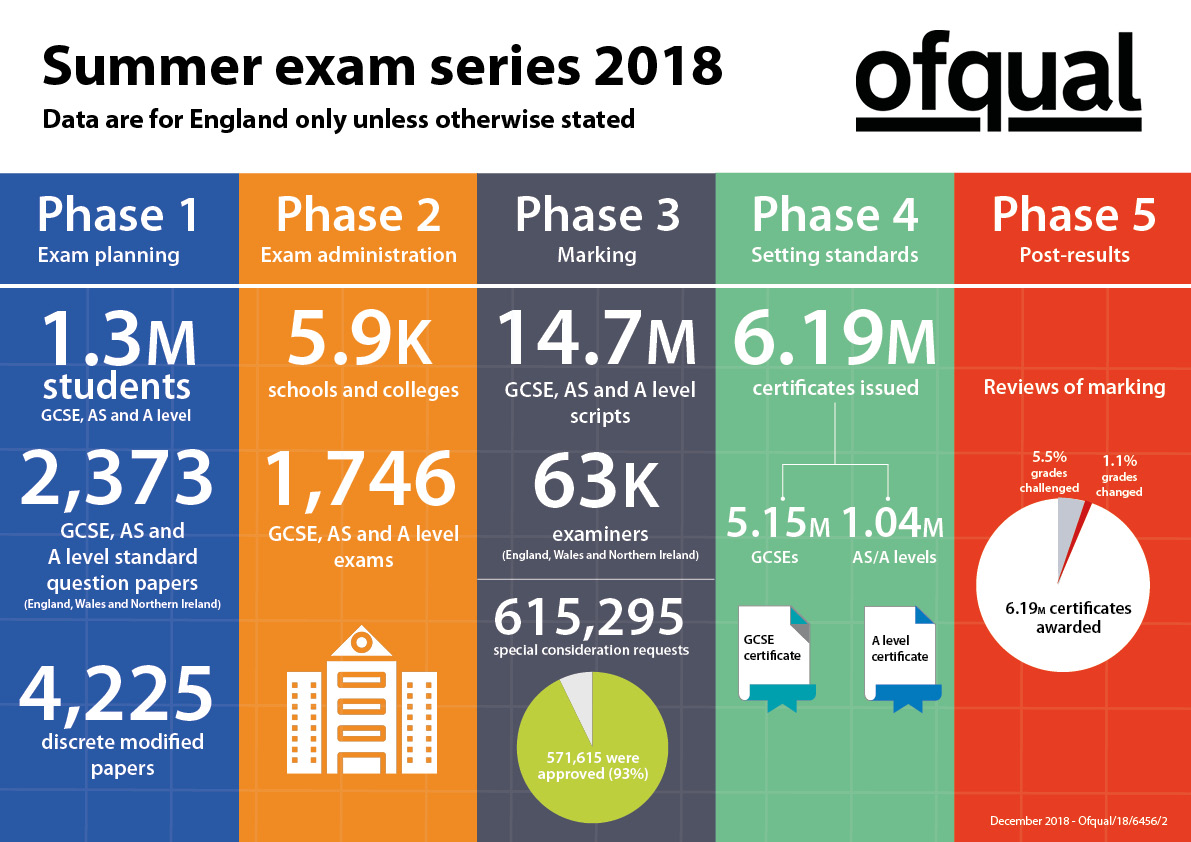
Ofqual has today (Thursday 13 December) published its review of GCSEs, AS and A levels in summer 2018, providing an overview of the exam boards’ planning, administration and marking which supported the series, along with a summary of the awarding process and what happened post-results.
2018 was the biggest year of reform, and most exams taken this summer were in reformed qualifications. We conclude that the 2018 summer series was successful, well planned, and effectively delivered. In recent years, exam results have been stable, and this trend continued. Variability in school and college results this summer was similar to previous years, suggesting that teachers and students responded well to the considerable reforms.
The majority of entries in 2018 were for reformed qualifications. Entries for GCSEs and A levels remained broadly stable. In line with recent trends, entries for AS subjects fell by almost 60% from 659,880 in 2017 to 269,090 in 2018. This is largely because new AS qualifications are stand-alone qualifications in England (meaning students do not have to take an AS as part of a reformed A level).
During the exam series, 14.7 million scripts were generated by 1.3 million students. As in previous years, the vast majority of exam papers were error free. Where errors did occur, none was sufficiently serious to have had a significant impact on students. There were fewer security breaches and incidents of malpractice, reflecting work undertaken by exam boards to strengthen procedures.
Chief Regulator, Sally Collier, said:
Against the backdrop of major reform, the 2018 exam series was successfully delivered, with marking completed and results announced on time. Security breaches and incidents of malpractice fell and exam boards better applied our rules around reviews of marking and moderation. We will be working with the exam boards on follow-up actions to drive further improvements in 2019.
The number of GCSE and A level grades challenged and changed fell in 2018 compared to the previous summer, according to official statistics published today. The data also indicate that nearly two-thirds of reviews resulted in no mark change, an increase from 2017. The reasons given for grade changes when they did occur this year are more consistent with the appropriate application of our rules regarding reviews of marking and reviews of moderation as introduced in 2016.
Official statistics of malpractice in the summer 2018 GCSE, AS and A level series, published today, show there were fewer incidents of malpractice. The number of malpractice penalties issued to students has remained stable since 2017. The main reason for penalties continues to be unauthorised materials – particularly mobile phones – in the examination room. Staff and centre malpractice penalties have both decreased. These falls are encouraging in the context of the significant communications and engagement campaign we, and the exam boards, conducted this summer. We are planning further activity, alongside exam boards, to support exams officers in tackling the problem of students retaining their mobile phones during examinations.
We monitor GCSE, AS and A level awards each summer to make sure, so far as possible, that there is a level playing field for students. One of the ways that we do this is to make sure that the grade standards in a subject are comparable, so that it is not easier or more difficult to get a particular grade with one exam board than with another. Across all awards in summer 2018, we concluded that the exam boards had maintained appropriate standards and that grade standards within each subject were aligned.
We have published more information about the operation of this year’s tests. This was the second year of the National Reference Test (NRT) (following the Preliminary Reference Test in 2016). The tests, in English language and maths, are taken by students in a sample of schools and they provide additional evidence about students’ performance over time in those subjects. In 2017 we benchmarked the NRT against GCSE results in English language and maths, so that in future years we can compare student performance with the 2017 baseline. Results from the 2018 NRT show an increase in performance in maths and a slight decrease in English, although in English the differences are not statistically significant. The improvement in maths is in line with what we might expect to see as schools get used to the new qualifications. We have been clear that we would not use the NRT results in awarding in summer 2018. From 2019 onwards the NRT results will provide an additional source of evidence for awarding decisions in GCSE English language and maths.
We have published analysis of the variability over time in the relationships between grades for the Extended Project Qualification (EPQ) and other variables (including GCSE grades) that could potentially influence students’ performance on EPQ. Findings indicate that there might have been modest grade inflation in EPQ grade outcomes, particularly since 2014. We are planning to do further work to assess grade standards in EPQs over time.
In summer 2018 we enhanced our analytics apps to show variability in school and college GCSE and A level results and launched an interactive map of England showing results in different subjects by grade and county. We have now added a further app to our suite, which provides new data and functionality, showing GCSE and A level entries and results by subject and year.