News story: Appointments made to the Board of Kew’s Royal Botanic Gardens

Defra Ministers have reappointed Liam Dolan and Sue Hartley to the Board of Trustees of the Royal Botanic Gardens, Kew, for second terms of three years. Both appointments will run from 1 March 2019 until 28 February 2022.

RBG Kew became an Executive Non-Departmental Public Body under the National Heritage Act 1983 and is sponsored by Defra. The Board of Trustees comprises a Chairman and 11 other members.

The appointments have been made in accordance with the Governance Code on Public Appointments published by the Cabinet Office. All appointments are made on merit and political activity plays no part in the selection process.

Trustees do not receive any direct remuneration for their services, although reasonable travel and subsistence expenses can be reimbursed.

There is a requirement for appointees’ significant political activity to be made public. Neither Liam Dolan nor Sue Hartley has declared any significant political activity in the past five years.

Biographical details

Liam Dolan

Professor Liam Dolan is from the Republic of Ireland and graduated with a degree in Botany at University College Dublin. He carried out PhD research on plant developmental genetics at the University of Pennsylvania, USA. He then spent three years as a post-doctoral researcher at the John Innes Centre, Norwich, before becoming an independent project leader. After 13 years running his own group in Norwich, Liam moved to the University of Oxford as the Sherardian Professor of Botany in 2009 and was Head of the Department of Plant Sciences between 2012 and 2017. Liam has received a number of awards in recognition of his contributions to science. These include the President’s Medal of the Society of Experimental Biology in 2001 and membership of the European Molecular Biology Organisation (EMBO) in 2009. He was elected a Fellow of the Royal Society in 2014 and awarded European Research Council Advanced Grants in 2010 and 2018. Liam’s research aims to understand how plants colonised the land over 400 million years ago using a combination of genetics and palaeontology.

Sue Hartley

Sue Hartley is Professor of Ecology at the University of York and Director of the York Environmental Sustainability Institute, a pioneering interdisciplinary research partnership generating solutions to global environmental challenges. Sue studied biochemistry at the University of Oxford before moving to the University of York for her PhD on plant defences against insect herbivores and then the University of Sussex where her research included projects on the factors maintaining the extraordinary biodiversity of tropical forests and the impact of climate change on plant resistance to herbivores. In 2009 she delivered the Royal Institution Christmas lectures, becoming only the fourth woman to do so since they began in 1825. Sue served as President of the British Ecological Society 2016-2017 and has been a Board Member of Natural England since 2018.


Speech: Global Britain’s Bright Energy Future

As you might just be aware, Brexit is dominating our political bandwidth. Sometimes it seems we talk of nothing else. But this makes it all the more important to keep in mind that there is a future and a world outside and beyond Brexit.

In November 2017 the Government published our Industrial Strategy. Amongst other things, it set out 4 “Grand Challenges”: the major global trends which will affect every economy over the coming decades, and to which every society will have to respond.

These are the challenges posed by an ageing population, the rise of artificial intelligence, the changing face of mobility, and Climate Change.

If you were focussed purely on Brexit, you could be forgiven for thinking that 15 months was a very long time.

But 15 months after we published the Industrial Strategy and those long-term trends are still there, just as much as before.

In December I was at the Consumer Electronics Show in Las Vegas, where I heard how the changing face of mobility will transform our energy use: from low-emission vehicles to the rise of mobility as a service rather than an asset, enabled by ride-sharing apps and self-driving cars.

And whilst 15 months may be a long time in the Brexit negotiations, it is in a sense an even longer time in the world of Climate Change. I am sure you will all have seen last year’s UN report, but I think it bears repeating.

After all, fighting Climate Change is about salience as much as science: most people know we have to stop it, but they do not prioritise stopping it.

To remind you, the UN said that we had just 12 years to avert Climate Change catastrophe.

That was last year. It’s now 11.

From heatwaves to hurricanes, you can try and ignore climate change, but it has a way of forcing itself up the agenda.

It is no longer just a case of saving the planet for our future generations: if we don’t fix the problem by 2030, we could see permanent harm in our own lifetimes.

I said this was a trend to which every society would need to respond.

Clearly this is about the whole of society, not merely the Government, but as a member of the Government you could ask me what we are doing about it.

Firstly, I should say at the outset, as this is a myth I often have to counter, that we are not and will not use Brexit as a means or an excuse to lower environmental standards.

The UK is legally committed to reducing greenhouse gas emissions by 80% between 1990 and 2050. This is a commitment that is part of our domestic law through the Climate Change Act, not EU law.

Our environmental standards are already above the EU minimum. If this Government had wanted to reduce environmental standards, we would have reduced them already. We do not.

We are proud of our country’s record as a champion of climate change action on the world stage, including setting the agenda by being the first country to legally-bind ourselves to meeting the Paris Accords.

Reducing our environmental standards would not be in the UK’s interest. The United Kingdom’s comparative advantage is in quality, not price, and that includes high environmental standards.

Secondly, the Government is taking tangible measures to combat Climate Change.

We have made a world-leading commitment to stop the sale of new petrol and diesel cars by 2040. We will close our remaining coal-fired power stations by 2025 – and indeed, there were many days during the last year when we had no coal-fired stations on the grid at all.

The UK is predicted to have enough capacity for 30 Gigawatts of electricity from offshore wind by 2030, building on its current position as the world’s largest producer of offshore wind, with 7.9 Gigawatts of capacity.

And we are making long term investments to advance this technology, such as the £246 million allocated to battery research through the Faraday Institute.

But, thirdly, in Climate Change as in all things, we must never let the perfect be the enemy of the good.

That is where oil and gas come in.

Yes, we must focus on a low-carbon future.

But the simple fact is that for the moment we do require fossil fuels to deliver secure and affordable energy: we are not in a position to heat our homes without gas or maintain our supply chains, our commutes or our rural areas without petrol.

That need for oil and gas is especially pressing for countries in the third world, who need affordable energy to grow their economies to a level we take for granted.

Yes, renewables are better than fossil fuels. But that should not mean that we ignore the role gas has to play in decarbonisation, when it burns nearly twice as efficiently as coal.

Nor should we ignore the role the oil and gas industry has contributed to our society.

This sector is estimated to have directly employed 37,000 people across the United Kingdom last year, and a further 127,000 in related supply chains. It has contributed billions in tax revenues, year after year, which fund our public services.

And the Extractive Industries Transparency Report, published this week, found that the UK extractive sector has an excellent track record on business ethics, leading the way on accountability and transparency.

And the oil and gas industry has also played a vital and prescient role in developing low-carbon alternatives, through investing in clean energy and its contribution to technology and know-how.

It is hard to imagine that offshore wind would be so competitive now, with the price down nearly two-thirds to £57 per Megawatt Hour at the latest auction, if it was not for years of learning how to build and maintain offshore platforms in drilling.

For all those reasons, the Government is proud to support the oil and gas industry. The Oil and Gas Authority has played a vital role in reviving the North Sea fields.

And the Department for International Trade is working closely with the Authority and with Industry to increase exports from the UK supply chain, as outlined in our Maximising Economic Recovery Strategy.

It should come as no surprise that boosting exports and international investment is such a major focus for us, when oil and gas is a supremely international industry.

For example, our recent support for Bapco’s Sitra refinery was in Bahrain, with Technip as the main engineering, procurement and construction contractor, and WorleyParsons as the main UK contractor – worth some £539 million.

There is also the Offshore Cape Three Points Project in Ghana, where UK Export Finance provided $400 million as part of an innovative project financing/reserve-based lending structure.

The project is going to continuously feed Ghana’s thermal power plants for over 20 years; as well as helping Ghana meet it’s Paris Agreement obligations by displacing heavy fuel oil with gas. This is the equivalent to taking 1.2 million cars off Ghana’s roads each year, or planting 152 million trees; and it will support jobs across the United Kingdom, from Bristol and Aberdeen.

All that is part of the Government’s wider drive to increase exports. My colleague Baroness Fairhead, the Minister of State for Exports, will headline the Energy Exporting Conference to be held in Aberdeen in June this year.

This is all part of our wider Export Strategy, which we launched in August. It sets a national goal to increase exports from 30% of GDP to 35% by providing the finance, connections, knowledge and encouragement businesses small and large need to export.

That international focus is only going to become more apparent as North Sea production declines and huge new opportunities arise in places such as Senegal/Mauritania, or in the East coast of Africa, which could become a major new area for hydrocarbon extraction.

So my challenge and yours is to help companies export.

And my challenge and yours is to prepare for the future.

I mentioned earlier a series of global megatrends that the government is preparing for, of which climate change and the transformation of mobility are particularly relevant for our purposes.

But there is a different trend, of particular relevance to our present political debates.

We are at the beginning of a Pacific century, after 4 Atlanticist ones.

The rise of Asia is no longer part of the future: one figure I often quote is that according the IMF 90% of global growth will occur outside the European Union. But that’s not 90% in the distant future. That’s 90% in the next 5 years. China alone will have 220 cities with a population of more than one million people by 2030, when the whole of Europe has just 35.

But it is important to realise that this does not mean ignoring our European markets.

Nor does it mean letting the perfect future be the enemy of a good future.

That is why I want to see us leave the European Union with a deal that maximises access to European markets, while also maximising our freedom to reach out to new markets around the world.

There is no perfect deal. But I can reassure you that the government’s goal it to make sure we leave in an orderly way.

We do not want a no deal, which, while survivable, would cause unnecessary disruption for businesses and for our economy.

And business should not want a No Brexit, which would undermine our democracy in a way that is not only unacceptable in itself, but would also hardly be conducive to a healthy business environment.

What we should be doing is leaving in an orderly way, so we can look to the world and the time and opportunities beyond Brexit.

But also so we can look to the challenges beyond Brexit: of which Climate Change is undoubtedly one of the most pressing.

The UK and the world are undergoing and must undergo a transition towards a low-carbon future.

And the UK and the world’s oil and gas industry can play a positive and important role here.

So I will leave you today with a question.

Where will you be on August 12th, 2026?

Certainly in my case I hope to be looking at the UK’s first full solar eclipse since 1999.

There are some things we can predict for certain, years in advance.

Climate change is one of them.

Our commitment to work with the oil and gas industry to deliver the affordable, secure, cleaner energy future is also something you can rely on.

And our commitment to tackle climate change is something else you can rely upon: a fixed point on the firmament for any investor.

Based on our current predictions of solar energy use, it is estimated that that eclipse will take up to 3.5 Gigawatts of power from the grid – something the National Grid is planning for.

So who says the UK isn’t a sunny place in which to live and work! A sunny place with a bright future.

Thank you.


Speech: Chief Secretary: Enterprise Nation remarks

It is brilliant to be here this morning with such an amazing view.

I do believe that we are fundamentally an enterprising nation and that is one of the many things that’s exciting about Britain.

Sometimes to appreciate your own country you have to travel overseas. Recently I did a trip to Korea and Japan and they were saying to me, “How can we get the same kind of start-up culture that you have in Britain?”, “How can we attract that investment in early stage businesses? or “How can we have that energy that we see every time we come to London?”

I think we’ve got to appreciate what we’ve got, and in the last year there’s been a 5% increase in business registrations.

The momentum hasn’t stopped. What is also very interesting is the attitudes of generations that are under 21.

They’re more likely to want to start up a business than previous generations and they’re doing it in droves, as we’ve seen an 85% increase in 18 to 24 year olds setting up businesses just in the last three years alone.

I had a group of those businesses called ‘20 under 20’ in my office in the Treasury talking to them about when they’d start up their business what motivated them, and most of them said that it was at age 11 that they’d first thought of their idea. They struggled with some of the hurdles – like they couldn’t open bank accounts to other sorts bureaucratic difficulties – but they persisted and actually due to new technology, due to the availability of things like YouTube and podcasts to be able to get wider advice or to be able to network with a wider world – they ultimately had succeeded in their ambition. It is those ideas, and it is these people that drive progress in our country.

In the 1960s we had an expression the ‘jet set’ because only the very rich could afford to travel round the world, but now thanks to new entrants it is a lot cheaper now and many more people can afford to travel. Or, what about supermarkets. I remember when getting pasta was exciting in the supermarket and now you can buy all kinds of things from fish sauce to won tons; you can get anything you want at your local Sainsbury’s, again that’s down to enterprise.

Even the internet itself, where the derivation of that idea came from Britain and great people like Ada Lovelace or Tim Berners Lee. Quite often we hear negative things and of course there are harms that we need to deal with, but a recent survey showed that 82% in Britain had said the internet had made their lives better. None of us have to get bored waiting in a queue at the supermarket anymore, we can use our time much more productively. We are seeing all this progress and sometimes I think we take that progress for granted. But the reason we’ve got that progress is because of the individuals that come forward and there has never been a better system than the system of free enterprise for harnessing the ideas and dreams of individuals.

For me it’s not just about economics. Of course, it is important that we get economic growth up. Of course, it is important that people that are able to afford to live better lives and that they are able to get better food for their children and get better opportunities. But starting businesses is also important for that sense of fulfilment and self-determination for individuals and that is one of the reasons that I do love meeting entrepreneurs, because you are people with dreams who want to bring those dreams to reality and there’s something really exciting about that.

British start-ups are also an area where it doesn’t matter what your background is. It doesn’t matter where you’re from. It doesn’t matter what gender you are. If you’ve got a good enough idea, if you’re prepared to work hard enough; if you’re prepared to fulfil those ambitions; or if there’s somebody out there who wants to buy what you’ve got to offer, you can do that and you don’t have to be ticked off by a piece of government bureaucracy.

I think that’s incredibly empowering and one of the areas that I’m very interested in the whole area of female entrepreneurship, because we do know there are fewer female entrepreneurs than male entrepreneurs. If we had as many female entrepreneurs as male entrepreneurs we’d have 1.2 million more businesses in this country, and I do see it as a source of empowerment, as a source of being able to take control of your own life and run your own life.

So what can the government do about this? First of all I think we need to be positive. Emma mentioned Brexit and the Brexit vote. I believe we will get a deal. I believe we’re very close to getting a deal. It’s always darkest just before dawn and I think that is the situation we have at the moment, but there is a definitely a will and you can sense it across Parliament, and you can sense it across the country that people who have been debating this issue for two years.

There are various permutations of exactly what we could do, but we want to get on with it. Leave the EU in an ordered way and in a way which provides the security and stability for everybody to carry on living their lives, but also so that we can carry on trading with the EU which is a vitally important market, as well as reach out further into other markets.

I would point out that many overseas markets are already doing extremely well, and we’ve seen our exports rise across the world. What does the government do next? In my role as Chief Secretary to the Treasury I’m in charge of public finances. We currently spend a £800 billion a year as a government and this year will be the year of the Spending Review and that’s where we set our government budgets for 2020. I think that’s a massive opportunity for us as we leave the European Union to reform our economy and to look at how we spend public money, and if we are we spending it right to deliver the maximum possible opportunities for people across the country.

First of all the challenge is to be able to keep taxes low. Often my number one job is saying ‘no’ to people who want to spend more money because I know that ultimately for every extra pound we spend that’s a pound we have to raise in tax, and we have been able to keep corporation tax at 19% which is the lowest in the G20. We’ve been able to lower business rates, particularly for those businesses on High Streets. I’m sure there are many people in this room who feel that there are issues still with tax. I certainly think there is a lot of room to simplify our tax system. I think it’s become over complicated. So those are some of the things we need to look at over the coming years.

The second area to highlight is infrastructure. One of the decisions this Government has made is to spend more money on capital spending, investing in infrastructure like roads; the railway network, fibre and broadband rather than day to day spending. I think that’s important. But what we need to make sure is that we’re spending that capital money in the right way and I’m very interested in your feedback as small businesses. What would make the most difference for your business. Is it rail connectivity? Is it fibre connectivity? Where is it geographically?

What would make the most difference to making your businesses more successful and in fact tomorrow I’m going to be in Felixstowe meeting businesses there and just hearing from the ground up about what it is that will make the difference in terms of capital investment.

Of course skills are vitally important. We’ve got a program of education reform taking place we’re introducing new T levels. I was previously the Education Minister we introduced new GCSE and A-levels and those continue to be important.

The second area I’d highlight is improving regulation and red tape. I think the government is always in danger of creating too much red tape. I’m interested in how we can simplify that landscape and how we can make it easier for businesses to engage. How we can flag up where there are bodies which maybe not intentionally, but quite often unintentionally, might be creating those problems. I think the biggest area I’d highlight of regulation is the planning system. We need to look at cities like Tokyo which have a more liberal planning system which make it easier for office spaces to be changed, for new houses to be built and we need to look at what we can do.

One of the things we’ve just announced in the Budget is we’re conducting a consultation on the ability to build up.

If you have a freestanding building you’ll be able to build up to five stories without getting planning permission, and that is the the type of innovation I think we’d need to see more of. We need to allow more spaces to be easily changed. We need to allow new land to be opened up both for housing and for office space and for manufacturing. Another subject close to my heart is childcare. Again I think there’s still more we need to do on simplifying the way we organise childcare. We spend £6 billion as a government per year on supporting childcare but I think those are areas we can do better.

The final point I want to make before we go onto questions is championing new entrants. It’s always tempting for government to end up listening to the big players. You can often see that it is big companies will have large lobbying organisations, big legal departments and I’m very keen as a government that we try to make sure that we’re looking at how will everything we do affect new entrants. How will that affect the people that have not yet got into that market and part of that market.

This means looking at things like business support. We spend over £20 billion on business support and that’s a combination of tax reliefs and other funding through things like LEP’s but also through special grants for particular sectors. I want to look at this through the lens of how we help new companies start up.

And finally, I want to mention about the issue of women. We launched a report recently that showed the vast majority of all venture capital funding was going into all- male teams and I do think that that is a barrier that the government has highlighted and we want to see more venture capital firms open up and fund a wider variety of businesses, because there’s no doubt that if you’re well networked, if you are based in London and the Southeast or if you are male it is easier to get funding than if you’re not.

We simply can’t afford, as we’re leaving the European Union, we’re seeking to become a more competitive country. We’re seeking to lead the world in enterprise. We simply cannot afford to ignore huge amounts of talent, and we can’t afford to ignore half the population or cities outside London. So the Government needs to make sure that we are not skewing the playing field against new entrants and ensure that those who fund businesses are also looking beyond the usual suspects.


Press release: Fishermen urged to be Brexit ready by registering with the IMO

Advice on preparing for the introduction of International Maritime Organization (IMO) numbers as part of contingency planning


Press release: Fishermen urged to be Brexit ready by registering with the IMO

boats

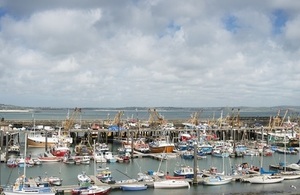
Under European Commission (EC) contingency proposals to enable it to grant our fishing vessels access to European Union (EU) waters in certain circumstances after Brexit, UK boats will be required to be registered with the International Maritime Organization (IMO).

While future access to fish in EU and other coastal State waters in the event of a no deal scenario remains a matter for negotiation, UK fishermen who want to prepare for all EU exit scenarios should apply for an IMO number now.

IMO registration is free and all UK fishing vessels will have to submit their IMO number to the Single Issuing Authority being established by the Marine Management Organisation (MMO) – on behalf of the UK Fisheries Administrations – to manage licensing for commercial fishing in non-UK waters.

Download the IMO registration application form. Fishing vessel owners should complete the form and send it to ship.imo@ihs.com.

When fishermen have received their IMO number they should email it to UKSIA@marinemanagement.org.uk along with their Port Letter and Number (PLN) and Registry of Shipping and Seamen (RSS) number.

Fishermen whose vessels already have IMO numbers should send the details to the MMO, via UKSIA@marinemanagement.org.uk, so accurate records can be maintained.

Published 27 February 2019