Press release: Change of British High Commissioner to Sri Lanka – August 2019
Mrs Sarah Hulton OBE has been appointed British High Commissioner to the Democratic Socialist Republic of Sri Lanka.
Mrs Sarah Hulton OBE has been appointed British High Commissioner to the Democratic Socialist Republic of Sri Lanka.
Mrs Sarah Hulton OBE has been appointed British High Commissioner to the Democratic Socialist Republic of Sri Lanka.
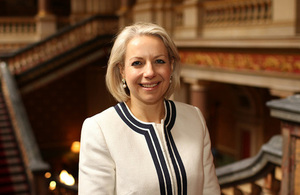
Mrs Sarah Hulton OBE has been appointed British High Commissioner to the Democratic Socialist Republic of Sri Lanka in succession to Mr James Dauris. Mrs Hulton will take up her appointment during August 2019.
Mrs Sarah Hulton OBE has been appointed British High Commissioner to the Democratic Socialist Republic of Sri Lanka in succession to Mr James Dauris who will be transferring to another Diplomatic Service appointment. Mrs Hulton will take up her appointment during August 2019.
Full name: Sarah Hulton
Married to: Anthony Hulton
Children: Three
| 2018 to present | FCO, Deputy Director, Human Resources Directorate |
| 2017 to 2018 | FCO, Head of Democratic People’s Republic of Korea Department, Asia Pacific Directorate |
| 2015 to 2017 | FCO, Head of Pacific Department, Asia Pacific Directorate |
| 2012 to 2015 | Harare, Head of Political Section |
| 2010 to 2012 | FCO, Head of Conflict Prevention Team, Conflict Department |
| 2008 to 2010 | FCO, Head of Weapons of Mass Destruction Controls, Counter Proliferation Department |
| 2005 to 2008 | Manila, Second Secretary, Political Press and Public Affairs |
| 2004 to 2005 | FCO, Full-time Language Training (Tagalog) |
| 2003 to 2004 | FCO, Deputy Programme and Communications Manager, Counter Terrorism Department |
| 2002 to 2003 | FCO, Head of Child Abduction Unit, Consular Directorate |
Published 2 April 2019
Thank you for your feedback
A £4.9 billion sale of loans acquired by the taxpayer during the financial crisis has been announced by the Chancellor today (Tuesday 2 April).
The sale of NRAM (formerly part of Northern Rock) mortgages and unsecured loans was approved following a highly competitive auction.
Two portfolios of mortgages will be sold to Citi, an investment bank, and the majority of financing is being provided by PIMCO, a bond manager.
The sale marks a major milestone in the plan to recover taxpayers’ money and pay off the country’s debt, while also protecting the rights of customers with these mortgages.
The Chancellor of the Exchequer Philip Hammond said:
Through our careful oversight of the country’s finances we are continuing to recover significant amounts of money that were loaned during the financial crash.
Today’s sale enables us to recover the full amount taxpayers loaned to Northern Rock and Bradford & Bingley, helping us pay down our debts and strengthen our finances for the future.
A key element in selecting the successful bidder was the treatment of customers. All bidders were required to agree to a non-negotiable package of customer protections before their bid was considered.
Customers will therefore see no changes to the terms and conditions of their mortgages, with the same protections they currently receive under UKAR’s ownership today. Borrowers will be contacted in due course to explain the change in ownership.
The proceeds from this sale will be used to fully repay the loans provided by the Treasury to NRAM and Bradford & Bingley plc (B&B) during the financial crisis and reduce public debt.
This sale simplifies the book of assets held by UK Asset Resolution (UKAR), the holding company for NRAM and B&B, bringing the government closer to the final disposal of NRAM and B&B, as announced at Autumn Budget 2018.
B&B’s and NRAM’s closed loan books are managed by UKAR on behalf of the taxpayer. Following this transaction, UKAR now owns c. £8 billion worth of assets, down from c. £14 billion in September 2018 and from £116 billion in 2010.
Statement by Ambassador Jonathan Allen, UK Deputy Permanent Representative to UN, at the Security Council briefing on International Humanitarian Law
Thank you Mr President.
As our briefers have made clear, and as we all know, International Humanitarian Law consists of a comprehensive and universal framework to which all Member States are not only committed but bound. It’s important of course that we enhance that framework whenever we see an opportunity. And our briefers have mentioned today, Security Council Resolution 2462 passed just last week at the initiative of the French delegation on terrorist financing which contained important provisions on humanitarian action. Also 2417 of 2018 on starvation of civilians as a weapon of war.
But Mr President, we don’t lack law. We lack enforcement and accountability. And sadly, we are too regularly used to hearing terrible humanitarian stories around this table. Time and time again, from Syria to South Sudan to Yemen, the DRC, in fact in every conflict situation on this council’s agenda, we witness the human cost of the lack of respect for humanitarian principles and International Humanitarian Law.
The most appalling incidents become notorious and are brought not only to our attention by those agencies and operatives on the ground, but also often brought to our peoples on their TV screens. For example, attacks on aid workers or the bombing of hospitals. But we hear much less about the routine and insidious actions which nevertheless have a human cost in the end. I’m talking about such things as denial of visas for humanitarian staff; removal of medical items from aid convoy; medical leave procurement and transport processes; looting and diversion of preposition goods by armed actors or by the authorities; taxes and fines on goods and people; the closure of crossings; denial of registration of NGOs. There is a long long list.
The human cost is clear: people starve; they suffer; they die when the humanitarian space is not respected and we lose the development gains that we’ve taken years to achieve.
To give one example from South Sudan which we’ve talked about a lot in this council. An international NGO within in country staff of fewer than 200 people estimates that it spends approximately $350,000 per year in South Sudan on administrative taxes and fees. These financial costs are primarily paid to official or quasi-official entities and this is all money which should be going to protecting the people that those officials are in place to serve.
So as well as documenting attacks on humanitarian personnel or other egregious crimes, we need to gather data on the bureaucratic impediments and the actions which impede humanitarian access and in that respect, let me commend the work that OCHA is doing to map out how access constraints relate to the severity of needs and humanitarian assistance received.
Let me also say that the UK is supporting research to ensure that the nature, frequency, scale and impact on attacks on health care in conflict is better understood through improved data collection analysis as called for in Security Council Resolution 2286. All of this data should be brought to the attention of the Security Council and its Sub-Committees.
Mr President, for its part the United Kingdom is always looking for innovative ways to promote compliance in International Humanitarian Law. On the 11 March, we published our first voluntary report on the implementation of International Humanitarian Law at domestic level. Publishing specific examples of our practice to implement International Humanitarian Law is intended to help improve understanding of it and encourage and inform dialogue on these issues both at home and abroad. We hope it will encourage other states to publish details of their activities to implement International Humanitarian Law at the domestic level, to identify best practice and to improve implementation and compliance.
But Mr President, more can be done of course by state actors. Mark Lowcock talked about the importance of increasing the understanding and training of some countries’ armed forces. But he also spoke about the need to do so with non-state actors – a point made also by Peter Maurer. I think this is an area to which Security Council could give greater focus. We can look both at education and training and ensuring Commanders are aware of their liabilities under International Law whether those are state or non-state actors and look at tackling actions through sanctions in particular of non-state actors.
Mr President, I hadn’t intended to talk today about Syria which this Council regularly discusses. But the Russian Representative today chose to continue his government’s misinformation campaign against the White Helmets. The Russian government does so to try to deflect attention away from the appalling war crimes committed by the Syrian regime. Its attacks on its own people including by its use of chemical weapons. So let us not have our attention deflected from the fact that Physicians for Human Rights corroborated 553 attacks on medical facilities in Syria in 2018. 498 of these 553 attacks were committed by the Syrian regime and its allies.
Mr President, it is very welcome that you have organised this briefing today and all here have reaffirmed their commitments. Good ideas have been shared by our briefers and by colleagues. However, I’m struck by the contrast between our willingness to stake out a clear position in the abstract while at the same time not tackling humanitarian violations in country-specific conversations. So in addition to today’s meeting, I think that we need to:
1) Ask for, gather and then discuss data about not just the most egregious violations of International Humanitarian Law but also the bureaucratic impediments of interference in humanitarian assistance which kills so many of those in most desperate need;.
2) Ensure that the UN system is able to support states in spreading understanding of International Humanitarian Law and training armed forces and wider government officials;
3) We should consider how such understanding and training could be expanded to non-state actors and ensure they also are held to account.
4) We could call out consistently violations of International Humanitarian Law by all actors in our regular business in our country-specific conversations, whether that’s South Sudan, Syria, Myanmar or elsewhere;
5) We could put greater attention on humanitarian violations when designing and implementing sanctions regimes;
6) We should push consistently for accountability mechanism where states cannot or will not act. As Peter Maurer said, International Humanitarian Law and its upholding relies on our common acceptance that there are limits to war. We all therefore have a stake in upholding it and strengthening it for our common humanity.
Thank Mr President.