Press release: England’s Marine Life Protected With Blue Belt Expansion
Environment Secretary Michael Gove has today created 41 new Marine Conservation Zones, marking the most significant expansion of England’s ‘Blue Belt’ of protected areas to date.
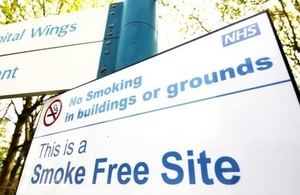
Press release: PHE calls on all NHS Trusts to ban smoking on hospital grounds
Survey finds that more than two-thirds of NHS acute Trusts in England now prohibit smoking on site as part of their journey to becoming smokefree.
thousands are admitted to hospital because of smoking-related conditions every day
new Public Health England (PHE) survey shows more NHS Trusts are now smokefree than ever before
PHE calls for all Trusts to ensure total smoking bans on hospital grounds
Public Health England (PHE) has found that Trusts are making steady progress in becoming smokefree, with smoking now banned completely on the grounds of more than two thirds (69%) of NHS acute Trusts in England. Yet despite this progress, almost a third (31%) have not yet enforced total smoking bans across hospital premises.
The survey was carried out as part of PHE’s Smokefree NHS campaign, which encourages all hospitals to provide smokefree environments as part of supporting smokers to quit and reducing tobacco-related harms. The NHS Five Year Forward View included a commitment for all Trusts to have fully smokefree sites by spring 2020.
Duncan Selbie, Chief Executive, Public Health England said:
One in four hospital beds are occupied by a smoker, and most of them want to quit. Many patients or visitors will be going through difficult times, but smoking remains England’s biggest preventable killer and it is time for the NHS to stop smoking within its hospital grounds, everywhere.
It cannot be right that it is more acceptable in some hospitals to smoke at the front door than it is outside a pub.
As well as encouraging Trusts to prohibit smoking on site, the Smokefree NHS campaign calls for all patients who smoke to be offered evidence-based quitting support. The NHS Long Term Plan, published in January 2019, commits to offering NHS-funded tobacco treatment services to all inpatients who smoke, regardless of why they are in hospital, by 2023 to 2024.
Professor Steve Powis, National Medical Director, said:
Quitting smoking has clear health benefits, which is why the NHS Long Term Plan details a number of practical actions to help people kick the tobacco habit.
Smokefree NHS premises are an important part of this drive, and the successful schemes we are seeing already provide a blueprint for other Trusts to achieve this over the coming year.
The survey highlighted examples of how Trusts are successfully implementing smokefree policies, including:
effective leadership to ensure policies implemented quickly
establishing smokefree steering or working groups
investing in dedicated staff to deliver stop smoking support to inpatients
tannoy system reminders about ‘no smoking’ to reduce confrontation
promoting healthy environments – for example, fruit and veg stalls at hospital main entrances
shelters with plants and trees
partnerships with local schools to produce ‘no smoking’ signage
NHS acute Trusts such as mid-Yorkshire, Northumbria and South Tees are among those highlighted as adopting innovative approaches to help ensure smokefree premises.
Some NHS Trusts reported that implementing policies on e-cigarette use and allowing vaping in designated areas had helped them to achieve smokefree status.
Seema Kennedy, Public Health Minister said:
No one should have to walk past a cloud of smoke in order to enter or leave their local hospital – we must lead by example, and I am determined to see a smoke-free NHS by 2020.
Smoking is still one of the biggest causes of death in this country, and through our NHS Long Term Plan, every smoker admitted to hospital will now be offered targeted NHS support to quit. I am encouraged by this new survey, which shows great strides have already been made towards a smokefree NHS – I strongly urge all Trusts to follow suit.
The PHE survey ran from December 2018 to March 2019. Participation in the survey was voluntary, with Trusts participating on condition of anonymity. Out of 145 Trusts contacted by PHE, 134 responses and 11 nil-returns were recorded.
Being a smokefree Trust was defined as providing evidence-based support for smokers to quit and prohibiting smoking anywhere on the premises, in line with NICE Guidance.
Trusts were scored on a seven-point scale according to the smokefree policies they have in place. Trusts with nil-returns were automatically scored zero for all criteria.
Main findings:
almost half (46%) of Trusts achieved maximum points, although this does not necessarily mean that all smokers were offered support to quit
two thirds (63%) of Trusts were rated ‘green’ as smokefree or substantially smokefree
nearly one third (31%) did not have a policy prohibiting all smoking on the premises
policy prohibits smoking in the grounds
Good examples of smokefree policies across NHS Trusts
Mid-Yorkshire Hospitals NHS Trust
tannoy announcement system plays anti-smoking reminders recorded by children. Any member of staff, patient or visitor can play the announcements by pressing a button located inside the hospital foyer
on-site Stop Smoking Service at Pinderfields for staff, patients and visitors, with plans to launch additional services at more sites
almost 3000 patient-facing clinicians have completed Very Brief Advice training on Smoking
currently recruiting for a Clinical Nurse Specialist in smoking cessation
trolley dashes around all wards and departments with information (for example leaflets, promotional literature) to raise awareness of smokefree site
public and staff education evenings held on smoking cessation as well as stop smoking drop-in clinics.
due to install announcement service with anti-smoking reminders recorded by children (for example “my grandfather is receiving treatment in this hospital, please do not smoke.”)
Press release: PHE calls on all NHS Trusts to ban smoking on hospital grounds
Survey finds that more than two-thirds of NHS acute Trusts in England now prohibit smoking on site as part of their journey to becoming smokefree.
News story: Government launches call for evidence on ivory trade
A range of animals including hippos, walruses and narwhals could join elephants in enjoying greater protection under the Ivory Act, as the government today (30 May) launched a call for evidence on the subject.
In December 2018, the landmark Ivory Act became law in the UK, bringing with it one of the toughest bans on elephant ivory in the world. The new call for evidence will seek to gain further understanding about the trade in ivory from other, non-elephant species.
Today’s announcement delivers on a pledge made by Ministers when the Act was passing through Parliament last year to gather evidence on the trade in ivory from species other than elephants. The Ivory Act includes a power to allow the ban to be extended to other, non-elephant, ivory-bearing species. This power is one way in which the government could further protect other ivory-bearing species.
The government is keen to hear from specialists across all relevant sectors during the 12-week call for evidence to ensure the latest information is considered. The Ivory Act is a landmark in our fight to protect wildlife and the evidence submitted to the review will inform the government’s decision on whether or not to bring forward any changes to the protections already in place.
Environment Minister Thérèse Coffey said:
Our ivory ban is one of the toughest in the world, demonstrates that we see the elephant ivory trade as a thing of the past and will help the global effort to protect elephants for future generations. But there are many more precious species, like the hippo and walrus, which could fall victim to the trade in ivory.
We said we would consider extending the Act to other species. This call for evidence will help inform government policy on this.
This call for evidence will help us to understand if we need to take any further action to protect these animals from the trade in their ivory. We want to hear from specialists in this field to inform any next steps.
The full list of species to be included within the scope of the call for evidence is:
common hippopotamus
walrus
narwhal
sperm whale
killer whale
common warthog
desert warthog
mammoth
Whilst extinct, the mammoth is included in the call for evidence because trade in mammoth ivory may be linked to the trade in elephant ivory, due to their similarity. Government seeks further information on this issue, including whether any proven links threaten elephant populations.