Press release: Sentence increase for teaching assistant who had sex with her pupil
Freya Squires has had her sentence increased to 4 years 8 months’ imprisonment by the Court of Appeal.
A teaching assistant who had sex with a pupil has had her sentence increased by the Court of Appeal to 4 years 8 months’ imprisonment.
Freya Squires, 46, worked as a teaching assistant. Over the course of 2 years she engaged in sexual activity with a 14 year old girl. Squires warned the victim there would be significant consequences if the relationship became public.
After pleading guilty to 6 counts of sexual activity with a child and one count of sexual activity with a child while in a position of trust, Squires was sentenced to 3 years and 4 months’ imprisonment. The sentence was referred as being unduly lenient to the Court of Appeal and was increased to 4 years 8 months.
After the hearing the Solicitor General, Lucy Frazer QC MP, said:
“Squires was placed in a position of trust, a position that she repeatedly abused. Any mitigating circumstances in her case were not sufficient to justify such a lenient sentence and the Court of Appeal has rectified that.”
Press release: Hinds visits Arsenal’s league leading language project
Damian Hinds visits Arsenal’s Double Club to see how it is helping pupils learn languages
Press release: Hinds visits Arsenal’s league leading language project
Damian Hinds visits Arsenal’s Double Club to see how it is helping pupils learn languages
Education Secretary Damian Hinds with Sheffield Park Academy pupils at the Emirates Stadium
Education Secretary Damian Hinds saw how Premier League football club Arsenal FC is helping school children learn and engage with modern foreign languages through its Double Club.
The Double Club is a pioneering initiative set up by the North London side and uses football to illustrate how learning a language can be fun, useful and engaging. The scheme culminates with pupils getting a guided tour of Arsenal’s Emirates Stadium.
On Thursday, 13 June, the Arsenal-supporting Secretary of State joined pupils from Sheffield Park Academy in Sheffield to see the stadium and meet Dan Lane, Gunners manager Unai Emery’s interpreter, to understand just how useful languages can be.
Education Secretary Damian Hinds said:
The Double Club is a fantastic initiative that really brings to life how fun and useful learning a language can be by harnessing the diversity and popularity of football.
Being an interpreter at one of the greatest footballs club in the world would be a dream job for so many but for people like me who don’t speak another language well it’s out of reach.
We’re making good progress in encouraging more pupils to take languages, with the proportion taking a language at GCSE rising from 40% to 46% since 2010, but there is still more to do to persuade more young people to choose languages.
Dan Lane, interpreter for Arsenal manager Unai Emery, said:
I have been fortunate to enjoy great experience after great experience in my role – from travelling around Europe and the world to games, to being in the tunnel after memorable wins.
This has all been made possible due to my ability to speak Spanish, so I would certainly encourage as many young people as possible to take on the challenge of learning a new language.
By volunteering on Arsenal’s Double Club I hope to encourage more young people and educate them about the endless opportunities that can come from learning a second language.
Premier League and Football League teams all over the country carry out a wide range of activities in their communities but Arsenal’s programme is understood to be the only one focused on increasing the uptake of languages in schools.
Press release: Horticulture industry urged to be vigilant for signs of tree pest
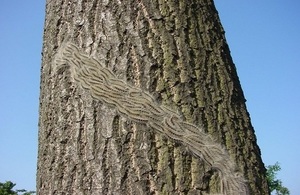
Oak Processionary Moth (OPM) caterpillars found on trees recently imported from the Netherlands.
Press release: Horticulture industry urged to be vigilant for signs of tree pest
Oak Processionary Moth (OPM) caterpillars found on trees recently imported from the Netherlands.
Woodland managers, land owners, the forest industry and tree nurseries are being urged to remain vigilant after the Plant Health Service intercepted a finding of Oak Processionary Moth (OPM) caterpillars on trees recently imported from the Netherlands.
Swift action is being taken to eradicate this finding in Hampshire, including surveillance and tracing work. However, the case highlights the need for continued vigilance to protect the UK’s trees and forests against pests and diseases.
OPM is an established pest in parts of London and surrounding areas, but the rest of the country is designated as a Protected Zone (PZ).
OPM caterpillars feed on oak leaves and can increase trees’ vulnerability to attack by other pests and diseases, making them less able to withstand adverse weather conditions such as drought and floods.
Professor Nicola Spence, Defra Chief Plant Health Officer, said:
Since 2012 we have invested more than £37 million in tree health research, including a dedicated programme of research and development on oak.
We are working with local authorities and land managers to tackle OPM with a control programme of treatment and surveillance and in 2018 we introduced tighter restrictions on the importation of oak trees to England.
Dr Anna Brown, Head of Tree Health & Contingency Planning, Forestry Commission, said:
Those of us involved in importing or trading plants must maintain our vigilance against exotic pests and diseases such as OPM. There is a lot we can do such as buying British, only buying stock from reputable, responsible suppliers and inspecting imported plants.
Inspect, inspect and inspect again – we can’t check imported plants too often for signs of trouble. Don’t presume that because your supplier found no evidence of a pest or disease that you won’t either. You might spot something that they have missed.
The Forestry Commission, councils and land managers tackle the pest with an annual control programme of tree treatment.
If you suspect OPM, you should not attempt to destroy or move infected material yourself as the nests and caterpillars can pose some risks to human health. Visit the Forest Research website for more information on how to identify OPM.