UK and Sweden partner on future combat air

Defence Secretary Penny Mordaunt and her Swedish counterpart Peter Hultqvist have signed a landmark agreement to partner on future combat air.

The Memorandum of Understanding (MOU) commits both governments to work on a joint combat air development and acquisition programme, including the development of new concepts to meet both nations’ future requirements.

At the MOU signing with her Swedish counterpart yesterday, the Defence Secretary said:

The UK and Sweden have an enduring defence relationship, with our two industries sharing a rich history of collaboration in air power.

Not only do we share the same commitment to tolerance, freedom and free trade, we also share the same determination to defend those values, including in Afghanistan, Iraq and today as part of the UK’s Joint Expeditionary Force.

This agreement further deepens this partnership and sees us look to the future with a bold and shared vision of UK and Swedish air power.

Announcing the signature of the Memorandum of Understanding (MOU) at the Royal International Air Tattoo, the Minister of Defence Procurement, Stuart Andrew, said:

I’m delighted that we have signed this Memorandum of Understanding, endorsing a shared and ambitious vision for future combat air systems which lays firm foundations for future collaboration.

Today we usher in an exciting new era in which the talents of two great combat air nations will be combined to lift Swedish and British airpower into the stratosphere.

The Defence Minister outlined the UK and Sweden’s long partnership on defence, including:

  • Joint exercises in the Arctic and in Exercise Ramstein Alloy over the Eastern European skies.
  • Swedish-made chaff and flare dispensers are used on UK Typhoons and Saab’s Giraffe radar is a key part of the UK’s Sky Sabre ground-based air defence system.
  • Swedish Gripen aircraft are equipped with radars designed and built by Leonardo in Edinburgh.
  • The UK, working with European partners including Sweden, has developed the state-of-the-art beyond-visual-range Meteor air to air missiles.

The Swedish Minister of Defence, Peter Hultqvist, confirmed both governments intend to remain at the forefront of combat air.

He stressed the opportunities to put advanced technologies onto Gripen and Typhoon, the world class combat aircraft currently operated by Sweden and the UK respectively, before inserting these technologies onto a future combat air system.

Peter Hultqvist also highlighted the strong industrial base shared by both countries as central to securing future Combat Air power, as well as the existing Gripen fighter systems.

He added that the significant progress made to date was a result of focussing the discussions on practical considerations, recognising the strengths of each party and treating each other as equal partners.

Discussions between industries and governments had been ongoing since the publication of the UK’s Combat Air Strategy in July 2018, with common ground identified based on similar future Combat Air requirements, including being optimised for air defence.

Defence Minister Andrew confirmed that other nations were encouraged to join the UK/Swedish dialogue, on the condition that they had similar requirements.

The Air Force Chiefs of both nations addressed the audience at the event, as well as industry. UK industry was represented by BAE Systems, whilst Swedish industry was represented by Saab.


Motorists urged to check vehicles before heading off on holiday

Hannah – from Leicestershire – patrols the M1 near East Midlands Airport and says it’s vital people do the basics before setting off to avoid timely breakdowns and delays to other motorists.

The call comes as part of Highways England’s ongoing safety campaign about motorway driving.

It advises motorists what to do if they break down and reminds them to follow speed limits, to keep left except when overtaking and not to ignore Red X signals above closed lanes.

Hannah said:

Today is the day when thoughts turn to those important summer holidays and quality family time. You’ve packed the sun cream, dusted off the sandals and got the suitcase packed. But, have you considered the safety of the vehicle your travelling in?

It’s vital motorists take part in ‘check your vehicle day’ because those plans could be ruined by a simple vehicle breakdown that could have easily been avoided.

She added:

We often find people have run out of fuel and that’s because they have ignored the warning light on the dashboard before setting off. There is an assumption that there is always more in the tank than the indicated level, but that is not the case and other factors such as driving style can quickly reduce fuel levels. Put simply, it’s not worth taking the chance.

By making sure that you have fuel levels topped up, there’s less likelihood of you being forced to make unplanned stops and causing delays to other drivers.

The other common breakdown I come across relates to tyre problems. Again, you shouldn’t always rely on the car to tell you something is wrong. Many modern cars have tyre pressure monitoring systems, but by manually checking the tyre pressure and tread regularly, you can reduce the likelihood of things like tyre blowouts while also improving fuel efficiency. We all have a part to play in helping everyone get where they’re going as quickly and as safely as possible.

The ‘check your vehicle day’ is being supported by 1992 Formula 1 World Champion Nigel Mansell CBE, in his role as IAM RoadSmart president, the RAC, Michelin UK, Green Flag and Halfords Autocentres.

Nigel Mansell added:

The ‘check your vehicle day’ is a great initiative from Highways England. As someone who raced in Formula 1 for well over a decade, I know a thing or two about good vehicle preparation – and what this means for getting to your finish line.

Making sure your car is fully ready for the journey ahead could not only save you and your family a lot of heartache on the way to your destination; but ensure that you, your occupants and other road users are as safe as possible.

It should be a weekly task for the driver to make sure all lights are working on his or her car, all glass areas are clean, wipers clear the windscreen properly, tyres at least meet legal requirements and water and oil levels are topped up.

I am delighted to give my stamp of approval to Highways England’s call to action and please pay attention to it, as it could save your life and those around you.

July and August are the busiest months for breakdowns on motorways and major A-roads with one breakdown reported every two minutes during the final weekend in July and first weekend in August.

Highways England is expecting to respond to an extra 700 breakdowns a week for the next six weeks, taking the average number of motorway breakdowns each week to almost 5,000.

Highways England says simple checks are a way to make sure the vehicle is roadworthy. Things to consider are:

  • Check tyres: prior to setting off on a long/significant journey, check your tyre pressures are suitable for the load and the condition of your tyres, including the spare. Look out for cuts or wear and make sure the tyres have a minimum tread depth of 1.6mm, which is the legal limit
  • Check engine oil: use your dipstick to check oil regularly and before any long journey, and top up if needed. Take your car back to the garage if you’re topping up more than usual
  • Check water: to ensure you have good visibility, always keep your screen wash topped up so you can clear debris or dirt off your windscreen
  • Check lights: if your indicators, hazard lights, headlights, fog lights, reverse lights or brake lights are not functioning properly, you are putting yourself and your family at risk. In addition, light malfunctions can be a reason for your vehicle to fail its MoT
  • Check fuel: before setting out, check your fuel levels and make sure you have enough to get to your destination

Highways England has also issued five basic safety tips to follow if your car does break down on a motorway:

  • Get away from the traffic. Exit the motorway or get to an emergency area or hard shoulder and use the free phone provided.
  • If that’s not possible, move left onto the verge.
  • Get out of the left side of your car and behind the barrier if you can and it is safe to do so.
  • Get help – contact your breakdown provider or Highways England on 0300 123 5000.
  • If you break down in moving traffic and cannot leave your car, keep your seatbelt and hazard lights on and call 999.

Get more information about driving on motorways.

General enquiries

Members of the public should contact the Highways England customer contact centre on 0300 123 5000.

Media enquiries

Journalists should contact the Highways England press office on 0844 693 1448 and use the menu to speak to the most appropriate press officer.


Norwich–Ely rail passengers protected by CMA

The Competition and Markets Authority (CMA) is responsible for looking into the awarding of rail franchises as part of its mergers work, and has therefore been investigating the award of the East Midlands Rail Franchise to Abellio. 

The Phase 1 probe has found competition concerns on 2 of the routes Abellio would operate – Norwich to Ely and Thetford to Ely. This is because under current proposals for the franchise, Abellio would operate both East Midlands Trains and Greater Anglia, and so provide the only train services on this line. The CMA is concerned that this could reduce competition, as passengers have no other rail options, which could lead to higher fares. The CMA has found no concerns on the other routes.

Joel Bamford, Senior Director of Mergers at the CMA, said: 

Thousands of people rely on this route, so it’s crucial that passengers don’t suffer as a result of reduced competition. 

If the franchise is awarded to Abellio as currently planned, we’re concerned passengers could face increased prices. 

We look forward to hearing from Abellio about how they will seek to overcome these concerns.

Abellio has offered to work with the CMA to keep fares and advance ticket availability at current levels on the 2 routes. In previous similar cases, such as the award of the Northern franchise to Arriva and FirstGroup and MTR’s acquisition of South Western, the CMA’s concerns were resolved by the operator agreeing to price-caps on the affected lines.

The CMA’s decision comes in advance of the start of the franchise, due to begin on 18 August. Further details can be found on the case page

Notes for editors

  1. The CMA is the UK’s primary competition and consumer authority. It is an independent non-ministerial government department with responsibility for carrying out investigations into mergers, markets and the regulated industries and enforcing competition and consumer law. For CMA updates, follow us on Twitter @CMAgovuk, Facebook, and LinkedIn.
  2. Under the merger control provisions of the Enterprise Act 2002 in conjunction with the Railways Act 1993, the CMA may look into the award of UK rail franchises to ensure that no competition concerns arise.
  3. Under the Enterprise Act, Abellio East Midlands Ltd will now have 5 working days to propose undertakings in lieu (UILs) of reference to resolve the competition concerns raised by the CMA. If it does not propose UILs, or if the CMA is not satisfied with them, the merger will be referred to an in-depth (‘phase 2’) investigation.
  4. The CMA will announce by 2 August 2019 its preliminary decision on whether any UILs offered by Abellio might be sufficient to resolve the competition concerns identified. If the CMA provisionally accepts UILs, a consultation will follow.

Media enquiries to the CMA should be directed to press@cma.gov.uk or 020 3738 6460.


Fatal accident at Margam

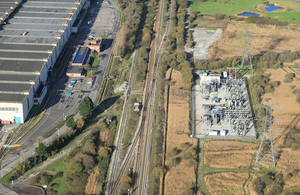
The railway at Margam (image courtesy of Network Rail)

The railway at Margam (image courtesy of Network Rail)

At around 09:52 hrs on Wednesday 3 July 2019, two track workers were struck and fatally injured by a passenger train at Margam East Junction on the South Wales Main Line. A third track worker came very close to being struck. These three workers were part of a group of six staff, who were undertaking scheduled track maintenance on lines that were still open to traffic.

The train, which was travelling from Swansea to London Paddington, was approaching Margam on the up line at around 73 mph (117 km/h). Its driver saw three track workers walking away from him on the adjacent line and, beyond them, three more track workers on the line ahead of his train. He sounded the train horn and applied the emergency brakes. The track workers walking on the adjacent line became aware of the train approaching and tried to warn their colleagues as the train passed them.

The three track workers on the up line were working on a set of points, using a petrol-engined tool for loosening and tightening large nuts. Consequently, at least one of the workers was wearing ear defenders. CCTV images taken from a camera at the front of the train suggest that the workers did not become aware of the train until it was very close to them. By this time, it was travelling at around 50 mph (80 km/h).

The RAIB’s investigation will identify the sequence of events that led to the accident and consider:

  • what might have influenced the actions of those on site
  • the protection arrangements that were in place
  • the planning of the work and the implementation of Network Rail’s standard for keeping people safe on or near the line
  • any relevant underlying management or organisational factors

Our investigation is independent of any investigation by the railway industry, the British Transport Police or by the industry’s regulator, the Office of Rail and Road.

We will publish our findings, including any recommendations to improve safety, at the conclusion of our investigation. This report will be available on our website.

You can subscribe to automated emails notifying you when we publish our reports.

Published 4 July 2019
Last updated 19 July 2019 + show all updates

  1. Entry updated to provide further details of the events surrounding the accident and a summary of what the RAIB’s investigation will consider.
  2. First published.


Membership of the Veterinary Products Committee

The Veterinary Products Committee (VPC) is looking to appoint four new members:

  • Veterinary immunologist
  • Veterinary surgeon (mixed/small animal)
  • Medical/clinical microbiologist
  • Veterinary surgeon (fish)

Members receive £148 for each meeting attended and an additional £76 for preparation time.

Meetings are held at the Veterinary Medicines Directorate (VMD) offices in Surrey.

The VPC schedules three regular meetings a year (February, June and September typically) and it may occasionally be necessary to hold ad hoc meetings. Usually an Open meeting is held on the day before the September meeting.

Further information on the VPC is available on its website and from the VPC secretary, Sandra Russell, email: s.russell@vmd.defra.gsi.gov.uk or tel: 01932 338490.

Please contact Chris Abbott, c.abbott@vmd.defra.gsi.gov.uk for details of how to apply. The closing date for applications is noon on 23rd August 2019.