AAIB report: Boeing 737-4Q8, Partial loss of electrical power on approach

G-JMCR

The aircraft was operating a night flight to East Midlands Airport, with the left engine generator disconnected, and had just commenced its descent when the crew faced an unusual array of electrical failures on the flight deck. Despite the loss and degradation of a number of systems, the aircraft landed safely at East Midlands.

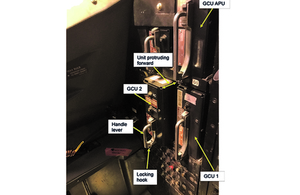
The electrical failures were caused by the right engine Generator Control Unit (GCU) which had been incorrectly secured in its mounting tray and had disconnected in flight. The investigation also uncovered a number of contributory factors including: the management of defects and Acceptable Deferred Defects (ADD), recording of maintenance, and a number of weaknesses in the operator’s Safety Management System with regards to managing risk.

Six Safety Recommendations are made to the operator regarding its safety management system and one to the Civil Aviation Authority.

Read the report.

Published 5 September 2019


Fish pass at iconic Grade II Crumpwood weir now in action

Environment Agency completes fish pass that will help fish like Atlantic salmon and brown trout populate a further seven kilometres of the River Churnet.

Water once again flows under the 19th century pump house at the Grade II listed Crumpwood weir, after work to create a unique fish pass is complete.

The work, which involved opening up the previously sealed off channel to the pump house has seen around 240 tonnes of soil and silt cleared from around the pump house, one of the original pump house turbines removed and cleaned for display and the refurbishment of the old oak sluice gates. Which means the building is beginning to come back into use while helping to secure the future of salmon in this country.

Crumpwood weir, originally built between 1807 and 1811 was part of the Froghall to Uttoxeter Canal and later used for public water supply. Today it forms an important historic feature in the Churnet Valley’s landscape. But, while it is very pretty to look at, the 2.7 metre difference in the height of the water means it is an impossible barrier for fish and wildlife to pass.

This new fish pass along the River Churnet means seven kilometres of river habitat can now be populated by Atlantic salmon, brown trout, grayling and chub to name a few. Helping fish migrate up and down the river means they can find the best habitat to feed, shelter, spawn and grow, helping achieve resilient and sustainable UK fisheries.

Local historians who are part of Lichfield Waterworks have also been involved, and they have helped the project team by providing invaluable advice by supplying historic plans and guidance on how to remove the historic turbine.

The fish pass has been built in partnership with South Staffs Water, JCB and Staffordshire Wildlife Trust. The Environment Agency is very grateful to JCB who have loaned the heavy plant equipment for this project, and for the support of South Staffs Water who own the historic pump house. Without their support and contributions this project would not have been achievable.

As part of the work, Environment Agency fisheries biologists have tagged fish found below the weir and these will be monitored by the angling clubs above the weir so we can evaluate how successful the fish pass has been.

Chris Grzesiok, fisheries, biodiversity and geomorphology expert from the Environment Agency said:

This has been a wonderful project to be part of. As well as contributing over £330,000 to this project, we’ve been able to see how the 19th century pump house was built and with the help of local historians, we’ve been able to repurpose and breathe new life into what was a derelict building. This fish pass is another step towards delivering the 25 year environment plan’s vision of catchments functioning more naturally where wildlife can thrive and migrate freely.

Ken MacDonald, Head of Water Strategy, at South Staffs Water said:

We’re always looking for opportunities to work with local community groups and to protect and enhance the biodiversity of the natural environment. We aim to provide a reliable supply of high-quality drinking water for future generations at the same time as allowing wildlife to flourish. This new fish pass at Crumpwood is a practical example of how we can achieve this by working in collaboration with other organisations.

This project is being part funded by the Marine Management Organisation, which is contributing £240,000.

Funding from the Marine Management Organisation is part of a coordinated and funded programme of projects for 2018/19 with the aim of freeing migration routes of barriers to fish. This project is part of that programme funded by over £1.6 million of European Maritime and Fisheries Funds, which is matched by more than £1 million of Environment Agency/Defra funding and £300,000 of other funds.


Fish pass at iconic Grade II Crumpwood weir now in action

Atlantic salmon and brown trout can now populate a further seven kilometres of the River Churnet.


New service to open overseas markets for UK businesses

A new online tool launched today will allow British business to report issues preventing them from trading around the world.

Barriers include unnecessary, legal, regulatory or administrative requirements. This includes labelling restrictions, out-of-date regulations and licensing requirements.

The tool will ensure British businesses can flag these issues and the government’s trade experts can work with countries around the world to resolve them.

The online form allows any UK-based business to report a barrier that is stopping or hindering their trade and investment overseas.

Once a request is submitted, it is shared with the Department for International Trade’s global team of trade experts who assess trade barriers and work with other governments to resolve these issues. The Department will also collect feedback to improve the service offered to businesses.

Market access barriers make British exports less competitive than locally produced goods and services. In some cases, they can prohibit imports entirely.

A study by the OECD suggests all G20 economies could see increased exports by more than 20% in the long term, if trade barriers were halved globally.

The government has also announced today that it has resolved market access issues to:

  • Lift the Mexican government’s ban on British exports of food condiments and supplements containing beef.
  • Reduced restrictions on Vodka exports to Canada.

Other recent market access wins secured by the UK government include:

  • Lifting a ban on British beef and lamb exports to Japan in January 2019, allowing exports worth an estimated £130 million over 5 years.

  • Helping UK pharmaceutical company’s like GlaxoSmithKline win a £35 million contract in Bulgaria through securing changes to health procurement rules.

  • Lifting the ban on British pork exports to Taiwan in August 2018, allowing exports worth an estimated £50 million over 5 years.

International Trade Secretary, Liz Truss said:

Opening up new markets for British businesses is a top priority and the Department for International Trade has 1,000 people located around the world to help create more opportunities than ever before.

In the last 12 months, we’ve secured wins to sell beef to Japan, langoustines to China and pork to Taiwan – just to name a few.

I am delighted to announce today that we’ve secured new wins to lift the ban on exports of products containing beef in Mexico and reduce restrictions on Vodka exports to Canada.

I urge businesses to make full use of our new market access tool, which will help us to rapidly identify and knock down unnecessary trade barriers.

The Department for International Trade now has over 4,000 trade experts based in the UK and across 109 different countries worldwide.

One business already taking advantage of the opening of markets in Mexico is importer Impulsa.

Commercial Manager at Impulsa, Montserrat Cortina MP said:

Thanks to the support of the Department for International Trade in Guadalajara, over the last 2 years, the necessary procedures were carried out between Mexico and the UK at a government level to remove import restrictions on beef products from Great Britain. This means that, in 2019, we realised the reintroduction of products containing beef to Mexico after many years of absence in the market.

British businesses can now directly report barriers preventing them from trading online at great.gov.uk.

Notes to Editors:

Digital Market Access Service

In February 2019, DIT launched the new internal government digital market access service to collate a list of UK facing businesses, a sign of the close collaboration across Whitehall and with overseas missions that is allowing the government to better meet the needs of businesses.

Case studies

New opportunities for products containing beef in Mexican markets

  • DIT has secured market access for UK food condiments including condiments and supplements containing beef. The win will create new opportunities for UK food suppliers and manufacturers.

Reduced restrictions on Vodka classifications in Canada

  • DIT successfully encouraged a review of Canadian vodka regulations to allow for more flexibility in the compositional standard of vodka.

  • Previously, only spirits derived from potatoes or grains could be marketed as vodkas in Canada.

  • The new standards allow for vodkas to be produced from any products of agricultural origin. This increases the opportunities in Canada for UK distillers innovating with unique, cutting-edge spirit recipes.


SATs results show more primary pupils reach the highest standards

More pupils in England are reaching the highest standards of reading, writing and maths than last year, data from this year’s key stage 2 assessments – better known as SATs – shows.

The statistics also show that typically the longer a primary school has been an academy, the better its results. 71% of pupils in converter academies open for 8 or more years met the expected standard in reading, writing and maths compared to 66% of pupils in those open for one year.

Results in sponsored academies – those that were typically converted due to previous poor performance – have also increased nationally, driven by greater improvements in those that have been open for longer.

Statistics published today also show:

  • 65% pupils reached the expected standard in reading, writing and maths (combined), and 11% pupils reached the higher standard – meaning they are working at a level beyond that expected of primary pupils – in all three subjects, up from 10% last year
  • 85% of pupils who met the phonics standard in year 1 attained the expected standard in reading at the end key stage 2
  • The attainment gap between disadvantaged pupils and their peers has narrowed by 13% since 2011 based on the Disadvantage Gap Index
  • The attainment gap in reading, writing and maths (combined) between pupils whose first language isn’t English and those who speak it as their first language has almost disappeared – going down from 4 percentage points in 2016 to just 1 percentage point
  • Sponsored academies open for two and five years have shown considerable improvement – each seeing 3 percentage point improvements
  • London remains the best performing part of the country with Richmond upon Thames the best performing borough

This data has been released after initial data, published in July, showed 65% of pupils meet demanding standards in reading writing and maths – up from last year.

School Standards Minister Nick Gibb said:

We want all pupils to leave primary school equipped with the knowledge and skills that will help them to be successful in the rest of their education and beyond – that’s why I’m pleased to see an increase in pupils reaching the very highest standards at the end of primary school.

The fact that the attainment gap between disadvantaged pupils and their peers has significantly reduced since 2011 illustrates how the programme of reforms we’ve put in place since 2010 is helping to level the playing field.

We reformed Key Stage 2 tests in 2016 to make sure they assessed schools’ performance in equipping pupils to understand the new, improved primary curriculum. These results are testament to the hard work of pupils, parents and teachers.

This year’s results are the fourth to be released following the introduction of more rigorous assessments in summer 2016, bringing primary education in line with the best in the world.

The attainment gap between disadvantaged students and their more affluent peers has fallen between 2011 and 2018. And in 2016 England achieved its highest ever score in the international PIRLs literacy study. This follows a greater focus on reading in the primary curriculum, and a particular focus on phonics.

National Curriculum Assessments – better known as SATs – are intended as a measure of school standards, as opposed to individual pupils. They enable government to hold primary schools to account for their performance and also highlight where pupils may need additional support when they arrive in secondary school