British Ambassador Andrew Noble delivers speech at Investors Days

2019 has been so far a year of major political and economic swings. Nevertheless, Romania remains a viable investment destination for British investors.

Following a key court ruling in May, the Romanian government pledged to focus on improving the rule of law situation and confidence of the electorate in the government. However, the recent change in Justice Minister appears to undermine this. Ahead of the election cycle, it is important that Romania continues to focus on political stability and make progress on commitments made which support this goal.

In this first year of the electoral cycle, Romania has reaffirmed its commitment to Euro Atlantic values. This is a reassurance for British investors, and I hope this newfound political strength will translate into predictability and market-orientated legislation.

It is our strong hope that the negative effects of the legislation at the beginning of the year will be countered or eliminated completely in the near future. (NOTE: EO 114 is under debate in Parliament with numerous amendments to tone down or cancel its effects).

While one of the appealing points of Romania is its high-quality human capital, large parts of Romania are still struggling with underdevelopment. Public investment and stronger local institutions would allow investors to move away from the major urban centres and look to other parts of the country, thus helping to alleviate the socio-economic situation that has such high impact on the safety and quality of life of Romania’s citizens;

While the tech sector remains one of the sectors of core interest for British investors (as proof by the expanding LSEG tech hub in Bucharest), I am pleased to see that Romania provides profitable investment opportunities in other areas as well; Example: Liberty house has taken over the steel operations in Galati, as part of a multinational deal with ArcelorMittal (seven major steelworks and five service centres across seven European countries).

Despite a difficult start the Bucharest Stock Exchange has had a very nice run this year. This good run confirms the excellent potential of the capital market here. Increased liquidity and new financial instruments would encourage more investors. We wish to see stronger cooperation between the stock exchange here and London stock exchange, with dual listings and other projects as well.

Healthy capital markets need strong and transparent corporate governance rules. It is crucial for all companies, no matter of their shareholder structure (private or state-owned) to uphold these rules at the highest standard in order to attract large credible investors.

Although some macroeconomic indicators may be worsening, the overall economy preservers a healthy balance. Demand is well stimulated whilst the supply (industrial production and value-adding activities) needs to catch up. Increased public investment (in sectors that generated value – infrastructure, education etc) and structural reforms are the simple solutions needed.


Alister Jack responds to September 2019 labour market figures

Commenting on the latest labour market figures for Scotland, published on the 10th September 2019, Scottish Secretary Alister Jack said:

It is disappointing to see a sharp increase in unemployment after a period of encouraging figures.

It shows we cannot be complacent. One of our key priorities is to work with the Scottish Government to boost the Scottish economy and create jobs.

The UK Government is investing £1.4 billion in city and growth deals and we are preparing to take advantage of the opportunities that will arise when we leave the EU on October 31.

But I would urge the Scottish Government to use their powers to best effect.

Making Scotland the highest taxed part of the UK and creating uncertainty by threatening a second independence referendum are holding Scotland back.

Overview

For the three months to July, Scotland’s overall labour market is weakening: employment fell substantially (-33,000) and unemployment increased robustly (+19,000) and activity decreased (+15,000). In addition, monthly claimant count numbers are worsening over the month of August, as there are 112,100 people in Scotland claiming Jobseeker’s Allowance and out-of-work Universal Credit (seasonally adjusted); this is up 2,300 on the month of July (revised) and 20,000 up on the year before.

As a result, Scotland’s unemployment rate at 4.0% is now back to the rate we had 12 month ago and up on the recent record low at the start of the year. Also, Scotland’s unemployment rate is now above that of the UK as a whole at 3.8%, which remained unchanged over the last quarter. Furthermore, the number of people employed at 2,669,000 in Scotland is somewhat down on the recent record high at 2,702,000. This means that Scotland’s employment rate, at 74.9%, remains below the UK’s rate at 76.1%.


Cameroon sends 15 scholars to study in the UK

British High Commissioner to Cameroon, Rowan James Laxton called on the 15 scholars to be real ambassadors of Cameroon to the UK and ensure they make the best out of this lifetime opportunity.

Talking about UK education, the British diplomat said:

UK education opens doors, wherever you go in the world and it has been the preferred choice for some of the most important minds in history.

Education is not just to read and write, but to make use of the knowledge gained to improve self and community.

About the importance of Education to a community, Rowan Laxton quoted Malala Yousafzai who once said:

With guns you can kill terrorists, with education you can kill terrorism.

Chevening scholars will live and study in the UK for one year, during which they will develop professionally and academically, network extensively, experience UK culture and build lasting positive relationships with the UK.

Chevening scholarships are the UK government’s global scholarships programme funded by the Foreign and Commonwealth Office and partner organisations. The programme enables outstanding emerging leaders from all over the world to pursue one-year master’s degrees in any subject at any UK university.

Applications for the 2020 to 2021 academic year are open till 5 November 2019. Applications must be sent via the Chevening website.


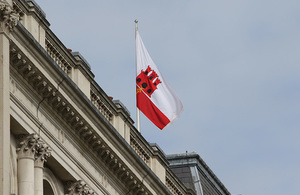
Foreign Office to fly Gibraltar flag on National Day as FCO minister visits the Rock

Gibraltar Flag

Minister for Europe Christopher Pincher will visit ‘the Rock’ to join in the celebrations, reminding the people of Gibraltar that they are, and will remain, a vital and valued part of the UK family.

During a speech in Casemates Square, the Minister will reflect on the significance of this year in over 300 years of shared history, as together we prepare to leave the European Union.

The Minister will use the opportunity to reflect on the United Kingdom’s unwavering commitment to Gibraltar.

He will say:

The British Government will remain steadfast in our support of the people of Gibraltar – and your prosperity, your security, and your interests – as we leave the EU.

We will never enter into arrangements under which the people of Gibraltar would pass under the sovereignty of another state against their wishes. Nor will we enter into a process of sovereignty negotiations with which Gibraltar is not content.

Minister Pincher will be meeting with Chief Minister of Gibraltar Fabian Picardo for the first time.

Further information

Published 10 September 2019


Independent Commission on Examination Malpractice

Ofqual welcomes the Report of the Independent Commission on Examination Malpractice, published today (10 September 2019). The Commission supports our view that there is not an endemic problem of malpractice in the exam system in England, and that the vast majority of people involved act with integrity and professionalism. Nevertheless, it is essential for public confidence that all opportunities are taken to reduce the incentives and potential for malpractice to occur, particularly in the light of growing threats posed by the use of technology. We look forward to working with JCQ and the exam boards to implement the recommendations.

Many of the Report’s recommendations are ones that we have also identified, support and have begun to work with other stakeholders to address. In general, there is a need for greater clarity and consistency in the ways in which malpractice is identified, prevented and sanctioned, and also how associated data should be collected and communicated.

In particular, we agree that it is unhelpful to have varying definitions of malpractice, which can create confusion and inconsistency in approaches between individuals and organisations. We therefore support efforts to broaden understanding of what constitutes malpractice and what the anticipated responses might be when issues arise. From our perspective, we are at various stages of consultation (either intended or already initiated) on revisions to our guidance for awarding organisations around issues of personal interest and what constitutes malpractice and maladministration.

We agree with the Commission’s view that gathering good quality data and reporting it in engaging ways is important, and we are pleased that our work in this area has been recognised. Nevertheless, we will reflect on the Commission’s view that there is more that can be done and we will work with counterpart organisations as appropriate.

With regard to access arrangements, the Commission’s report supports our strong view that there is a need for more meaningful candidate level data to be collected, alongside greater clarity of different arrangement definitions. It is only with this data that questions of fairness can be answered satisfactorily. There is, of course, a balance to be struck between gathering meaningful data and being mindful of any extra burden this could place on schools and colleges. We are discussing this trade-off with stakeholders and will work to develop a way to ensure the necessary data is collected in the most efficient way possible.