Detailed guide: Identify livestock for export to the EU in a no-deal Brexit
How to identify sheep, cattle, pigs and goats when exporting to the EU in a no-deal Brexit.
How to identify sheep, cattle, pigs and goats when exporting to the EU in a no-deal Brexit.
DFR with its famous dome once led the world in fast breeder technology.
The reactor was built in the 1950s at a time when there was a worldwide shortage of uranium for electricity generation. Its core was surrounded by a blanket of natural uranium elements that, when exposed to the effects of the radiation, would “breed” to create a new fuel, plutonium. After the reactor closed in 1977 most of the core fuel was removed. But work to remove elements from the breeder zone came to a halt when some were found to be swollen and jammed. Almost 1,000 – around two-thirds of the total – were left in place.
Decommissioning the 60-year-old reactor is one of the most technically challenging projects in the Nuclear Decommissioning Authority estate and removing the breeder elements has been a top priority.
After designing and testing remotely-operated equipment, a decommissioning team began recovering the elements in 2017, using purpose-built tools that reached down into the reactor to cut the breeder elements free and lift them into a flask for removal to the next stage of the process.
The success of the locally manufactured tooling has played a big part in the successful removal of half the remaining radioactive fuel inventory inside the reactor vessel. Local companies who manufactured mechanical equipment to demanding timescales included JGC Engineering and Technical, Precision Machining Services, and Calder Engineering. Contec Design Services carried out electrical, control and instrumentation works.
Senior Project Manager Raymond Hill commented:
This is a challenging project and I am pleased that we are making good progress on the removal of the elements, which is contributing towards the Nuclear Decommissioning Authority’s mission to clean up the UK’s nuclear legacy.
View the breeder elements being removed from the reactor here: Material being removed from the Dounreay Fast Reactor
The Charity Commission has opened a new statutory inquiry into CWM Harry Land Trust Limited (1100899), an environmental charity whose objects also include the education and rehabilitation of prisoners and ex-offenders.
The charity was previously included in a class inquiry in November 2018, which was opened to examine charities which had repeatedly failed on their reporting requirements. As part of the class inquiry the Commission issued an order directing the trustees of the charity to provide information by specified dates, including the charity’s annual accounts for the financial years ending 31 March 2016 and 2017. However the trustees failed to comply. The charity has failed to file financial information in line with statutory requirements for 3 consecutive years, raising serious concerns over the charity’s administration, accountability and transparency.
The Commission also has concerns over a number of related party transactions, including payments to a trustee and two loans to the charity from a company where one trustee was a director.
The inquiry will examine the extent to which:
It is the Commission’s policy, after it has concluded an inquiry, to publish a report detailing what issues the inquiry looked at, what actions were undertaken as part of the inquiry and what the outcomes were. Reports of previous inquiries by the Commission are available on GOV.UK.
Ends
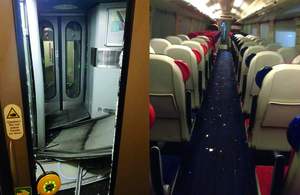
Damage to the vestibule end and debris in the saloon (left image courtesy of CrossCountry, right image courtesy of Bombardier Transportation UK).
At around 06:11 hrs on 26 September 2019, an explosion occurred in an electrical equipment cupboard located in a coach vestibule as an empty train departed from Central Rivers depot. The explosion resulted in considerable damage to the vehicle interior, which was not discovered until the driver moved through the train to change ends at Birmingham New Street station.
We have undertaken a preliminary examination into the circumstances surrounding this accident. Having assessed the evidence which has been gathered to date, we have decided to publish a safety digest.
The safety digest will be made available on our website in the next few weeks.
Published 11 October 2019
Drivers across the East of England will benefit from a brand new dual carriageway opening a full year ahead of schedule in December 2019.
The 12-mile bypass is part of a wider 21 mile scheme in Cambridgeshire which will save drivers up to 20 minutes per journey, benefitting people living and working across the entire region.
It will also support the whole UK by boosting access to and from the country’s biggest and busiest container port at Felixstowe – crucial as the UK looks to a bright future after Brexit.
The opening of the bypass follows confirmation last week that 18 new road schemes have been given the go ahead by the Department for Transport, in addition to the £25.3 billion that has already been committed for investment in the strategic road network between 2020 and 2025.
Roads Minister Baroness Vere said:
This government is committed to delivering an infrastructure revolution and it’s fantastic that a key section of this vital route will be delivered a year ahead of schedule, helping people travelling in the east of England get to their destination quickly and safely.
The A14 upgrade will not only improve the experience for local drivers but will also boost access between the region’s ports and the West Midlands – a key logistics hub.
I look forward to seeing the benefits in action in December and to seeing similar infrastructure schemes developing around the country as we improve links and spread growth opportunities.
The bypass is part of a £1.5 billion project to upgrade 21 miles of the A14 in Cambridgeshire, the biggest upgrade of its kind in the UK.
It had been due to open in December 2020, but excellent progress made by the Highways England-led team means that the road will now be ready for drivers to use this December.
To take advantage of the early opening, the road will open as a best-in-class A road rather than a motorway as originally planned, but the design will remain the same.
Highways England project director David Bray said:
I’m delighted that we will be able to deliver the benefits of this key section of the project so much earlier than originally planned. As well as a significant improvement for drivers, this major milestone will start to realise some of the benefits of the upgrade for residents and communities along the A14 too.
And it will mean that we are able to start work sooner on the improvements we are making to local roads in and around Huntingdon as we start to dismantle the old viaduct over the train station, which will be a real boost for local communities.
Work on the upgrade has progressed at pace, with around 10 million cubic metres of earth having been moved – more than 4 times the great pyramids of Giza.
The full project remains on track to open to traffic by the end of 2020.