Official Statistics: Area of crops grown for bioenergy in England and the UK: 2008-2019
Estimates of the areas of crops grown in England and the UK for bioenergy.
Estimates of the areas of crops grown in England and the UK for bioenergy.
Previously published monthly National Statistics publications on the agricultural price index (API). A set of indices of the prices paid and received by UK farmers for agricultural goods and services.
At 11.03am on 15 December 2015, Tim Peake ascended into the sky on a Soyuz rocket and became the first Briton ever to live aboard the International Space Station (ISS). Tim’s mission, Principia, helped inspire a generation of schoolchildren to discover the opportunities offered by science, technology, engineering and maths (STEM) subjects.
During the 6-month mission, the UK Space Agency worked with Tim on more than 30 outreach projects with a range of partners, including experiments to grow salad from seeds in space, create imaginative films inspired by spaceflight and exercise like an astronaut. Over 2 million students took part in the outreach programme with 1 in 3 UK schools taking part.
This new campaign, organised by the UK Space Agency and Tim Peake, will run from 10 December until 31 January 2021. It aims to uncover stories from people like Lowena Hull, 18, who is studying science at university after she designed code for an MP3 player which Tim then used on the ISS; or Michael Woodward who after following Tim’s mission now works at Goonhilly Earth Station in Cornwall, where he maintains antennas used to talk to the ISS. One lucky participant will get the chance to win a group video call with Tim himself.
Tim Peake, British ESA astronaut, said:
I am excited to hear how my mission encouraged people to explore a future in STEM. When I was younger, I was inspired by scientists, explorers and aviators; they all helped me to pursue my dreams.
You don’t have to be an astronaut to work in space. The UK space sector is an exciting place to work. Careers include coders, environmentalists, engineers and designers. I’m sure many of the young people we hear from will one day make an impact on the world through their career in space.
Tim may have inspired the subjects you or your students chose to study or the career you embarked on, or maybe you took up stargazing as a hobby. However he inspired you, whether you’re a grown-up or a child, the UK Space Agency wants to hear from you by completing the Inspired by Tim survey or sending in a short video.
While onboard the Space Station in 2016, Tim hosted question and answer sessions with school students. These sessions saw children given their chance to put their questions to Tim from thousands of miles away, and have answers beamed back down to Earth.
Science Minister, Minister Solloway, Said:
“From the moment we caught a glimpse of Tim Peake gliding through the hatch of the International Space Station, we knew we were witnessing an historic moment that would open up the possibilities for UK spaceflight and inspire a generation like never before.
“As we mark 5 years since Tim’s remarkable mission, I can’t wait to hear first-hand how it has motivated the UK’s most talented young people – from ambitious astronauts to aspiring engineers – to embark on their own careers in our thriving space industry.”
Ahead of his mission, Tim spent 5 years in training, learning how to cope with G-force and zero-gravity living; the rudiments of the spacewalk; and how to live in isolation with his future crew mates, including the American Tim Kopra and Russian cosmonaut Yuri Malenchenko.
Onboard Tim contacted young people via HAM radio, ran the London Marathon, and took part in cosmic classroom live link where half a million children watched the broadcast online.
Tim spent 186 days on the Station, during which time he orbited the Earth 2,720 times and took part in 250 scientific experiments.
On 15 January 2016, Tim became the first Briton to don the familiar white pressure suit and leave the safety of the ISS with just a tether in space. He spent almost five hours doing maintenance work on the exterior of the station.
The UK is a founding member of the European Space Agency and invests around £40 million each year in international space exploration programmes, including human spaceflight activities and missions to send UK-built rovers to Mars.
In addition, earlier this week the UK Space Agency announced over £7 million of funding to put the UK at the forefront of space innovation. The National Space Innovation Programme (NSIP) is supporting 21 high-risk, high-reward projects that support companies and universities with radical ideas for how we tackle climate change through earth observation or address satellite communications challenges, from providing greater connectivity to remote places to increasing the efficiency of our homes.
Press release
Mr Paul Brummell CMG has been appointed Her Majesty’s Ambassador to the Republic of Latvia in succession to Mr Keith Shannon.
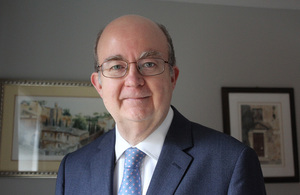
Mr Paul Brummell CMG has been appointed Her Majesty’s Ambassador to the Republic of Latvia in succession to Mr Keith Shannon. Mr Brummell will take up his appointment in summer 2021.
Full name: Paul Brummell
Married to: Adriana Mitsue Ivama Brummell
Children: one
| Dates | Role |
|---|---|
| 2018 to present | FCDO, Head, Soft Power and External Affairs Department, Communication Directorate |
| 2014 to 2018 | Bucharest, Her Majesty’s Ambassador |
| 2013 to 2014 | Full-time Language Training (Romanian) |
| 2009 to 2013 | Bridgetown, British High Commissioner |
| 2005 to 2009 | Nur-Sultan, Her Majesty’s Ambassador |
| 2002 to 2005 | Ashgabat, Her Majesty’s Ambassador |
| 2001 | FCO, Deputy Head, Afghanistan Emergency Unit |
| 2000 to 2001 | FCO, Deputy Head, Eastern Department |
| 1995 to 2000 | Rome, First Secretary (Political, Press and Public Affairs) |
| 1993 to 1994 | FCO, Head, Science and Technology Section, Environment, Science and Energy Department |
| 1992 | UK Mission to the UN, New York, Conference Support Officer |
| 1989 to 1992 | Islamabad, Third later Second Secretary (Political) |
| 1988 to 1999 | FCO, Desk Officer, South America Department |
| 1988 | FCO, Desk Officer, Research Department |
Published 10 December 2020

Last week, we published our framework for data quality in government. We developed the framework in collaboration with the Government Digital Service, using best practice drawn from across and outside government. We’re holding a series of events to support its roll-out.
On 3 December, we held a virtual launch event to introduce the framework. We discussed the content of the framework, why it’s important, and what it sets out to achieve.
We also heard from a range of guest speakers. Alison Pritchard, Director General for Data Capability at the Office for National Statistics, explained that data is a high priority in government, and highlighted how the framework sets the foundations for this. Lisa Allen, Head of Data and Analytical Services at Ordnance Survey, discussed the benefits that come from establishing a data quality culture in an organisation. Finally, Nicola Askham, Director at the Data Management Association of the UK, explained that everyone has a role in achieving good quality data. The event was chaired by the Head of the Government Data Quality Hub, James Tucker, and included an opportunity to ask questions of the panel.
We’d like to thank everyone who joined us for making the event a massive success. If you didn’t manage to attend, the recording will be shared on YouTube shortly.
We know that the framework contains a lot of useful information, and that there’s too much to cover in just one hour. So we’re holding a second event on 13 January 2021 at 3pm to explore some of the themes in more depth. We will hear from colleagues across the public sector on how they have assessed, improved and communicated data quality. We will then open the floor for a round table discussion about data quality in government.
Everyone is welcome. Please register via Eventbrite to join us, and pass this invitation on to colleagues who might also be interested.
You can also share your thoughts on data quality with us by completing our survey by 17 December.
We have an ambitious plan to support the public sector to understand, assess, and improve data quality, but we need your help to achieve this. If you want to talk to us about the framework or want to know more about our work, email us at DQHub@ons.gov.uk or tweet us at @DQHubUKGov.
Added date of second event and included link to register for this.
First published.