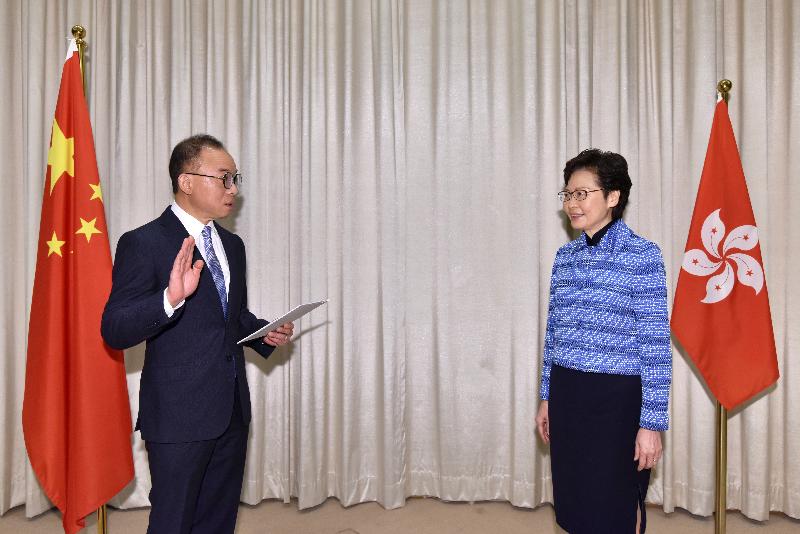
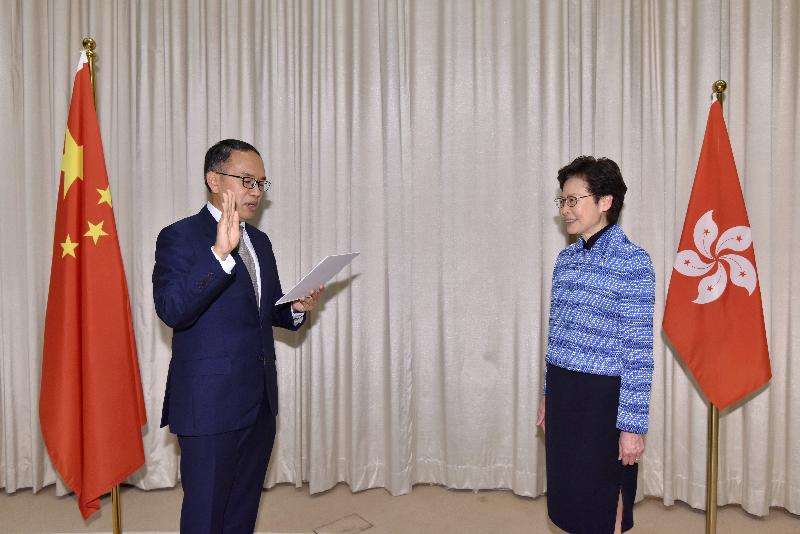
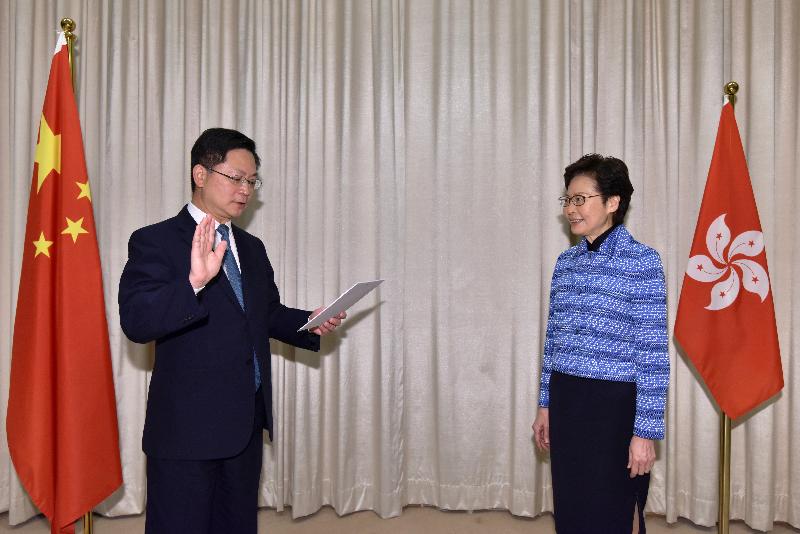
Government announces appointment and removal of Principal Officials (with photos)

     The State Council, on the recommendation by the Chief Executive, Mrs Carrie Lam, today (April 22) approved the appointment of Mr Patrick Nip Tak-kuen as the Secretary for the Civil Service, Mr Caspar Tsui Ying-wai as the Secretary for Home Affairs, Mr Erick Tsang Kwok-wai as the Secretary for Constitutional and Mainland Affairs, Mr Christopher Hui Ching-yu as the Secretary for Financial Services and the Treasury and Mr Alfred Sit Wing-hang as the Secretary for Innovation and Technology as well as the removal of Mr Joshua Law Chi-kong from the post of Secretary for the Civil Service, Mr Lau Kong-wah from the post of Secretary for Home Affairs, Mr Nip from the post of Secretary for Constitutional and Mainland Affairs, Mr James Henry Lau Jr from the post of Secretary for Financial Services and Treasury, Mr Nicholas W Yang from the post of Secretary for Innovation and Technology and Mr Tsang from the post of Director of Immigration.
 
    "Mr Law, Mr Lau Kong-wah, Mr James Lau and Mr Yang have served Hong Kong and the Government with integrity and dedication over the years. I would like to extend my sincere thanks for their valuable contributions," the Chief Executive said.
 
    On the appointment of Mr Nip, Mr Tsui, Mr Tsang, Mr Hui and Mr Sit, the Chief Executive said, "I have no doubt that they are competent for their new posts and would lead their respective policy bureaux to rise to the challenges in serving the community."
 
    Following are the biographical notes on Mr Nip, Mr Tsui, Mr Tsang, Mr Hui, Mr Sit, Mr Law, Mr Lau Kong-wah, Mr James Lau and Mr Yang:
 
Mr Patrick Nip Tak-kuen
————————-
     Aged 55. Mr Nip joined the Government's Administrative Service in August 1986 and rose to Administrative Officer Staff Grade A in April 2011. The career of Mr Nip has spanned a wide range of policy bureaux and departments including the Office of the Government of the Hong Kong Special Administrative Region in Beijing and the former Health, Welfare and Food Bureau. He became Director of Social Welfare in August 2009; Director (Special Duties), Chief Secretary for Administration's Private Office in June 2013; Director of Information Services in February 2014; and Permanent Secretary for Food and Health (Health) in July 2016. He has been Secretary for Constitutional and Mainland Affairs since July 2017.
 
Mr Caspar Tsui Ying-wai
————————-    
     Aged 43. Before joining the Government, Mr Tsui worked in the banking sector. He was Political Assistant to the Secretary for Home Affairs from June 2008 to June 2012 and from September 2012 to June 2017 and has been Under Secretary for Labour and Welfare since August 2017.
 
Mr Erick Tsang Kwok-wai
————————–
     Aged 56. Mr Tsang joined the Immigration Department as an Assistant Immigration Officer in April 1987. He was promoted to Chief Immigration Officer in December 2004, Assistant Principal Immigration Officer in June 2007 and Principal Immigration Officer in July 2009. He became Assistant Director of Immigration in July 2012 and Deputy Director of Immigration in July 2014. He has been Director of Immigration since April 2016.
 
Mr Christopher Hui Ching-yu
——————————
     Aged 43. Mr Hui was an Administrative Officer in the Government from 1999 to 2003 and served in the Economic Development Branch, the Office of the Government of the Hong Kong Special Administrative Region in Beijing and the Home Affairs Department. Mr Hui worked in the banking sector after leaving the Government in 2003 and has worked for the Hong Kong Exchanges and Clearing Limited for over 10 years. He has been Executive Director of the Hong Kong Financial Services Development Council since 2019.
 
Mr Alfred Sit Wing-hang
————————-
     Aged 58. Mr Sit joined the Government as Assistant Electrical and Mechanical Engineer in September 1984 and was promoted to Chief Electrical and Mechanical Engineer in August 2001, to Government Electrical and Mechanical Engineer in December 2007 and to Deputy Director of Electrical and Mechanical Services in September 2011. He has been Director of Electrical and Mechanical Services since October 2017.

Mr Joshua Law Chi-kong
————————–
     Aged 63. Mr Law joined the Government's Administrative Service in September 1980 and rose to the rank of Administrative Officer Staff Grade A1 in September 2005. He served in various bureaux and departments. He was Permanent Secretary for Constitutional and Mainland Affairs and Permanent Secretary for Security and has been Secretary for the Civil Service since July 2017.
 
Mr Lau Kong-wah
——————-
Aged 62. Mr Lau's political career began in 1985 when he was elected to be a District Councillor in Sha Tin, and he served the district for nearly 20 years. He was a member of the Legislative Council from 1997 to 2012 and a member of the Executive Council from 2008 to 2012. He has been Under Secretary for Constitutional and Mainland Affairs since December 2012 and has been Secretary for Home Affairs since July 2015.
 
Mr James Henry Lau Jr
————————
     Aged 70. Mr Lau joined the Hong Kong Government as an Administrative Officer in 1979. He joined the Hong Kong Monetary Authority in 1993. He was seconded to the Hong Kong Mortgage Corporation in 2004 as Chief Executive Officer until he retired at the end of 2012. He has been Under Secretary for Financial Services and the Treasury since January 2014 and has been Secretary for Financial Services and the Treasury since July 2017.
 
Mr Nicholas W Yang
———————
     Aged 65. Mr Yang pursued his career in the United States in his early years and took up various posts in several technology, venture capital and private equity firms afterwards. He worked as Chief Executive Officer of the Hong Kong Cyberport Management Company Limited from October 2003 to February 2010. He was Executive Vice President of the Hong Kong Polytechnic University from March 2010 to February 2015. He was appointed as Non-official Member of the Executive Council and Advisor to the Chief Executive on Innovation and Technology in March 2015. He has been Secretary for Innovation and Technology since November 2015.
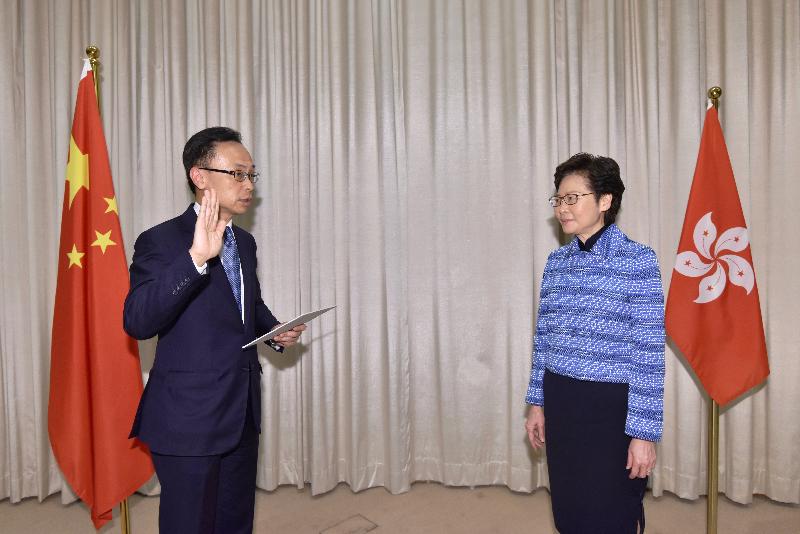
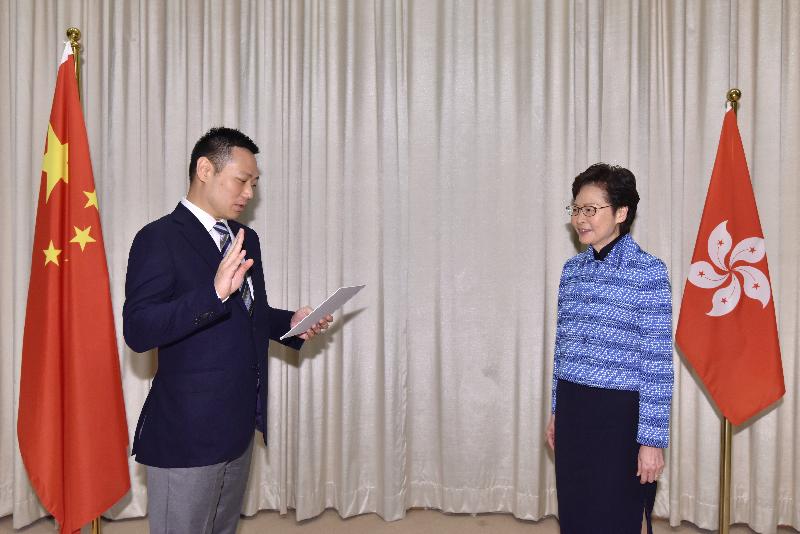
Photo  Photo  Photo  Photo  Photo  


Secretary for Home Affairs to leave post

     â€‹The Secretary for Home Affairs, Mr Lau Kong-wah, today (April 22) made the following statement on his departure:
 
     I assumed the post of Under Secretary for Constitutional and Mainland Affairs in December 2012 and have served as the Secretary for Home Affairs since July 2015. As a politically appointed official of the Hong Kong Special Administrative Region Government, I have served the Hong Kong citizens in various areas and it is now an appropriate time for me to say goodbye. My successor, Mr Caspar Tsui, is younger and possesses leadership skills. He is energetic and enthusiastic. I am confident that he will be competent for the post.
 
     I would like to thank the Chief Executive, colleagues and government staff for working hand in hand with me over the years. I would also like to thank the stakeholders for their support and encouragement, which facilitated the development of various policies.
 
     I hope that Hong Kong can swiftly triumph in the epidemic fight and that, after the battle, we can together make Hong Kong thrive.


Departure of S for IT

     The Secretary for Innovation and Technology, Mr Nicholas W Yang, today (April 22) made the following statement on his departure:
 
     I respect the decision made by the Chief Executive and am willing to leave my current post. I have no regret for joining the political team and having served as the Secretary for Innovation and Technology.
 
     During my tenure, I had the support of my team in driving innovation and technology development and securing breakthroughs in developing the Hong Kong-Shenzhen Innovation and Technology Park in the Lok Ma Chau Loop and cross-boundary remittance of science and technology funding. I am also glad to see Hong Kong's innovation and technology ecosystem vibrant and growing.
 
     Today is my 65th birthday and I will start a new chapter in my life after leaving the Government. I will continue to contribute myself to the innovation and technology development in Hong Kong and our country. My thanks also go to my colleagues, stakeholders and the media for their staunch support over the years.


Departure statement by Secretary for Financial Services and the Treasury

     The Secretary for Financial Services and the Treasury, Mr James Lau, today (April 22) made the following statement on his departure from the Hong Kong Special Administrative Region Government:

     I joined the Hong Kong Government in 1979 and later served in various divisions of the Hong Kong Monetary Authority and the Hong Kong Mortgage Corporation until the end of 2012. I was appointed as Under Secretary for Financial Services and the Treasury in January 2014 and then Secretary for Financial Services and the Treasury on July 1, 2017. It has been my greatest honour to have the opportunities to serve the people of Hong Kong in the past 40 years. There is a time for everything, and my departure at the age of 70 is a memorable milestone.

     During my tenure, I would not have been able to promote the development of policy portfolios under the Financial Services and the Treasury Bureau (FSTB) without the support and assistance rendered by the Chief Executive, the Financial Secretary, my colleagues in the political team, the financial regulators, fellow civil servants, in particular my teammates in the FSTB, and the many interlocutors in the Legislative Council and the markets.  
 
     The Chief Executive has chosen my successor and I wish Chris (Hui Ching-yu) the best as he brings fresh impetus to the FSTB. I have every confidence that my bureau colleagues will support him as always.


LCQ19: Supply and demand for and training of land surveyors

     Following is a question by the Hon Tony Tse and a written reply by the Secretary for Development, Mr Michael Wong, in the Legislative Council today (April 22):

Question:

     Some members of the land surveying sector have pointed out that as there is growing popularity of the application of land spatial data and an increasing demand for more accurate land surveying data for work such as monitoring ground settlement, they expect that the demand for land surveyors will increase. Nevertheless, the numbers of training programme places and in-service training places for land surveyors have not increased correspondingly. In this connection, will the Government inform this Council:
 
(1)       whether it carried out any assessment in the past five years on the manpower supply and demand for as well as the training of land surveyors; if so, of the outcome; if not, whether it will carry out such an assessment;

(2)       of the numbers of land surveying degree programmes offered by the various local tertiary institutions and the total number of places of such programmes, in each of the past five years; whether it knows if the various institutions have plans to offer more programmes of this type or more such places in the coming three years; and

(3)       of the respective numbers of land surveying graduate trainee vacancies offered by the relevant government departments and the respective numbers of such trainees employed by them, in each of the past five years; whether such departments have plans to increase the numbers of vacancies for this type of trainees in the coming three years?
 
Reply:

President,

     Land surveyors are equipped with the professional knowledge of surveying, mapping, and maintaining and analysing land spatial data.  Both the Government (mainly the Survey and Mapping Office (SMO) of the Lands Department (LandsD)) and private institutions employ land surveyors, whose major responsibilities include collecting and processing surveying data, and producing survey record plans for land and works through the use of surveying technology to support the work related to town planning, land development, housing development, and construction projects. 

     Having consulted the Education Bureau, our reply to the various parts of the question raised by Hon Tse is as follows:

(1) The SMO of LandsD has been conducting assessment on the manpower demand and supply of the land surveyors within the Government, having regard to the technological development in land surveying, requirements of land surveying work, development of spatial data policies and the number of graduates from the relevant disciplines. The SMO also maintains communication with practitioners in the field regarding the development of the entire profession.

     In recent years, the Government is keen to promote the use of common spatial data, which will be conducive to spurring social innovation, enhancing data-driven decision-making process and improving the quality of life for the community.  We are speeding up our work in this area, starting with the roll-out of a Common Spatial Data Infrastructure (CSDI) portal with at least 240 datasets in phases, first within the Government by end 2021 and then to the public by end 2022. Four quick win projects, including Map Application Programming Interface, Geotagging Tool, Address Data Infrastructure, and District-based Spatial Information Dashboard will also be launched by end 2020 for public use. Starting from this year, a high-quality three-dimensional (3D) map showing topographical and exterior features of terrain, buildings and infrastructures will be gradually opened up in phases, and its coverage is expected to extend across the territory by end 2023. We will also publish 3D pedestrian network data covering various locations over the territory and a 3D digital map showing the internal layout for 1 250 buildings. The Development Bureau (DEVB) is currently seeking funding approval of $300 million from the Finance Committee of the Legislative Council to implement the above spatial data-related initiatives. Upon the official commencement of the abovementioned projects, we will be able to explore with the practitioners and the academic sector the development opportunities and the manpower requirements of the industry in more concrete terms. 

(2) According to information provided by the Education Bureau, the number of land surveying programmes accredited by the Hong Kong Institute of Surveyors (HKIS) and other related programmes (including programmes related to urban informatics) offered by local post-secondary institutions, and the actual number of student intakes from the 2015/16 to 2019/20 academic years are set out in the table below:
 

Academic year Number of programmes Actual number of student intakes
2015/16 5 166
2016/17 5 163
2017/18 5 127
2018/19 5 139
2019/20 5 166
(provisional figure)

Note: The above post-secondary programmes include sub-degree, bachelor’s degree (including first-year first-degree and senior year undergraduate) and taught postgraduate programmes.

     To this day, the Government has not been notified of any plans from the institutions to adjust the number of intakes for their current programmes. In addition, we are aware that the Hong Kong Polytechnic University and the University of Hong Kong will each launch a new master programme on urban informatics in the 2020/2021 academic year, exact number of student intake for each programme to be confirmed.

     The SMO of LandsD will keep under review the manpower situation of land surveyors within the Government and maintain communication with the practitioners and the academic sector regarding the development of the entire industry, so as to convey their views on land surveying and related programmes provided by local post-secondary institutions to the University Grants Committee as appropriate.

(3) LandsD has been hiring university graduates who are graduating or were graduated from the relevant disciplines in the current year or previous years to be Land Surveying Graduates (LSGs) under the Graduate Training Scheme. These LSGs are provided with two years of practical training to enable them to meet the basic requirement of training period under the Assessment of Professional Competence of the Land Surveying Division of the HKIS. The details of the recruitment of LSGs in the past five years are as follows:
 

Year of recruitment Quota for recruitment of LSGs Actual number of LSGs recruited
2015 11 11
2016 11 11
2017 11 11
2018 14 14
2019 14 14

 
     LandsD plans to further increase the quota of LSG to at least 25 in 2020, with a view to relieving the impact of the epidemic on the employment of graduates and coping with the training needs of the industry. We will keep under review the number of LSG positions having regard to the development of land surveying and spatial data policies, the number of graduates from related disciplines and their employment situation, and the departmental resources.