LCQ1: Fuel mix for electricity generation

     Following is a question by the Hon Kenneth Leung and a written reply by the Secretary for the Environment, Mr Wong Kam-sing, in the Legislative Council today (May 6):
 
Question:
 
     The Government released Hong Kong's Climate Action Plan 2030+ (Action Plan) in January 2017, and stated its plan to phase down coal-fired electricity generation in order to reduce carbon emissions, with one of the targets being that by around 2020, natural gas will meet about half of Hong Kong's electricity demand while coal-fired electricity generation will drop to about 25 per cent. On the other hand, the Government pointed out in 2014 that it was doubtful as to whether there would be an economic case to develop and use off-shore wind farms in Hong Kong. In this connection, will the Government inform this Council:
 
(1) of Hong Kongʼs greenhouse gas emissions in 2018 and 2019, and set out a breakdown in the table below;
 

Year Greenhouse gas emissions (in kilotonnes CO2-e)
Energy Waste Industrial  processes and product use Agriculture, forestry and other land use Total
Electricity
generation
Transport Other end use of fuel
2018              
2019              

 
(2) of the respective percentages of (i) coal, (ii) natural gas, (iii) nuclear energy and (iv) renewable energy in the fuel mix for electricity generation in Hong Kong as at April this year, and whether such fuel mix has met the target set out in the Action Plan; if so, of the next target; if not, the follow-up actions; and
 
(3) as some research findings have indicated that the costs of off-shore wind power electricity generation have gone down by 60 per cent over the past decade, whether the Government will assess afresh the feasibility and economic case of developing off-shore wind farms; if so, of the details and timetable; if not, the reasons for that?
 
Reply:
 
President,
 
(1) Each year, the Environmental Protection Department compiles a greenhouse gas (GHG) inventory in accordance with the guidelines published by the United Nations' Intergovernmental Panel on Climate Change. As the process is complex, there is usually a time lag of two to three years in the local authorities' publication of their inventories. We expect that Hong Kong's inventory in 2018 and 2019 can be released in the third quarter of this year and next year respectively. 
 
     The GHG emissions by source in 2017 are set out as follows:
 

Year GHG emissions (in kilotonnes CO2-e)
Energy Waste Industrial
Processes
and Product
Use
Agriculture,Forestry and
Other Land
Use
Total+
Electricity
Generation and Towngas production 


Transport Other End
Use of Fuel
@
2017 26,600 7,230 2,280 2,810 1,740 30 40,700


Remarks:
@ including the use of fuel for combustion in commercial, industrial and domestic premises.
+ because of rounding, individual items may not necessarily add up to the total.
 
(2) In the overall fuel mix for electricity generation in Hong Kong in 2019, coal-fired generation accounted for around 44 per cent, gas-fired generation accounted for around 29 per cent, nuclear electricity imported from the Mainland and local renewable energy (RE) accounted for around 27%. 
 
     In 2020, the two power companies have one new gas-fired generating unit each coming into operation. The percentage of local gas-fired generation will thereby increase to around 50 per cent, while that of coal-fired generation will correspondingly drop to about 25 per cent, as envisaged in Hong Kong's Climate Action Plan 2030+. To achieve the target of further reducing carbon intensity by 2030, the two power companies will continue to gradually replace the retiring coal-fired generating units with gas-fired generating units and non-fossil fuel sources in the next decade.
 
     In order to formulate the decarbonisation strategy for the longer term, the Government has invited the Council for Sustainable Development to gauge the views of the community. The report to be submitted by the Council later will help the Government consider how to reduce carbon emissions from electricity generation.
 
(3) The development of local RE is restricted by objective factors such as Hong Kong's geographical environment. In exploiting the RE potential of offshore wind power within Hong Kong, we need to resolve technical and financial issues, as well as consider the tariff impact.
 
     According to the assessment of the power companies, there are two offshore sites within Hong Kong (off the sea of Ninepin Group and the waters near Lamma Island) which are more suitable for developing wind farms on a commercial scale. The two power companies have also been conducting wind measurement work at these locations. Yet, the combined cost of the two projects will be over $10 billion and their total capacity is about 300 megawatts. The amount of electricity provided is estimated to be less than 1.5 per cent of Hong Kong's total electricity consumption. The cost is relatively higher than using natural gas for electricity generation.
 
     The development of offshore wind farms within Hong Kong faces uncertainties in various aspects.  Nonetheless, we will continue to keep in view the development in this area, and actively explore its feasibility and cost effectiveness.


ENB disburses about $6.5 million to help ease difficulties of municipal solid waste transfer sector

     Under the Government's latest round of anti-epidemic measures, the Environment Bureau launched the Subsidy Scheme for the Refuse Transfer Station Account Holders for Transporting Municipal Solid Waste (MSW) to provide a one-off relief subsidy of $8,000 to each of the eligible private MSW collectors. A spokesman for the Environmental Protection Department (EPD) said today (May 6) that subsidies totalling about $6.5 million have been disbursed to 809 private MSW collectors by cheque.  

     The spokesman said, "The beneficiaries of the subsidy are the eligible private MSW collectors operating in the first quarter of this year, i.e. those refuse transfer station account holders who transported MSW to refuse transfer stations or landfills between January 1 and March 31 of this year. The subsidy will assist them in increasing resources to enhance the provision of workers' personal protective equipment and strengthen the disinfection of refuse transport vehicles to curb the risk of virus transmission and maintain environmental hygiene."  
     
     In order to provide financial support to the industry as soon as possible, the EPD, following funding approval by the Finance Committee of the Legislative Council, expedited the subsidy disbursement arrangements by waiving the application procedures. The respective cheques have been issued and posted to all eligible private MSW collectors.


Lifting of certain social distancing measures under Prevention and Control of Disease Ordinance

     The Government will gazette the directions and amendments under the Prevention and Control of Disease (Requirements and Directions) (Business and Premises) Regulation (Cap. 599F) and the Prevention and Control of Disease (Prohibition on Group Gathering) Regulation (Cap. 599G) as appropriate to relax some of the social distancing measures in relation to catering business, scheduled premises and group gathering in public places. The latest measures will come into effect from May 8, 2020 for 14 days till May 21, 2020.

     A spokesperson for the Food and Health Bureau said today (May 5), "In light of the more stabilised situation in Hong Kong in terms of the number of confirmed cases of COVID-19 in the recent weeks and the 'suppress and lift' strategy adopted to contain the epidemic, a window of opportunity exists for us to lift some of the social distancing measures at the moment."

Key requirements under the latest measures

     Following the directions and amendments under Cap. 599F and Cap. 599G, the latest social distancing measures will be as follows –

On catering business and scheduled premises

(1) For catering business, the number of persons allowed to be seated together at one table within any catering premises will be increased from four to eight. Previously announced requirements (at Annex 1) continue to apply including keeping a distance of at least 1.5 metres between tables and wearing mask except consuming food or drinks. Karaoke activities carried out on any premises should continue to be suspended.

(2) Catering premises (or part thereof) exclusively or mainly used for the sale or supply of intoxicating liquors as defined in section 53(1) of the Dutiable Commodities Ordinance (Cap. 109) (i.e. bars and pubs) will be allowed to resume operation subject to the following conditions –
(a) the number of customers must not at any one time exceed 50 per cent of the normal seating capacity of that premises (or part thereof);
(b) no more than four persons may be seated together at one table therein, irrespective of the hour of operation; and
(c) live performance and dancing must not be allowed.

(3) The following scheduled premises will be allowed to resume operation subject to conditions (summarised at Annex 1) – 
(a) amusement game centre;
(b) fitness centre;
(c) place of amusement;
(d) place of public entertainment;
(e) beauty parlour;
(f) massage establishment; and
(g) mahjong-tin kau premises; and

     Club-house will be allowed to continue operation subject to conditions (see Annex 1).

(4) The following scheduled premises will be required to remain closed for 14 days –
(a) bathhouse;
(b) party room;
(c) club or night club; and
(d) karaoke establishment.

On group gatherings

(5) The number of persons allowed in group gatherings in public places will be relaxed from four to eight.

(6) The scope of existing exempted group gatherings will be expanded (at Annex 2): (a) to cover different functions of the Judiciary; (b) to increase the maximum number of persons at wedding ceremonies (at which no food or drink is served) from 20 to 50; and (c) to cover shareholders' meeting of a listed company that is held in accordance with any ordinance or regulatory instrument, subject to no food or drink being served and no more than 50 persons in a room or partitioned area.

(7) As an interface between Cap. 599F and Cap. 599G, gatherings within scheduled premises which could be opened according to directions issued under section 8 of Cap. 599F will not be subject to the restriction on group gatherings (of no more than eight persons) under Cap 599G.

     A spokesperson added, "The above measures have balanced the oft-competing factors of public health protection, economic impact and social acceptance. They could help maintain social distancing while allowing room for resumption of social activities. The Government will continue to closely monitor the epidemic situation and review the various measures in place with a view to suitably adjusting them taking into account all relevant factors."
 
     Persons responsible for carrying on catering business and the managers of scheduled premises that contravene the statutory requirements under Cap. 599F would be a criminal offence. Offenders are subject to a maximum fine of $50,000 and imprisonment for six months. 

    Separately, any person who participates in a prohibited group gathering; organises a prohibited group gathering; owns, controls or operates the place of such gathering; and knowingly allows the taking place of such gathering, commits an offence under Cap. 599G. Offenders are liable to a maximum fine of $25,000 and imprisonment for six months. Persons who participate in a prohibited group gathering may discharge liability for the offence by paying a fixed penalty of $2,000.


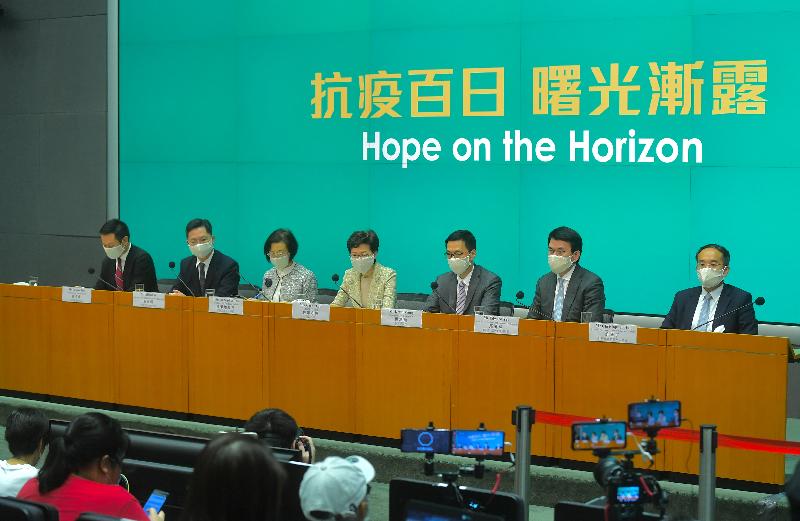
Transcript of remarks of press conference (with photo/video)

     The Chief Executive, Mrs Carrie Lam, held a press conference this afternoon (May 5). Also joining were the Secretary for Commerce and Economic Development, Mr Edward Yau; the Secretary for Food and Health, Professor Sophia Chan; the Secretary for Education, Mr Kevin Yeung; the Secretary for Innovation and Technology, Mr Alfred Sit; the Secretary for Home Affairs, Mr Caspar Tsui; and the Secretary for Financial Services and the Treasury, Mr Christopher Hui. Following is the transcript of remarks of the press conference.
 
Reporter: Hi, Mrs Lam. Will the Government consider a Harbin style of lockdown, given that after they have detected several imported cases and they carried out a city lockdown? And as you’ve mentioned that you will be lifting and relaxing on social distancing measures, given there may be a future relaxation on border control, under what circumstances will the Government consider another wave of tightening social distancing measures?

Chief Executive: First of all, Hong Kong has never gone into a stage of a complete city lockdown. In some of the European countries where they practise a city lockdown, residents are simply not allowed to leave their home, except for some very essential purposes, but we have never adopted that practice. In fact, many renowned experts are now trying to study our situation, why do Hong Kong succeed in keeping the confirmed cases at a low level without drastic measures like the complete city lockdown, and I do think that it is a very interesting topic for further research.
 
     To answer your question of when we may need to go back to some more tighter social distancing measures, of course this depends on the situation of the infection. The strategy that Hong Kong has been adopting and advocated by some of our experts is what we call a “suppress and lift” strategy. In light of the number of confirmed cases and the likelihood of the spread of the disease in a community, we will have to suppress in order to make sure that there will be no surge in the number of confirmed cases as we have seen in some neighboring regions. But when the situation of the infection stabilises, that is the time for lifting – that is loosening a bit so that society can operate more normally, especially for the business and for individuals’ behavior. We are now right in the stage of lifting because we don't have a local case for 16 days already and the number of imported cases is very low, and we are now quite confident that the system of testing and holding that we have put in place for all arrivals from overseas would enable us to control the number of imported cases, so this is the time for lifting, and this afternoon we have announced a number of lifting measures. 
      
     Of course, if the situation continues to stay at the current level, no local cases, very few imported cases, then at the end of the 14-day period – that is May 22 – will be the time for more relaxation. On the other hand, if the situation turns a bit more tricky with suddenly a local case surfacing, then we will have to go back, maybe, to some suppression measures.  That's why we said that we really have to monitor the situation very closely in order to take the necessary and pertinent response measures.  
      
Reporter: Thank you, Mrs Lam. On the social distancing rules that some of the measures you are relaxing, the public gathering number that’s being doubled to eight, and I think for the bars you said they would re-open but there is no music or dancing. Can you sort of explain the thinking behind that because at the moment it seems a bit arbitrary, was there any scientific basis for that? Secondly, on class resumption, maybe for the education secretary, is it a bit premature to be planning for class resumption, especially when only yesterday, the CHP was saying it’s a bit too early to conclude that the local transmission chain has been broken at this stage? And finally, on masks, we’re seeing more plentiful supply in the market now, how are you going to make sure that the most needy in society, the underprivileged, are able to get those masks first, especially if maybe they don’t have ready access to the Internet?
 
Chief Executive: There are a few questions. I will try to answer some and then leave the Secretary for Education to deal with the resumption of classes. First, we have to understand this particular virus. Many researchers and scientists are still struggling to understand more about the transmission of this disease and as you know, we have yet to have a vaccine – an effective one – that will help to create immunity for the people. So with that context, I think it would not be very realistic to say that we need very tight social distancing and border control measures until we see that there are no cases at all or no local cases at all. This is not very realistic because if you remember the analogy that I drew – a three-way tug of war – on one hand, we have the public health concern; the second, on the other hand, we have this economic impact of this border control and social distancing measures; and thirdly is the tolerance and the patience of the people which is all for you to see over this four-day long weekend. People were becoming very impatient, especially when the weather was good, they all rushed out to enjoy themselves. It is unrealistic for the Government to insist that we need to keep social distance because there are still some cases in society. I just want to give the proper context for us to understand these measures. You will not reach very easily that situation where everything is clean; there are no cases whatsoever.

     About the supply of mask, I have outlined six measures to distribute masks freely to the people of Hong Kong and of course in so doing, we will take special account of the disadvantaged, the elderly, the street sleepers. Apart from being a member of the Hong Kong population whereby they will receive their reusable masks and they will receive their disposable masks, we have this mask distribution programme, together with a large number of non-governmental organisations, charity groups and self-help groups. We will continue to work with them to distribute another three million masks, which were donated to us. And I am announcing that if we run out of donated masks, but there is still a need from these disadvantaged groups, we will take the government masks, the masks that we procure, supposed for our own use, to share with the needy groups in society, so that’s a way to ensure that in a public health situation that we are now in, the needs of the disadvantaged groups will be fully taken care of.
      
     Again, you may remember that I have said that in deciding when to lift and how much to lift, it is not an exact science. I hope it is an exact science, so I don’t need to use my judgement and run the risk, especially political risk, of being attacked, but it is not an exact science. We have to take a large number of factors into account, which I have just shared with you. Raising the number from four to eight both for the catering business and also for the prohibition against group gathering under Cap 599G, it is not an exact science, but this is a step in the right direction of relaxation. Maybe in another 14 days’ time, we will raise the number eight to 10, to 12, to 15, and so on. For example in France, the limit now is not more than 10. We feel that that is a prudent way of relaxing the control measures that we have put in place.
      
     As far as the bar and the pub, I have to confess that this is one of the difficult areas to decide because bars and pubs come in different forms, as long as they have a liquor license, and almost all of them will have also a food licence. You have stand-alone bars, and you have also bars in a restaurant, whether it’s Chinese or Western restaurant, so hitherto, the ban is whenever there is an area exclusively for serving alcoholic drinks, it has to be closed. If it is a pure stand-alone bar, then it has to be closed, there is no business whatsoever. But if it is a bar area in a Western restaurant, yes, the bar area will be closed, but wines will continue to be served on the premises where people have food. Taking that into account and the public health situation, the low number of the cases and so on, we have decided that perhaps to strike a pragmatic balance is to allow them to re-open for business but to put in far more stringent requirements, including the requirements that you have referred to. That is, yes, you can sit down, four a table, to drink, but there should be no live music, no band performance, and no dancing in the bar premises, and that would be another way to keep the social distance and prevent as much as possible physical interactions.
      
     I now invite the Secretary for Education to answer about the class resumption.
 
Secretary for Education: You asked whether it is a bit premature to announce class resumption today. But actually we are not announcing class resumption right away. We are giving an advance notice of about three weeks for all stakeholders to get prepared for the school resumption. The first day is May 27, so during this period we will of course continue to monitor the situation, and if really necessary, we could adjust the resumption plan. But at this stage, we are still pretty confident that we should be able to resume classes on May 27.

(Please also refer to the Chinese portion of the transcript.)

Photo  


EPD launches Enhanced Stage One of Countryside Conservation Funding Scheme

     The Environmental Protection Department (EPD) today (May 5) launched the Enhanced Stage One of the Countryside Conservation Funding Scheme (CCFS) to support non-profit making organisations to carry out remote countryside conservation and revitalisation projects on a wider spectrum.
 
     To encourage more conservation and revitalisation proposals to be carried out in the countryside, the EPD is now expanding the scope of the existing Stage One of the CCFS. The EPD is inviting applications for three new types of projects in relation to the Formulation of Proposals on Restoration of Built Heritage, Cultural Rehabilitation/Revitalisation, and Research Activities on Countryside Conservation and Revitalisation in addition to the Nature Conservation Management Agreement projects. 
 
     The Enhanced Stage One of CCFS is now open for applications. The Application Form and Guide to Application of CCFS can be downloaded from the EPD website (www.epd.gov.hk/epd/english/environmentinhk/conservation/ccfs/ccfs_main.html). An online briefing session will be held on May 8 (Friday) to brief interested parties on details of the Enhanced Stage One of CCFS and points to note in preparing applications. Persons may register with the CCFS Secretariat by May 7 (Thursday) for joining the briefing session.
 
     Launched in October 2019, Stage One of CCFS is dedicated to support sustainable and holistic conservation efforts in Hong Kong's remote countryside through an integrated funding source covering a wide spectrum of areas on different levels ranging from the natural environment/habitats, non-graded built heritage to cultural and historic assets, etc.
 
     Enquiries can be directed to the CCFS Secretariat at 3151 7137 or ccfs@epd.gov.hk.