Phishing emails related to BNP Paribas

The following is issued on behalf of the Hong Kong Monetary Authority:

     The Hong Kong Monetary Authority (HKMA) wishes to alert members of the public to a press release issued by BNP Paribas on phishing emails, which has been reported to the HKMA. Hyperlink to the press release is available on the HKMA website for ease of reference by members of the public.

     Anyone who has provided his or her personal information to the emails concerned or has conducted any financial transactions through the emails should contact the bank concerned using the contact information provided in the press release, and report to the Police or contact the Cyber Security and Technology Crime Bureau of the Hong Kong Police Force at 2860 5012.


Works contractor and chemical waste collector convicted of illegally handling asbestos waste (with photo)

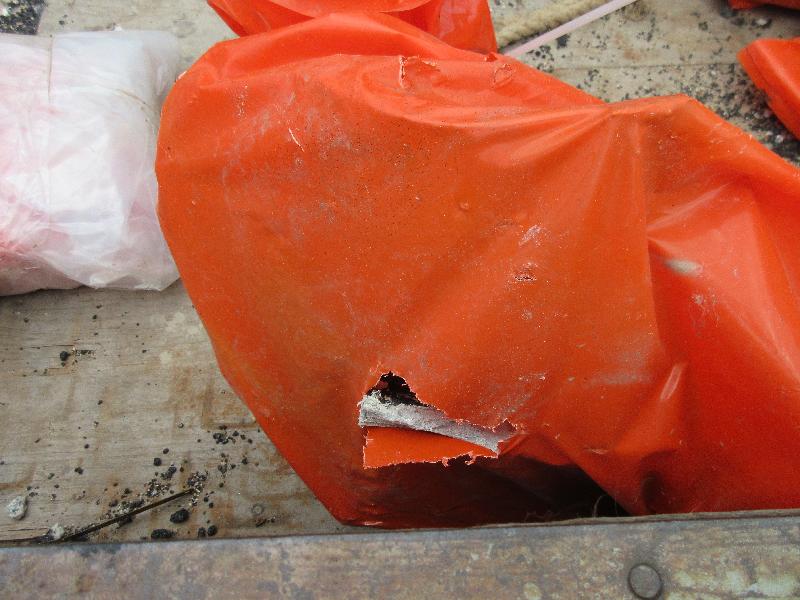
     A works contractor, Wo Hing Construction Company Limited, and a licensed chemical waste collector, Utilities Construction Limited, were convicted and fined a total of $16,500 at Kwun Tong Magistrates' Courts today (May 6) for contravening the Waste Disposal Ordinance (WDO) and the Waste Disposal (Chemical Waste) (General) Regulation as a result of illegally handling asbestos waste.

     In May last year, enforcement officers of the Environmental Protection Department (EPD) carried out a blitz operation to combat waste collectors illegally transporting or disposing of waste. During the operation, it was discovered that the packing for asbestos waste handled by the above-mentioned licensed chemical waste collector was damaged during transport. The asbestos exposed posed serious health risks to workers and members of the public.

     After an investigation, the EPD confirmed that the works contractor involved failed to give the EPD a notification before disposing of asbestos waste. The chemical waste collector also did not deliver asbestos waste to a disposal facility within 48 hours in accordance with the law, and failed to fill out statutory trip tickets during the delivery of the asbestos waste. The EPD then prosecuted the two companies under the WDO and the Waste Disposal (Chemical Waste) (General) Regulation.

     A spokesperson for the EPD said asbestos waste is classified as chemical waste. Inhalation of asbestos fibres can cause serious diseases such as asbestosis, lung cancer and mesothelioma. Relevant works contractors must register as chemical waste producers with the EPD in accordance with the law, and properly package, label and store asbestos waste. In addition, with the aim of facilitating the relevant landfill to make proper arrangements, works contractors must give the EPD prior notifications if they wish to transport asbestos waste to the relevant landfill for disposal.

     Anyone illegally collecting, storing or handling chemical waste will be prosecuted. First-time offenders may be liable to a maximum fine of $200,000 and six months' imprisonment. A maximum fine of $500,000 and two years' imprisonment may be imposed on a subsequent conviction.

     For more information about the control of chemical waste, please visit the EPD's website: www.epd.gov.hk/epd/english/environmentinhk/waste/guide_ref/guide_cwc.html.

Photo  


LCQ13: Food assistance services

     Following is a question by the Hon Wu Chi-wai and a written reply by the Secretary for Labour and Welfare, Dr Law Chi-kwong, in the Legislative Council today (May 6):

Question:

     At present, eight non-governmental organisations are subsidised by the Social Welfare Department (SWD) for operating short-term food assistance service projects (subsidised food banks) to provide low-income persons with basic food items on a short term basis (generally not more than eight weeks each time). In addition, quite a number of charities operate food banks on a self-financing basis to provide food assistance to the people in need. It has been reported that as the economy of Hong Kong has been badly hit in recent months by the coronavirus disease 2019 epidemic, quite a number of families have encountered financial difficulties, which has caused a surge in the demand for food assistance. However, quite a number of self-financing food banks have curtailed their services amid the epidemic for reasons including a sharp reduction in the quantity of food donated to them, shortage of volunteers for food handling, and avoidance of group gatherings for epidemic prevention. In this connection, will the Government inform this Council:

(1) Of the following details of the food assistance services provided by the subsidised food banks in each month from January last year to April this year: the number of applications received, the service quota, as well as (i) the number of meals served and (ii) the duration for which food assistance was offered in respect of each approved case on average; whether the Government has the corresponding figures regarding the self-financing food banks; if so, of the details; 

(2) Of the following details of the short-term food assistance service in each District Council district at present: the service quota, the number of service users, and the maximum number of meals that can be offered per month; whether such service is found to be lacking in particular districts; if so, whether there are plans to provide such service in those districts; 

(3) Given that the self-financing food banks have curtailed their services amid the epidemic, whether SWD will relax (i) the eligibility criteria for applying for, and (ii) the stipulation on the time limit for receiving, the short-term food assistance; if so, of the details; if not, the reasons for that; 

(4) Whether SWD has assessed if the food assistance services currently provided by the subsidised and self-financing food banks can meet the demand against the backdrop of a rapidly deteriorating economy in Hong Kong; whether SWD has plans to increase the funding for the subsidised food banks and provide subsidies to the self-financing food banks; if so, of the details; and

(5) Given that different thresholds have been set for application for the assistance provided by the Government under the Comprehensive Social Security Assistance Scheme and the two rounds of relief measures, and that it takes time to vet and approve the applications, whether the Government will provide immediate assistance to low-income and unemployed persons so as to reduce their reliance on the food banks; if so, of the details?

Reply:

President,

     My reply to the Member's question is as follows:

(1) According to the latest information of the Social Welfare Department (SWD), the details of the services provided by the operators of the Short-term Food Assistance Service Projects funded by the SWD for the period January 2019 to February 2020 are as follows:
 

Month Number of applications Number of service users Number of meal-days served
January 2019 772 2 100 183 948
February 2019 716 2 152 120 275
March 2019 1 070 3 063 166 393
April 2019 1 114 3 289 192 398
May 2019 1 412 4 164 228 620
June 2019 1 038 3 100 233 806
July 2019 1 000 2 922 238 571
August 2019 1 077 3 068 220 591
September 2019 1 222 3 697 212 465
October 2019 1 279 3 758 242 368
November 2019 1 231 3 578 237 246
December 2019 1 211 3 514 248 651
January 2020 1 047 3 092 227 705
February 2020 1 012 2 824 189 405
Total 15 201 44 321 2 942 442

Note 1: On average, a service user is granted food assistance for a period of 66 days (i.e. around 9.5 weeks).
Note 2: A "meal-day" refers to breakfast, lunch and dinner required on a day.

     â€‹The SWD does not possess the relevant figures on similar programmes not funded by the SWD.

(2) The Short-term Food Assistance Service Projects provide territory-wide services. The details of the services, broken down by the SWD's administrative districts, are as follows:

Service area Number of applications Number of service users Number of meal-days served
January 2019 to February 2020 (14 months)
Hong Kong Island, Islands, Tsuen Wan and Kwai Tsing 2 744 7 899 429 934
Kwun Tong 2 068 6 474 574 290
Wong Tai Sin and Sai Kung 1 316 3 868 356 289
Sha Tin, Tai Po and North 2 586 7 390 362 860
Sham Shui Po 1 732 5 190 286 623
Kowloon City, Yau Tsim Mong 2 242 6 323 351 547
Tuen Mun 643 1 813 166 824
Yuen Long 1 870 5 364 414 075
Total 15 201 44 321 2 942 442

(3) The Short-term Food Assistance Service Projects provide a one-off basic food assistance to eligible individuals or families for a period of up to eight weeks. Operators may extend the service period beyond eight weeks, depending on the special needs of individual applicants and their families. Currently, the SWD has put in place established vetting principles and eligibility criteria, and anyone who is in need and eligible (including those with income reduction or unemployed due to economic downturn, as well as their families) may apply for food assistance. Operators will refer service users with long-term welfare or other service needs (such as Comprehensive Social Security Assistance (CSSA)) to the suitable service unit.

(4) Given the prevailing local economic conditions and outlook, the Government has proposed in the Estimates this year an increase in the commitment for the Short-term Food Assistance Service Projects by $85 million to cope with the rising service demand. The SWD does not have plan to fund similar programmes currently not funded by the SWD.

(5) The Chief Executive announced on February 14, 2020 that the Anti-epidemic Fund would provide a special allowance to eligible Working Family Allowance households and Student Financial Assistance households, regardless of whether they are unemployed or under-employed, so as to support low-income households to weather the deteriorating economic and employment conditions due to the COVID-19 pandemic. The disbursement of the special allowance will commence by end-June 2020 in batches. It is expected to benefit about 200 000 households, and involve a total expenditure of about $990 million.

     Furthermore, having considered the unprecedented challenges posed by the pandemic, the Chief Executive announced on April 8, 2020 the second round of anti-epidemic measures, including the provision of a time-limited unemployment support scheme through the CSSA system.  Specifically, the SWD will temporarily relax the CSSA asset limits for able-bodied applicants by 100 per cent for six months (from June 1 to November 30, 2020). Moreover, under the existing CSSA arrangement, the value of an owner-occupied residential property of able-bodied households will be disregarded for a grace period of 12 months. This arrangement will also apply to applicants under the six-month unemployment support scheme. It is roughly estimated that the above-mentioned scheme will benefit about 40 000 households, and involve a total expenditure of about $3,520 million.


HA approves extension of rent concessions to non-domestic tenants

The following is issued on behalf of the Hong Kong Housing Authority:
 
     The Commercial Properties Committee of the Hong Kong Housing Authority (HA) today (May 6) approved the extension of rent concessions to over 8 300 non-domestic tenants/licensees for six months from April 1 to September 30, 2020.
 
     The HA had earlier granted a 50 per cent rent concession for six months from April 1, 2020, to its eligible retail and factory tenants. Under the extension of the rent concession, their rent concession will be increased to 75 per cent over the same period with retrospective effect from April 1, 2020. The rent concession does not include rates and air-conditioning charges.
       
     "The HA's further measures are to support the Government's new series of measures announced in early April to relieve the financial burdens of individuals and businesses," a spokesman for the HA said. 
 
     "A total of 2 450 retail and 3 300 factory tenants will benefit from the approved increase in the rent concession."
 
     The 75 per cent rent concession will also be extended to cover tenants and licensees of bus kiosks and most advertising signboards, as well as car park users for the monthly parking of commercial vehicles. About 40 tenancies for bus kiosks, 80 advertising signboards and an estimated number of about 2 500 car park users would benefit from the concession.
 
     For tenants of premises in the HA's properties which are required to be closed under relevant regulations or direction of the Government, they may also apply to the HA for a 100 per cent rent concession for the period during which they are required to be closed.
  
     "The arrangements endorsed previously will continue to apply. The rent concessions will apply to all eligible tenancies/licences that are in force during the concession period, except those under a rent-free period," the spokesman said.
 
     "We will continue to adopt a flexible approach in dealing with tenancies which expire before the end of the concession period. To enable the tenants to continue their use and occupation of the premises upon expiry of the existing tenancies, licences will be granted at the existing rent pending agreement on the new rent for the new tenancies. Upon finalisation of the new rent for the new tenancy, the new rent will take retrospective effect from the original effective date of the new tenancy and the licence fee paid shall be applied to the payment of rent under the new tenancy," he added.
 
     "The approved measures will be implemented as soon as possible. For rent and licence fees already paid for the months of April and May 2020, arrangements will be made for offsetting in the payment for subsequent months."
       
     The Commercial Properties Committee has since last September approved three rounds of rent concessions for the HA's retail and factory tenants. Together with this round of further measures, the total rent and licence fees foregone by the HA is estimated to reach more than $1 billion.


LCQ12: Use of modular integrated construction method in building projects by Government

     Following is a question by the Hon Chan Hak-kan and a written reply by the Secretary for Development, Mr Michael Wong, in the Legislative Council today (May 6):
 
Question:

     The first residential project developed in Hong Kong by using the modular integrated construction (MiC) method is the Disciplined Services Quarters for the Fire Services Department at Pak Shing Kok, Tseung Kwan O. Regarding the use of the MiC method in building projects by the Government, will the Government inform this Council:
 
(1) of the following latest information of the aforesaid quarters project: (i) the expected completion date, (ii) the total internal floor area, (iii) the number of domestic units, (iv) the average area of the domestic units and (v) the estimated construction cost;
 
(2) of the place(s) of origin of the main modules for the aforesaid quarters project and the means adopted for transporting them from the factory to the construction site; the total number of tenders received by the Architectural Services Department (ArchSD) in respect of the project;
 
(3) whether, upon the completion of the aforesaid quarters project, an occupation permit issued by the Buildings Department and/or a certificate issued by the Hong Kong Fire Services Department is/are required before the intake of residents;
 
(4) given that the Hong Kong Housing Authority (HA) has decided to pilot the use of the MiC method in the construction of a 12-storey public housing block in Tung Chung, whether HA conducted any exchanges with ArchSD on the technology and experience in the application of the MiC method before making the decision; of the estimated construction cost of the project and the expected construction period from the commencement of foundation works to the completion of superstructure works; and
 
(5) according to the information available to ArchSD, of the maximum height of a building that can be constructed by using the MiC method and the minimum site area needed for this construction method to be applied?
 
Reply:
 
President,
 
     The Development Bureau is proactively taking forward the modular integrated construction (MiC) method, which adopts the concept of "factory assembly followed by on-site installation", to transform as far as practicable the conventional on-site construction method in the construction industry into modern industrial production under which the structural frames of buildings, interior fitting-outs, building services installations, etc. are pre-fabricated in factories and delivered to the construction sites for installation. According to the overseas experience, this innovative construction method has effectively shortened the construction period on site, enhanced productivity, improved quality, better site safety and environmental performance as well as higher cost-effectiveness.
 
     My reply to the five parts of the question raised by the Hon Chan Hak-kan is as follows:
 
(1) The scope of the project of the Disciplined Services Quarters for the Fire Services Department at Pak Shing Kok, Tseung Kwan O includes the construction of five quarters blocks with 16 to 17 storeys, with eight units on each floor, producing a total of 648 three-bedroom units of 50 square metres, together with the provision of ancillary facilities such as covered walkway, amenity and communal areas. The total construction floor area reaches 47 000 square metres. The project, at an estimated cost of about $1.625 billion in money-of-the-day prices, commenced in August 2018 and is expected for completion in the second quarter of 2021.
 
(2) The MiC modules adopted in the project are manufactured in Huizhou, Guangdong Province, and delivered to the construction site by land transport.  The Architectural Services Department (ArchSD) had received a total of four tenders in respect of the project.
 
(3) Similar to other building projects undertaken by the ArchSD, the quarters have to obtain approvals from the relevant departments before occupation, such as fire services certificates, water supply certificates and lift use permits.
 
(4) According to the Hong Kong Housing Authority (HA), the HA has been exchanging views with various stakeholders in the industry, including the ArchSD, on the technologies and applications of the MiC method. A 12‑storey domestic block in the "Public Housing Development at Tung Chung Area 99" (TC99) project has been selected as the MiC pilot project. The whole TC99 project includes five residential blocks, shops and kindergarten, etc. The total project estimate is about $5 billion. As the project is still in the preliminary design stage, the project estimate will be further adjusted in the process of the detailed design. The foundation works of the TC99 project commenced in March this year, and the building works on the superstructure is expected to be completed in early 2024.
 
(5) The MiC method has been widely adopted in the construction projects of hotels, student dormitories, residences, etc. in the United Kingdom, Singapore and Australia. A 44‑storey residential building in Croydon, London, is currently the tallest building constructed by MiC method. Nevertheless, the Avenue South Residence, a 56‑storey residential development in Singapore, will become the tallest building constructed using the MiC method upon its completion.
 
     The application of the MiC method is site‑specific. Various factors including the type and nature of the building to be constructed, the site environment, the traffic condition in the vicinity, etc. have to be duly considered. Whether the MiC method is applicable to a certain project cannot be determined merely by the area of the site.