Close to 1.38 million registered for CuMask+[TM]

     As at 3pm today (May 6), the CuMask+™ online registration system had received over 500,000 registrations, covering close to 1.38 million registrants in total. The average waiting time was about one to two minutes. The Innovation and Technology Bureau (ITB) reminds citizens that there is no need to rush. The registration period for CuMask+™ will last for one month till June 6.
      
     In response to reports concerning the purpose of information collection and information security of the registration system, an ITB spokesperson said that during registration, citizens will need to provide their Hong Kong identity card numbers and dates of birth for the registration system to match data with the system of the Immigration Department, so as to ascertain whether the registrant is a Hong Kong resident and check against any duplicated registrations, etc. The local mobile number serves for receiving SMS messages on registration results and delivery, while the name and the local address of the main registrant serve for verifying whether the address exists and for arranging at-door delivery. The relevant purposes of information collection have been clearly displayed on the front page of the registration page for citizens to browse before registration. The text adopted in the relevant statement on the purpose of information collection is commonly used in the arrangements of personal information collection statements. The information provided by citizens in obtaining the masks will not be used by the Government for other purposes. The Government will also ensure that the retention period of the personal data is not longer than the time required for the purposes for which the data is used.
      
     The registration system for masks operates on the government private cloud to ensure the stability and security of the system. In order to prevent intrusion and data leakage, multiple security measures have been put in place in compliance with the Government Information Technology Security Policy and Guidelines. These measures include a firewall, intrusion detection, anti-bot technology and installation of the latest anti-virus software with regular updates of virus definitions. The service has also passed an information security risk assessment and audit before launch.
      
     The Privacy Commissioner for Personal Data has been consulted on the personal data processing arrangements of the system. The system has also passed an independent third-party privacy impact assessment to make sure that the relevant service and system comply with the Personal Data (Privacy) Ordinance (Cap 486).


SCEZD meeting held to review management of COVID-19 patients

     The Scientific Committee on Emerging and Zoonotic Diseases (SCEZD) under the Centre for Health Protection of the Department of Health convened a meeting today (May 6) to review the latest situation of coronavirus disease 2019 (COVID-19) and discussed the management of COVID-19 patients.

     During its meeting, the SCEZD reviewed the latest scientific data on COVID-19 and severe acute respiratory syndrome coronavirus 2 (SARS-CoV-2). Published studies in general showed that the viral load of SARS-CoV-2 from respiratory specimens collected from COVID-19 patients peaked early around the time of onset of illness, was relatively higher in the first week of illness, and then gradually decreased over time. Available scientific evidence also revealed that some patients might have prolonged viral ribonucleic acid (RNA) shedding. However, viable SARS-CoV-2 was not detected by viral culture after 10 days in spite of persistent positive reverse transcription polymerase chain reaction (RT-PCR).

     The SCEZD reached a consensus on the following recommendations based on the prevailing scientific evidence on COVID-19 and SARS-CoV-2.

     Confirmed patients of COVID-19 can be released from isolation if:

(i) Ten days have passed since the onset of illness (or collection of the first positive sample for those who did not have any symptoms all along); and
(ii) Their clinical conditions improve and they are afebrile; and
(iii) Either:

  • With two clinical specimens of the same type (i.e. respiratory or stool) tested negative for RT-PCR for SARS-CoV-2 taken at least 24 hours apart. For patients whose stool specimen(s) ever tested positive, they should have two negative stool specimens collected 24 hours apart before release from isolation; or
  • Tested positive for SARS-CoV-2 antibody.

     For recovered patients of COVID-19 who are discharged, although some of them may have prolonged viral RNA shedding, the SCEZD agreed that current evidence does not support correlation of prolonged viral RNA shedding with infectivity.


New call-up programme for Hong Kong residents born in 1957 to 1963 and 1970 to 1976 to apply for new smart identity cards

     The Immigration Department (ImmD) announced today (May 6) that in light of the more stabilised epidemic situation, the operation of all nine Smart Identity Card Replacement Centres (SIDCCs) (at Annex I) under the Territory-wide Identity Card Replacement Exercise (Replacement Exercise) will be fully resumed from May 11, 2020.
 
     To avoid the increased risk of the spread of coronavirus disease 2019 (COVID-19) due to excessive crowding, the ImmD earlier suspended the replacement of Hong Kong identity cards (HKICs) at nine SIDCCs under the Replacement Exercise. To arrange for those persons affected by the service suspension to replace their HKICs in an orderly manner, the Secretary for Security has made an Amendment Order to revise the specified periods for persons born in 1957 to 1963 and 1970 to 1976, and the arrangement for members of the sixth term of District Councils, which are as follows:
 

Eligible persons Revised application period
Holders of existing HKICs born in 1957, 1958 or 1959
 
November 16, 2019 – July 27, 2020
 
Holders of existing HKICs born in 1960 or 1961, and members of the sixth term of District Councils
 
February 18 – July 27, 2020
 
Holders of existing HKICs born in 1962 or 1963
 
July 28 – September 22, 2020
 
Holders of existing HKICs born in 1970, 1971 or 1972
 
September 23 – December 7, 2020
 
Holders of existing HKICs born in 1973 or 1974
 
December 8, 2020 – January 28, 2021
 
Holders of existing HKICs born in 1975 or 1976
 
January 29 – March 19, 2021

 
     In consideration of the possibility that the replacement of HKICs may need to be suspended again in the near future to cope with a sudden turn of the epidemic situation, the Amendment Order also provides that if all SIDCCs are not in service for a period of 21 working days or more from May 11 to July 27, 2020, for public health reasons, the specified periods of the abovementioned persons will be further extended or amended (at Annex II). The Amendment Order will be tabled at the Legislative Council on May 13, 2020, for negative vetting.  
 
     An ImmD spokesman said, "If the call-up programme has to be further adjusted for public health reasons, the ImmD will make announcement in advance as far as possible through various channels to inform the public of the latest arrangement.

     "To reduce crowd gatherings, applicants who have not made appointment bookings previously should do so via the Internet (www.gov.hk/newicbooking), the ImmD mobile application or the 24-hour telephone booking hotline 2121 1234. The ImmD also appeals to applicants to pre-fill the application form when making appointment bookings through the Internet or mobile application to save the waiting time," the ImmD spokesman said.

     For details of the replacement exercise, please visit the website www.smartid.gov.hk or call the ImmD's enquiry hotline at 2824 6111.


CFS finds traces of malachite green in grass carp sample

     The Centre for Food Safety (CFS) of the Food and Environmental Hygiene Department today (May 6) announced that a trace amount of malachite green was found in a grass carp sample. Follow-up is in progress.

     A CFS spokesman said, "The CFS collected the above-mentioned grass carp sample from a stall at the Western Wholesale Food Market for testing under its routine Food Surveillance Programme. The test result showed that the sample contained a trace amount of malachite green at a level of 1.4 parts per billion."

     The spokesman said that the CFS has informed the vendor concerned of the irregularity and instructed it to stop sale of the affected product. The CFS is also tracing the source of the product concerned.

     Malachite green is a type of industrial dye and has been used for treating infections in fish. Currently, malachite green has been prohibited for use in food-producing animals in many countries. According to the Harmful Substances in Food Regulations (Cap 132AF), no food sold in Hong Kong is allowed to contain malachite green. Offenders will be prosecuted and will be liable to a fine of $50,000 and to imprisonment for six months upon conviction.

     The CFS will continue to follow up on the incident and take appropriate action. Investigation is ongoing.


Hong Kong Customs seizes suspected smuggled frozen meat (with photos)

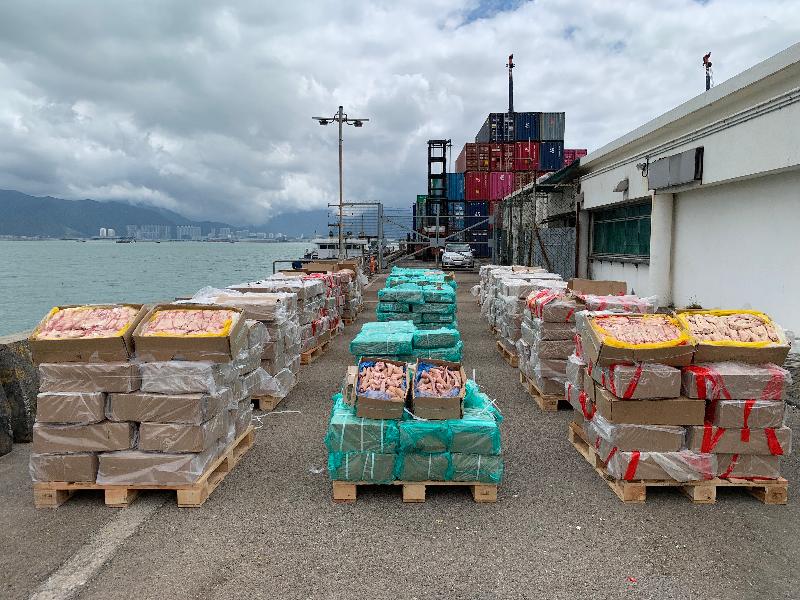
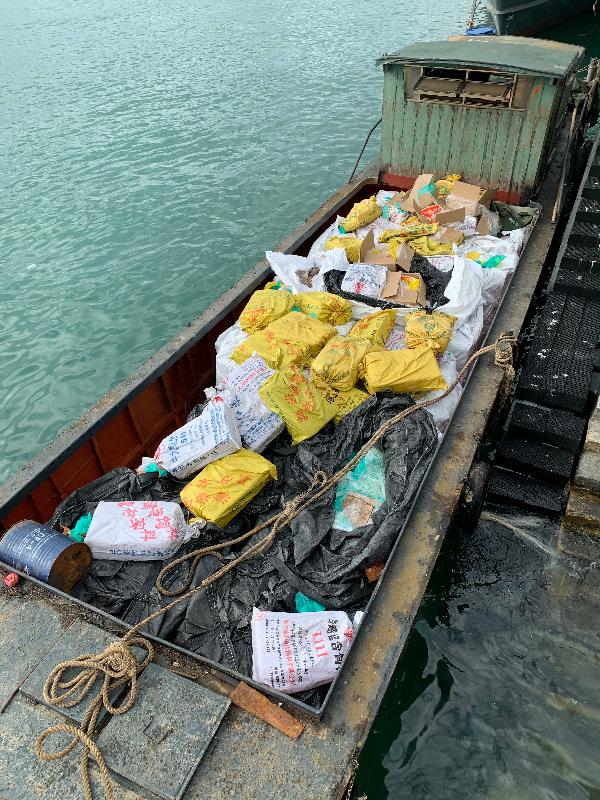
     Hong Kong Customs yesterday evening (May 5) detected a suspected smuggling case using a cargo vessel and a barge in the waters off Hong Kong International Airport (HKIA). About 160 tonnes of suspected smuggled frozen meat with an estimated market value of about $5.6 million were seized.

     Customs officers spotted a suspicious cargo vessel and a suspicious barge when conducting an anti-smuggling operation in the waters off HKIA. The cargo vessel had intended to leave Hong Kong waters later on. Customs officers then took immediate action to intercept the two vessels for examination. During the interception, a man onboard the cargo vessel jumped overboard into the sea and fled. Customs officers immediately searched the area and informed the relevant departments to conduct a search on-site as well.

     In the operation, two men aged 45 and 51 were arrested. The batch of suspected smuggled frozen meat was seized on board the cargo vessel and the barge.

     An investigation is ongoing.

     Smuggling is a serious offence. Under the Import and Export Ordinance, any person found guilty of importing or exporting unmanifested cargo is liable to a maximum fine of $2 million and imprisonment for seven years.

     Members of the public may report any suspected smuggling activities to Customs' 24-hour hotline 2545 6182 or its dedicated crime-reporting email account (crimereport@customs.gov.hk).

Photo  Photo  Photo