Classes of kindergartens and some special schools are suspended

Attention TV and radio duty announcers:

     Please broadcast the following special announcement by the Education Bureau concerning schools, and repeat it at suitable intervals:

     As the Tropical Cyclone Warning Signal no. 3 is now in force, classes of kindergartens, schools for children with physical disability and schools for children with intellectual disability are suspended today. These schools, however, should keep their premises open and implement contingency measures to look after arriving students. They should ensure that conditions are safe before allowing students to return home.


Transcript of remarks by FS at media session (with photo/video)

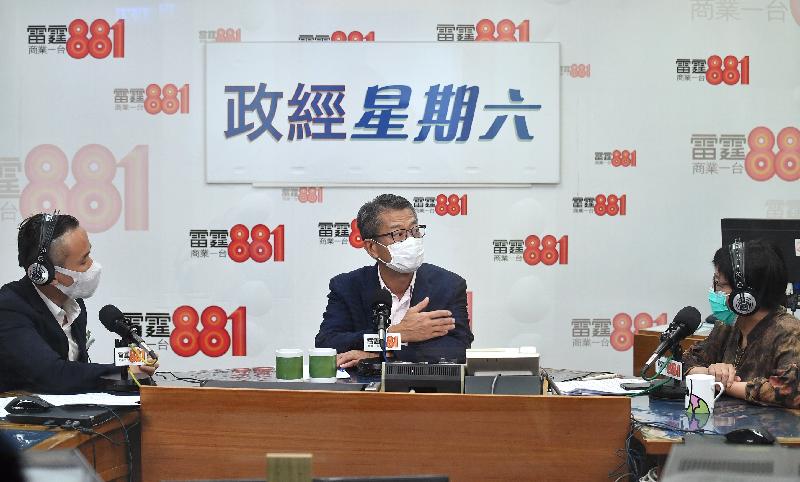
     Following is the transcript of remarks by the Financial Secretary, Mr Paul Chan, at a media session after attending radio programme this morning (June 13):

Reporter: Secretary, first of all, on the US dollar clearing, it has been described as the nuclear option. You have asked people not to be too worried. Can you further explain the steps, specific steps that you have taken or you have prepared Hong Kong in case there is a potential measure taken? And my second question is on Cathay Pacific, do you have a specific set of criteria, because you've mentioned about the government doesn't want to be a long term stakeholder in the airline. So, what are the specific criteria for the government to exit Cathay Pacific and also the criteria set to ensure that this airline will remain the local carrier, will remain Hong Kong company after all this crisis. 
 
Financial Secretary: One of the conditions for the government to step in to invest in Cathay Pacific is that so long as the Government's loan and preference shares have not been fully repaid by Cathay Pacific, Swire Pacific has to remain as the controlling shareholder of Cathay Pacific. 
 
Reporter: Sorry, the criteria for the government to exit Cathay Pacific as well? 
 
Financial Secretary: The design of this rescue package has built in a mechanism for the government to exit. With regard to the bridging loan, in fact the availability of the loan is 12 months from the day of announcement of the rescue package. If they need to use the money, they can draw down, but they have to repay us within 18 months with interest. As the bridging loan is available for a limited period of 12 months only, so by that design, the bridging loan itself has an expiry date and has an exit mechanism. 

     As to the preference shares, the coupon rate is, for the first three years, 3 per cent. The fourth year, 5 per cent, and then 7 per cent, and then 9 per cent. Given currently the liquidity in the market is relatively ample, generally speaking, 7 per cent or 9 per cent coupon rate is rather high in terms of financial costs. So the design of this dividend rate applicable to the preference share gives the incentive to Cathay Pacific to redeem our shares as early as practically possible. 

     Finally, on your question about US dollar clearing, we have made reference to the sanctions previously invoked by the US towards different jurisdictions. Some of those sanctions are trying to cause inconvenience to the targeted individuals or institutions. Say for example, sanctions in respect of named individuals and institutions. We have our response plan, but please pardon me for not being able to disclose the details here, but let me assure you, we have taken that into consideration and we are confident that we have contingency plan in place to respond to that.

(Please also refer to the Chinese portion of the transcript.)
Photo  


Red flag hoisted at Cheung Chau Tung Wan Beach

Attention TV/radio announcers:

Please broadcast the following as soon as possible:

Here is an item of interest to swimmers.

     The Leisure and Cultural Services Department announced today (June 13) that due to big waves, red flag has been hoisted at Cheung Chau Tung Wan Beach in Islands District. Beach-goers are advised not to swim at the beach.


Correctional officer stops person in custody committing self-harm

     A correctional officer stopped a person in custody who was committing self-harm at Nei Kwu Correctional Institution yesterday (June 12).
       
     At 7.01pm yesterday, the 43-year-old female person in custody was found emotionally unstable and banged her head against the wall inside the dormitory. An officer at the scene immediately ordered her to stop the act and called for reinforcement. The person in custody was found conscious. She was required to be sent to a public hospital for further treatment after receiving examination and treatment by the institution medical officer. A clinical psychologist of the department will follow up on the case.

     A spokesman for the Correctional Services Department said, "The department uses all possible measures to prevent persons in custody from attempting suicide or self-harm. These measures include administrative arrangements, the improvement of institutional facilities, staff training and first aid services."

     The person in custody was sentenced for the offence of possession of a dangerous drug in April 2020.


Transcript of remarks by SCS

     Following is the transcript of remarks by the Secretary for the Civil Service, Mr Patrick Nip, at a media session after attending a radio programme this morning (June 13):

Reporter : Secretary, can you talk about the issue of social media? You mentioned that civil servants should not oppose the national security legislation. But in their private capacity on social media, they do have the freedom of expression but you asked them to be mindful. So can you promise that if civil servants in their personal capacities, while they are not working, when they express opinions that could be against the national security law, they won't be penalised? Even when somebody takes a screen capture of private messages or private opinions on social media, they are supposed to be only shared among friends. That is question number one. Question number two on the de-acting of Michael Ngan, a union representative. Aside from him, there are a few other, a total of eight people according to reports who were de-acted. So is it really usual for a department to de-act so many staff at one point? Can you promise that this has nothing to do with you, your decision as well as any political consideration?

Secretary for the Civil Service:  As regards your first question, the Basic Law and our Hong Kong laws guarantee the freedom of expression and also the freedom of assembly, and all that. So if you do it in your personal capacity to express your views, so long as you comply with the law, that's of course okay. But if you are at the same time holding a capacity as a civil servant, then you have to be mindful of your public expression and your act, so as to comply with the requirements and your responsibility as a civil servant. I think that's the basic principle.

     As regards the social media, the hard fact is even though you mean to talk about things within the private circle, the reality is that sometimes this will be leaked out and then become public. Then you have to deal with the situation where people will regard what you said might be in contradiction with the capacities that you are holding. So you have to be mindful about that. This is not just confined to civil servants, it is confined to anyone. And we are facing this reality in nowadays' society. So that's the point that I really want to make. The basic point is that as a person, you are entitled to your views and expressions. But when you are discharging your duty as a civil servant, you have to make sure that what you said and your own personal view would not affect the impartiality of discharging your duty as a civil servant. And you have to be responsible to the HKSAR Government.

     As regards acting arrangements, it's entirely for every department to follow the established mechanism and procedures, including the guidelines issued by the Civil Service Bureau and relevant regulations to deal with acting arrangements. Basically acting arrangements are of two types: one is arranging acting with a view to promotion. So when the Board identifies a person who has potential will then arrange an acting arrangement to test his ability with a view to promotion. The other type is acting for administrative convenience because of the operational needs of the department. This is the acting for administrative convenience. So it is for departments to make appropriate arrangements having regard to their operational needs and the actual situation. The important thing is to follow the established rules and procedures.

(Please also refer to the Chinese portion of the transcript.)