CHP investigates five additional confirmed cases of COVID-19

     The Centre for Health Protection (CHP) of the Department of Health has announced that as of 4pm today (July 3), the CHP was investigating five additional confirmed cases of coronavirus disease 2019 (COVID-19), taking the number of cases to 1 248 in Hong Kong so far (comprising 1 247 confirmed cases and one probable case).
     
     The newly reported cases announced today involve one male and four females aged between 3 and 49. They had travel history during the incubation period. The CHP's epidemiological investigations and relevant contact tracing on the confirmed cases are ongoing. For case details and contact tracing information, please see the Annex.
 
     As the number of inbound travellers at Hong Kong International Airport has substantially increased recently, the DH considered that it is necessary to adjust the test result waiting arrangements according to the daily number of inbound travellers after reviewing the maximum capacity of the result waiting area at the Temporary Specimen Collection Centre (TSCC) at AsiaWorld-Expo and the Holding Centre for Test Result (HCTR) at the Regal Oriental Hotel.
 
     If the day's number of inbound travellers is expected to exceed the capacity of the TSCC and the HCTR, the DH will adopt a triage measure based on risk assessment. Passengers arriving from areas with lower risk will proceed to the designated place for the 14-day compulsory quarantine after collecting their deep throat saliva samples at the TSCC. If their test result is positive, the DH will arrange to send them to a hospital for treatment as soon as possible and arrange to send their close contacts to a quarantine centre.
 
     As for the arrangement to stay at the HCTR, the DH will make flexible arrangements according to its capacity and the daily number of passengers arriving on afternoon flights. If necessary, inbound travellers arriving in the afternoon could also be arranged to wait for test results at the TSCC. The DH urged inbound travellers to follow instructions from staff and allow flexibility for arrangements upon their arrival.
     
     The CHP again urged members of the public to maintain an appropriate social distance with other people as far as possible in their daily lives to minimise the risk of infection. In particular, they should go out less and avoid social activities such as meal gatherings or other gatherings to reduce the chance of contacting infected persons who may not present any symptoms, and minimise the risk of outbreak clusters emerging in the community.
          
     A spokesman for the CHP said, "Given that the situation of COVID-19 infection remains severe and that there is a continuous increase in the number of cases reported around the world, members of the public are strongly urged to avoid all non-essential travel outside Hong Kong.
 
     "The CHP also strongly urges the public to maintain at all times strict personal and environmental hygiene, which is key to personal protection against infection and prevention of the spread of the disease in the community. On a personal level, members of the public should wear a surgical mask when having respiratory symptoms, taking public transport or staying in crowded places. They should also perform hand hygiene frequently, especially before touching the mouth, nose or eyes.
     
     "As for household environmental hygiene, members of the public are advised to maintain drainage pipes properly, regularly pour water into drain outlets (U-traps) and cover all floor drain outlets when they are not in use. After using the toilet, they should put the toilet lid down before flushing to avoid spreading germs."
 
     Moreover, the Government has launched the website "COVID-19 Thematic Website" (www.coronavirus.gov.hk) for announcing the latest updates on various news on COVID-19 infection and health advice to help the public understand the latest updates. Members of the public may also gain access to information via the COVID-19 WhatsApp Helpline launched by the Office of the Government Chief Information Officer. Simply by saving 9617 1823 in their phone contacts or clicking the link wa.me/85296171823?text=hi, they will be able to obtain information on COVID-19 as well as the "StayHomeSafe" mobile app and wristband via WhatsApp.
 
     To prevent pneumonia and respiratory tract infection, members of the public should always maintain good personal and environmental hygiene. They are advised to:
 
• Wear a surgical mask when taking public transport or staying in crowded places. It is important to wear a mask properly, including performing hand hygiene before wearing and after removing a mask;
• Perform hand hygiene frequently, especially before touching the mouth, nose or eyes, after touching public installations such as handrails or doorknobs, or when hands are contaminated by respiratory secretions after coughing or sneezing;
• Maintain drainage pipes properly and regularly (about once a week) pour about half a litre of water into each drain outlet (U-trap) to ensure environmental hygiene;
• Cover all floor drain outlets when they are not in use;
• After using the toilet, put the toilet lid down before flushing to avoid spreading germs;
• Wash hands with liquid soap and water, and rub for at least 20 seconds. Then rinse with water and dry with a disposable paper towel. If hand washing facilities are not available, or when hands are not visibly soiled, performing hand hygiene with 70 to 80 per cent alcohol-based handrub is an effective alternative;
• Cover your mouth and nose with tissue paper when sneezing or coughing. Dispose of soiled tissues into a lidded rubbish bin, then wash hands thoroughly; and
• When having respiratory symptoms, wear a surgical mask, refrain from work or attending class at school, avoid going to crowded places and seek medical advice promptly.


Woman convicted of overcharging foreign domestic helper

     A woman purporting to act as a licensee of an employment agency (EA) or his/her associate was convicted of overcharging a foreign domestic helper (FDH) and fined $3,600 at the Kowloon City Magistrates' Courts today (July 3).
 
     In April 2019, the Employment Agencies Administration (EAA) of the Labour Department (LD) received a complaint from an FDH against Best Ka Hei Employment Agency, located in Kowloon City, for charging her an excessive commission. As the investigation revealed sufficient evidence that an associate of the licensee and another female purporting to act as the licensee or his/her associate of the EA concerned had overcharged the FDH, the LD decided to take out prosecution against both persons. The associate of the licensee of the EA was earlier convicted of overcharging the FDH and fined $3,000 at the Kowloon City Magistrates' Courts. Today, the female purporting to act as the licensee or his/her associate of the EA was also convicted of overcharging the FDH.
 
     Under the Employment Ordinance, an EA licensee or his/her associate, or a person purporting to act in such capacities, is not allowed to collect from a job seeker any fees or charges other than the prescribed commission, which is an amount not exceeding 10 per cent of the first month's salary of the job seeker upon successful placement.
      
     The LD reminds EAs to operate in full compliance with the law and the Code of Practice for Employment Agencies at all times. Failure to do so may lead to prosecution and/or revocation of licence. The Employment (Amendment) Ordinance 2018, effective since February 9, 2018, has raised the maximum penalty for overcharging job seekers to a fine of $350,000 and imprisonment for three years.
      
     For enquiries or complaints about unlicensed operations or overcharging by EAs, please call the EAA of the LD at 2115 3667, or visit its office at Unit 906, 9/F, One Mong Kok Road Commercial Centre, 1 Mong Kok Road, Kowloon.


Hong Kong Customs spares no effort to combat illegal import and sale for electronic cigarette oil containing nicotine or cannabidiol (with photos)

     Hong Kong Customs has conducted a series of enforcement actions against the illegal import and sale of electronic cigarette oil containing Part 1 poisons since early this year. As of yesterday (July 2), Customs has detected 39 relevant cases in total and seized items suspected to be connected with the cases worth about $2.5 million. Thirty-one persons have been arrested.

     During the operation, Customs has detected 29 illegal import and 10 illegal sale cases of electronic cigarette oil containing nicotine or cannabidiol. Eighteen men and 13 women, aged between 20 and 52, including cross-boundary lorry drivers, shop proprietors and salespersons, have been arrested.

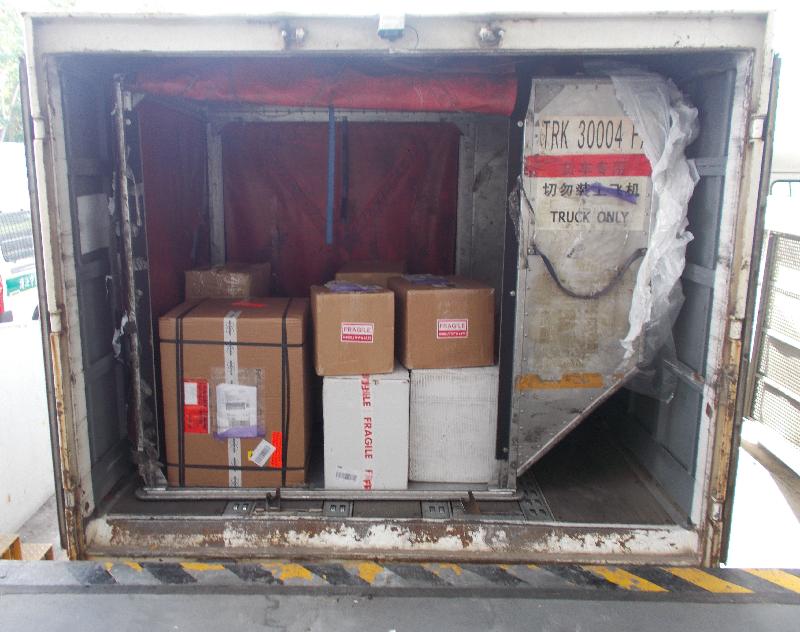
     Customs has all along striven to combat the illegal import and sale of electronic cigarette oil containing nicotine or cannabidiol. The department will continue its action by actively pursuing risk-management and intelligence-based enforcement strategies, along with mounting targeted enforcement operations at suitable times and maintaining close co-operation in its intelligence exchanges with local and overseas law enforcement agencies in order to step up intercepting the inflow of relevant smuggled electronic cigarette oil through air cargo, postal parcel and express courier channels to Hong Kong at source.

     With a view to expanding enforcement efforts, Customs will also strengthen its deployments to conduct follow-up investigations and raid retail shops involved in the illegal sale of relevant products of electronic cigarette oil and land a solid blow against relevant activities.

     Smuggling is a serious offence. Under the Import and Export Ordinance, any person found guilty of importing or exporting unmanifested cargo is liable to a maximum fine of $2 million and imprisonment for seven years. As well, any person who imports pharmaceutical products without a valid import licence commits an offence. The maximum penalty upon conviction is a fine of $500,000 and imprisonment for two years.

     According to the Pharmacy and Poisons Ordinance, nicotine and cannabidiol are Part 1 poisons which can only be sold at pharmacies under the supervision of a registered pharmacist. The illegal sale and possession of Part 1 poisons are criminal offences. The maximum penalty for each offence is a fine of $100,000 and two years' imprisonment.

     Members of the public may report any suspected smuggling activities or illegal sale of alternative smoking products to Customs' 24-hour hotline 2545 6182 or its dedicated crime-reporting email account (crimereport@customs.gov.hk).

Photo  Photo  


Canned fried fish fibre sample detected with mercury exceeding legal limit

     The Centre for Food Safety (CFS) of the Food and Environmental Hygiene Department announced today (July 3) that a canned fried fish fibre sample was found to contain a metal contaminant, mercury, at a level exceeding the legal limit. The CFS is following up on the case.
  
     Product details are as follows:

Product name: Fried Fish Fiber
Brand: Hsin Tung Yang
Place of origin: Taiwan
Net weight: 200 grams per can
Distributor: B&S Company
Best-before date: April 10, 2021

     A spokesman for the CFS said, "The CFS collected the above-mentioned sample from an online shop for testing under its routine Food Surveillance Programme. The test result showed that it contained mercury at a level of 0.81 parts per million (ppm), exceeding the legal limit of 0.5 ppm."

     The CFS has informed the vendor concerned of the irregularity and instructed it to stop sale and remove from shelves the affected batch of the product. The distributor concerned has initiated a recall according to the CFS' instructions. Members of the public may call the distributor's hotline at 3628 7800 during office hours for enquiries about the recall. The CFS is also tracing the source of the affected product.

     "Mercury may affect the nervous system, particularly the developing brain. At high levels, mercury can affect foetal brain development, and affect vision, hearing, muscle co-ordination and memory in adults. Furthermore, as some international organisations such as the World Health Organization have pointed out, consuming predatory fish species is the main source of mercury intake for human beings. The report of the CFS' Total Diet Study has also pointed out that large fish or predatory fish species may contain high mercury levels (for example, tuna, alfonsino, shark, swordfish, marlin, orange roughy and king mackerel). Hence, groups particularly susceptible to the adverse effects of mercury, such as pregnant women, women planning pregnancy and young children, should opt for fish that are smaller in size for consumption and avoid consumption of the above-mentioned types of fish which may contain high mercury levels to minimise the health risk posed to the foetus, infants and young children by excessive exposure to metal contaminants in food," the spokesman said.
   
     According to the Food Adulteration (Metallic Contamination) Regulations (Cap 132V), any person who sells food with metallic contamination above the legal limit may be prosecuted and is liable upon conviction to a fine of $50,000 and imprisonment for six months.
   
     "People are advised to maintain a balanced and varied diet. To avoid health risks posed by excessive intake of metallic contaminants, the general public, especially pregnant women, women planning pregnancy and young children should avoid eating large or predatory fish," the spokesman said.

     The CFS will alert the trade, continue to follow up on the case and take appropriate action to safeguard food safety and public health. Investigation is ongoing.


A sunny and exceptionally hot June

     Due to the stronger than usual subtropical ridge over southern China, June 2020 was much hotter than usual in Hong Kong. The monthly mean minimum temperature was 27.8 degrees, 1.6 degrees above the normal figure and the highest on record for June. The monthly mean temperature and the monthly mean maximum temperature were 29.6 degrees and 32.3 degrees respectively, both being the second highest on record for June. With a total of 18 hot nights, June 2020 was on par with July 1993 as the highest on record in terms of the number of hot nights in a month. The 12 consecutive hot nights that started from June 19 also set a new record in terms of the number of consecutive hot nights for June. The first half of this year was exceptionally warm, with both the mean maximum temperature of 25.7 degrees and the mean temperature of 23.0 degrees being the highest on record for the same period. The mean minimum temperature of 21.1 degrees in the first half of this year was also the third highest on record for the same period. June 2020 was marked by sunny weather with the monthly total sunshine duration amounting to 192.5 hours, about 32 per cent above the normal figure of 146.1 hours. Despite the episode of heavy rain from June 6 to 8, the monthly total rainfall was only 397.2 millimetres, about 13 per cent below the normal figure of 456.1 millimetres. The accumulated rainfall for the first half of the year was 963.4 millimetres, about 12 per cent below the normal figure of 1 096.9 millimetres.
      
     Under the influence of an anticyclone aloft, the weather of Hong Kong was hot with a mixture of sunshine and showers on the first five days of the month. There were also isolated thunderstorms on June 2, 4 and 5. Affected by a trough of low pressure lingering over the coastal areas of Guangdong, local weather deteriorated with outbreaks of heavy showers and squally thunderstorms from June 6 to 8. More than 250 millimetres of rainfall were recorded over most parts of the territory on these three days and the rainfall over Tsuen Wan, Sha Tin, Tai Po and Sai Kung even exceeded 450 millimetres. There were reports of serious flooding in the New Territories and some parts of Kowloon. The rain was particularly heavy in the morning of June 6 and the incessant downpour necessitated the issuance of the Black Rainstorm Warning, the first instance of issuing this signal since May 2017. More than 14 350 cloud-to-ground lightning strokes were detected in Hong Kong on that day, the second highest on record since the launch of the lightning location system in 2005. Moreover, a waterspout was reported near Hong Kong International Airport in the morning of June 8.
      
     With the trough of low pressure moving away and the strengthening of an anticyclone aloft, showery activity weakened with sunny intervals during the day on June 9. Apart from some isolated showers, local weather gradually became fine and very hot from June 10 to 12. With plenty of sunshine, the maximum temperature at the Hong Kong Observatory soared to 35.0 degrees on June 12, the highest of the month.
      
     Meanwhile, an area of low pressure developed into a tropical depression over the Philippines in the morning of June 12 and was later named as Nuri. It moved generally northwestward across the South China Sea during the day of June 12 and further intensified into a tropical storm that night. The weather of Hong Kong was very hot on June 13, with sunny periods, a few squally showers and isolated thunderstorms. Affected by Nuri, local winds started to strengthen gradually in the afternoon and became fresh to strong southeasterlies with occasionally gales on high ground that night. As Nuri made landfall over Yangjiang in Guangdong in the late morning on June 14 and weakened gradually into an area of low pressure inland, winds over Hong Kong moderated with sunny intervals in the afternoon. A person tragically drowned in the rough seas while surfing in Lower Cheung Sha Beach of Lantau Island on June 14.
      
     Under the influence of a southerly airstream, local weather was hot with a mixture of sunny periods and showers from June 15 to 17. Dominated by the subtropical ridge, apart from isolated showers, it was generally fine and hot in the next week. Under the influence of a southwest monsoon, the weather turned slightly cloudier with isolated showers and thunderstorms from June 25 to 27. With the strengthening of the anticyclone aloft, the weather turned generally fine and very hot apart from some isolated showers towards the end of the month.
      
     One tropical cyclone occurred over the South China Sea and the western North Pacific in June 2020.
      
     Details of the issuance and cancellation of various warnings/signals in June are summarised in Table 1. Monthly meteorological figures and departures from normal for June are tabulated in Table 2.