CPS already disburses payment to 3.15 million people today

     A Government spokesman said the Cash Payout Scheme today (July 6) started effecting payment in batches to eligible people who have registered electronically through banks on or before June 30.

     The first batch of about 3.15 million people have received payment through their specified bank accounts today. The remainder will receive payment in the coming one to two days.

     The payment will be shown on the bank book or statement of the registrants with wordings such as "HKSARG$10000", "HKSARG" or "HKG", depending on the setting of relevant bank. The banks will also send notifications through SMS, email or post to inform the registrants within three business days that the sum has been deposited in their specified bank accounts.
 
     People who register electronically through banks on or after July 1 will receive payment about one week after registration.
 
     The public may visit the website of the Scheme (www.cashpayout.gov.hk) or call 18 2020 for detailed information on the Scheme.


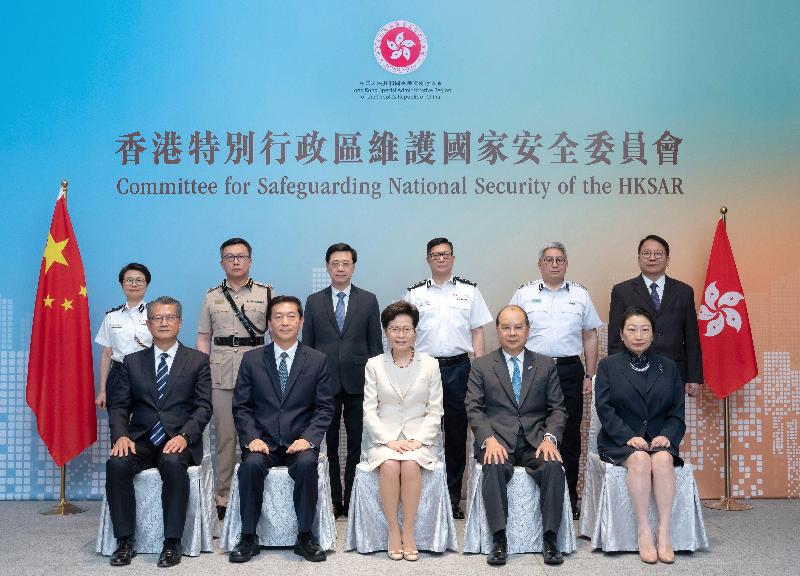
Committee for Safeguarding National Security of HKSAR convenes first meeting (with photo)

     The Hong Kong Special Administrative Region (HKSAR) established the Committee for Safeguarding National Security of the HKSAR (the Committee) on July 3 in accordance with Article 12 of the Law of the People's Republic of China on Safeguarding National Security in the Hong Kong Special Administrative Region (the National Security Law). The Committee today (July 6) convened its first meeting, which was attended by all its members. The National Security Adviser appointed by the Central People's Government also sat in on the meeting.
      
     The Committee is chaired by the Chief Executive, Mrs Carrie Lam. The members comprise the Chief Secretary for Administration, Mr Matthew Cheung Kin-chung; the Financial Secretary, Mr Paul Chan; the Secretary for Justice, Ms Teresa Cheng, SC; the Secretary for Security, Mr John Lee; the Commissioner of Police, Mr Tang Ping-keung; the Deputy Commissioner of Police (National Security), Ms Edwina Lau; the Director of Immigration, Mr Au Ka-wang; the Commissioner of Customs and Excise, Mr Hermes Tang; and the Director of the Chief Executive's Office, Mr Chan Kwok-ki. Mr Chan Kwok-ki is also the Secretary General of the Committee.
      
     As stipulated in Article 15 of the National Security Law, the Committee shall have a National Security Adviser, who shall provide advice on matters relating to the duties and functions of the Committee in safeguarding national security. The National Security Adviser shall sit in on meetings of the Committee. The State Council has appointed Mr Luo Huining as the National Security Adviser earlier.
      
     According to Article 14 of the National Security Law, the duties of the Committee shall be (1) analysing and assessing developments in relation to safeguarding national security in the HKSAR, making work plans and formulating policies for safeguarding national security in the HKSAR; (2) advancing the development of the legal system and enforcement mechanisms of the HKSAR for safeguarding national security; and (3) co-ordinating major work and significant operations for safeguarding national security in the HKSAR. Article 14 of the National Security Law also stipulates that no institution, organisation or individual in the HKSAR shall interfere with the work of the Committee. Information relating to the work of the Committee shall not be subject to disclosure. Decisions made by the Committee shall not be amenable to judicial review.

Photo  


Public hospitals daily update on COVID-19 cases

The following is issued on behalf of the Hospital Authority:

     As at noon today (July 6), one COVID-19 confirmed patient (case number: 1173) was discharged from hospital in the past 24 hours. So far, a total of 1,157 patients with confirmed or probable infections have been discharged.
 
     At present, there are 601 negative pressure rooms in public hospitals with 1,169 negative pressure beds activated. A total of 111 confirmed patients are currently hospitalised in eight hospitals, among which one patient is in critical condition (case number: 595), one is in serious condition (case number: 1269) and the remaining 109 patients are in stable condition.
 
     The Hospital Authority will maintain close contact with the Centre for Health Protection to monitor the latest developments and to inform the public and healthcare workers on the latest information in a timely manner.


Update on cases of Legionnaires’ disease

     The Centre for Health Protection (CHP) of the Department of Health today (July 6) reported the latest number of cases of Legionnaires' disease (LD), and stressed the importance of using and maintaining properly designed man-made water systems, adding that susceptible groups should strictly observe relevant precautions.
 
     From June 28 to July 4, two imported LD cases were reported:
 
1. A male patient, aged 70 with underlying illnesses, who lived alone in Shenzhen; and
 
2. A male patient, aged 47 with underlying illnesses, who stayed in the Mainland since December 2019.
 
     "Epidemiological investigations are ongoing to identify potential sources of infection, high-risk exposures and clusters, if any," a spokesman for the CHP said.
 
     As of July 4 this year, 50 LD cases had been reported. In 2019 and 2018, there were 105 cases each year.
 
     "Men, people aged over 50, smokers, alcoholics and persons with weakened immunities are more susceptible to LD. Some situations may also increase the risk of infection including poor maintenance of water systems leading to stagnant water; living in areas with old water systems, cooling towers or fountains; using electric water heaters, whirlpools and spas or hot water spring spas; and recent stays in hotels or vessels," the spokesman said.
 
     Legionellae are found in various environmental settings and grow well in warm water (20 to 45 degrees Celsius). They can be found in aqueous environments such as water tanks, hot and cold water systems, cooling towers, whirlpools and spas, water fountains and home apparatus which support breathing. People may become infected when they breathe in contaminated droplets (aerosols) and mist generated by artificial water systems, or when handling garden soil, compost and potting mixes.
 
     Immunocompromised persons should:
 
• Use sterile or boiled water for drinking, tooth brushing and mouth rinsing;
• Avoid using humidifiers, or other mist- or aerosol-generating devices. A shower may also generate small aerosols; and
• If using humidifiers, or other mist- or aerosol-generating devices, fill the water tank with only sterile or cooled freshly boiled water, and not water directly from the tap. Also, clean and maintain humidifiers/devices regularly according to manufacturers' instructions. Never leave stagnant water in a humidifier/device. Empty the water tank, wipe all surfaces dry, and change the water daily.

    The public should observe the health advice below:
 
• Observe personal hygiene;
• Do not smoke and avoid alcohol consumption;
• Strainers in water taps and shower heads should be inspected, cleaned, descaled and disinfected regularly or at a frequency recommended by the manufacturer;
• If a fresh-water plumbing system is properly maintained, it is not necessary to install domestic water filters. Use of water filters is not encouraged as clogging occurs easily, which can promote growth of micro-organisms. In case water filters are used, the pore size should be 0.2 micrometres (µm) and the filter needs to be changed periodically according to the manufacturer's recommendations;
• Drain and clean water tanks of buildings at least quarterly;
• Drain or purge for at least one minute infrequently used water outlets (e.g. water taps, shower heads and hot water outlets) and stagnant points of the pipework weekly or before use;
• Seek and follow doctors' professional advice regarding the use and maintenance of home respiratory devices and use only sterile water (not distilled or tap water) to clean and fill the reservoir. Clean and maintain the device regularly according to the manufacturer's instructions. After cleaning/disinfection, rinse the device with sterile water, cooled freshly boiled water or water filtered with 0.2 µm filters. Never leave stagnant water in the device. Empty the water tank, keep all surfaces dry, and change the water daily; and
• When handling garden soil, compost and potting mixes:
     1. Wear gloves and a face mask;
     2. Water gardens and compost gently using low pressure;
     3. Open composted potting mixes slowly and make sure the opening is directed away from the face;
     4. Wet the soil to reduce dust when potting plants; and
     5. Avoid working in poorly ventilated places such as enclosed greenhouses.

     The public may visit the CHP's LD page, the Code of Practice for Prevention of LD and the Housekeeping Guidelines for Cold and Hot Water Systems for Building Management of the Prevention of LD Committee, and the CHP's risk-based strategy for prevention and control of LD.


Woman fined for operating unlicensed guesthouse

     A woman was fined $6,000 at the Kwun Tong Magistrates' Courts today (July 6) for contravening the Hotel and Guesthouse Accommodation Ordinance.
           
     The courts heard that in December last year, officers of the Office of the Licensing Authority (OLA), the Home Affairs Department, inspected a suspected unlicensed guesthouse on Tong Tak Street in Tseung Kwan O. During the inspection, the OLA officers posed as lodgers and successfully rented a room in the guesthouse on a daily basis.
           
     According to the OLA's records, the guesthouse did not possess a licence under the Ordinance on the day of inspection. The woman responsible for operating the premises was charged with contravening section 5(1) of the Ordinance.
           
     A department spokesman stressed that operating or managing an unlicensed guesthouse is a criminal offence and can lead to a criminal record. Upon conviction, the offender is liable to a maximum fine of $200,000 and two years' imprisonment.
           
     The spokesman appealed to anyone with information about suspected unlicensed guesthouses to report it to the OLA through the hotline (Tel: 2881 7498), by email (hadlaenq@had.gov.hk), by fax (2504 5805) using the report form downloaded from the OLA website (www.hadla.gov.hk), or through the mobile application "Hong Kong Licensed Hotels and Guesthouses".