LCQ8: Immigration figures

     Following is a question by Hon Claudia Mo and a written reply by the Secretary for Security, Mr John Lee, in the Legislative Council today (July 8):
    
Question:
 
  Regarding immigration figures, will the Government inform this Council:
 
(1)   of the monthly number of travellers, since November last year, who entered and exited Hong Kong via the various boundary control points, with a breakdown by traveller type (namely Hong Kong residents, Mainland travellers and other travellers);

(2) of the respective numbers of applications submitted under the following schemes that the Government received and approved in each month since November last year: the Immigration Arrangements for Non-local Graduates, the Admission Scheme for Mainland Talents and Professionals, the Quality Migrant Admission Scheme, the Capital Investment Entrant Scheme, and the Technology Talent Admission Scheme; the number of approved applications the applicants of which have entered the territory and, among such applicants, the number of those who came from Hubei Province;

(3)   of the monthly number of Mainland residents, since November last year, who came to Hong Kong for settlement on Permits for Proceeding to Hong Kong and Macao (commonly known as "One-way Permits"), with a breakdown by place of household registration;

(4)   of the monthly number of Mainland travellers, since January this year, who visited Hong Kong, with a breakdown by the type of travel documents they held; and

(5)   of the total number of person-times, since the implementation of the regulations under which persons arriving at Hong Kong shall be subject to 14-day compulsory quarantine, of persons coming from the Mainland, Macao and Taiwan to visit Hong Kong each month who were exempted from complying with the relevant requirement, and a breakdown of the number by such places?

Reply:
 
President,
 
     In consultation with the Food and Health Bureau (FHB), our reply to the question raised by the Hon Claudia Mo is as follows:
 
(1) The respective monthly figures of inbound and outbound passenger trips made by Hong Kong residents, Mainland visitors and visitors from other countries or places at various immigration control points between November 2019 and May 2020 are set out at Annex.
 
(2) The statistics on applications received and approved for admission into Hong Kong under the Immigration Arrangements for Non-local Graduates (IANG), the Admission Scheme for Mainland Talents and Professionals (ASMTP), the Quality Migrant Admission Scheme (QMAS), the Capital Investment Entrant Scheme (CIES) and the Technology Talent Admission Scheme (TechTAS) between November 2019 and May 2020 are tabulated as follows:
 
IANG

  2019 2020
November December January February March April May
Number of applications 448 291 259 107 278 139 264
Number of applications approved 428 288 242 68 274 69 287

Note: The applications approved in a particular month may not be the ones received in the same month.
 
ASMTP

  2019 2020
November December January February March April May
Number of applications 1 202 866 883 481 665 485 884
Number of applications approved 1 006 658 917 0 452 41 982

Note: The applications approved in a particular month may not be the ones received in the same month.
 
QMAS

  2019 2020
November December January February March April May
Number of applications 696 618 239 346 282 434 308
Number of applications with quota(s) allotted 0 237 0 0 0 293 0

Note 1: The applications with quota(s) allotted in a particular month may not be the ones received in the same month.
 
Note 2: After completing preliminary processing of the applications, the Immigration Department (ImmD) will submit them to the Advisory Committee on Admission of Quality Migrants and Professionals (the Advisory Committee) for further advice. The Advisory Committee will conduct regular selection exercises on a quarterly basis and recommend to the Director of Immigration about quota allocation.
 
CIES*

  2019 2020
November December January February March April May
Number of applications 0 0 0 0 0 0 0
Number of applications approved 1 4 0 0 4 4 4

*  CIES has been suspended with effect from January 15, 2015. However, ImmD will continue to process the applications received before the suspension in accordance with the rules of CIES.
 
TechTAS

  2019 2020
November December January February March April May
Number of applications 3 7 2 6 11 3 14
Number of applications approved 1 5 3 0 8 2 22

Note: The applications approved in a particular month may not be the ones received in the same month.
 
  Other statistics mentioned in the question are not regularly compiled and maintained by ImmD.
 
(3) Between November 2019 and May 2020, a total of 8 014 persons entered Hong Kong on the strength of One-way Permits (OWPs) (i.e. Permits for Proceeding to Hong Kong and Macao). According to the information that they provided voluntarily upon entry into Hong Kong, the monthly numbers of these OWP holders by reference to their provinces of origin are as follows:
 

  2019 2020 (Note)
November December January February March April May
Guangdong Province 1 375 1 673 1 976 106 0 0 0
Fujian Province 291 247 376 22 0 0 0
Guangxi Zhuang Autonomous Region 95 74 96 1 0 0 0
Hunan Province 70 82 102 4 0 0 0
Sichuan Province 63 68 99 6 0 0 0
Hubei Province 83 83 60 0 0 0 0
Hainan Province 32 50 35 3 0 0 0
Chongqing 31 37 37 3 0 0 0
Others 218 219 282 15 0 0 0
Total 2 258 2 533 3 063 160 0 0 0

Note: Generally, OWP holders are allowed to enter Hong Kong via the Lo Wu Control Point only. In response to the development of COVID-19 epidemic, the HKSAR Government has suspended the passenger clearance services at the Lo Wu Control Point since February 4, 2020.
 
(4) The monthly numbers of arrivals of Mainland visitors between January and May 2020 (Note 1) by type of endorsement/travel document are tabulated as follows:
       

  January February March April May
Endorsement for individual visit "One trip per week" endorsement 500 354 4 389 0 1(Note 2) 0
Single or double-entry endorsement (Note 3) 857 363 4 599 8(Note 3) 3(Note 3) 5(Note 3)
Endorsement for group visit 425 989 1 729 13(Note 4) 0 0
Endorsement for business visit 68 577 3 726 11(Note 5) 1(Note 5) 4(Note 5)
Endorsement for visiting relatives 230 283 16 153 7 599 2 520 4 870
Other endorsement 77 690 2 760 284 73 166
Chinese Passport 341 669 62 024 18 928 236 425
Other travel documents 18 669 1 336 682 111 153
Total 2 520 594 96 716 27 525 2 945 5 623

Note 1: In response to the development of COVID-19 epidemic, the HKSAR Government has suspended passenger clearance services at most of the control points in phases with effect from end-January 2020:
â—�   West Kowloon Station of the Guangzhou-Shenzhen-Hong Kong Express Rail Link, Hung Hom, Man Kam To, Sha Tau Kok, China Ferry Terminal and Tuen Mun Ferry Terminal (with effect from January 30, 2020);
â—� Lo Wu, Lok Ma Chau Spur Line, Lok Ma Chau and Macau Ferry Terminal (with effect from February 4, 2020); and
â—� Kai Tak Cruise Terminal (with effect from the afternoon of February 5, 2020).
 
Note 2: Including one Mainland private air crew member arriving from the Mainland and disembarking at the Hong Kong International Airport (HKIA) who was exempted from the 14-day compulsory quarantine arrangement (the arrangement).
 
Note 3: Including 10 Mainland private air crew members arriving from the Mainland and disembarking at HKIA who were exempted from the arrangement, two Mainland visitors arriving from Macao via the control point at the Hong Kong-Zhuhai-Macao Bridge Hong Kong Port (HZMB HKP) before the implementation of the compulsory quarantine measure on travellers arriving from Macao starting from March 25, 2020, one Mainland visitor arriving from the Mainland via the control point at HZMB HKP who was exempted from the arrangement and three Mainland visitors arriving from the Mainland via Shenzhen Bay Control Point who were exempted from the arrangement.
 
Note 4: Including 11 Mainland private air crew members arriving from the Mainland and disembarking at HKIA who were exempted from the arrangement and two Mainland visitors arriving from Macao via the control point at HZMB HKP before the implementation of the compulsory quarantine measure on travellers arriving from Macao starting from March 25, 2020.
 
Note 5: Including five Mainland private air crew members arriving from the Mainland and disembarking at HKIA who were exempted from the arrangement, one Mainland visitor arriving from abroad via HKIA before the implementation of the new immigration control measure on March 25, 2020, one Mainland visitor arriving from the Mainland via HKIA who was exempted from the arrangement, five Mainland visitors arriving from Macao via the control point at HZMB HKP before the implementation of the compulsory quarantine measure on travellers arriving from Macao starting from March 25, 2020 and four Mainland visitors arriving from the Mainland via Shenzhen Bay Control Point who were exempted from the arrangement.
 
(5) Pursuant to the Compulsory Quarantine of Certain Persons Arriving at Hong Kong Regulation (Cap. 599C) and Compulsory Quarantine of Persons Arriving at Hong Kong from Foreign Places Regulation (Cap. 599E), with the exception of persons exempted by the Chief Secretary for Administration according to the relevant regulation, all persons entering Hong Kong are currently subject to 14-day compulsory quarantine.
 
     The Department of Health (DH) will arrange 14-day medical surveillance for persons exempted under the above regulation during their stay in Hong Kong. Persons under medical surveillance are required to wear masks and check temperature twice daily, and should report to DH if they feel unwell. In addition, the exempted persons are also subject to temperature check and health declaration procedures performed by DH at the boundary control points during arrival clearance.
 
     According to information provided by DH, the number of Notification of Medical Surveillance issued to exempted persons (including those exempted under Cap. 599C and 599E) at various boundary control points as at May 2020 are as follows –
 

Month Number of Notification of Medical Surveillance issued to exempted persons at various boundary control points in service
February 2020 93 602
March 2020 39 211
April 2020 36 039
May 2020 40 220

Note 1: Boundary control points in service include Hong Kong International Airport, Hong Kong-Zhuhai-Macao Bridge Hong Kong Port, Shenzhen Bay, Man Kam To, Lok Ma Chau and Sha Tau Kok.
 
Note 2: Exempted persons are issued with new Notification of Medical Surveillance every time when they enter Hong Kong (except in cases set out in note 3 below).
 
Note 3: "Crew members of aircraft who need to commute to and from foreign places, Mainland, Macao and Taiwan for performance of necessary duties" with valid Notification of Medical Surveillance issued in the past 14 days would not be issued new Notification of Medical Surveillance afresh every time they enter Hong Kong. In addition, from February 25, 2020 onwards, DH has streamlined the procedures for issuing Notification of Medical Surveillance to "cross-boundary goods vehicle drivers and necessary accompanying personnel". Those with valid Notification of Medical Surveillance issued in the past 14 days would not be issued with new Notification of Medical Surveillance afresh every time they enter Hong Kong.
      
     DH does not maintain the breakdown figures of Notification of Medical Surveillance issued to the exempted persons by country/places.
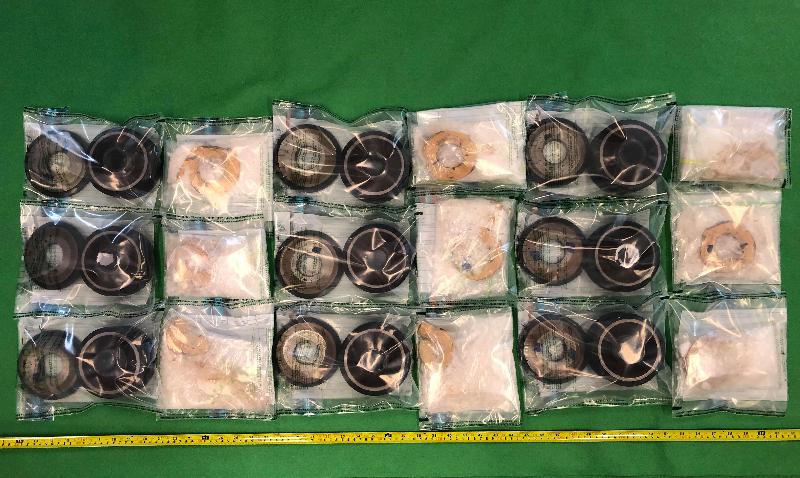


Hong Kong Customs seizes suspected methamphetamine (with photo)

     Hong Kong Customs seized about 1.1 kilograms of suspected methamphetamine with an estimated market value of about $690,000 at Hong Kong International Airport on July 4.

     Customs officers inspected an air consignment arriving in Hong Kong from Malaysia, declared as carrying pulley, at the Hong Kong Air Cargo Terminals on that day. The batch of suspected methamphetamine was found concealed inside the false compartments of nine pulleys.

     After follow-up investigation, Customs officers yesterday (July 7) arrested a 34-year-old woman suspected to be in connection with the case in Sham Shui Po.

     Investigation is ongoing.

     Under the Dangerous Drugs Ordinance, trafficking in a dangerous drug is a serious offence. The maximum penalty upon conviction is a fine of $5 million and life imprisonment.

     Members of the public may report any suspected drug trafficking activities to Customs' 24-hour hotline 2545 6182 or its dedicated crime-reporting email account (crimereport@customs.gov.hk).

Photo  


CHP investigates 24 additional confirmed cases of COVID-19

     The Centre for Health Protection (CHP) of the Department of Health has announced that as of 4pm today (July 8), the CHP was investigating 24 additional confirmed cases of coronavirus disease 2019 (COVID-19), taking the number of cases to 1,324 in Hong Kong so far (comprising 1,323 confirmed cases and one probable case).
    
     The newly reported cases announced today involve 14 males and 10 females aged between 31 and 92. Among them, five had travel history during the incubation period.
 
     For the local cases announced today, the CHP will distribute deep throat saliva specimen bottles to residents of buildings where the patients live at as well as to those whom they might have contact with during the infectious period. People are also urged to seek medical attention early if symptoms develop.
 
     The CHP's epidemiological investigations and relevant contact tracing on the confirmed cases are ongoing. For case details and contact tracing information, please see the Annex.
 
     The CHP again urged members of the public to maintain an appropriate social distance with other people as far as possible in their daily lives to minimise the risk of infection. In particular, they should go out less and avoid social activities such as meal gatherings or other gatherings to reduce the chance of contacting infected persons who may not present any symptoms, and minimise the risk of outbreak clusters emerging in the community.
             
     A spokesman for the CHP said, "Given that the situation of COVID-19 infection remains severe and that there is a continuous increase in the number of cases reported around the world, members of the public are strongly urged to avoid all non-essential travel outside Hong Kong.
    
     "The CHP also strongly urges the public to maintain at all times strict personal and environmental hygiene, which is key to personal protection against infection and prevention of the spread of the disease in the community. On a personal level, members of the public should wear a surgical mask when having respiratory symptoms, taking public transport or staying in crowded places. They should also perform hand hygiene frequently, especially before touching the mouth, nose or eyes.
        
     "As for household environmental hygiene, members of the public are advised to maintain drainage pipes properly, regularly pour water into drain outlets (U-traps) and cover all floor drain outlets when they are not in use. After using the toilet, they should put the toilet lid down before flushing to avoid spreading germs."
    
     Moreover, the Government has launched the website "COVID-19 Thematic Website" (www.coronavirus.gov.hk) for announcing the latest updates on various news on COVID-19 infection and health advice to help the public understand the latest updates. Members of the public may also gain access to information via the COVID-19 WhatsApp Helpline launched by the Office of the Government Chief Information Officer. Simply by saving 9617 1823 in their phone contacts or clicking the link wa.me/85296171823?text=hi, they will be able to obtain information on COVID-19 as well as the "StayHomeSafe" mobile app and wristband via WhatsApp.
    
     To prevent pneumonia and respiratory tract infection, members of the public should always maintain good personal and environmental hygiene. They are advised to:
    
• Wear a surgical mask when taking public transport or staying in crowded places. It is important to wear a mask properly, including performing hand hygiene before wearing and after removing a mask;
• Perform hand hygiene frequently, especially before touching the mouth, nose or eyes, after touching public installations such as handrails or doorknobs, or when hands are contaminated by respiratory secretions after coughing or sneezing;
• Maintain drainage pipes properly and regularly (about once a week) pour about half a litre of water into each drain outlet (U-trap) to ensure environmental hygiene;
• Cover all floor drain outlets when they are not in use;
• After using the toilet, put the toilet lid down before flushing to avoid spreading germs;
• Wash hands with liquid soap and water, and rub for at least 20 seconds. Then rinse with water and dry with a disposable paper towel. If hand washing facilities are not available, or when hands are not visibly soiled, performing hand hygiene with 70 to 80 per cent alcohol-based handrub is an effective alternative;
• Cover your mouth and nose with tissue paper when sneezing or coughing. Dispose of soiled tissues into a lidded rubbish bin, then wash hands thoroughly; and
• When having respiratory symptoms, wear a surgical mask, refrain from work or attending class at school, avoid going to crowded places and seek medical advice promptly.


EAC reminds persons who wish to run for election to comply with legislative requirements

The following is issued on behalf of the Electoral Affairs Commission:
 
     The nomination period of the 2020 Legislative Council General Election is approaching. The Electoral Affairs Commission (EAC) has noticed recent reports on various election-related activities held by individuals or organisations. A spokesman for the EAC today (July 8) reminded those who wish to run for an election and other stakeholders that they must understand and comply with the legislative requirements so as to avoid committing any criminal offence inadvertently. The requirements include:
 
     The Elections (Corrupt and Illegal Conduct) Ordinance (ECICO) (Cap. 554) prohibits corrupt conduct and illegal conduct at elections, regulates election advertising and election expenses, imposes requirements with respect to the receipt of donations and the expenditure of money at or in connection with elections, and provides for related matters. According to Section 2 of the ECICO:

  1. "candidate" means a person who stands nominated as a candidate at an election, and also means a person who, at any time before the close of nominations for an election, has publicly declared an intention to stand as a candidate at the election; and
  2. "election expenses", in relation to a candidate or group of candidates at an election, means expenses incurred or to be incurred, before, during or after the election period, by or on behalf of the candidate or group for the purpose of (a) promoting the election of the candidate or group, or (b) prejudicing the election of another candidate or group, and includes election donations.

 
     "In accordance with Section 37 of the ECICO, all candidates must lodge with the appropriate authority an election return setting out the candidate's election expenses and all election donations received. Therefore, if the definition of 'candidate' is met, regardless of whether he or she has submitted his or her nomination form to run for the 2020 Legislative Council General Election, he or she must declare all election expenses involved. Section 23 of the ECICO stipulates that only candidates and authorised election expense agents shall incur election expenses or else an illegal conduct is engaged. However, if a third party publishes an election advertisement on the Internet, and the only election expenses incurred by the person for the purpose of publishing the election advertisement are either or both of electricity charges and charges necessary for accessing the Internet, the person is exempted from the relevant criminal liability. When considering what expenses would amount to 'election expenses', it is considered both necessary and useful to take heed of the points made by the Court of Final Appeal in a case relating to the 2008 Legislative Council General Election which touched on election expenses (FACV No. 2 of 2012) and independent legal advice should be sought," the spokesman said.
 
     In addition, the spokesman said that according to Section 42 of the Legislative Council Ordinance, a candidate who has submitted a nomination form may withdraw his or her candidature only before the end of the nomination period. Under the subsisting law, candidates are not allowed to withdraw their candidature after the end of the nomination period and there is no such mechanism of so-called "abandonment of election". According to Sections 7 to 9 of the ECICO, it will be a corrupt conduct if a person corruptly affects a person to stand or not to stand as a candidate by bribery, force, duress or deception. The person who commits an offence is liable on conviction to a fine of $500,000 and to imprisonment for seven years.
 
     Members of the public, including candidates and other relevant persons, should make a report to the Independent Commission Against Corruption if anyone is suspected to have violated the ECICO. The EAC will handle any relevant complaint received in a serious manner and refer to law enforcement agencies for follow-up.


LCQ14: Government outsourced service contracts

     Following is a question by the Hon Luk Chung-hung and a written reply by the Secretary for Labour and Welfare, Dr Law Chi-kwong, in the Legislative Council today (July 8):

Question:

     Regarding those government outsourced service contracts (contracts) that rely heavily on the employment of non-skilled employees, will the Government inform this Council:

(1) of the numbers and total value of the contracts awarded by various government departments and the numbers of non-skilled employees involved, in each of the past three years, with a breakdown by the category of services (i.e. cleansing, security, and others) procured under the contracts;

(2) of the following information from May 1, 2019 (i.e. the effective date of the prevailing statutory minimum wage rate) to June 30, 2020:

(A) the respective numbers of non-skilled employees employed by the outsourced service contractors (contractors) under the four major procuring departments (i.e. (i) Leisure and Cultural Services Department, (ii) Housing Department, (iii) Food and Environmental Hygiene Department and (iv) Government Property Agency) (set out in Table 1);

Table 1

Procuring departments (i) (ii) (iii) (iv)
Number of
non-skilled employees
       

(B) a breakdown of the numbers in (A) by the range to which the hourly wages payable to non-skilled employees belonged (i.e. hourly wage (a) at $37.5 [equal to the statutory minimum wage], (b) between $37.6 and $39.5, (c) between $39.6 and $41.5, (d) between $41.6 and $43.5, (e) between $43.6 and $45.5, (f) between $45.6 and $47.5, (g) between $47.6 and $49.5, (h) between $49.6 and $51.5, (i) between $51.6 and $53.5, (j) at $53.6 or more, and (k) at a rate higher than the statutory minimum wage rate [which is equal to the total of (b) to (j)]), as pledged by the contractors in the tenders, and their respective percentages (set out in Table 2); and

Table 2

Range
of
hourly wages
(i) (ii) (iii) (iv)
Number
of
employees
% Number
of
employees
% Number
of employees
% Number
of employees
%
(a)                
               
(k)                
Total   100   100   100   100

(C) in respect of each of the ranges of hourly wages mentioned in (B), a breakdown of the following figures by the category of services (i.e. cleansing, security, and others) provided by the non-skilled employees: the number of such employees employed by the contractors under each of such departments, the subtotals of these numbers and the relevant percentages, and (X) the year-on-year rates of change of such subtotals (set out in Table 3);

Table 3

Range of hourly wages Cleansing service Security service Other services Total %
(i) (ii) (iii) (iv) Subtotal % (X) (i) (ii) (iii) (iv) Subtotal % (X) (i) (ii) (iii) (iv) Subtotal % (X)
(a)                                              
                                             
(k)                                              
Total           100             100             100     100

(3) of the details of the re-tendering exercises for the outsourced services concerned which were/will be conducted by the four aforesaid major procuring departments last year and this year, including the names of the contractors before tenders were/are invited, the commencement dates of the new contracts and the service districts involved, as well as the names of the successful contractors;

(4) given that the Government announced on October 10, 2018 that it would introduce a number of new measures which aim at enhancing the protection of the employment terms and conditions as well as labour benefits of non-skilled workers, but these new measures and the transitional arrangements concerned are not applicable to contracts awarded before that date of announcement, of the number of such contracts which have not yet expired at present and the percentage of such contracts in the total number of contracts; of the expected completion dates of the re-tendering exercises for the outsourced services concerned;

(5) whether it will consider providing subsidies for the non-skilled employees employed under the contracts mentioned in (4), so as to compensate them for the differences between their remuneration packages and those stipulated under existing contracts; and

(6) given that at present, a non-skilled employee with no less than one year’s continuous service under a Standard Employment Contract of a government outsourced service contract is entitled to a contractual gratuity, whether the Government will consider relaxing the relevant restrictions (e.g. affording those employees who have less than one year's service when their employment is terminated contractual gratuities calculated on a pro rata basis), so as to eradicate evasion of payment of contractual gratuities by employers through early termination of contracts?

Reply:

President,

     Having consulted the relevant policy bureaux and departments, my consolidated response to the Member's questions is set out below:

(1) In the past three years, the number and total value of the service contracts awarded by the four major procuring departments (i.e. (i) Leisure and Cultural Services Department, (ii) Housing Department, (iii) Food and Environmental Hygiene Department and (iv) Government Property Agency) and the number of non-skilled employees involved are set out at Annex 1.

(2) As at May 31, 2020 (the date when the most updated data are available in the four major procuring departments):

(A) Table 1 sets out the number of non-skilled employees employed by the outsourced service contractors in the four major procuring departments:

Table 1

Procuring departments (i)Leisure and Cultural Services Department (ii)Housing Department (iii)Food and Environmental Hygiene Department (iv)Government Property Agency
Number of
non-skilled employees
10 791 5 807 11 863 1 910[Note]

Note: Information on the numbers of non-skilled employees above is provided by relevant service contractors.

     Reply to (B) and (C) are set out at Annex 2.

(3) The details of the outsourced services contracts tendered and awarded from April 1, 2019 (the commencement date of the improvement measures) to May 31, 2020 by the four major procuring departments and the names of last contractors is set out at Annex 3.

(4) The number of valid service contracts that were awarded before the commencement of the improvement measures (i.e., awarded before October 10, 2018) and the percentage of such contracts in the total number of contracts in the four major procuring departments are provided as follows:
 

Procuring departments Number of valid contracts awarded before 10.10.2018 Percentage of these contracts in the total number of contracts
Leisure and Cultural Services Department 50 48%
Housing Department 45[Note] 21%
Food and Environmental Hygiene Department 50 35%
Government Property Agency 1 14%
Total 146  

Note: Nine HOS/GSH property management contracts are excluded. For the Property Management Agency Contracts of the brand new HOS/GSH courts, upon expiry of the 2-year initial contract, the procurement of the subsequent service contracts shall be decided by a resolution of the owners passed as a general meeting/meeting of owners in accordance with the Building Management Ordinance (Cap. 344).

     The expected completion dates of the re-tendering exercises for these outsourced services for the four major procuring departments are set out as follows:

(i) Leisure and Cultural Services Department 
It is estimated that 26 and the remaining 24 out of the 50 contracts will be expired in 2020 and 2021 respectively. The tender exercises of the above contracts are expected to be completed before the end of the contracts concerned.

(ii) Housing Department 
Among 45 contracts, 28 will be expired in 2020, 13 will be expired in 2021, one will be expired in 2022 whereas the remaining 3 will be expired in 2023. The tender exercises of the above contracts are expected to be completed before the end of the contracts concerned.

(iii) Food and Environmental Hygiene Department 
It is estimated that 25, 18, 4 and 3 out of the 50 contracts will be renewed in 2020-2021, 2021-2022, 2022-2023 and 2023-2024 financial years respectively.

(iv) Government Property Agency (GPA) 
The above contract was awarded by Highways Department in the Financial Year 2017-18 and has been taken over by the GPA since 2020 for the provision of management, operation and maintenance services to the boundary crossing facilities at the Hong Kong-Zhuhai-Macao Bridge Hong Kong Port. The term of the service contract is until the end of 2020. The GPA will carry out the re-tendering work in due course.

(5) If acceded to, this could have significant implications on all procuring Bureaux/Departments in terms of their contract management duties as well as finances. The then inter-bureaux/departmental Working Group, when proposing the sets of improvement measures, have also considered this issue. In view of the principle of prudent use of public funds, the financial implications for top-up payments and the administrative cost in providing top-up payments in the form of reimbursement to government service contractors (GSCs), the improvement measures and the top-up payment as a one-off measure under the transitional arrangement are not applicable to service contracts awarded before October 10, 2018.

(6) Having considered the possible change of GSCs upon expiry of service contracts, the Government introduced contractual gratuity to forestall labour disputes between GSCs and non-skilled employees over payment of severance payment. The eligibility requirement for contractual gratuity (minimum 1 year of employment) is in fact more lenient than severance payment (minimum 24 months of employment).

     The arrangement of contractual gratuity helps forestall labour disputes between GSCs and non-skilled employees over the termination compensation. Government service contracts engage a large number of non-skilled employees and GSCs have to provide sufficient manpower to fulfill the requirements of service contracts. The labour supply of these posts is still tight and we do not see the trend of GSCs dismissing their employees at will to evade payment of contractual gratuity. The Government will keep in view of the situation and will inform relevant procuring departments and conduct review as appropriate should GSCs be suspected of dismissing employees at will to evade payment of contractual gratuity.