Prevention and Control of Disease (Regulation of Cross-boundary Conveyances and Travellers) Regulation and the Prevention and Control of Disease (Wearing of Mask) (Public Transport) Regulation gazetted

     In view of the development and severity of the COVID-19 epidemic situation in Hong Kong, the Government yesterday (July 13) gazetted and enacted the Prevention and Control of Disease (Regulation of Cross-boundary Conveyances and Travellers) Regulation (Cap. 599H) and the Prevention and Control of Disease (Wearing of Mask) (Public Transport) Regulation (Cap. 599I). Cap. 599H and Cap. 599I will come into effect at 0.00am on July 15, 2020.

     The epidemic situation of COVID-19 in Hong Kong has undergone drastic changes recently.  Among the 52 confirmed cases announced on July 13, 2020, 41 were local cases. New cases recorded during the period from July 7 to July 13, 2020 include 181 cases without travel history during the incubation period. The recent emergence of local cases of unknown infection source indicates the existence of sustained silent transmission in the community. The latest public health risk assessment shows that the risk of a large-scale outbreak is extremely high.

     In addition to local cases, the Government is also very concerned about the considerable number of imported cases. New cases recorded during the period from July 7 to July 13, 2020 include 55 imported cases. The sources of these cases are mainly arrivals from places with high risk of COVID-19, such as Pakistan, India, Bangladesh, Nepal and South Africa, as well as foreign domestic helpers from the Philippines and Indonesia.

     A spokesman for the Food and Health Bureau said, "As the epidemic situation evolves and develops, taking into account the limited capacities of our quarantine and isolation facilities, the Government must implement measures to prevent imported and local cases. To this end, having regard to the latest public health risk assessment, we need to impose conditions on travellers coming to Hong Kong on cross-boundary conveyances to reduce the health risk they may bring, as well as mandate the wearing of masks by any person on transport carriers during a specified period to prevent the spread of the disease through transport carriers."

Prevention and Control of Disease (Regulation of Cross-boundary Conveyances and Travellers) Regulation
———————————————————————————————–

     Cap. 599H introduces a mechanism to empower the Secretary for Food and Health (the Secretary) to impose conditions related to the prevention and control of the specified disease or protection of public health, on cross-boundary conveyances arriving at Hong Kong from specified places and relevant travellers coming to Hong Kong on the conveyances.  The mechanism empowers the Government to flexibly impose various conditions on travellers, either based on their originating place (e.g. specific high-risk places), or solely having regard to the office they assume (e.g. air crew or sea crew), including requiring inbound travellers from cross-boundary conveyances to obtain a negative result from a COVID-19 test conducted by a recognised laboratory before arriving at Hong Kong. The Secretary will issue directions on the above matters in due course.

     If any conditions specified by the Secretary is not met in relation to any traveller on a conveyance, a health officer or authorised officer acting on the advice of a health officer may prohibit the aircraft from landing in Hong Kong or prohibit the vessel from entering or staying in the waters of Hong Kong.

     To ensure the operator of a conveyance comply with the relevant requirements, the health officer or authorised officer acting on the advice of a health officer may require the operator to provide information, including information concerning the meeting of the specified conditions for the relevant traveller(s) on the said conveyance, the travel record of the conveyance or the health condition of the persons on the conveyance. As for travellers coming to Hong Kong, the health officer or authorised officer acting on the advice of a health officer may require them to provide information concerning their health condition, travel history and the meeting of the specified conditions, including their COVID-19 test results.

    If any conditions specified by the Secretary is not met in relation to any relevant traveller on the conveyance, each of the operators of the conveyance commits an offence, and is liable on conviction to the maximum penalty of a fine at level 5 ($50,000) and imprisonment for six months. If an operator fails to comply with a requirement to provide information, or knowingly or recklessly provides any information that is false or misleading in a material particular, he or she is liable on conviction to the maximum penalty of a fine at level 5 ($50,000) and imprisonment for six months.

     As for travellers, if a traveller coming to Hong Kong fails to comply with a requirement to provide information, or knowingly or recklessly provides any information that is false or misleading in a material particular, he or she is liable on conviction to the maximum penalty of a fine at level 3 ($10,000) and imprisonment for six months.

Prevention and Control of Disease (Wearing of Mask) (Public Transport) Regulation
——————————————————————————————-

     Cap. 599I empowers the Secretary, for preventing, protecting against, delaying or otherwise controlling the incidence or transmission of the specified disease, to, by notice published in the Gazette, specify a period. During the specified period, a person must wear a mask at all times when the person is boarding or on board a public transport carrier (see Annex), or is entering or present in an MTR paid area.

     The relevant provision does not apply to a person who is under the age of two, and a person who has lawful authority or reasonable excuse for not wearing a mask. Reasonable excuses listed under Cap. 599I include:

(a) the person cannot put on, wear or remove a mask:
     (i) because of any physical or mental illness, impairment or disability; or
     (ii) without severe distress;
(b) the person is accompanying, or providing assistance to, another person who relies on lip reading to communicate with the person;
(c) it is reasonably necessary for the person not to wear a mask in order to avoid any physical harm to the person or others;
(d) it is reasonably necessary for the person to board or be on board a public transport carrier, or enter or be present in an MTR paid area, in order to avoid any physical harm to the person but the person does not have a mask;
(e) the person is not wearing a mask in order to do any of the following acts (only if the act is lawful and reasonably necessary in the circumstances):
     (i) eat or drink;
     (ii) take medication;
     (iii) maintain personal hygiene; or
(f) the person is required by a public officer (who is performing a function of the officer) to remove a mask the person is otherwise wearing.

     In addition, if a person is boarding or on board a public transport carrier that is not in service, or is entering or present in an MTR paid area that is not open to the public, the relevant provision does not apply either.

     The Secretary has published in the Gazette a notice, specifying for the period of 14 days from 0.00am of July 15 to July 28, 2020, a person must wear a mask at all times when the person is boarding or on board a public transport carrier, or is entering or present in an MTR paid area.

     If a person does not wear a mask in accordance with the requirement, an authorised person may deny that person from boarding a public transport carrier or entering the area concerned, as well as require that person to wear a mask and disembark from the carrier or leave the said area. A person who contravenes the relevant provision commits an offence and the maximum penalty is a fine at level 2 ($5,000).

     Cap. 599H and Cap. 599I are made under the Prevention and Control of Disease Ordinance (Cap. 599). Section 8 of the Ordinance empowers the Chief Executive in Council to make public health emergency regulation for the purposes of preventing, combating or alleviating the effects of a public health emergency and protecting public health.

Government further tightens social distancing measures

     The Government gazetted yesterday (July 13) amendments and directions under the Prevention and Control of Disease (Requirements and Directions) (Business and Premises) Regulation (Cap. 599F) and the Prevention and Control of Disease (Prohibition on Group Gathering) Regulation (Cap. 599G) to further tighten social distancing measures. The above amendments and directions will take effect at 0.00am on July 15, 2020.

     The epidemic situation of COVID-19 in Hong Kong has undergone drastic changes recently.  Among the 52 confirmed cases announced on July 13, 2020, 41 were local cases. New cases recorded during the period from July 7 to July 13, 2020 include 181 cases without travel history during the incubation period. The recent emergence of local cases of unknown infection source indicates the existence of sustained silent transmission in the community. The latest public health risk assessment shows that the risk of a large-scale outbreak is extremely high.

     According to the World Health Organization and health experts, COVID-19 would not be eradicated without effective treatment and vaccination. The Government thus is required to incorporate work in relation to disease prevention and control as well as infection management into the new normal of the daily operation of the society. To this end, the Government has all along adopted the "suppress and lift" strategy in order to quickly adjust epidemic control measures should there be inevitable small-scale community outbreaks. Subsequent to the announcement of the tightening of social distancing measures on July 9, in view of signs of further deterioration of the epidemic situation, the Government considers that there is a need to further tighten social distancing measures.

     A spokesman for the Food and Health Bureau said, "The detection of quite a number of local cases with unknown sources of infection over a short period of time raises an important alarm, reminding the community that members of the public must not let down their guard in terms of epidemic prevention and control. In view of the latest public health risk assessment, in particular the higher risks brought about by activities conducted without wearing masks as shown in recent cases, we are of the view that it is now necessary to tighten social distancing measures, including imposing stringent limits on number of persons and capacity, and other infection control requirements on catering business and requiring the closure of scheduled premises."

     The requirements and restrictions under the latest directions (details at Annex 1) are as follows:
     
Catering business
——————–

(1) On catering business, the number of customers at any catering premises at any one time must not exceed 50 per cent of the normal seating capacity of the premises. No more than 4 persons may be seated together at one table within any catering premises.

(2) From 6pm to 4.59am of the subsequent day, save for specific premises (i.e. premises set out in Schedule 1 to Cap. 599F, such as hospitals, residential care homes, treatment centres, boarding schools, premises controlled or managed by the Government, and certain catering business designated by the Chief Secretary for Administration in accordance with Section 5 of the Regulation), a person responsible for carrying on a catering business must cease selling or supplying food or drink for consumption on the premises of the business; and close any premises, or part of the premises, on which food or drink is sold or supplied by the business for consumption on the premises. The premises concerned may still sell or supply food and/or drink for takeaway services and deliveries.

(3) Any premises (commonly known as bar or pub) that is exclusively or mainly used for the sale or supply of intoxicating liquors as defined in section 53(1) of the Dutiable Commodities Ordinance (Cap. 109) (intoxicating liquors) for consumption in that premises must be closed. Any part of a catering premises that is exclusively or mainly used for the sale or supply of intoxicating liquors for consumption in that part must be closed.

(4) Live performance and dancing must not be allowed in any catering premises. All karaoke and mahjong-tin kau activities carried on at any catering premises must also be suspended.  Other requirements and restrictions in relation to catering business premises will be maintained.

Scheduled premises
———————-

(5) All scheduled premises set out below are required to suspend operation: 

(a) Amusement game centres;
(b) Bathhouses;
(c) Fitness centres;
(d) Places of amusement;
(e) Places of public entertainment;
(f) Premises (commonly known as party rooms) that are maintained or intended to be maintained for hire for holding social gatherings;
(g) Beauty parlours; 
(h) Establishments (commonly known as clubs or nightclubs) that are open late into the night, usually for drinking, and dancing or other entertainment; 
(i) Karaoke establishments; 
(j) Mahjong-tin kau premises; and 
(k) Massage establishments (save for those under Annex 2).

(6) Save for catering premises therein, all club-houses must be closed.

     The above requirements in respect of catering business and scheduled premises will take effect from July 15, 2020 to July 21, 2020, for a period of seven days.

Group gatherings
——————-

(7) The number of persons allowed in group gatherings in public places will be tightened from 50 to four, with effective from July 15, 2020.  Unless exempted, the prohibition on group gatherings at public places will continue during the 14-day period from July 15, 2020 to July 28, 2020.

(8) In view of the latest limit on the number of persons in group gatherings, the Government will accordingly adjust the exempted group gatherings under Cap. 599G (see Annex 3), including:

(a) exempting group gatherings of not more than 20 persons during wedding ceremonies at which no food or drink is served;
(b) for shareholders' meeting of a listed company that is held in accordance with any ordinance or regulatory instrument, subject to no food or drink being served, tightening the number of persons allowed in a room or partitioned area from 50 to 20; and
(c) removing the exemption on group gatherings during religious activities.

     All of the other directions issued earlier by the Secretary for Food and Health in accordance to Cap. 599F and Cap. 599G (i.e. the directions which took effect on July 11 and July 3 respectively) will be suspended on July 15 procedurally.

     "We will continue to closely monitor the development of the epidemic situation and review the various measures in place from time to time with a view to making suitable adjustments taking into account all relevant factors. We also strongly urge the public to stay vigilant, maintain at all times strict personal and environmental hygiene, and maintain an appropriate social distance with other people as far as possible in their daily lives to prevent the virus from spreading in the community," said the spokesman.

     Persons responsible for carrying on catering businesses and the managers of scheduled premises that contravene the statutory requirements under Cap. 599F would have committed a criminal offence. Offenders are subject to a maximum fine of $50,000 and imprisonment for six months.  Separately, any person who participates in a prohibited group gathering; organises a prohibited group gathering; owns, controls or operates the place of such gathering; and knowingly allows the taking place of such gathering, commits an offence under Cap. 599G.  Offenders are liable to a maximum fine of $25,000 and imprisonment for six months. Persons who participate in a prohibited group gathering may discharge liability for the offence by paying a fixed penalty of $2,000.


Transcript of remarks of press conference (with photos/video)

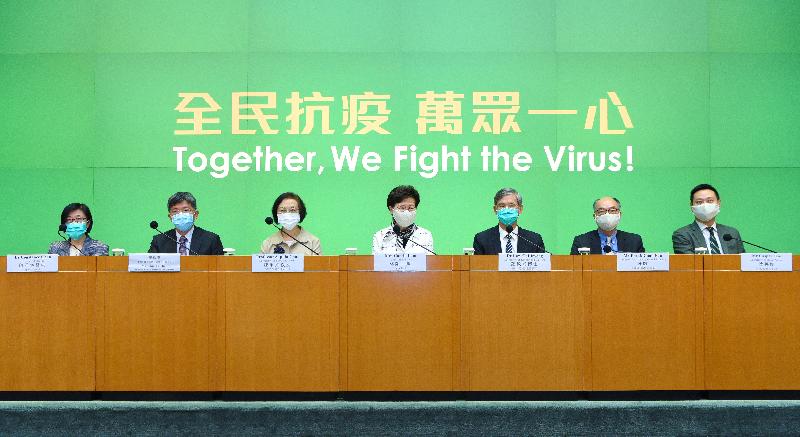
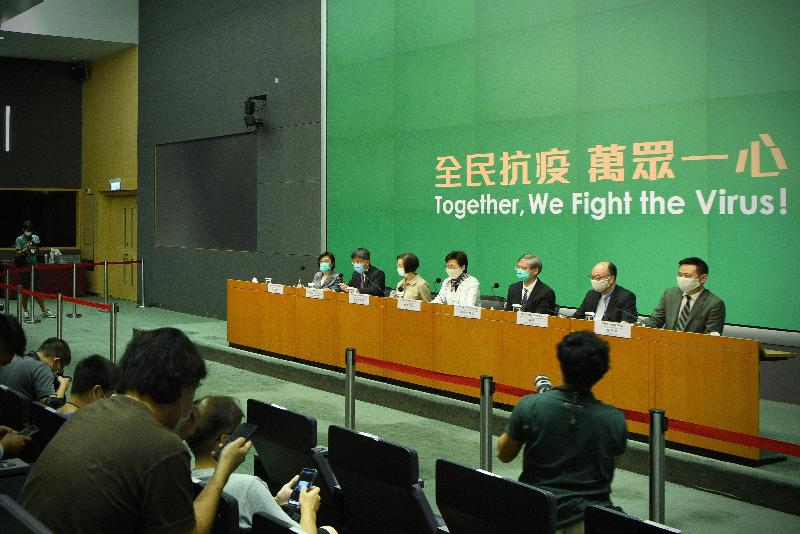
     The Chief Executive, Mrs Carrie Lam, held a press conference on July 13. Also joining were the Secretary for Labour and Welfare, Dr Law Chi-kwong; the Secretary for Transport and Housing, Mr Frank Chan Fan; the Secretary for Food and Health, Professor Sophia Chan; the Secretary for Home Affairs, Mr Caspar Tsui; Permanent Secretary for Food and Health (Health), Mr Thomas Chan and the Director of Health, Dr Constance Chan. Following is the transcript of remarks of the press conference.
 
Reporter: Just a few English questions. The Government has set a new rule saying there will be no eating and services after 6pm. So can you explain why do you think it might help curb the virus spreading and what about lunch time and breakfast time because these are peak hours too so why not include these times? And second question regarding making it mandatory to wear a mask on public transport, why only public transport and not public areas in general, because in other countries we do see this rule applying to other public areas? Third question, because this tightening of anti-epidemic measures is certainly going to deal a blow to the recovery of the economy and the recovery of the businesses so would the Government consider giving another round of anti-epidemic subsidies to help these businesses out? And separate question regarding the primaries of the pan-dems, what do you make of hundreds of thousands of people defying your minister’s warning that it is a breach of the National Security Law and people turning out to vote anyways? Thank you.
 
Chief Executive: I’ll invite the Secretary for Food and Health to address the first two questions about eating, prohibition and wearing a mask and I’ll come back to answer the other two questions.
 
Secretary for Food and Health: Thank you for your question. For this time when we devise the regulations and directions, first of all, it is targeted. We look at the recent outbreak and also the latest situation. For example, many of the mask off activities are actually high risk. Not only they are high risk of transmission, when more people gather together, there is also a high risk of transmission or extending the transmission chain in the community. Therefore, in terms of both mask wearing and catering business directions, we are targeting at the recent cases that we have found. For example, a number of them are found in the eateries and also a number of them are taxi drivers and passengers. Therefore, Cap 599F and Cap 599I are devised in terms of this targeted approach and also targeting at the mask-off approach. Of course, we understand that we also have to strike a balance. If we close the entire catering business, not allowing breakfasts and lunches, this would be a big disruption to the community. We reckon that there are people going to work. It is important for us to minimise the time people spending on dining in. Therefore, we issue this direction of not allowing dining in from 6pm to 5am (the following day). I think this is basically the thinking behind our amendments to the regulations and directions.

Chief Executive: On the question about the impact on business of the tightening of the social distancing restrictions, we naturally confess that this will have an adverse impact on business, especially with the closures of the 12 types of premises and for the first time the banning of eat-in for restaurants after 6pm. But you will recall that in the last five, six months, whenever we talked about this subject, we said that we were in a situation of a three-way tug of war. One is we have to take account of the latest public health situation, secondly is the economic impact and thirdly is the social acceptability of the people. I think based on what we have seen in the last seven or eight days about the re-emergence of local cases and the spread and the diversity of these local cases, this is the time for tightening, which means that it will affect business, which means that people will become more inconvenienced.  I will have to appeal to people, that I fully understand they want to go to Book Fair, they want to go to restaurant, they want to meet friends, but this is a time for us to put our act together in order to fight this latest re-emergence of cases.
 
     As far as business is concerned, we will continue to help our businesses because this is very important to Hong Kong. The Employment Support Scheme (ESS) is still available. We are still only in the first batch covering the three months of June, July and August. We will have a second tranche of payment from September, October to November. We will invite applications, hopefully, either end of this month or early August. That subsidy is still there to help businesses to preserve jobs as much as possible. Beyond the ESS, if there are particular areas that we feel some more targeted help is needed, the Government will provide it. You may or may not recall that since approval by the Finance Committee of the Legislative Council, we have actually improved more than half a dozen of new items which were not in the original plan, like the laundries and the car repair shops, and we are paying these new items from what we call the contingency from the AEF (Anti-epidemic Fund). Right now I still have over $8 billion of contingency to meet the needs of business in a very targeted manner. I’m very willing to deploy the contingency to help the business, so it’s a bit premature to talk about another round. I think the right approach is to understand the needs of certain businesses and try to provide help as early as possible.
      
     The last question has nothing to do – or it may have something to do with COVID-19 if the gathering that we have seen over the last two days have resulted in more infections in Hong Kong, and that is a very regretful approach. Election is a very serious and solemn matter in every jurisdiction. People have to uphold their right to be able to cast a vote in an election which is open, fair and honest. We will not tolerate any practices trying to interfere, disrupt, cause confusion to a coming election in September for the Legislative Council. As far as what has happened over the last two days on this so-called "primary" – by the way there is no such thing as a primary in Hong Kong’s election system, I hope people would not be confused by this so-called "primary", it is not part of Hong Kong’s electoral system – we have received quite a large number of complaints relating to the two days of activities, mainly in three aspects. One is it is causing unfairness to the upcoming election because of the way that it is presented to the people. Secondly is it will probably have breached the 599G on prohibiting group gathering of more than 50 people because in some of the places we have seen large queues and large crowd. And finally is breaching the privacy protection, which I believe the Privacy Commissioner is looking into this area. Different departments have received a large number of complaints and we will have to investigate. If we discover there is sufficient evidence to take action, we will take action. This is a lawful society. I will just put down a further note of warning: if this so-called "primary" election’s purpose is to achieve the ultimate goal of delivering what they call a "35+" with the objective of objecting to, resisting every policy initiative of the Hong Kong SAR Government, then it may fall into the category of subverting the state power, which is now one of the four types of offences under the new National Security Law. I’m not saying that it has breached it but I have to put forward a warning that if that is going to be proven to be the case, then there is certainly a case to answer. Thank you.
      
Reporter: My first question is, regarding the cost of the two bodies engaged in trying to carry out tests, what would be the estimated cost and will the cost be made transparent later when the test is carried out? And the second question is, you just said you have spent the past week preparing for the latest round of the anti-epidemic measures, but given the drastic restrictions to be imposed on the restaurants and the food and beverage sector, did you actually consult them in the past week before introducing this? The third one is, we've seen a number of cases, we've seen an elderly care home in Tsz Wan Shan completely compromised by the virus. There have been wide calls for the Government to introduce testing in elderly care homes a lot earlier, but the response which the Government have given was sort of disproportionate at the earlier stage. Do you think that the failure of the Government to respond proactively has contributed to what we are seeing at the elderly home in Tsz Wan Shan right now? Thanks.
 
Chief Executive: The first and third questions are related to testing. I'll address that. As far as the restaurants are concerned, maybe Secretary for Food and Health could answer that. First of all, to ramp up the testing capacity is not an easy task. We have been discussing and exploring various options over the last few weeks, and we managed, with the support of especially the Shenzhen Municipal Government to help us or even send the experts to us, to secure this latest test provider, which has been doing a huge amount of tests in various Mainland cities and even in overseas countries. The other test provider has been operating in Macao, and we are also discussing with them for a while. Finally, I can assure you that the estimated cost will be in the public domain, the unit cost per test, because the money will come out from the Anti-epidemic Fund and we promised the Legislative Council that we will be as transparent, as accountable, as possible in accounting for the money that we have spent under the Anti-epidemic Fund. I'll just give you a little bit of preview. When you finally see the cost, the cost will be lower than what we have been quoting in Hong Kong, running into $1,200, but it will not be as low as in Shenzhen or Macao because of the cost of logistics, and the cost of logistics is high because of the staff costs and the transportation costs. This cost of collecting all the specimens and so on, it will jack up the cost of a test in Hong Kong, but it will still be cheaper than what we have seen. So it will be helpful for the next phase, when travellers need to have a COVID-19 test negative in order to cross the border, in order to go on a travel bubble. I believe that what we are now doing in ramping up private sector capacity will be helpful to our next stage of work.
 
     As far as elderly homes are concerned, I have to be very frank with you, throughout the last five months my biggest worry is an outbreak in an elderly home because of the situation of our homes, especially in the private homes. We have still yet to find out the exact cause of this particular outbreak, but once there is an infection, apparently it’s spread very fast. Dr Law told me that there are now only four elderly residents who are not infected, so over 30 have been infected. We have been doing testing in homes. According to Director of Health, she has been sending bottles into elderly homes to ask them to return the saliva specimens for tests to be conducted, and I think the figure is running into two, three thousand, and all are negative. But if you do a comprehensive one involving 40 000, then it brings us back to the capacity issue. I'm happy to say that we've now solved that, so we will go for more comprehensive testing in the four high-risk groups that I have just mentioned.
 
Secretary for Food and Health: Your question is about the catering business and our measures this time issued for the catering business under Cap 599F. In terms of the catering business, of course when you see that in our recent outbreak, many of the confirmed cases are from these small or medium-sized eateries. Therefore, it is precautionary for us to tighten the existing (requirements), for example, the number of people, capacity and even the time that people spend in these eateries. So, there are the directions not permitting dining in after certain hours as well as cutting down to four people per table plus 50 per cent capacity. In such a rush we had to make these decisions. In terms of consultation, I learnt from the restaurants operators that actually many people have already cancelled the tables that they have reserved. Yesterday I visited some of the small eateries. The operators were actually quite thankful to our AEF (Anti-epidemic Fund) for the catering business and also our ESS (Employment Support Scheme). Although they understand their business will be affected, they are also mindful of the epidemic situation and the latest local situation. Because they well know that if these requirements are not tightened, perhaps there will be high-risk people who may go to their restaurants or eateries, and that in turn will also affect their business. Therefore, I think there is some understanding among the operators as well.
 
Chief Executive: I should just supplement that although, as the Secretary said, we have not done any consultations with the catering business sector, the fact that we are now imposing this ban for seven days instead of the more standard 14 days is also a response to their suggestion. On previous rounds of consultation, they said that, "Mrs Lam, if you have to impose strict measures again, could you do seven days, and then seven days if needed?", rather than a 14-day period, which apparently gives them less hope that this measure will be lifted soon. Thank you.

(Please also refer to the Chinese portion of the transcript.)

Photo  Photo  


Latest arrangements on LCSD public services

     The Leisure and Cultural Services Department (LCSD) announced today (July 13) that, in view of the latest situation of COVID-19, further measures have to be adopted to maintain social distancing. The leisure and cultural venues/facilities reopened earlier will be temporarily closed starting from July 15 (Wednesday) until further notice. The recreational, sports and cultural programmes to be held in July will also be cancelled.

     Outdoor leisure venues/facilities including tennis courts, bowling greens, sports grounds, Ngau Chi Wan Park Archery Range, Shek O Obstacle Golf Course, Tuen Mun Recreation and Sports Centre, grass pitches, artificial turf soccer pitches, hard-surface pitches, gateball courts, table tennis tables, barbecue sites, skateparks, roller skating rinks, roller hockey grounds, skateboard grounds, outdoor fitness equipment, model car play areas, model boat pools, cycling facilities (except for cycle paths), amphitheatres, public swimming pools, beaches, water sports centres; holiday camps and Pui O Campsite will be temporarily closed.

     All indoor sports facilities including sports centres, squash centres and badminton centres will also be closed on July 15.

     Passive/Amenity areas at LCSD's parks (such as lawns and benches in parks) and outdoor jogging tracks at parks will remain open.

     Meanwhile, all booking applications for the department's land-based recreation and sports facilities in July will be suspended. The LCSD will also suspend group booking for public swimming pools in July. Application for use of amphitheatres and non-fee charging leisure venues for non-designated use/sales activities will continue to be suspended until further notice.

     For refund arrangements in relation to venue closures, the hirer may submit a completed refund application form together with the original booking permit to the LCSD booking office at a District Leisure Services Office or to relevant leisure venues by post. The application form can be downloaded from www.lcsd.gov.hk/en/aboutlcsd/forms/refund.html.

     All public libraries and their students' study rooms will be temporarily closed.

     All book drop services of the Hong Kong Public Libraries and those located at three MTR stations as well as the self-service library stations at Island East Sports Centre Sitting-out Area, the Hong Kong Cultural Centre and Tsuen Nam Road, Tai Wai will also suspend services. Public libraries will continue to provide online services such as e-Books and e-Databases.

     All museums, performance venues and music centres of the Music Office will be temporarily closed. All major facilities of performance venues will not be opened before the end of July; all public programmes at museums will be suspended.

     The URBTIX outlets and ticket dispensing machines at LCSD performance venues will also be closed. URBTIX will maintain internet and mobile app ticketing and hotline services.

     Refund arrangements in relation to the closure of cultural facilities will be announced in due course.

     The LCSD will continue to monitor the situation closely and review the arrangements in a timely manner.


Appeal for information on missing man in Tseung Kwan O (with photo)

          Police today (July 13) appealed to the public for information on a man who went missing in Tseung Kwan O.

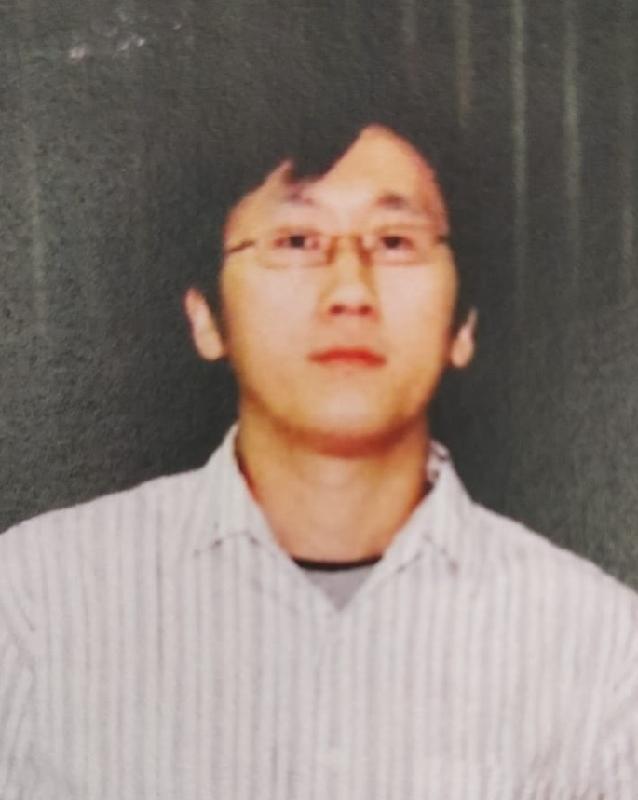
          Ng Ka-chun, aged 44, went missing after he left his residence on Tong Chun Street on July 10 morning. His family made a report to Police yesterday (July 12).
         
          He is about 1.8 metres tall, 70 kilograms in weight and of medium build. He has a pointed face with yellow complexion and short black hair. He was last seen wearing a pair of glasses, blue jeans and grey shoes.

          Anyone who knows the whereabouts of the missing man or may have seen him is urged to contact the Regional Missing Person Unit of Kowloon East on 3661 0316 or email to rmpu-ke-2@police.gov.hk, or contact any police station.
     

Photo