Territory-wide flag-selling activity cancelled

     The Social Welfare Department (SWD) has been informed by A Drop of Life Limited that the territory-wide flag-selling activity in public places scheduled to be held today (July 15) has been cancelled, a spokesman for the SWD said.
 
     Details of the charitable fund-raising activities, including any updated information, covered by the issued Public Subscription Permit have been published on the GovHK website (www.gov.hk/en/theme/fundraising/search/).
 
     For enquiries, please contact Ms Yan of the organisation concerned at 2735 8016.


FHB responds to media enquiries

     In response to media enquiries on the Government's initiative to conduct COVID-19 tests for high risk groups, a spokesman for the Food and Health Bureau (FHB) said on July 14:
      
     "The epidemic situation in Hong Kong has undergone drastic changes recently, with the emergence of a number of local cases with unknown sources of infection over a short period of time. In view of the situation, the Government has decided to make use of the Anti-epidemic Fund to conduct large scale testing for designated high-risk groups, and to expand the overall testing capacity of Hong Kong accordingly.
      
     With a view to targeting clusters of infection in various premises and sectors in the community, the Government has decided to immediately enhance COVID-19 tests for high risk groups in the community on a voluntary basis. These include staff of residential care homes for the elderly (RCHEs), residential care homes for persons with disabilities (RCHDs) and nursing homes, taxi drivers, restaurant staff and frontline staff of the property management sector. The estimated number of individuals involved is around 400 000.
      
     After liaising with the major private laboratories in Hong Kong, the Government noted that there are only three laboratories in the market that could provide the abovementioned testing services at a massive scale up to tens of thousands. The three laboratories are Sunrise Diagnostic Centre Limited established by BGI, China Inspection Company Limited and Prenetics. 
      
     As there is an urgent need to roll out large scale testing as soon as possible to protect public health, after considering the suitability of the testing service models for the actual operation of the relevant sectors provided by the relevant laboratories, the Government decided to directly procure testing services from Sunrise Diagnostic Centre and Prenetics under the Anti-epidemic Fund for voluntary testing of staff of RCHEs, RCHDs and nursing homes, taxi drivers and restaurant staff. The Hong Kong Association of Property Management Companies has also been discussing with China Inspection Company Limited to provide testing services for the property management sector, with subsidy from the Anti-epidemic Fund.
      
     Such services provide a one-stop solution to cover procedures from specimen-taking to testing. The testing arrangements for different sectors vary. For instance, on-site specimen collection is more suitable for staff of residential homes, and the relevant logistics costs would be higher. Hence, the testing costs would vary across services for different sectors. In view of the large scale testing, testing would be conducted by phases, with the two groups with higher risks namely staff of RCHEs, RCHDs and nursing homes, and taxi drivers starting from this week. The relevant testing service costs are still under discussion with individual companies. The Government would review the testing costs to ensure that the procurement price is reasonable, and will announce the details of use of funding in accordance with the requirements of the Anti-epidemic Fund at a later stage.
      
     At the same time, the Department of Health (DH), through the connection of Hong Kong Association of Medical Laboratories (HKAML), has earlier procured testing services directly from five local private laboratories to enhance public testing capacity. The relevant private laboratories have started testing service for DH today, with a total capacity of handling about 1 000 specimens per day. To further expand the scope of testing, the Hospital Authority (HA) is exploring the possibility of setting up special counters at the general out-patient clinics to distribute deep throat saliva specimen bottles to persons with mild symptoms who wish to get tested. HKAML and the Government have reached a consensus that private laboratories would endeavor to assist DH and HA in providing more testing services if the testing capacity could be ramped up in the future, in order to alleviate the pressure on the public testing capacity.
      
     The collection and use of any personal data for the purpose of voluntary COVID-19 tests should comply with the provisions of the Personal Data (Privacy) Ordinance. Government departments or testing agencies that process the relevant data will report to DH or other relevant departments on a need basis for the purpose of disease control. The workflow does not involve the provision of any personal data to any organisations or persons outside Hong Kong.  We will also consider taking various measures to minimise the amount of personal data to be collected and accessed.
      
     If the epidemic situation remains serious, the Government would not preclude the possibility of further procuring services directly from private laboratories in order to rapidly increase testing capacity of Hong Kong."


Queen Elizabeth Hospital announces a cluster of COVID-19 suspected of nosocomial infection

The following is issued on behalf of the Hospital Authority:

     Queen Elizabeth Hospital today (July 14) announced a cluster of COVID-19 suspected of nosocomial infection:
      
     A 92-year-old female patient was admitted to the general medical ward via the Accident & Emergency Department in the early morning of July 12 due to her chronic disease. Her nasopharyngeal swab specimen was tested and confirmed positive for COVID-19 on the same evening.  She was immediately arranged to be transferred to the isolation ward to continue treatment, and the current situation is stable.

     The hospital's infection control team immediately conducted a contact tracing. A nurse who took the specimen for the patient did not wear full set of personal protective equipment. The hospital will maintain close communication with the Centre for Health Protection to arrange the required quarantine arrangements.
      
     Among the 10 patients in the same cubicle, one has died due to her own disease. The hospital arranged isolation treatment and quarantine for the remaining nine patients according to the recommendations of the Centre for Health Protection.  In addition, the 27 healthcare staff who had contacted with the patient and the other 44 inpatients in the same ward required medical surveillance.  The hospital will provide the staff concerned with the test if required.
      
     Among the nine patients in the same cubicle, a 77-year-old female patient was diagnosed with COVID-19 in the evening of July 13. The patient was sent to the hospital on June 28 due to a fall and was discharged on July 2. However, she was re-admitted to the hospital due to hypertension on the same evening and was transferred to the general medical ward on July 9.  In view of the stable condition of the patient, the hospital transferred the patient to ‪Hong Kong Buddhist Hospital on July 12 to continue treatment.  ‪The nasopharyngeal specimen collected by Hong Kong Buddhist Hospital for this patient was tested negative for COVID-19. However, when QEH learned that the 92-year-old female patient was confirmed, the patient was arranged to return to the hospital for isolation on July 13. After retesting, she was found to be positive for COVID-19 on the evening of July 13. The patient is currently in stable condition.

     Hong Kong Buddhist Hospital will arrange for the isolation of five patients who have been in the same cubicle. In addition, 13 healthcare staff who have contacted the patient will undergo medical surveillance.
      
     There is another 64-year-old female patient in the same cubicle with two confirmed patients in the hospital. She was also diagnosed with COVID-19 on July 14. The female patient was admitted to the ward for palliative treatment on June 19 due to chronic disease. However, staff found that the patient had fever on the evening of July 13 and collected a nasopharyngeal swab specimen for the patient. On the afternoon of July 14, it was confirmed to be positive for COVID-19. The patient is currently in stable condition.
      
     Professor Yuen Kwok-Yung, Chair Professor of the Department of Microbiology, University of Hong Kong and Dr Raymond Lai, Chief Infection Control Officer of the Hospital Authority visited QEH tonight. The expert group initially suspected that the virus was likely spread through indirect contact.
      
     The medical ward that the patients had stayed has been suspended for admitting patients and arranged for thorough cleansing.
      
     The hospital will continue to follow up the incident closely with the CHP. The hospital reminds staff again that appropriate personal protective equipment needs to be worn when conducting high-risk procedures for patients. The hospital will continue to maintain close communication with frontline staff, provide the necessary personal protective equipment, reinforce the importance of hand hygiene and also monitor the elderly patients admitted to the hospital.


CE inspects virus tests for staff of residential care home for the elderly (with photos)

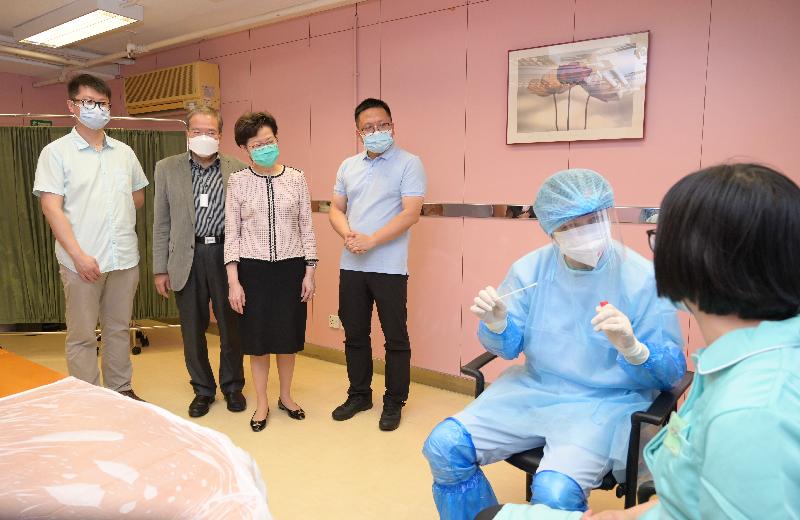
     The Chief Executive, Mrs Carrie Lam, visited a residential care home for the elderly in Tsz Wan Shan today (July 14) to inspect COVID-19 tests arranged by the Government for staff members working at residential care homes for the elderly.

      At the residential care home for the elderly in Tsz Wan Shan, Mrs Lam was briefed by the person-in-charge of Sunrise Diagnostic Centre Limited, established by BGI Genomics, on the arrangements and procedures for collecting throat swab samples for COVID-19 tests for about 80 staff members of the elderly home. Today is the first day that the Government, together with the testing institution, conducted virus tests for staff members of residential care homes for the elderly, residential care homes for persons with disabilities and nursing homes. With the experience gained, the tests will be extended to all care institutions in Hong Kong as soon as possible.

     Noting that the epidemic in Hong Kong has become more severe at the beginning of this month, with soaring numbers of local infection cases and the emergence of confirmed cases in a residential care home for the elderly for the first time, Mrs Lam said that the Government has rolled out various measures to curb the disease in the past days. Among them, the Government will conduct virus tests for four high-risk groups, including staff members of residential care homes for the elderly, residential care homes for persons with disabilities as well as nursing homes; staff members of restaurants; taxi drivers and employees of property management. The goal is to strengthen detection in the community for identification of asymptomatic patients to achieve "early identification, early isolation and early treatment of the infected", thus reduce the risk of spreading the virus in society.

     "The Government has been striving to enhance the testing capabilities by various means. With the increase in equipment and manpower, the public sector may increase the number of tests to 8 000 next month, and if necessary, procure testing services directly from local private laboratories to cope with the needs of the Centre for Health Protection for epidemic management. Nevertheless, in order to enhance the testing capabilities in the community, while taking into account the demand for virus tests by cross-boundary travellers with the implementation of the health code system in the future, we have to extend the scale of private testing services in Hong Kong. I would like to express my gratitude for the participation of the private institutions, which contribute to the fight against the disease in Hong Kong," Mrs Lam said.     

Photo  Photo  


EAC statement on “primaries”

The following is issued on behalf of the Electoral Affairs Commission:
      
     The Electoral Affairs Commission (EAC) today (July 14) issued the following statement in respect of the "primaries" for the Legislative Council General Election (LCGE) held last weekend (July 11 to 12).
      
     Election is a solemn matter and the electoral procedures are strictly governed by the relevant electoral legislation. Public elections must be held in an open, fair and honest manner. There is no mechanism of "primaries" under the law of Hong Kong. The so-called "primaries" is not part of the electoral procedures of the Legislative Council Election or other public elections.
      
     In accordance with Section 37 of the Elections (Corrupt and Illegal Conduct) Ordinance (ECICO), all candidates must lodge with the appropriate authority an election return setting out the candidate's election expenses and all election donations received. Therefore, if the definition of "candidate" under section 2 of the ECICO is met, regardless of whether he or she has submitted his or her nomination form to run for the 2020 LCGE, he or she must declare all election expenses involved. A spokesman for the EAC emphasised that Section 23 of the ECICO stipulates that only candidates and authorised election expense agents shall incur election expenses or else an illegal conduct is engaged. However, if a third party publishes an election advertisement on the Internet, and the only election expenses incurred by the person for the purpose of publishing the election advertisement are either or both of electricity charges and charges necessary for accessing the Internet, the person is exempted from the relevant criminal liability.
      
     The spokesman reiterated that according to Sections 7 to 9 of the ECICO, it will be a corrupt conduct if a person corruptly affects a person to stand or not to stand as a candidate by bribery, force, duress or deception. The person who commits an offence is liable on conviction to a fine of $500,000 and to imprisonment for seven years. In addition, according to Section 42 of the Legislative Council Ordinance, a candidate who has submitted a nomination form may withdraw his or her candidature only before the end of the nomination period. Under the subsisting law, candidates are not allowed to withdraw their candidature after the end of the nomination period and there is no such mechanism of so-called "abandonment of election".
      
     Members of the public, including candidates and other relevant persons, should make a report to the Independent Commission Against Corruption if anyone is suspected to have violated the ECICO. The EAC will handle any relevant complaint received in a serious manner and refer to law enforcement agencies for follow-up.
      
     The Law of the People's Republic of China on Safeguarding National Security in the Hong Kong Special Administrative Region (the National Security Law) was implemented on June 30. Under Article 29 of the National Security Law, a person who steals, spies, obtains with payment, or unlawfully provides State secrets or intelligence concerning national security for a foreign country or an institution, organisation or individual outside the mainland, Hong Kong, and Macao of the People's Republic of China shall be guilty of an offence; a person who requests a foreign country or an institution, organisation or individual outside the mainland, Hong Kong, and Macao of the People's Republic of China, or conspires with a foreign country or an institution, organisation or individual outside the mainland, Hong Kong, and Macao of the People's Republic of China, or directly or indirectly receives instructions, control, funding or other kinds of support from a foreign country or an institution, organisation or individual outside the mainland, Hong Kong, and Macao of the People's Republic of China, to commit rigging or undermining an election in the Hong Kong Special Administrative Region, which is likely to cause serious consequences, shall be guilty of an offence. Whether an election-related activity constitutes an offence will depend on the decisions of the prosecuting authorities and the court. Members of the public should take heed of the relevant provisions in the course of organising and participating in election-related activities.
      
     The EAC is an independent, apolitical and impartial body which decides on public election matters in accordance with actual and objective considerations and related legislation. The EAC issued a statement last Wednesday (July 8) pointing out that as the nomination period of the 2020 LCGE was approaching, the EAC had noticed reports on various election-related activities held by individuals or organisations. The statement aimed at reminding those who wish to run for an election and other stakeholders that they must understand and comply with the legislative requirements so as to avoid committing any criminal offence inadvertently.