Two new COVID-19 cases related to Sheung Shui Slaughterhouse

     The Food and Environmental Hygiene Department (FEHD) said the Centre for Health Protection (CHP) today (July 27) has notified that a new confirmed case and a preliminary confirmed case of COVID-19 related to the Sheung Shui Slaughterhouse (SSSH), which involve two buyers. The buyers concerned earlier sought medical treatment from private clinics after feeling unwell and took virus tests. They were informed by the CHP last night (July 26) and this morning that they were preliminarily tested positive and tested positive for COVID-19 respectively. In addition, the CHP today has noted that an earlier preliminary case concerning a buyer has been changed to a confirmed case.
 
     The SSSH has immediately conducted thorough cleaning and disinfection at places where the person concerned had stayed or visited, and will fully co-operate with the CHP for its follow-up investigation. So far there are a total of five COVID-19 cases found to be related to SSSH, of which two are confirmed cases, while the other three are preliminary confirmed cases. Since there are three buyers preliminarily tested positive or tested positive for COVID-19, the SSSH will endeavour to complete the virus tests for all of the stakeholders going in and out of the SSSH as soon as possible, so as to have the infected persons isolated timely.
 
     A spokesman for the FEHD said, "The Government is very concerned about the cases in relation to SSSH, and will strive to ensure the smooth operation of the slaughterhouse and that the supply of live pigs will not be affected. The Government and the SSSH have reviewed the purchase and sale process and has implemented social distancing measures in the slaughterhouse. It will closely monitor the latest development and further enhance anti-epidemic measures in light of the actual circumstances."
 
     The spokesman said the operation of the SSSH has remained normal, and it has strived to ensure that its operation meets the required hygienic and environmental standards, and that all meat supplied to the market is fit for human consumption. The FEHD and CHP have contacted the operator to better understand the situation, and have immediately implemented all necessary measures and follow-up work to safeguard public hygiene and public health.
 
     The CHP has already contacted the two buyers of the new cases today for investigation and has traced their close contacts in the slaughterhouse. Arrangements will be made for them to be tested or isolated if necessary.
 
     Upon receiving notification of the first preliminary confirmed case found to be related to a worker in the slaughterhouse last Friday, the SSSH, in addition to regularly undertaking daily thorough cleaning and disinfection work according to the daily clearance arrangement, has immediately conducted additional enhanced deep cleaning and disinfection work at its surrounding areas, offices, rest areas and public facilities in the past few days.
 
     During the epidemic, the SSSH has required all workers to observe the personal protective equipment guidelines, and implemented the following anti-epidemic measures:

(1) Install two infrared body temperature monitors at the entrance to ensure that only people with normal body temperature are allowed to enter the slaughterhouse;
(2) Require all people to wear a mask when they are in the slaughterhouse;
(3) Require all people to maintain social distancing and avoid gathering;
(4) Provide alcohol-based handrub and remind all people to keep their hands clean; and
(5) Remind all those working in the slaughterhouse to observe personal hygiene, and that if they feel unwell, they should seek medical advice as soon as possible and should not go to work.
 
     To further protect the health and safety of the workers working at the lairage area, in addition to requiring all workers to wear a face mask and increase social distance in the slaughterhouse, all workers working at the lairage area are additionally given a protective gown every day as enhanced protection.
 
     The spokesman stressed that members of the public need not to be worried about the food safety of meat slaughtered at the slaughterhouse. According to the current scientific information and advice of the World Health Organization (WHO), it is unlikely that humans will be infected with COVID-19 via food. Members of the public are unlikely to be infected via fresh meat slaughtered at the slaughterhouse.
 
     Nevertheless, the Center for Food Safety, based on the WHO advice on food safety, reminds the public to maintain personal, food and environmental hygiene at all times, including washing hands before and after handling raw and cooked foods; separating raw meat and internal organs from cooked foods; cooking food thoroughly, avoiding to eat raw or undercooked animals, etc. so as to ensure food safety.
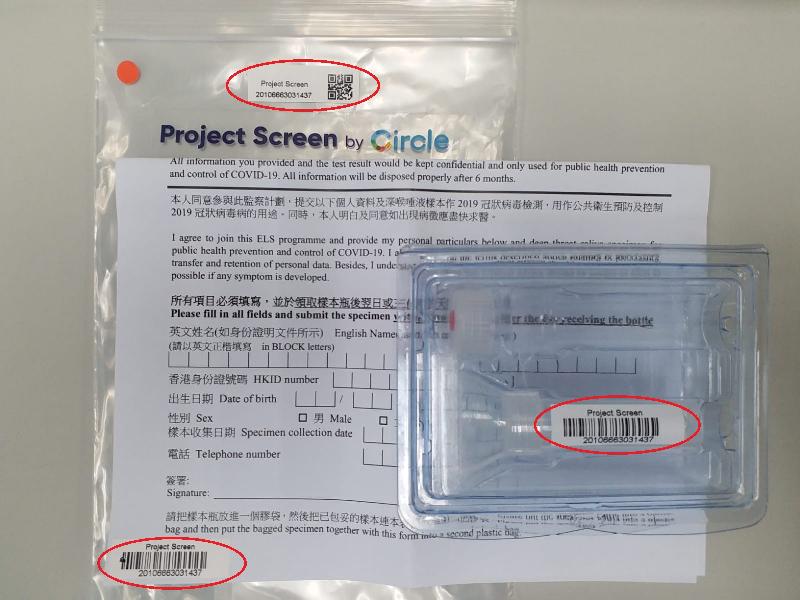


To verify specimen collection pack barcode carefully (with photo)

The following is issued on behalf of the Hospital Authority:

     The spokesperson for the Hospital Authority (HA) made the following announcement today (July 27) on the arrangement of distributing deep throat saliva specimen collection packs in Lam Tin General Out-patient Clinic (GOPC):

     The HA commenced a pilot arrangement to assist the Centre for Health Protection to distribute deep throat saliva specimen collection packs in 22 GOPCs today. Having reviewed the first day operation, the HA found that the barcodes affixed on the specimen bottles and on the personal information form in the specimen collection packs distributed in Lam Tin GOPC this morning may be unmatched.

     The HA spokesperson reminded members of the public who obtained specimen collection packs from Lam Tin GOPC today to carefully verify the barcodes affixed on the specimen bottle and on the personal information form before collecting deep throat saliva specimen. It is advised to stop collecting deep throat saliva specimen and return the specimen collection pack to the Lam Tin GOPC, if the barcode is unmatched. Clinic staff will make necessary arrangement and queue up for obtaining specimen collection pack is not required. In addition, the spokesperson also reminded members of the public who obtained specimen collection packs from Lam Tin GOPC today to return the specimen bottles to the clinic so as to verify and ascertain the accuracy of test results.

     The spokesperson added, "Each specimen bottle and personal information form in the specimen collection pack are affixed with a unique and matched barcode, which ensures the specimen and the identity are matched. Regardless the distribution points of the specimen collection packs are obtained, members of the public are reminded to verify the barcodes carefully, to follow the instruction when collecting deep throat saliva specimen and to return on time. Members of the public should avoid mixing up the specimen with others including family members, which may affect the test results."

     The HA has requested GOPC staff to remind the public to verify the barcode carefully again during collecting specimen bottles.
 

Photo  


Government further tightens social distancing measures

     The Government announced today (July 27) that it would gazette amendments and directions under the Prevention and Control of Disease (Requirements and Directions) (Business and Premises) Regulation (Cap. 599F), the Prevention and Control of Disease (Prohibition on Group Gathering) Regulation (Cap. 599G) and the Prevention and Control of Disease (Wearing of Mask) Regulation (Cap. 599I) to further tighten social distancing measures. The above amendments and directions will take effect at 0.00am on July 29.

     The Government strongly urges the public to stay at home as much as possible, go out less often unless necessary, and avoid dining out and unnecessary social activities (including private gatherings), to fight the epidemic together without letting down one's guard and prevent the virus from continuing to spread in the community. Maintaining good personal and environmental hygiene at all times is key to prevention of infection and the spread of the disease in the community.

     The epidemic situation of COVID-19 in Hong Kong has continued to deteriorate. New cases recorded during the period from July 20 to July 26 include 679 cases without travel history during the incubation period. The recent emergence of local cases of unknown infection source indicates the existence of sustained silent transmission in the community. The latest public health risk assessment shows that the risk of a large-scale community outbreak is now the highest since the emergence of the epidemic in Hong Kong.

     According to the World Health Organization and health experts, COVID-19 would not be eradicated without effective treatment and vaccination. The Government thus is required to incorporate work in relation to disease prevention and control as well as infection management into the new normal of the daily operation of the society. To this end, the Government has all along adopted the "suppress and lift" strategy in order to quickly adjust epidemic control measures having regard to the development of the epidemic situation. In view of the continued deterioration of the epidemic situation, the Government considers it necessary to further tighten social distancing measures.

     A spokesman for the Food and Health Bureau said, "In view of the latest public health risk assessment, in particular the higher risks brought about by activities conducted without wearing masks as well as various social activities as shown in recent cases, we are of the view that it is now necessary to tighten social distancing measures implemented under Cap. 599F, Cap. 599G and Cap. 599I, including requiring the cessation of dine-in services at catering businesses, incorporating more premises into the list of scheduled premises and requiring their closure, as well as requiring any person to wear mask at all times when entering or being present in any public place."

     The requirements and restrictions under the latest directions (details at Annex 1) are as follows:

Catering business
—————–

(1) Save for specific premises (details at Annex 2), a person responsible for carrying on a catering business must, at any time, cease selling or supplying food or drink for consumption on the premises of the business; and close any premises, or part of the premises, on which food or drink is sold or supplied by the business for consumption on the premises. The premises concerned may still sell or supply food and/or drink for takeaway services and deliveries. A person responsible for carrying on a catering business is also required to put up a notice at the entrance to the catering premises to remind customers that food or drink should not be consumed in areas adjacent to the catering premises. Of the aforementioned specific premises, exempted catering businesses must strictly comply with limits on number of persons and capacity, and other infection control requirements, which would be reviewed by the Government from time to time and tightened where necessary.

(2) Considering the implementation situation of the requirement to cease dine-in services above at some food courts in shopping malls, the Government amends the relevant provisions under Cap. 599F, to ensure that the relevant responsible person for carrying on the catering business and manager of the premises at which the food court is situated will close the seating area adjacent to the catering business, including seats provided in a food court.

(3) Any premises (commonly known as bar or pub) that is exclusively or mainly used for the sale or supply of intoxicating liquors as defined in section 53(1) of the Dutiable Commodities Ordinance (Cap. 109) (intoxicating liquors) for consumption in that premises must be closed. Any part of a catering premises that is exclusively or mainly used for the sale or supply of intoxicating liquors for consumption in that part must be closed.

(4) Live performance and dancing must not be allowed in any catering premises. All karaoke and mahjong-tin kau activities carried on at any catering premises must also be suspended.

Scheduled premises
——————

(5) Taking into account the higher risks brought about by activities conducted without wearing masks, the Government amends the relevant provisions under Cap. 599F to incorporate sports premises and swimming pools into the list of scheduled premises with effect from July 29, and will continue to require closure of all scheduled premises as below:

(a) Amusement game centres;
(b) Bathhouses;
(c) Fitness centres;
(d) Places of amusement;
(e) Places of public entertainment;
(f) Premises (commonly known as party rooms) that are maintained or intended to be maintained for hire for holding social gatherings;
(g) Beauty parlours; 
(h) Establishments (commonly known as clubs or nightclubs) that are open late into the night, usually for drinking, and dancing or other entertainment; 
(i) Karaoke establishments; 
(j) Mahjong-tin kau premises; 
(k) Massage establishments (save for those set out in Annex 3); 
(l) Sports premises (new); and
(m) Swimming pools (new).

(6) Save for catering premises therein, all club-houses must be closed. Catering premises in club-houses must follow the directions set out for catering premises, including the requirement to cease dine-in services.

     Cap. 599F permits individual catering business and scheduled premises to continue operation having regard to governmental operation or public interest such as to support anti-epidemic work where necessary.

     The above measures concerning catering business and scheduled premises will take effect on July 29, for a period of seven days till August 4.

     Persons responsible for carrying on catering businesses, persons making available seating and tables adjacent to catering business premises and managers of scheduled premises that contravene the statutory requirements under Cap. 599F would have committed a criminal offence. Offenders are subject to a maximum fine of $50,000 and imprisonment for six months.

Group gathering
—————

(7) The number of persons allowed in group gatherings in public places will be tightened from four to two, with effective from July 29, 2020. Unless exempted, the prohibition on group gatherings of two persons or above in public places will continue during the seven-day period from July 29, 2020 to August 4, 2020.

     Any person who participates in a prohibited group gathering; organises a prohibited group gathering; owns, controls or operates the place of such gathering and knowingly allows the taking place of such gathering, commits an offence under Cap. 599G. Offenders are liable to a maximum fine of $25,000 and imprisonment for six months. Persons who participate in a prohibited group gathering may discharge liability for the offence by paying a fixed penalty of $2,000.

Mask-wearing requirement
————————

(8) The Secretary for Food and Health will, by way of a notice published in the Gazette, further specify all public places, to extend the mask-wearing requirement to cover all outdoor public places. When the specifications take effect on July 29, 2020, a person must wear a mask at all times when the person is boarding or onboard a public transport carrier, is entering or present in an MTR paid area, or is entering or present in a public place (indoor or outdoor). The relevant specifications will take effect for seven days till August 4, 2020. When the relevant specifications take effect, SFH's specifications made on July 22 will be suspended procedurally.

     Under Cap. 599I, if a person does not wear a mask in accordance with the requirement, an authorised person may deny that person from boarding a public transport carrier or entering the area concerned, as well as require that person to wear a mask and disembark from the carrier or leave the said area. A person in contravention of the relevant provision commits an offence and the maximum penalty is a fine at level 2 ($5,000). In addition, authorised public officers may issue fixed penalty notices to persons who do not wear a mask in accordance with the requirement and such persons may discharge liability for the offence by paying a fixed penalty of $2,000.

     "We will also continue to closely monitor the development of the epidemic situation and review the various measures in place from time to time with a view to making suitable adjustments taking into account all relevant factors," said the spokesman.


DH’s Yaumatei Maternal & Child Health Centre closed for disinfection tomorrow

     The Department of Health today (July 27) said that its Yaumatei Maternal & Child Health Centre (MCHC) learnt that a COVID-19 patient had earlier visited the MCHC. The MCHC will be closed for thorough cleaning and disinfection tomorrow (July 28). Staff is contacting affected clients to reschedule their service appointments.
      
     â€‹The patient accompanied a client to the Yaumatei MCHC on July 17 and had a mask on during the whole visit. The patient was confirmed with COVID-19 infection on July 23.
     â€‹
     In view of the current epidemic situation, MCHC has stepped up infection control measures, including temperature screening before clinic entry, limiting number of accompanying carers etc. At present, all MCHC staff members are wearing mask at work and practising hand hygiene at all times, and no staff members have developed symptoms or are confirmed cases. The DH is highly concerned about the COVID-19 situation and has reminded all staff again to maintain personal hygiene and be vigilant at all times. If feeling unwell, they should seek medical attention immediately.


New Territories South Animal Management Centre of AFCD launched to be another quarantine facility for animals related to COVID-19 cases

     In light of the latest developments of COVID-19, there has been a sharp increase in both the numbers of confirmed and close contact human cases that required pet owners to send their pet animals to the Agriculture, Fisheries and Conservation Department (AFCD) for quarantine and veterinary monitoring. Hence, the Department needs to have more room to cater for such needs. The AFCD today (July 27) announced that the New Territories South Animal Management Centre (NTSAMC) would be launched tomorrow (July 28) as another quarantine facility for pet animals related to COVID-19 cases. All animals originally kept in the NTSAMC have been transferred to other Animal Management Centres for follow-up, and the NTSAMC will cease to receive any other animals until further notice.

     The animal keeping facility at the Hong Kong Port of the Hong Kong-Zhuhai-Macao Bridge will only be used for quarantine and veterinary monitoring for animals tested positive for the COVID-19 virus.

     An AFCD spokesman reminded pet owners to adopt good hygiene practices (including hand washing before and after being around or handling animals, their food or supplies, as well as avoiding kissing them) and to maintain a clean and hygienic household environment. People who are sick should restrict contact with animals. If any changes in the health condition of the pets are spotted, advice from a veterinarian should be sought as soon as possible.

     The spokesman emphasised that currently there is no evidence that pets are playing a role in the spread of human infection with the COVID-19. Pet owners should always maintain good hygiene practices and under no circumstances should they abandon their pets.