Scheme for Admission of Hong Kong Students to Mainland Higher Education Institutions for 2020 enters admission stage

     The Education Bureau (EDB) today (July 30) reminded students who have completed online enrolment and verification for the Scheme for Admission of Hong Kong Students to Mainland Higher Education Institutions (the Admission Scheme) that they should log on to the designated website during the specified period from August 1 to 7 to check their admission results, as well as submit and check supplementary enrolment results.

     The students concerned should log on to the website of the Education Examinations Authority of Guangdong Province (eea.gd.gov.cn) (Chinese version only), choose "Admission of HKDSE Students" under the "Application and Examination" menu, click "HKDSE Students Admission (Student Login)", and then log on to the system of the Admission Scheme with their candidate numbers and passwords for checking admission results. Institutions will release first-round admission results in batches in order of priority as follows:

  • First priority admission results: 8am on August 1 (Saturday)
  • Second priority admission results: 8am on August 4 (Tuesday)
  • Third priority admission results: 8am on August 6 (Thursday)
  • Fourth priority admission results: 8am on August 7 (Friday)

 
     Students who meet the minimum entrance requirements but are not admitted in the first round can complete their supplementary enrolment through the admission system from 4pm on August 7 (Friday) to 4pm on August 9 (Sunday). During the supplementary enrolment stage, students can choose two institutions and, for each institution, make four programme choices. Students who have completed supplementary enrolment can log on to the system of the Admission Scheme on August 11 and 12 to check admission results. Institutions will release supplementary enrolment results in batches in order of priority as follows:

  • First priority supplementary enrolment results: 8am on August 11 (Tuesday)
  • Second priority supplementary enrolment results: 8am on August 12 (Wednesday)

 
     Students who have been admitted during the first round or the supplementary enrolment stage should receive acceptance letters from their respective institutions by post before September 1. Students who have not received an acceptance letter by that date may contact institutions direct for enquiries. Contact information of the student admission offices of institutions is listed in the programme directory of the Admission Scheme for 2020 (Chinese version only) on the EDB's website (edb.gov.hk/admissionscheme20). 


CHP reminds public on precautions against heat stroke during very hot weather

     The Centre for Health Protection (CHP) of the Department of Health (DH) today (July 30) reminded members of the public, particularly those undertaking outdoor activities, to take heed of necessary measures against heat stroke and sunburn in very hot weather.

     "The public should carry and drink plenty of water to prevent dehydration while engaging in outdoor activities," a spokesman for the CHP said.

     "Those engaged in strenuous outdoor activities should avoid beverages containing caffeine, such as coffee and tea, as well as alcohol, as they speed up water loss through the urinary system," the spokesman explained.

     "The obese, the sick, including those with heart disease or high blood pressure, the old and the young are more vulnerable to heat-related illnesses. They should pay special attention," the spokesman added.

     The public should adopt the following precautions:
 

  • Wear loose and light-coloured clothing to reduce heat absorption and facilitate sweat evaporation and heat dissipation;
  • Avoid vigorous exercise and prolonged activities like hiking or trekking as heat, sweating and exhaustion can place additional demands on the physique;
  • Perform outdoor activities in the morning or late afternoon;
  • For indoor activities, open all windows, use a fan or use air-conditioning to maintain good ventilation; and
  • Reschedule work to cooler times of the day.

     If working in a hot environment is inevitable, introduce shade in the workplace where practicable. Start work slowly and pick up the pace gradually. Move to a cool area for rest at regular intervals to allow the body to recuperate.

     The public should also note the latest and the forecast Ultraviolet (UV) Index released by the Hong Kong Observatory (HKO). When the UV Index is high (6 or above):
 

  • Minimise direct exposure of the skin and the eyes to sunlight;
  • Wear long-sleeved and loose-fitting clothes;
  • Wear a wide-brimmed hat or use an umbrella;
  • Seek a shaded area or put on UV-blocking sunglasses;
  • Apply a broad-spectrum sunscreen lotion with a Sun Protection Factor (SPF) of 15 or above. Apply liberally and reapply after swimming, sweating or toweling off; and
  • While using DEET-containing insect repellents for personal protection against mosquito-borne diseases, apply sunscreen first, then insect repellent.

     If symptoms develop, such as dizziness, headache, nausea, shortness of breath or confusion, rest and seek help immediately, and seek medical advice as soon as possible.

     The public may obtain more information from the DH's Health Education Infoline (2833 0111), heat stroke page and UV radiation page; the HKO's Dial-a-Weather (1878 200), latest weather and forecastUV Index and weather information for hiking and mountaineering; and press releases of the Labour Department on precautions against heat stroke for outdoor workers and their employers when the Very Hot Weather Warning is in force.


Very Hot Weather Warning issued

Attention TV/radio announcers:

Please broadcast the following as soon as possible:

     The Hong Kong Observatory has issued the Very Hot Weather Warning.

     To prevent heat stroke, avoid prolonged activities outdoors.

     If engaged in outdoor work or activities, wear a wide-brimmed hat and light-coloured, loose-fitting clothes. Stay in shaded areas as much as possible.

     Drink plenty of water, and avoid beverages containing caffeine or alcohol.

     If you feel sick, consult a doctor right away.


HKSAR Government says measures by European Union are “misguided”

      The Hong Kong Special Administrative Region (HKSAR) Government has today (July 29) described as "misguided" European Union's (EU) conclusions and measures in response to the enactment of the Law of the People's Republic of China on Safeguarding National Security in the HKSAR (the National Security Law).
      
     "The HKSAR Government calls on EU Member States to adopt a pragmatic and rational attitude, and refrain from adopting measures that will adversely affect the long-standing mutually beneficial relations between Hong Kong and the EU," said a Government spokesman.
      
     "We reiterate that the HKSAR is an inalienable part of the People's Republic of China (PRC), a local administrative region that enjoys a high degree of autonomy under 'One Country, Two Systems' and comes directly under the Central People's Government (CPG).
      
     "Matters relating to the HKSAR remain our Country's internal affair. No other state has the right to intervene, directly or indirectly, in such internal affairs.
      
     "To uphold and implement the principle of 'One Country, Two Systems' meets the interests of the Hong Kong people, responds to the needs of maintaining Hong Kong's prosperity and stability and serves the fundamental interests of the nation.
      
     "The CPG has time and again made it clear that the Central Government will unswervingly implement the policy of 'One Country, Two Systems'."
      
     The spokesman said that it was the legitimate right and duty of every state to safeguard its national security.
      
     "The National Security Law is entirely constitutional, lawful, rational and reasonable as national security falls squarely under the purview of the Central Authorities and since, after some 23 years, the HKSAR has yet to fulfil its constitutional obligations to enact local legislation to safeguard national security," the spokesman said.
      
     "The National Security Law will not affect the high degree of autonomy, judicial independence and the rule of law in Hong Kong. The legitimate rights and interests of Hong Kong citizens will not be affected.
      
     "The legislation only targets an extremely small minority of persons committing the four types of crimes that seriously endanger national security under the National Security Law, and protects the lives and property, basic rights and freedoms of the vast majority of citizens."
      
     Referring to the specific measures announced by the EU, the Government spokesman said, "The EU's intention to provide Hong Kong people with more relaxed asylum, migration and residency policy on the pretext of the enactment of the National Security Law is a blatant interference in the affairs of the HKSAR. Such moves are deeply regretted.
 
     "Currently, the HKSAR has signed agreements on surrender of fugitive offenders (SFO) with seven EU Member States (Czech Republic, Finland, France, Germany, Ireland, the Netherlands and Portugal). The HKSAR has established a comprehensive co-operation regime for SFO, and has all along upheld the principle of mutual assistance and reciprocity to carry out law enforcement co-operation with other members of the international community in accordance with the law with a view to fighting crime. We object to any attempt of politicising juridical co-operation, which damages the good basis of cooperation established between the two sides over the years and deviates from the purpose of juridical cooperation in safeguarding justice and the rule of law.
 
     "The export restrictions on sensitive equipment and technologies proposed to be imposed by the EU on Hong Kong are based on groundless allegations. All law enforcement actions by the HKSAR Government are made in accordance with the law. We urge the EU to stop such political manipulation which is not in the interests of Hong Kong residents and our EU partners. We will continue to identify suitable suppliers for procurement as needed."
 
     Hong Kong and EU Member States maintain close economic and trade relations, and have been nurturing bilateral cultural and technological co-operation in recent years.
 
     In 2019, there were more than 2,300 companies in Hong Kong with parent companies in the EU, an increase of 7.5 per cent from 2017. According to EU statistics, the total merchandise trade between the EU and Hong Kong amounted to 48 billion euro, with the EU enjoying a trade surplus of 25.4 billion euro over Hong Kong.
 
     In addition, over 29,000 EU nationals live in Hong Kong and a number of European Chambers of Commerce have been operating here for many years. Two international schools offer European curricula in Hong Kong.


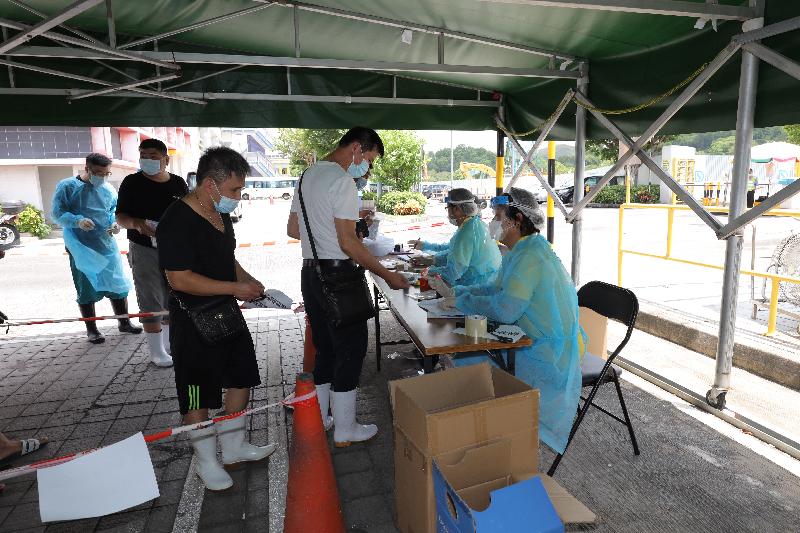
FEHD arranges COVID-19 testing for SSSH stakeholders (with photo)

     â€‹The Food and Environmental Hygiene Department (FEHD) said today (July 29) that in view of the recent COVID-19 cases related to the Sheung Shui Slaughterhouse (SSSH), the FEHD has arranged COVID-19 testing for all SSSH stakeholders, including the operator, importers, buyers and transportation companies, so as to have the infected persons isolated as soon as possible.
 
     The testing agency (Prenetics Limited) collects deep throat saliva samples from all SSSH stakeholders today and tomorrow, and will then immediately commence the testing work in order to complete the virus tests as soon as possible.

     Separately, two more workers in the slaughterhouse had preliminarily positive results from their COVID-19 tests. The Centre for Health Protection (CHP) has also notified yesterday (July 28) that the three earlier preliminary positive cases have been changed to confirmed cases. In addition to the two confirmed cases announced by the CHP previously, there are so far a cumulative total of seven cases related to the SSSH, i.e. two preliminarily tested positive cases and five confirmed cases.
 
     The two workers concerned in the new cases are both responsible for handling livestock sundry duties at the lairage area in the slaughterhouse. The stakeholders of the SSSH have taken the initiative to procure from private medical institutions at their own expense to conduct COVID-19 tests for their employees. The two persons have been preliminarily tested positive yesterday and today respectively.  They last performed duties at SSSH on July 24 and July 27 respectively.
 
     The SSSH immediately reported the cases to the CHP, and conducted thorough cleaning and disinfection at places where the persons concerned had stayed or commuted.  It has also reminded all workers that if they feel unwell, they should seek medical advice as soon as possible and should not go to work.
 
     A spokesman for the FEHD said, "The Government is very concerned about the cases in relation to SSSH, and will strive to ensure the smooth operation of the slaughterhouse and that the supply of live pigs will not be affected. The Government and SSSH have reviewed the purchase and sale process and has implemented social distancing measures in the slaughterhouse. It will closely monitor the latest development and further step up the anti-epidemic measures in light of the on-the-ground situation."
 
     The spokesman said that the operation of the SSSH has remained normal, and it has strived to ensure that its operation meets the required hygienic and environmental standards, and that all meat supplied to the market is fit for human consumption. The FEHD and CHP have contacted the operator to better understand the situation, and have immediately implemented all necessary measures and follow-up work to safeguard public hygiene and public health.
 
     The CHP has already contacted the new cases involving the two workers for investigation and has traced their close contacts in the slaughterhouse. Arrangements will be made for them to be tested or isolated if necessary.
 
     Upon receiving notification of the first preliminary confirmed case found to be related to a worker in the slaughterhouse last Friday, SSSH, in addition to regularly undertaking daily thorough cleaning and disinfection work according to the daily clearance arrangement, has immediately conducted additional strengthened deep cleaning and disinfection work at its surrounding areas, offices, rest areas and public facilities in the past few days.
 
     During the epidemic, the SSSH has required all workers to observe the personal protective equipment guidelines, and implemented the following anti-epidemic measures:

(1) Install two infrared body temperature monitors at the entrance to ensure that only people with normal body temperature are allowed to enter the slaughterhouse;
(2) Require all people to wear a mask when they are in the slaughterhouse;
(3) Require all people to maintain social distancing and avoid gathering;
(4) Provide alcohol-based handrub and remind all people to keep their hands clean; and
(5) Remind all those working in the slaughterhouse to observe personal hygiene, and that if they feel unwell, they should seek medical advice as soon as possible and should not go to work.
 
     To further protect the health and safety of the workers working at the lairage area, in addition to requiring all workers to wear a face mask and maintain appropriate social distance in the slaughterhouse, all workers working at the lairage area are additionally given a protective gown every day as enhanced protection.
 
     The spokesman stressed that members of the public need not worried about the food safety of meat slaughtered at the slaughterhouse. According to the current scientific information and advice of the World Health Organization (WHO), it is unlikely that humans will be infected with COVID-19 via food. Members of the public are unlikely to be infected via fresh meat slaughtered at the slaughterhouse.
 
     Nevertheless, the Centre for Food Safety, based on the WHO advice on food safety, reminds the public to maintain personal, food and environmental hygiene at all times, including washing hands before and after handling raw and cooked foods; separating raw meat and internal organs from cooked foods; cooking food thoroughly, avoiding to eat raw or undercooked animals, etc. so as to ensure food safety.

Photo