LCQ3: Privatisation of listed companies

     Following is a question by the Hon Rock Chen and a reply by the Secretary for Financial Services and the Treasury, Mr Christopher Hui, in the Legislative Council today (March 19):
 
Question:
 
     It has been reported that in the first half of last year, a total of 14 listed companies in Hong Kong announced that they would be delisted, with the companies' market capitalisation reaching as high as $66 billion, including some relatively renowned enterprises to be delisted through privatisation. In this connection, will the Government inform this Council:
 
(1) whether it knows the respective numbers of listed companies delisted from the Hong Kong stock market and delisted through privatisation last year, as well as the market capitalisation of the companies involved; whether it has reviewed the reasons for the wave of delisting of listed companies last year and its impact on the Hong Kong stock market, and whether it has assessed the trend of the wave of privatisation of listed companies of this year; if it has assessed, of the details, and whether it has measures in place to abate the relevant impact, so as to prevent the excessive privatisation from undermining the attractiveness of Hong Kong stocks; and
 
(2) whether it knows if relevant regulatory bodies have plans to improve the delisting mechanism so as to allow delisted companies more time and flexibility in the delisting process; if they have, of the specific measures and timetable?
 
Reply:
 
President,
 
     With Hong Kong being an international financial centre, the Government has been utilising our unique advantage of enjoying strong support of the motherland and being closely connected to the world under "one country, two systems" in enhancing the competitiveness of the financial services industry and promoting high-quality market development. In recent years, the Government, in collaboration with the Securities and Futures Commission (SFC) and Hong Kong Exchanges and Clearing Limited (HKEX), has taken forward reforms in different aspects of the securities market and implemented a series of enhancement measures, so as to attract more enterprises and investors to participate in investment and financing activities in Hong Kong, inject vitality into our market and enhance liquidity.
 
     To facilitate more quality enterprises to list and raise funds in Hong Kong, we have provided tailored listing mechanisms based on the needs of different enterprises, including establishing listing avenues for new economy and technology enterprises with weighted voting rights structures, reforming the listing mechanism for small and medium enterprises, broadening the financing channels for overseas issuers, clarifying the timetable for listing application vetting process. We have also introduced a new treasury share regime and relaxed the restrictions on issuers' share repurchases to provide issuers with greater flexibility, and strived to increase disclosure by listed companies and improve corporate governance. To enhance the trading mechanism and efficiency, we have implemented severe weather trading and conducted a review on reduction of minimum price spread, and are advancing preparatory work for the uncertificated securities market regime to lay a solid foundation for further opening up new markets and attracting new capital.
 
     As our country's economy demonstrates resilience with breakthroughs in key technologies, the enhancement measures for the securities market begin to bear fruit. Last year, the trading volume of securities market hit new highs, with the total market capitalisation increased by 14 per cent year-on-year and the average daily turnover surged by close to 30 per cent year-on-year. Hong Kong is also one of the world's four largest initial public offering (IPO) markets, welcoming listings of 71 companies within the year with over $87 billion of IPO funds raised, up nearly 90 per cent year-on-year. As of February this year, the HKEX was processing over 100 listing applications, demonstrating increasing confidence of companies in the Hong Kong securities market.
 
     In consultation with the SFC and the HKEX, my reply to the two parts of the question is as follows:
 
(1) In 2024, there were 32 and 16 companies whose listing was cancelled pursuant to the delisting procedures under the Listing Rules or delisted through privatisation, with market capitalisation of approximately $17.7 billion and $122.6 billion respectively.
 
     Over the past five years, the average number of companies that were delisted through privatisation was 21 per year. Apart from the 16 companies in 2024, the number of companies delisted through privatisation from 2020 to 2023 were 26, 30, 17 and 14 respectively. The number of companies delisted through privatisation accounted for less than one per cent of the total number of listed companies, and there was no upward trend. During the same period, the number of newly listed companies on the HKEX was 118 on average. The impact of delisting through privatisation on the overall market is not significant.
 
     The reasons of privatisation of companies vary. For example, a company's major shareholders or management may, through privatisation, prevent a takeover, maintain control over the company, and avoid outside influence on the company. As an internationally-aligned securities market, the SFC and the HKEX will continue to provide a fair and transparent acquisition and privatisation mechanism in accordance with the relevant provisions of the Codes on Takeovers and Mergers and Share Buy-backs and the Listing Rules, in order to facilitate listed companies to choose different paths for corporate development based on their own operational needs.
 
(2) As regards the delisting mechanism, in accordance with the relevant provisions of the Listing Rules, the HKEX may cancel the listing of securities of Main Board companies that have been suspended for 18 consecutive months or securities of GEM companies that have been suspended for 12 consecutive months. The reasons for suspension include (but are not limited to) insufficient public float of the issuer's securities; the issuer does not have sufficient business operations or does not have assets of sufficient value to support its operations; the issuer has not published its results in accordance with the relevant requirements under the Listing Rules; or the issuer or its business is no longer suitable for listing. The HKEX in general will provide guidance on resumption of trading within three months of the issuer's suspension, and will give listed issuers sufficient time to address relevant matters and follow up. Generally speaking, when handling cases on resumption of trading, the HKEX will make an assessment based on specific facts and circumstances of individual issuers. For example, when assessing the issuer's business, the HKEX will consider the issuer's business operation model, business scale and performance, source of funds, customer base size and type, internal control mechanism, etc., and will make reference to the practices and standards of the relevant industry.
 
     As mentioned by the Financial Secretary in the 2025-26 Budget, the SFC and the HKEX will further take forward a comprehensive review of the listing regime in reviewing listing requirements and post-listing ongoing obligations, evaluating listing-related regulations and arrangements to improve the vetting process, optimising the thresholds for dual primary listing and secondary listing, and reviewing the market structure. Through the reform, we hope to better align with the latest economic trends and corporate needs, enhance the competitiveness of Hong Kong's listing platform and further attract different companies to raise funds in Hong Kong. At the same time, the review aims to attract more investors, especially patient capital and overseas long-term investors, to participate and increase their allocation of Hong Kong stocks.
 
     During the review process, we will continue to maintain close communication with the industry to fully understand the needs of different market participants. We also welcome Members and stakeholders to provide their opinions on different measures and practical operational arrangements to the regulator and the HKEX. Thank you, President.
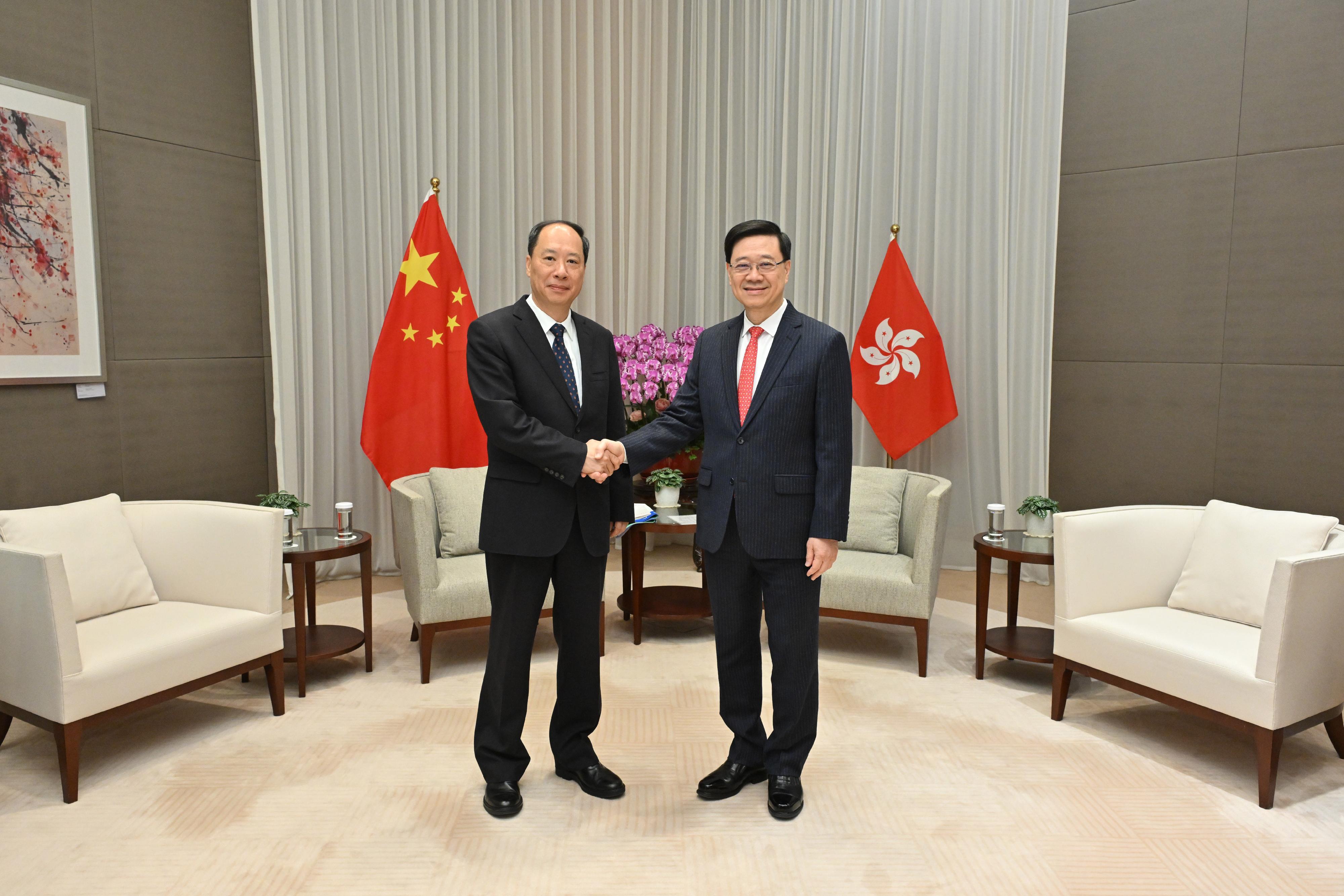


CE meets Secretary of CPC Jiangmen Municipal Committee (with photo)

     â€‹The Chief Executive, Mr John Lee, met the Secretary of the CPC Jiangmen Municipal Committee, Mr Chen Anming, today (March 19) to exchange views on further deepening Hong Kong's co-operation with Jiangmen and promoting the high-quality development of the Guangdong-Hong Kong-Macao Greater Bay Area (GBA). Also attending the meeting were the Secretary for Constitutional and Mainland Affairs, Mr Erick Tsang Kwok-wai, and the Secretary for Environment and Ecology, Mr Tse Chin-wan.
      
     Mr Lee welcomed Mr Chen and his delegation to Hong Kong. Noting Jiangmen is a hub and gateway city in the western part of the GBA, and that the city is experiencing rapid development in advanced manufacturing, Mr Lee said that Hong Kong, being an international city in the GBA, enjoys the unique advantages of having the strong support of the motherland and being closely connected to the world under the "one country, two systems" principle. There is vast potential for collaboration between the two places. Hong Kong will continue to give full play to its roles as a "super connector" and a "super value-adder", leveraging its highly internationalised and market-oriented business environment with its pool of professional services talent to explore business opportunities with Mainland enterprises and inject new impetus into the high-quality development of the GBA.
      
     Mr Lee expressed his confidence that Hong Kong and Jiangmen will continue to complement each other's strengths, enhancing co-operation in areas such as green industries, scientific research and elderly care services, and jointly building an international first-class bay area ideal for living, working and travelling.

Photo  


Merchant Shipping (Safe and Environmentally Sound Recycling of Ships) Bill to be gazetted on Friday

     The Merchant Shipping (Safe and Environmentally Sound Recycling of Ships) Bill will be published in the Gazette on Friday (March 21) to enact legislation to implement the Hong Kong International Convention for the Safe and Environmentally Sound Recycling of Ships, 2009 (HKC).

     The HKC was adopted in Hong Kong, China on May 15, 2009, at the Diplomatic Conference of the International Maritime Organization (IMO) held in Hong Kong, China from May 11 to 15, 2009. It aims to ensure that ship recycling does not pose any unnecessary risk to human health, safety or the environment by addressing various issues in relation to ship recycling concerned by the IMO's member states and other relevant parties. It will enter into force globally on June 26, 2025. The Central People's Government is considering ratifying the HKC and will decide on the applicability of the HKC to the Hong Kong Special Administrative Region.

     The HKC regulates both ships and ship recycling facilities. Although some objectives of the HKC align with those of the local legislation, existing provisions of the local legislation are not enough to fully implement the requirements of the HKC. A new ordinance with a new regulation will hence be enacted, with the new ordinance to be enacted first to ensure that it will be in place before the global entry-into-force date.

     A spokesman for the Transport and Logistics Bureau said, "Hong Kong is the fourth largest shipping register in the world with more than 2 300 ships. We aim to ensure that these ships will fully comply with the requirements of the HKC, which is conducive to promoting sustainable development for ships that have reached the end of their operating life and protection of workers and the environment in the context of ship recycling. We believe the shipping industry and the public will welcome the enactment of such a Bill."

     The Panel on Economic Development of the Legislative Council (LegCo) and the Hong Kong Fleet Operation Advisory Committee have been consulted. Members supported the proposal. 
     â€‹
     The Bill will be introduced into the LegCo on March 26. 


LCQ4: Kai Tak Sports Park

     â€‹Following is a question by the Hon Paul Tse and a reply by the Secretary for Culture, Sports and Tourism, Miss Rosanna Law, in the Legislative Council today (March 19):
 
Question:
 
     It has been reported that at the Kai Tak Sports Park (KTSP) Grand Opening Ceremony, some self-proclaimed "insiders" charged a fee of $1,000 per person to lead people without tickets to enter the venue "through the back door", and they even claimed that there were ways to bring reporters to the scenes of other activities without tickets. Subsequently, at the World Snooker Grand Prix 2025 held in the KTSP, the word "curfew" appeared on the screen of the venue before the end of the competition, requesting the audience to leave the venue. Some foreign media reported the incident, and the foreign players in the venue also thought that Hong Kong had imposed a curfew. There are views that the incident has brought Hong Kong's international image into disrepute. Moreover, it is learnt that a businessman lost his way when leaving the venue but did not receive any assistance from the staff. In this connection, will the Government inform this Council:
 
(1) of the number of stress tests conducted by different government departments before the opening of the KTSP; the number of staff members involved, as well as the contents, objectives and public expenditure of each stress test;
 
(2) whether it has examined why the aforesaid incidents of "passage without tickets", "midnight curfew" and "nobody showing the way" still occurred after public money has been spent on stress tests; and
 
(3) without incurring substantial public money, of the measures in place to ensure that the aforesaid mistakes will not recur when organising the concerts by the band Coldplay and major competitions such as the National Games in the future?
 
Reply:
 
President,
 
     Being the largest sports infrastructure project in Hong Kong's history, the Kai Tak Sports Park (KTSP) will boost sports development and inject impetus into related industries such as recreation, entertainment and tourism, and mega-event economy. The KTSP provides Hong Kong with the largest and state-of-the-art venues, including a 50 000-seat Kai Tak Stadium, a 10 000-seat Kai Tak Arena and a 5 000-seat Kai Tak Youth Sports Ground.
      
     With its official commissioning on March 1, the KTSP becomes a new hub for hosting major sports and entertainment events, creating favourable conditions for further promoting the mega-event economy. A series of mega events have been scheduled to take place in the KTSP, including the Hong Kong Sevens at the end of this month, followed by concerts of renowned bands and singers in Asia and around the world at the Kai Tak stadium. Competition events of the 15th National Games, the 12th National Games for Persons with Disabilities and the 9th National Special Olympic Games will also be held in the KTSP towards the end of this year. Mega sports and entertainment events, one after another, will bring to the audience an exciting experience.
      
     My consolidated reply to the questions raised by the Hon Paul Tse is as follows:
      
     Since late October last year until February this year, the Government and the Kai Tak Sports Park Limited (the Operator) conducted almost 20 test events and stress tests of different nature and scale across the three major venues in a gradual and orderly approach, with a view to evaluating different operation and contingency arrangements of the KTSP to better prepare its official commissioning. Both sport and non-sport test events took place in the three major venues with particular objectives, allowing relevant departments, the Operator and all participating parties to familiarise themselves with the preparatory work of both the hardware and software of the Sports Park, such as entry and exit arrangements, transportation, stage setup and backstage facilities.
      
     In addition, to assess the maximum capacity of the KTSP and better understand the patterns of spectator flow after its full opening, the Government organised five large-scale stress tests involving civil servants, district personalities, youth groups, and stakeholders of the Operator, among which were two stress tests with 63 000 participants each and one with approximately 50 000 participants. The costs associated with these stress tests were covered by the construction cost of the KTSP, recurrent expenditure of the Culture, Sports and Tourism Bureau (CSTB) and other participating departments and hence, cannot be quantified separately.
      
     The Operator is responsible for the day-to-day operation of the KTSP after its opening. It has the duty to oversee the security, optimise operational arrangement, as well as maintain close liaison and co-ordination with event organisers to ensure a pleasant experience for visitors. Both the Operator and event organiser attach high importance to security checks and ticket verification. With respect to earlier reports of suspected unauthorised entry to the venue without valid tickets, the Operator has retrieved its records and referred the case to law enforcement agency for follow-up. We note that signage within the precinct and training for front-line staff have been improving during the test events and stress tests over the past months, which will be further enhanced taking into account the needs of different events upon commissioning, so as to provide the most appropriate assistance to visitors.
      
     The World Snooker Grand Prix 2025 concluded recently was the first major sport event staged at the KTSP after its commissioning. It was also the first time that the event organiser hosted the event in Hong Kong. There was obviously room for improvement in terms of internal and external communication, as well as event co-ordination and arrangements between the Operator and the event organiser, with a notable example being the spectators were asked to leave before the match concluded on the first day. As I have said earlier in public, the incident was highly undesirable. Having reviewed the arrangements on the day, the Operator and the event organiser responded immediately and revised the match arrangements afterwards to accommodate the needs of the match and spectators. Subsequent matches were completed smoothly and successfully, with both spectators and players commending the arrangements of the venue.
      
     The CSTB attaches great importance to ensuring a good experience for visitors attending events at the KTSP. Being the party responsible for day-to-day operations, the Operator must put in place a sound response and contingency mechanism for handling emergency matters to ensure effective internal communication of accurate information, allowing the team (including front-line staff) to execute directives accordingly. External communication of official information should also be sufficient and timely to avoid confusion. The CSTB has expressed serious concerns to the Operator's management of the Sports Park thus far and has directed the Operator to make prompt adjustments to its structure, including improvements to its mechanism in decision-making, communication and crisis management. The CSTB has also requested the Operator to provide further training to its staff on their sensitivity and arrangements for external communication, including assigning a dedicated spokesperson, so as to enhance public knowledge and build their confidence in the operation of the KTSP.
      
     As the KTSP has officially commenced its operation, the Operator must learn from every experience and strive to improve operations, as well as maintain close communication with all stakeholders to ensure an enjoyable experience for visitors. The CSTB will continue to monitor the performance of the Operator and maintain close liaison with both the Operator and relevant stakeholders to realise the opportunities presented by this world-class infrastructure in joint hands, with a view to unleashing the potential of the KTSP to promote the development of sports and mega-event economy.


LCQ17: Handling of waste vehicle tyres

     Following is a question by the Hon Frankie Yick and a written reply by the Secretary for Environment and Ecology, Mr Tse Chin-wan, in the Legislative Council today (March 19):
 
Question:
 
     According to the paper submitted by the Environment and Ecology Bureau to the Panel on Environmental Affairs of this Council in November 2023 (the paper), nearly 30 000 tonnes of waste vehicle tyres were generated in Hong Kong in 2021, of which 70 per cent were generally first cut and disposed of at landfills, and only some 20 per cent were retreaded and reused or recycled. It has been learnt that although waste vehicle tyres disposed of at landfills will be cut first, it still takes a long time for them to decompose, which also leads to the problem of landfills being exhausted. In this connection, will the Government inform this Council:
 
(1) of the total weight of waste vehicle tyres generated in Hong Kong in each of the past three years, with a breakdown by the following methods for their disposal: (i) recovered and recycled locally, (ii) ‍recovered and exported after treatment, and (iii) disposed of at landfills;
 
(2) of the weight of landfilled waste vehicle tyres that were handled by the Government in the past three years, and its percentage in the weight of all waste vehicle tyres disposed of at landfills; the reasons for not recovering and recycling such waste vehicle tyres;
 
(3) Whether the Government has compiled statistics on the maximum handling capacity, actual handling capacity and remaining handling capacity of waste vehicle tyre recyclers in the market at present; if so, of the details; if not, whether it will compile such statistics;
 
(4) Given that it has been learnt that in order to promote the local recycling industry, the Government had allocated 20 sites for lease to the industry by January 2024, of the details of such sites, including their location and size, the recycling projects involved, and the number of such sites used for handling waste vehicle tyres; and
 
(5) Given that the paper proposes that landfills no longer accept and handle the disposal of waste vehicle tyres, when the proposal is expected to be formally implemented?
 
Reply:
 
President,

     About 20 000 tonnes of vehicle tyre waste are generated in Hong Kong every year, of which some are retreaded for reuse or recycled. Vehicle tyre waste can be processed to recover metals, cut and shredded into crumb rubber as raw materials for other products, or utilised as alternative fuel as a means of converting waste to energy.  
 
     The reply to the question raised by the Hon Frankie Yick is as follows:
 
(1) Statistics on vehicle tyre waste generation by weight and handling method each year from 2021 to 2023 are tabulated below. The figures show that the proportion of vehicle tyre waste being recycled and retreaded for reuse is increasing year by year. Statistics for 2024 are still under compilation.
 

Year Quantity recycled locally
(tonnes)
Quantity exported for recycling
(tonnes)
Quantity disposed of at landfills (Note 1)
(tonnes)
Total quantity of vehicle tyre waste (Noted 1, Note 2)
(tonnes)
2021 7 600 40 19 900 27 500
2022 10 200 0 16 200 26 500
2023 13 900 20 14 300 28 300

Note 1: The quantity includes a small quantity of other tyres which cannot be classified.
Note 2: The sum of individual items may not equal to total due to rounding.
 
(2) and (5) At present, tyres replaced during vehicle maintenance services undertaken by government departments are usually sent to contractors for retreading and reuse, or to recyclers for shredding and recycling. Vehicle tyre waste collected in public places by government departments and their outsourced service contractors is currently delivered to landfills for disposal. The relevant figures from 2021 to 2023 are tabulated below. Statistics of 2024 are still under compilation. 
 

Year Quantity of landfilled vehicle tyre waste collected by government departments
(tonnes)
Percentage to vehicle tyre waste disposed of at landfills
(Per cent)
2021 2 160 11
2022 2 570 16
2023 2 530 18

     The Government has been maintaining regular meetings with the tyre trade and disseminating information on recycling of vehicle tyre waste (such as contact information of collectors and recyclers) through relevant trade associations, tyre dealers, retailers as well as vehicle repair workshops, with a view to facilitating their recycling arrangement.
 
     Meanwhile the Government plans to introduce an amendment bill to the Legislative Council in the first half of 2025 to establish a common legislative framework for the producer responsibility schemes (PRSs). Upon the passage of the amendment bill by the Legislative Council, we will progressively cover more products under the PRSs, including vehicle tyres, in the light of prevailing circumstances. The Government shall implement the PRSs based on a market-led approach by which recycling service will be provided by the market, allowing the relevant stakeholders to jointly share the eco-responsibility. We will also set statutory recovery targets in order to ensure vehicle tyre waste are properly collected and treated, for the sake of enhancing the recycling rate of vehicle tyre waste as well as promoting the development of local circular economy.
 
     In addition, the amendment bill will amend the scope of waste control to accommodate the subsequent implementation of various PRSs. Upon the implementation of the PRS for vehicle tyres in future, designated waste disposal facilities (including landfills) will no longer accept and handle vehicle tyre waste, for the purpose of diverting them to recycling facilities for recycling.
 
(3) Based on the Waste Recovery Survey conducted by the Environmental Protection Department, the maximum recycling capacity for vehicle tyre waste was around 25 000 tonnes while the actual recycling quantity was around 14 000 tonnes in 2023.
 
(4) As of January 31, 2025, among the 20 short-term tenancy (STT) sites for exclusive bidding and use by the recycling industry, one of them is being used for the processing of tyre waste. Information on the 20 STT sites is set out at Annex.